1 Sections

Democrats say Peltola can win Alaska’s U.S. Senate seat. Really, though?

Mary Peltola at the U.S. Capitol in 2022, after she won a special election for a congressional seat.
Mary Peltola at the U.S. Capitol in 2022, after she won a special election for a congressional seat. (Liz Ruskin | Alaska Public Media)

WASHINGTON — National Democrats cheered when former Alaska Congresswoman Mary Peltola announced on Monday that she’s challenging U.S. Sen. Dan Sullivan.

Peltola, they said, gives Democrats a shot at winning a majority in the Senate.

But much more often than not, Alaska votes Republican in statewide races. Is it just wishful Democratic thinking that this race might be different?

“Alaska might be a state that has traditionally voted for Republicans, but it’s far more of an independent state than it is a hard Republican state,” said Lauren French, a senior political advisor with Senate Majority PAC, affiliated with Democrat Chuck Schumer from New York, the Senate Minority Leader. “You have people there who cross parties just looking for someone who will fight for them and represent them well in the U.S. Congress and in the U.S. Senate.”

French talked up Peltola’s attributes as a candidate and said she has a winning message, which is in part an Alaska version of “affordability,” a case Democrats are making nationwide. French cited the conventional wisdom that the president’s party tends to lose seats in Congress in midterm elections.

“You’re likely to see an election that, just by historical standards, is a little bit tougher for Republicans,” she said.

Analyst Kyle Kondik at the University of Virginia Center for Politics said 2026 is shaping up to be a good one for Democrats but that it would take a very big blue wave for Peltola to win.

“The Alaska Senate race is probably a lot more competitive now than it was before Mary Peltola got in,” he said. “I do still think that Dan Sullivan is favored.”

Kondik is managing editor of Sabato’s Crystal Ball, which rates congressional races. When Peltola announced her run, he moved the rating for the Alaska Senate seat two categories to the left, from “safe Republican” to “leans Republican.” So did The Cook Political Report. That’s one category away from “toss-up.”

Peltola proved in 2022 – twice – that she can win a statewide election in Alaska, Kondik said, despite losing her U.S. House race in 2024.

“I think even in losing, she performed fairly impressively,” he said. “Donald Trump won Alaska by 13 (percentage) points. She lost in the final ranked choice voting allocation to now-Rep. Nick Begich by about two and a half points.”

(Peltola ultimately lost ground in the rankings. With just first choices counted, Peltola lagged Begich by about only two percentage points).

Peltola’s 2024 “overperformance” – meaning she got more votes in Alaska than the Democrat at the top of the ticket, presidential candidate and then-Vice President Kamala Harris – is important, Kondik said. It shows a significant number of Alaskans who voted for Trump also voted for Peltola.

Peltola will need that crossover appeal to succeed this year, Kondik said.

“And I do think Peltola has a fighting chance to win, even though I think you’d generally rather be the Republican nominee in a state like Alaska,” he said.

As Kondik sees it, Sullivan is a mainstream Republican without baggage, and in Alaska, that gives him a leg up.

Alaska pollster Ivan Moore, who’s worked for Democrats, points to a different metric he finds significant.

“Seven percent more Alaskans like Mary than like Dan,” he said.

Moore’s firm, Alaska Survey Research, asks Alaskans four times a year whether they have a positive or negative view of various political figures, including Peltola and Sullivan. Since Peltola became known statewide in 2022, Moore has found her “positives” to be consistently higher than Sullivan’s. Moore said it’s a simple measure that matters.

“It’s about who you like,” he said. “You generally tend not to vote for people that you don’t like.”

But likeability is not the whole story. Moore also found that 10% of people who said they didn’t like Sullivan also said they’d vote for him. That could be because they prefer Republicans or because they like Trump, and Sullivan aligns himself with the president.

How Alaskans feel about Trump, Moore said, is tied to how they feel about Sullivan.

“And so his numbers will rise and fall based on Trump’s fortunes,” he said.

Sullivan’s campaign spokesman, Nate Adams, said Team Sullivan remains confident of the senator’s re-election. Adams, who has access to internal polling that hasn’t been made public, doesn’t think much of the idea that the election is a referendum on Trump, or that Sullivan’s fate is linked to Trump’s popularity.

“I think Alaska is still very much a state that is a lot more complex than ‘red team and blue team,'” he said.

Amid the substantial national attention Peltola generated with her launch, Sullivan’s campaign has been highlighting prominent Alaskans endorsing the Republican incumbent.

“You know, Alaska Native leaders, trades, unions,” Adams said. “There are more of these forthcoming, but these are groups and coalitions that have traditionally backed Mary in her previous races, who, on Day 1 – if not before and certainly in the days after – have decided to support Sen. Sullivan.”

One thing everyone is certain of: National groups on both sides will raise and spend boatloads of money trying to win Alaska’s U.S. Senate seat.

Alaska lawmakers return to Juneau on Tuesday. Here’s what to expect.

Speaker of the House Bryce Edgmon, I-Dillingham, speaks to a nearly empty floor at the Alaska State Capitol on Tuesday, Aug. 19, 2025.
Speaker of the House Bryce Edgmon, I-Dillingham, speaks to a nearly empty floor at the Alaska State Capitol on Tuesday, Aug. 19, 2025. (Clarise Larson | KTOO)

Lawmakers return to the Alaska State Capitol on Tuesday and, as always, they’ve got a long agenda to tackle, from health care and energy to the state’s persistent budget struggles.

Alaska Public Media’s state government reporter, Eric Stone, will be tracking the session in Juneau. He joined Wesley Early on Alaska News Nightly to give a sense of what the session will bring.

The following transcript has been lightly edited for clarity.

Wesley Early: So, Eric — lots to do, only four months to do it. What are lawmakers prioritizing ahead of the session?

Eric Stone: Well, Wesley, as you said, there’s a lot to do. And there will always be some surprises. But what’s not a surprise is how difficult the budget will be this year. We heard a lot last year about how this might be a painful year.

Maybe this will set the tone — last year, we had a $1,000 Permanent Fund dividend, the smallest ever when you adjust for inflation. And this year, what I keep hearing is that even a $1,000 dividend will be a challenge. Here’s Fairbanks Republican Rep. Will Stapp — he sits on the House Finance Committee.

Rep. Will Stapp, R-Fairbanks: At the current level of spending and revenue, I don’t see how that’s possible without large savings draws, and I don’t know how people are going to feel about that.

ES: This has been an issue for years, of course. Lawmakers and the governor have worked to cut state spending in a variety of areas, though there’s some dispute about how much there is left to cut.

Stapp says he’d like lawmakers to take a closer look at department budgets with something known as zero-based budgeting. Basically, rather than starting from a baseline of “what did we spend last year,” this would be starting at zero and building the budget from scratch. Stapp included an amendment in last year’s budget asking the governor’s office to try that for one department of their choice, but he says as far as he can tell, that didn’t happen.

So he says he’s renewing his efforts this year.

Stapp: Because you don’t really want to tell people the state needs a lot more money in terms of taxes … when you can’t really articulate where the money goes initially and what the money does.

ES: Gov. Mike Dunleavy’s budget, as usual, contains what he calls a statutory PFD, $3,800 or so. But that, and the expenses they have to catch up on from this current year, mean that the governor’s budget would require spending more than half of what the state has in savings.

But it’s a bit incomplete. The governor has said he plans to introduce a fiscal plan. Last we heard, when he released his budget in December, it was still a work in progress. But the governor has his last State of the State speech this session — usually those come pretty early in the session, so a fiscal plan would be something to watch for there. Then again, a few years ago, Dunleavy said he was planning to introduce a sales tax and never did.

Democratic Anchorage Rep. Andrew Gray says he hopes Dunleavy does propose some kind of tax.

Rep. Andrew Gray, D-Anchorage: He’s not running for reelection, so he can afford to take that risk …. He could, going forward into the future, have established a reliable source of revenue to fund our state. I mean, there could be no more worthy legacy for him. It would be monumental.

ES: Gray says he’d prefer an income tax — he says that would be fairer to low-income Alaskans — but if the governor proposes a sales tax, Gray says he thinks lawmakers would have to find a way to get it passed. He says he thinks lawmakers on both sides would be willing to discuss just about any solution to secure the state’s financial future.

But it’s an election year, and a fiscal plan requires some hard votes, so it’ll take some gumption for lawmakers and the governor to actually come together rather than kick the can down the road yet again.

WE: Alright, so we have the perennial budget debate with a bit more urgency this year. That’ll be something to watch. What else is on your radar?

ES: This one came up recently — health care. You might have heard of this Rural Health Transformation Program. That’ll send more than a billion dollars to the state over the next five years to, essentially, improve health care. There are a bunch of restrictions on how it can be spent, and most of that decision-making will happen inside the executive branch in the Department of Health.

But Health Commissioner Heidi Hedberg said on a call with reporters recently that there is a role for the Legislature to play. To make Alaska’s grant application more competitive, the state said it would do a bunch of things by the end of 2027. Those include expanding what pharmacists are allowed to do, and joining a variety of “license compacts” for EMS workers, nurses and a few others. The deal is, if you’re licensed in some states, you can also practice in Alaska without a need for retraining.

That’s an issue the Legislature has not made a focus in past years, though there are some pending bills. And Gray says he could see those scrambling caucus lines.

Gray: In terms of where people land and what they support, I think that it’s not going to be clear-cut. It’s not going to be a majority-versus-minority. I think that that it’s going to be all over the place.

ES: But Gray, who is also a physician assistant, says he supports the policy changes.

Stapp, for his part, says he’s on board — he says he’s still reviewing what all is needed, but he says from what he’s seen so far, he doesn’t see why those policy changes will be a problem.

WE: Finally, Eric, what about the Alaska LNG project? Are you expecting movement on that front?

ES: That one is interesting. The gas pipeline developer, Glenfarne, has yet to announce what’s known as a final investment decision — a green light to move forward. Lawmakers heard last year from its consultants about a variety of changes they could make to ensure the project is profitable enough and stable enough to go forward. We could see some movement on that — for instance, Gov. Dunleavy says he’d like to see lawmakers offer some property tax relief to the gas line project to help it pencil out. And a lot of lawmakers say they support efforts to help the gas line move forward — but I think they’ll approach that question with some caution. They don’t want their home communities to get taken to the cleaners, so to speak.

Alaska’s first on-site addiction treatment for those who overdose launches with pilot programs

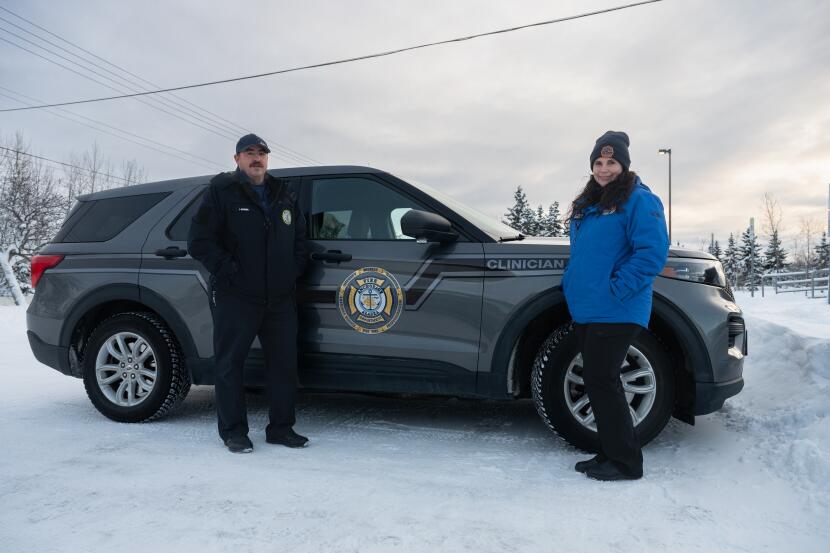
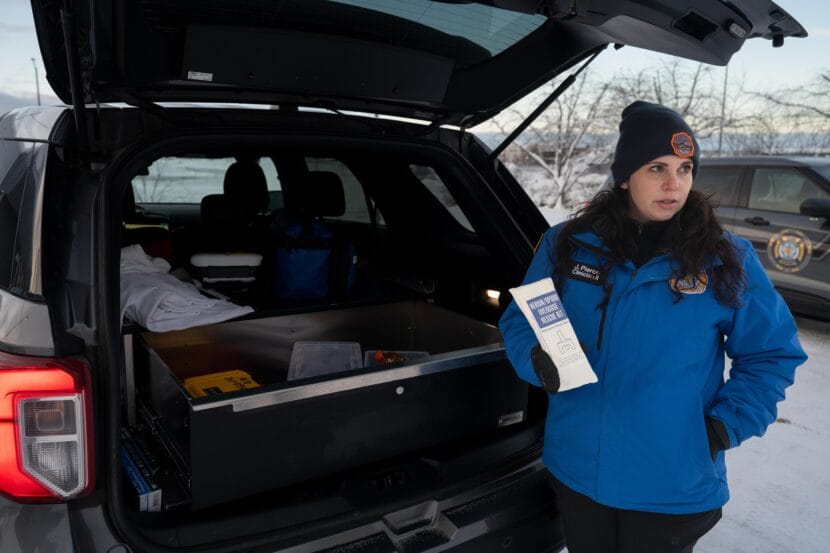
A woman holds up an opioid overdose kit next to a grey SUV with the trunk open.
Dr. Jennifer Pierce with an Anchorage Fire Department vehicle on Jan. 9, 2026. Pierce and the vehicle are part of a new program that will offer addiction treatment to those who overdose. (Matt Faubion/Alaska Public Media)

Stomping through stubborn, crunchy January snow, Dr. Jennifer Pierce made her way recently to a new Anchorage Fire Department vehicle. It might look like a simple SUV, but it’s equipped as a new mobile unit that – for the first time – will allow emergency responders to administer buprenorphine on-site, which can help get patients on the road to recovery.

“We want people to see us as a beacon of help,” Pierce said.

Pierce is on a mission: to treat Anchorage residents who overdose and connect them with care afterwards. After being treated for an overdose, many patients don’t agree to further treatment at the hospital or emergency room. Working out of mobile units allows the team to meet those Alaskans where they are.

“We don’t want people to fall through the cracks,” she said.

Narcan, or naloxone, is used to reverse overdoses. But it puts people into immediate and uncomfortable withdrawal. Research shows that in similar mobile programs, offering that second medication, buprenorphine, makes it more likely patients will enter long-term recovery. Even if people don’t continue treatment, Pierce said, the medication can help them make it through a critical window when overdose survivors are at high risk of dying.

“Even if it’s just one life,” she said. “We’re saving lives out there and preventing individuals, maybe from overdosing the next day or overdosing again later and dying.”

Paramedic Joshua Browning (left) will work with behavioral health clinician Dr. Jennifer Pierce to treat overdose and connect people to medication treatment afterwards. (Matt Faubion/Alaska Public Media)

Pierce visited successful programs in Texas and Washington state for ideas and best practices to replicate in Alaska.

The Anchorage team can get dispatched by 9-1-1 when someone is experiencing an overdose. During slower parts of their shift, they’ll be able to do treatment outreach with people who are at higher risk of overdose, Pierce said.

Offering patients buprenorphine has several benefits, said Seth Workentine, an addiction medicine specialist in Juneau who consulted for the pilot program there.

Buprenorphine lasts much longer than Narcan, at least 24 hours, protecting people from re-entering overdose. It also reduces withdrawal symptoms, which can push people back to opioid use, Workentine said.

“Withdrawal is an extremely uncomfortable experience hated by almost everyone who’s ever experienced it and is often a barrier to people seeking treatment,” he said. “Now they just feel normal and have a much bigger leg up into entering recovery.”

But buprenorphine is an opioid, and Workentine said he’s heard critics of similar programs argue that it’s just swapping one drug for another. That’s not the case, he said, because buprenorphine is different and, over time, it actually helps reverse the brain changes that happen with addiction.

“So it’s not replacing one for the other, even though they’re in the same category,” Workentine said. “It is actually part of healing you.”

And that, he said, is integral to the recovery process.

Dr. Quigley Peterson, an emergency room physician heading Juneau’s pilot program, said he’s also seen the healing benefits of buprenorphine. He’s confident the pilot will do well partly because he’s seen how helpful the medication can be in a different setting: the emergency room.

“We have something that can help engage people, that’s super safe and it’s cheap, and it works,” Peterson said.

The pilot programs will collect data over the year to see what happens to patients after they’re given buprenorphine for an overdose, Peterson said. His hope is that it reduces emergency room visits and calls for emergency medical care. That would be good for the mental health of emergency responders, too, who get burnt out responding to the same patients over and over, he said.

If you can get patients into long-term care, Peterson said, “you won’t need to see them in the future. You won’t have these recurrent EMS calls.”

If the pilot programs are successful, Peterson’s goal is to inspire similar programs in more communities across Alaska.

Proposed surcharge on oil would help pay for responses to climate-related disasters in Alaska

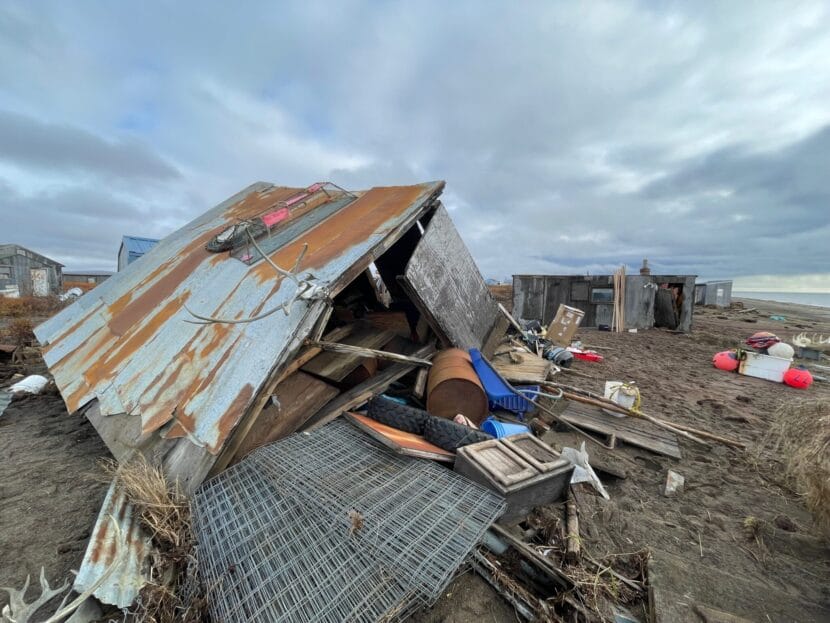
A fish camp in the Nome area, seen on Sept. 24, 2022, shows damages wreaked by the remnants of Typhoon Merbok. The day before, then-President Biden declared a major disaster for a vast stretch of western Alaska that had been slammed with high winds and floods caused by the remnants of that typhoon. The storm is among several recent disasters in Alaska that scientists link to climate change. (Photo by Jeremy Edwards/Federal Emergency Management Agency)

Landslides, storm-driven floods, infrastructure-damaging permafrost thaw and intensifying wildfires are among the expensive disasters that scientists link to Alaska’s rapidly changing climate.

Now a state legislator is proposing to levy a 20-cent surcharge on every barrel of Alaska-produced oil to fund programs that respond to and prepare for disasters related to climate change.

Rep. Andy Josephson, D-Anchorage, introduced the measure, House Bill 247, in advance of the legislative session scheduled to start on Jan. 20.

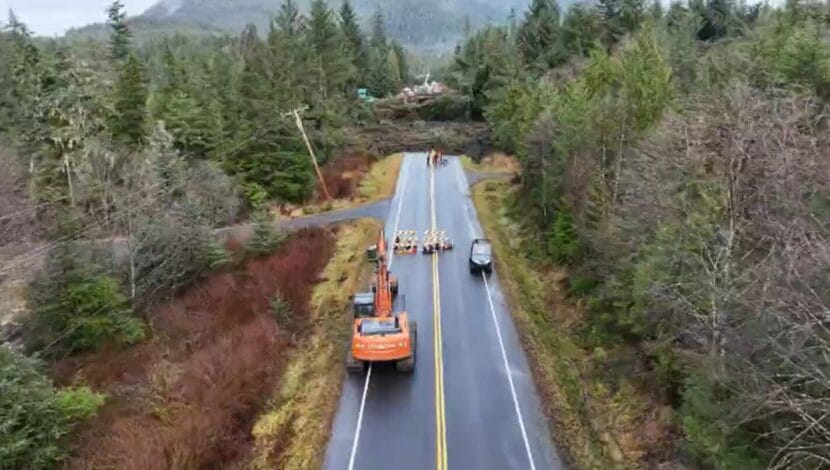
To explain why the state needs such a fund, Josephson ticked off a list of recent disasters in Alaska that imposed heavy costs — and, in some cases, killed people. Those events, which include deadly landslides in Southeast Alaska, landslides that have blocked roads, severe flooding in Western Alaska last October from the remnants of Typhoon Halong and similar damage in 2022 from the remnants of Typhoon Merbok, all had some links to climate change that is caused by greenhouse gas emissions from fossil fuel burning, he said.

“It’s a true statement that a lot of the disaster dollars we need right now are related to climate change. That, in my opinion, is sort of inarguable,” he said.

Disasters like those that have occurred in recent years are expected to continue in the future, he said: “We’re in a new normal.”

The bill is logical from a fiscal standpoint, Josephson said.

As of now, the state’s disaster relief fund is “basically a sub-fund of the general fund,” and it gets whatever lawmakers are able to appropriate, he said. But if there is a new stream of money as proposed by his bill, “we would free up those dollars we’re otherwise spending in the disaster relief fund.”

At 20 cents per barrel, the proposed surcharge would raise about $30 million a year, he said.

In comparison, Gov. Mike Dunleavy in December proposed that lawmakers approve a $40 million appropriation for the state’s existing disaster relief fund. The need could increase from that total if the Trump administration fails to reimburse 100% of the costs for Typhoon Halong relief rather than the normal 75%. The Biden administration in 2022 approved 100% reimbursement for Merbok-related costs.

As introduced by Josephson, the bill would give the Alaska Department of Environmental Conservation oversight over the money generated by the surcharge. It would distribute fund money in the form of grants to local governments and other entities for purposes like disaster response, disaster preparation and upgrades that make infrastructure better protected against climate change.

The surcharge idea has precedent in Alaska. The Department of Environmental Conservation already administers another fund with money coming from a per-barrel fee on oil produced in the state.

Debris dovering the Zimovia Highway in Wrangell is seen in the aftermath of the deadly landslide that struck on Nov. 20, 2023. (Photo provided by Alaska Department of Transportation and Public Facilities)

After the 1989 Exxon Valdez oil spill, the state began levying a 5-cent-per-barrel surcharge on oil that goes into the state’s Oil and Hazardous Substance Release Prevention and Response Fund. The fund itself was created by the legislature in 1986, with the surcharge established after the disastrous Prince William Sound spill.

That surcharge and rules concerning the fund’s operations have been modified over the years, broadening the purposes for which the fund can be used and boosting DEC’s reporting requirements, according to the department.

In its current configuration, each 5-cent-per-barrel surcharge sends 1 cent into a spill response account, to be used for spills that have been officially declared disasters. The other 4 cents goes into a spill prevention account, which can be used to address spills that have not been declared disasters, among other functions.

In 2015, refined petroleum products were added to the program. The state added a small surcharge, 0.95 cents per gallon, on refined fuel projects sold, transferred or used at the wholesale level, according to the DEC.

The idea of a similar levy to raise money for climate change preparedness and response is not new.

Rick Steiner, a retired University of Alaska marine conservation professor who founded and leads an environmental organization called Oasis Earth, has been advocating for the approach for several years.

“The legislature has so far seemed unable or unwilling to connect the dots between the many climate-related disasters we are experiencing — typhoon Merbok, wildfires, landslides, floods, coastal erosion, permafrost thaw, storm damage, infrastructure damage, subsistence impacts, commercial fishing impacts, etc..– to see the larger picture of the threat and costs these interrelated climate disasters pose,” he said in a letter to lawmakers sent last September. “The money to address these issues will have to come from government.”

In advocating for what he called an Alaska Climate Resilience Fund, Steiner said funding issues have become more pressing because of federal cutbacks.

The climate-response surcharge idea is not unique to Alaska, either.

Hawaii has put its version of a climate surcharge into law, a measure that seeks to raise money for responses to future disasters like the deadly 2023 Lahaina wildfire on the island of Maui.

In May, Hawaii Gov. Josh Green, a Democrat, signed a bill that increases the state’s hotel and lodging tax by less than a percentage point. The increase is applied to the state’s Transient Accommodations Tax, known at TAT. The governor said the increase would amount to an additional charge of about $3 on a $400-a-night hotel room fee. It is expected to generate about $100 million a year, according to state officials.

Newscast – Friday, Jan. 16, 2026

In this newscast:

  • The Juneau School Board held off returning about $1 million in funding earmarked for childcare to the City and Borough of Juneau amid questions about the current privately-run program,
  • Alaska’s capital city will soon have a new fire chief,
  • A local master Chilkat and Ravenstail weaver has been awarded a national fellowship that bolsters culture and tradition across the United States,
  • Martin Luther King Jr. Day is coming up on Monday, and there are two events honoring the day in Juneau,
  • Hundreds of health care workers and government officials descended on Anchorage this week for the kickoff of a five-year, $1.3 billion program aimed at reimagining medical care across Alaska

City and Borough of Juneau announces new fire chief

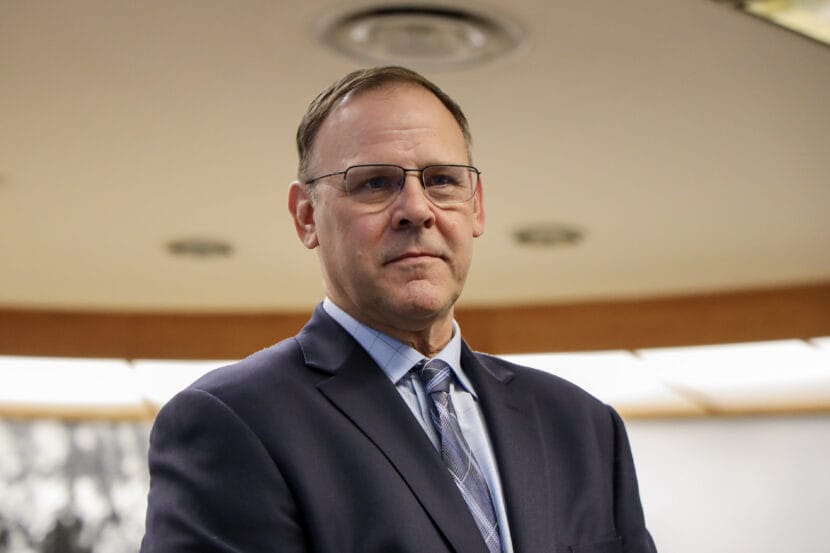
Capital City Fire/Rescue’s new fire chief, Thomas Hatley, during a public presentation in Juneau on Tuesday, Dec. 16, 2025. (Photo by Clarise Larson/KTOO)

Alaska’s capital city will soon have a new fire chief. 

The City and Borough of Juneau named Thomas Hatley as Capital City Fire/Rescue’s new fire chief on Friday afternoon. His first day will be Feb. 9. 

He was one of the two finalists for the position to replace longtime fire chief Rich Etheridge, who retired at the end of December after more than 15 years leading the department. 

Hatley served as the deputy chief for the Spokane Valley Fire Department in Washington until April of this year, when he left due to a family medical reason. He has more than three decades of experience in fire service, holding positions like fire chief, assistant chief and fire marshal at multiple agencies in the Northwest. 

During a public candidate presentation in Juneau in December, Hatley said he was drawn to the position because of the complexities of Juneau’s fire and emergency medical services needs. He pointed to its lack of outside support, large service area and seasonal population surges. 

Hatley said he wanted to see the department focus on resolving its staffing issues, especially by retaining the department’s employees. The Juneau Career Firefighters Union is currently at an impasse in its negotiations over a new contract with the city. Union representatives say uncompetitive wages and staffing shortages are driving people away from the department.

The annual salary listed on the city’s website for the position is between $125,944 and $161,761.

Cindy Carte, the city’s human resources manager, is currently serving as acting chief.

Site notifications
Update notification options
Subscribe to notifications