Recent News

Juneau opens up application for $2.5M in affordable housing funding

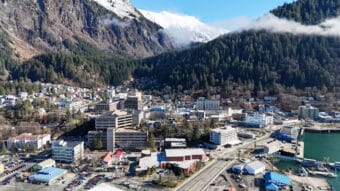
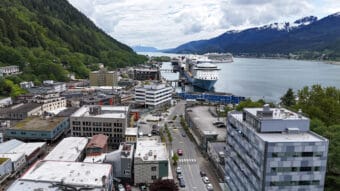
Downtown Juneau on Wednesday, March 26, 2025. (Photo by Clarise Larson/KTOO)

Juneau is inviting developers, nonprofits and tribal governments to apply for grants or loans from its affordable housing fund.

The city created the fund five years ago to address the city’s lack of housing — specifically, low and middle-income rentals. There is $2.5 million available in the fund this year. The application period opened last week and runs through Aug. 22. 

“Things are getting more challenging with the landscape for housing on the federal level,” said Joseph Meyers, the city’s housing and land use specialist. “I’m really hopeful that we get a lot of people applying for these funds, and get more units on the grounds.”

The city then uses criteria like proximity to public transportation and long-term affordability to decide which projects get funding and how much.  

The city has awarded nearly $13 million in grants or loans from the fund since its establishment. But not all projects funded in the past have been required to offer affordable units. In 2022, the Juneau Assembly approved a $1.2 million loan from the fund for a development called Ridgeview. 
The Assembly initially approved the loan for the project with an affordability requirement, but later stripped those requirements after input from city leadership. The developer listed the units as condos available for purchase at market price to the dismay of many Juneau residents. Some testified at public meetings and others posted hundreds of comments on social media. 

Meyers said since then, the Assembly has required affordability for projects approved to receive funding. 

“If the application doesn’t meet that requirement, they’d have to go back to the drawing board,” he said. “We really do want to focus on providing some affordability, at least with all these projects.”

The application period closes on Aug. 22. Then, a committee will review them and make recommendations to the Assembly for final approval. 

How expensive is Juneau? New report shows how it compares to Lower 48 cities

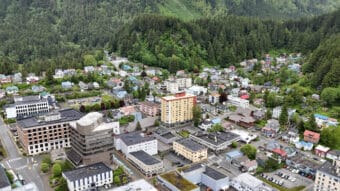
Downtown Juneau on Friday, June 13, 2025. (Photo by Clarise Larson/KTOO)

Simmering frustration with Juneau’s increasingly high cost of living has come to a boil in the form of grassroots initiatives to lower it. This spring and summer, advocates collected enough signatures to include two ballot measures aimed at lowering household costs for residents in this fall’s local election. 

Now, a recently released report from the state confirms some of the financial hurdles Juneau residents are facing. 

“I can’t say we’re surprised with this report,” said Brian Holst, executive director of the Juneau Economic Development Council. 

The state’s Department of Labor and Workforce Development released a report in early July that focuses on the cost of living in Juneau, Anchorage and Fairbanks, compared to hundreds of U.S. cities.

Juneau is the most expensive city among the three in-state municipalities included in the study. The 2024 data shows Juneau had the second-highest grocery and health care costs overall and the third-highest prices for miscellaneous goods and services of the more than 250 cities that were surveyed. Holst said that makes sense to him.
“There are just some things about being in Alaska that make our costs higher,” he said. “We’re far from other markets, we’re isolated, transportation costs all contribute.” 

According to the report, all three Alaska cities were among the top 25 most expensive cities surveyed. Fairbanks and Anchorage also ranked among the top spots for the highest health care and grocery costs. 

The report also shows that housing costs are nearly half of most Alaska residents’ annual income. Juneau has had the highest average sale price for a single-family home in the state for the past two years. 

Dan Robinson is an economist and authored the state’s report. He says there are some silver linings in the data when it comes to housing. 

“Even though our housing costs are relatively high, housing has been inflating much faster in the U.S. than it has in Alaska,” he said. 

He says over the past 10 years or so, the rise in housing costs in the state has slowed down, while other areas in the Lower 48 began picking up. 

“They have been growing significantly faster than Alaska,” he said. 

The high — and growing — cost of living in Juneau and across the state has triggered some policy responses in recent months. A new state law went into effect this month that raises the state’s minimum wage and implements a new sick-leave policy. 

The two ballot initiatives set to appear in Juneau’s fall election ask voters whether to place a limit on the city’s property tax rate and remove local sales tax on food and utilities. Advocates for the initiatives say they will provide immediate financial relief to residents – if they’re approved by voters.

Juneau releases hazard mitigation project list for public comment

Downtown Juneau on Monday, June 9, 2025. (Photo by Clarise Larson/KTOO)

Juneau officials released a list of potential hazard mitigation projects for public review on Thursday, July 10. 

The city and the Central Council of the Tlingit & Haida Indian Tribes of Alaska are considering more than a hundred projects to reduce risks in the Juneau area. Officials came up with some of the project ideas, while others were pulled together from past hazard mitigation plans, a public survey and even Facebook posts. 

Projects that officials choose will go into an updated plan to make the city eligible for federal disaster funding. 

Potential projects range from plans to increase affordable housing to elevating buildings in flood zones. One idea is to explore a federal buyout program for homes in high-hazard areas. Another is to regulate new construction in severe hazard zones. 

Other ideas include renovating buildings to handle earthquakes, installing landslide and avalanche monitoring equipment and encouraging electric utilities to bury power lines. 

The city’s last hazard mitigation plan expired in 2017. The update must be finished by October for the city to qualify for a federal grant to fight glacial outburst floods in Mendenhall Valley. 

Officials said the full draft hazard mitigation plan will be published next week. 

The public comment period closes July 25. Residents can submit comments via email to laura.young@fairweather.com

Taku River glacial outburst ends without reaching flood stage

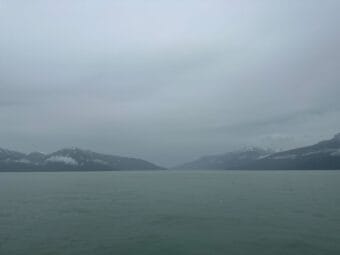
Taku Inlet on June 30, 2025. (Photo courtesy of Harper Gunn)

Update, Tuesday 11 a.m.:

The glacial outburst flood event on the Taku River has ended.

According to an update from the National Weather Service, the river crested early Tuesday morning without reaching flood stage. Water levels will continue declining throughout the day.

“People who live on or near the Taku River should remain alert of the river conditions and potential remaining debris in the water. Otherwise no impacts are expected,” the update reads.

Original story:

A glacial outburst flood is underway on the Taku River south of Juneau. Although water that was held back by glacial ice is draining out of Lake No Lake, the National Weather Service forecasts that the release is not expected to breach the Taku River’s banks. 

Aaron Jacobs, a senior hydrologist at the National Weather Service in Juneau, said the release started Sunday night. To issue the forecast, he looked at water volumes that burst from Lake No Lake in past years and snowpack data from this winter. 

“Since we are about below normal on our snowpack, we’re not seeing any additional inflow into Lake No Lake that would have put our water volume above what the normal water volume released would be,” Jacobs said.

The water is expected to crest at 41.9 feet around 10 a.m. on July 1. That’s below the height that would make it a minor flood, which is 43 feet, so no flooding is expected at this time. 

But Jacobs said boaters should be vigilant.

“People in the area should be aware of any debris floating down the river and then also into Taku Inlet,” he said. 

Jacobs says the National Weather Service will update the forecast if there are major changes.

Battling invasive plants in downtown Juneau — a walk with an optimist

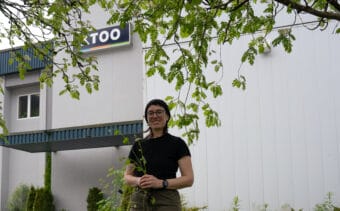
Emily Reed clutches invasive garlic mustard beneath an invasive European mountain ash tree in front of KTOO. (Photo by Alix Soliman/KTOO)

Listen to this story:

Invasive species are everywhere, but the people who dedicate their lives to battling them believe they can win, especially in Alaska. 

Last week was the state’s invasive species awareness week. On a walking tour around downtown Juneau, Emily Reed, the regional invasive plant coordinator at the Southeast Alaska Watershed Coalition identified some of the pesky plants that have taken root in the region. 

She started with a tree just a few steps outside KTOO’s front door. It’s an invasive European mountain ash and it’s blooming with small white flowers that will give rise to bright orange and red berries in the early fall. 

Reed said that birds choose to eat these berries over native berries. 

“Because the birds fly long distances and the seeds can germinate after being pooped out, we’re finding these in really kind of more natural areas,” she said.

There are thousands of European mountain ashes around Southeast, she estimates. They are still planted ornamentally here, and are hard to get rid of because they can resprout from a stump. Reed says the best way to kill the tree is to apply a bit of herbicide to the stump after chopping it down. 

A non-native species becomes ‘invasive’ when it throws off the balance of an ecosystem and starts taking over. Alaska’s geographic isolation and low population make Reed optimistic that invasions can be kept at bay, since the state isn’t completely overrun by noxious weeds yet — unlike most of the U.S. 

She walks down Egan Drive to the back of the Four Points hotel parking lot, where the hillside is covered in one of the most invasive plants in the world: Japanese knotweed. The plant mainly reproduces by spreading underground rhizomes, which are modified stems that are known to crack roads and building foundations.

“They go pretty deep, and a new plant can regenerate from a piece of rhizome as small as your fingernail,” she said. 

That makes ripping the plant out of the ground futile and controlling it extremely difficult. She and her colleagues return to the same patches year after year to apply herbicide to the plants. 

Reed continues up Main Street and takes a left on Fourth Street, where creeping buttercup blooms along the sidewalk with yellow flowers reaching toward the sun. This invasive plant has spread through most of Southeast Alaska, and it does well wherever there is bare ground. 

“We’re in this kind of final stage of invasion, where it’s more like we’re not going to get rid of it,” she said.

So instead of trying to get rid of it, Reed says she’s focused on keeping it from creeping into new habitats. She’s particularly worried about uplift meadows, which are tidal flats and marshes that are now rising above the seawater as the land sheds the weight of melting glaciers. They offer a lot of bare ground for buttercup to take over.

Reed disappears into the brush behind an old, broken-down truck on Village Street and emerges with a long stalk that has small white flowers on top. 

“Yeah, they can be quite satisfying to pull, you just have to be really on top of it,” she said, gesturing to the long taproot.

It’s garlic mustard, and it’s on the opposite end of the invasion spectrum. So far, Reed says Juneau is the only place in Alaska where garlic mustard has been found, though it has invaded much of the lower 48 already.

“It’s also what we call allelopathic, which means that it puts out chemicals into the soil that prevent other plants from growing,” Reed said.

That gives it a competitive advantage over native plants.

But she has hope about managing invasive plants in Alaska because many of them, like garlic mustard, are in the early stages of invasion.

“An ounce of prevention worth a pound of cure,” Reed said. “We’re in a place where we can be thinking about prevention and rapid response, which is very different than anywhere else I’ve lived or studied invasive species.”

The more people know what to look out for, the better those efforts can succeed. Reed recommends learning to identify the invaders near you, washing your shoes and brushing your dog when leaving an area and taking pictures and GPS locations to report invasives when you get home. 

As for aquatic invaders, Juneau has not yet seen European green crab, but appearances in the Metlakatla Indian Community and Ketchikan have confirmed that it is spreading north. The Alaska Department of Fish & Game recommends Alaskans keep an eye out for green crab and other potential aquatic invaders like zebra and quagga mussels, and to report sightings so that ecosystem managers can quickly respond.

Reports can go to the Alaska Invasive Species Partnership, the Alaska Department of Fish & Game, or the Southeast Alaska Watershed Coalition. Reed says it’s helpful to use an app called iNaturalist to make sure you include all the information needed to make a report.

Former Juneau Empire editor launches new, local online newspaper

The front page of the Juneau Independent on Friday, June 20, 2025. (Courtesy of the Juneau Independent)

The Juneau Independent, a new web-based newsroom in Juneau, launched today with a mission to offer a newspaper that is locally owned and operated. 

Mark Sabbatini, the former managing editor of the Juneau Empire, is leading the effort. He’s worked in the newspaper industry for nearly four decades with stints at the Empire, the Los Angeles Times and the Antarctic Sun.

Sabbatini announced his resignation from his role with the Empire this week over disagreements with its Mississippi-based publisher, Carpenter Media Group, which bought the paper last year. He said he was then fired by the company.  

Sabbatini said his goal is to make the Juneau Independent the city’s new paper of record. 

“Media is going through a lot of pretty drastic changes. And so, yes, it’s a little ambitious to launch a news website,” he said. “But if the company that owns the Empire says, ‘we’re not going to keep anybody here,’ then for all practical purposes, the Empire becomes a satellite office of a different paper.”

Sabbatini said he wants to give Juneau residents the option to support a nonpartisan newspaper that is written, edited and reported by people who live in the community. He’s applied to make the outlet a nonprofit, but that is still pending. 

The Juneau Independent is currently online only. But, Sabbatini said he’d like to offer a print version one day. 

So far, the website includes news stories written by Sabbatini, along with a handful of contributed opinion pieces from community members. Sabbatini said his goal is to create a board of directors and hire a handful of full-time reporters. He said that it will come down to how much the community supports it. 

“I’m very confident this can do well the way it is,” he said. “Bigger, it’s going to need both more people involved in helping out with it in terms of logistics, and it will need a wider amount of support from the community, in terms of subscribers.”

As of Friday afternoon, the Juneau Independent’s Facebook page already had nearly 1,000 followers. 

Site notifications
Update notification options
Subscribe to notifications