Recent News

Juneau lawmakers discuss state budget woes, education funding at town hall

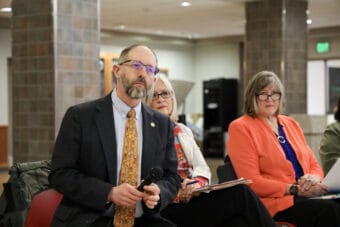
Juneau’s legislative delegation listens as constituents ask questions at a town hall meeting at Yadaa.at Kalé Juneau-Douglas High School on Monday, June 9, 2025. (Photo by Clarise Larson/KTOO)

Juneau’s three Democratic state lawmakers met with constituents downtown on Monday to share some of what happened — and didn’t happen — during this year’s legislative session. 

The first session of the 34th Alaska Legislature wrapped up in May. House Rep. Sara Hannan says the state’s financial issues were a top concern among lawmakers. 

“It was a really tough budgeting cycle,” she said. “There is no fat, we are cutting off and amputating parts of the body.”

Lawmakers were able to pass a balanced budget. Major pieces of legislation that make up the state’s annual budget are now on Gov. Mike Dunleavy’s desk. 

The budget outlines how much state funding will go to Alaska’s public schools. Lawmakers increased the state’s basic per-pupil funding by $700 this year. House Rep. Andi Story said the permanent boost to K-12 funding is long overdue.

“We have flat-funded education for so long that we have got constituents screaming across the state, to ‘please fund our public education,’” she said. 

In a joint session, the legislature successfully voted to override a veto by the governor of House Bill 57, which is the permanent funding increase, among other policies. 

But the governor can still choose to reduce that funding when he passes the budget. It’s unclear if he will or not. He said in Fairbanks on Tuesday that he’d release his line-item vetoes this week, possibly as soon as Thursday. 

Lawmakers also passed a budget with a $1,000 Permanent Fund dividend for Alaskans. It’s an all-time low for the state’s annual oil-wealth check, when adjusted for inflation. Sen. Jesse Kiehl said it will continue to shrink unless the state drastically rethinks how it spends its money.

“Math isn’t that hard. Revenues don’t go up, costs do go up, services don’t go down,” he said. Something is going to give, and the only source I can see — the PFD goes away. That’s a bad outcome. That’s the path we’re on.”

The delegates also expressed concern about potential cuts to federal Medicaid reimbursements and how those may impact the state’s budget and Alaskans’ access to healthcare. 

The second session of the 34th Alaska Legislature is set to begin next January. Because the Alaska Legislature operates on a two-session cycle, lawmakers will be able to pick up bills where they left off.  

Juneau Assembly approves Telephone Hill demolition plan that will evict residents this fall

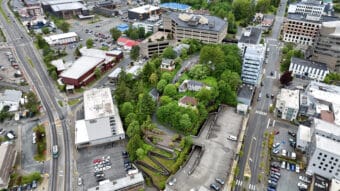
Trees outline the Telephone Hill neighborhood in downtown Juneau on Monday, June 9, 2025. (Photo by Clarise Larson/KTOO)

The City and Borough of Juneau plans to evict all residents of the historic downtown Telephone Hill neighborhood by Oct. 1.

It’s part of a plan that will demolish existing homes and clear the area for newer, denser housing in response to the city’s housing crunch this fall. But no developer has signed onto the project.

Tenants living there now have about four months to move out and find new housing before demolition begins.

The Assembly’s approval of the redevelopment project on Monday was a decision years in the making. The only Assembly member to vote against the plan was Paul Kelly. 

Assembly member Christine Woll said she recognizes the decision was a difficult one. 

“I wish we could sign an agreement with a contractor today that said we aren’t kicking out these families until we have a plan to get 10 times more people in that place — that’s not possible,” she said. “I’m excited to move forward on investing resources that we’re going to need to build that high-density, affordable housing in this place.”

The Assembly approved spending roughly $5.5 million in city dollars — pulled from a few different sources  — to fund the first phase of demolition and site preparation for the area. The total project cost is estimated at $9 million. 

But the city has not yet secured a developer to construct new housing there.

This is a preliminary concept drawing of what the Telephone Hill neighborhood redevelopment could look like. (Courtesy/City and Borough of Juneau)

Some residents, like Tony Tengs, who lives downtown, said the Assembly had already made its decision long before the vote even occurred. 

“This will be a very visible $9 million scar in the heart of downtown and the subject of much ridicule,” he said. “You may go down as the most notorious Assembly in the history of Juneau, if your big gamble doesn’t pay off.”

The city plans to get the land ready for a developer to then come in and start building housing next summer. But, as Douglas resident Mark Whitman points out, no developer has signed onto the project yet. 

“You are waiving a $9 million carrot, hoping someone will buy into this — and no clear takers,” he said. “A bad gamble with our money. This is not fiscal responsibility.”

The neighborhood gets its name because it was home to Alaska’s first commercial telephone service. The hill and many of its houses were a part of the original Juneau townsite in the late 1800s.

All the people living on Telephone Hill are renters, and have been since the state took ownership of the neighborhood in the 1980s. It was originally intended to be redeveloped back then to build a new Capitol complex there —  but that didn’t happen. 

The state then transferred the land to the city in 2023. Last year, the Assembly voted to redevelop the neighborhood and add more than 100 new housing units there in response to Juneau’s ongoing housing crunch. 

Assembly member Wade Bryson said the Assembly’s decision shouldn’t be a surprise.

“People who are living on Telephone Hill, how much time would be enough? Because this action, this night was talked about five years ago, four years ago, three years ago, two years ago, a year ago,” he said. “This was not a surprise, or it certainly should not have been a surprise to anybody that eventually it would come to this.”

Demolition is slated to begin between October and December, and city officials say they hope that a developer could begin construction as soon as next summer. 

Juneau’s new Coast Guard icebreaker is on its way to Alaska

The U.S. Coast Guard icebreaker Storis on May 22, 2025. (Photo courtesy of the U.S. Coast Guard)

A polar icebreaker is destined for what will eventually be its new home port in Juneau. It set out on Tuesday from Pascagoula, Mississippi, on its maiden voyage as an official U.S. Coast Guard vessel, according to a news release. 

The 360-foot ship is built to operate in the Arctic and is meant to increase U.S. presence in the region. The Coast Guard estimates it will bring hundreds of Coast Guard personnel and their families to Juneau in the coming years.
The ship was previously named the Aiviq. It was renamed the Storis in honor of another Coast Guard ship that was stationed in Juneau in the 1950s.

The Storis is intended to serve as a stopgap while the Coast Guard builds a new fleet of icebreakers called Polar Security Cutters. It’s the first icebreaker the Coast Guard has acquired in more than 25 years.

It’s not a new ship —  the Coast Guard bought it for $125 million from a private entity late last year. Alaska’s congressional delegation tucked the funding to purchase it in a spending bill signed by President Joe Biden last year. 

A ProPublica investigation of the ship published earlier this year found it has a design problem and a history of failure.

The Coast Guard announced last summer that Juneau would be the vessel’s homeport. It’s currently headed to San Diego, according to a vessel tracker. It’s expected to arrive in Juneau this August, but it will leave again to be temporarily berthed in Seattle until the necessary shore infrastructure is finished in Juneau. 

Juneau Assembly considers ranked choice voting system for local elections

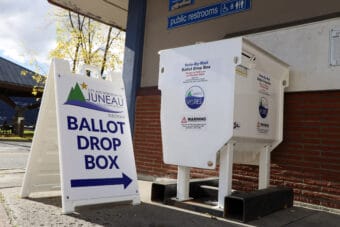
A ballot drop box sits outside City Hall on Tuesday, Oct. 1, 2024. (Clarise Larson/KTOO)

The Juneau Assembly is mulling over a plan to implement a ranked choice voting system for local elections beginning next year.

At a Monday Committee of the Whole meeting, members unanimously forwarded an ordinance for public testimony and a vote on whether to implement the system. 

Assembly member Ella Adkison proposed the ordinance. During a previous meeting, she said she thinks voters will support the change. 

“I think that ranked choice voting, in this case, makes it a lot easier to build consensus in our community to fully express the nuances of every Juneauite’s vote,” she said. 

Alaska uses a ranked choice voting system for statewide elections. It allows voters to rank candidates by preference in open primaries rather than partisan primaries. Proponents say the system helps tame hyperpolarized politics and promote a more inclusive election process. Pushback comes primarily from Alaska conservatives. 

Voters approved the system in 2020 and used it for the first time in 2022. Alaska is one of only two states that use ranked choice voting. Meanwhile, 10 Republican-led states have banned it.

Juneau wouldn’t be the first municipality to adopt the system. Cities across the U.S., including New York, San Francisco and Minneapolis, already use ranked choice voting in local elections.

Assembly member Alicia Hughes-Skandijs said during Monday’s meeting that she supports the change, but wants to make sure there is enough opportunity for the public to weigh in. The city plans to do more public outreach before the Assembly’s final vote in late July. 

“I love that we do ranked choice voting at the state. I love that we voted to keep it,” she said. “I don’t have a problem saying, ‘Yep, and this is how the state of Alaska votes, and this is how we vote locally, too.’”

According to data from the state’s Division of Elections, Juneau voters appear to favor ranked choice voting. Juneau overwhelmingly voted against a repeal effort on the ballot last election, which only very narrowly failed statewide. Advocates have already filed two new initiatives in an attempt to repeal it in the 2026 state election.

The next municipal election will not use a ranked choice voting system, even if members adopt the ordinance before then.

Southeast Alaska business owners less optimistic amid federal uncertainty, report says

Downtown Juneau on Friday, April 4, 2025. (Photo by Clarise Larson/KTOO)

Businesses do not like uncertainty. But many in Southeast Alaska say that’s exactly what they’re facing amid recent actions by the federal government. That’s driving down local business owners’ optimism about their economic prospects. 

The news comes in a report released Tuesday by the Southeast Alaska Business Climate Survey. It included insight from more than 400 business leaders from throughout the region. 

“Anytime you put the words uncertainty and business together — it’s not a recipe for success,” said Meilani Schijvens, the owner of Rain Coast Data, which conducts the annual survey. 

The survey shows that almost half of the businesses that participated expect recent federal actions to negatively impact their operations. Those actions include the Trump Administration’s funding and job cuts, executive orders and tariffs. Timber, arts and manufacturing businesses were reportedly the most concerned.

Schijvens said both business confidence and economic optimism have also appeared to shrink compared to previous years. That worries her. 

“We’ve seen a big shift in how people view the economy and in a short period of time, which has been really interesting, really fascinating,” she said. “It’s definitely not the positive outlook that we’re looking for.” 

Tourism industry leaders shared concerns that tariffs might stop people from traveling or participating in tours. They’re also worried about the increasing cost and decreasing availability of goods, such as parts for helicopters. 

Housing availability was also an important topic in the report. Nearly 80% of employers reported that housing issues directly cause turnover or deter potential hires from moving to the region. 

The study says that’s most problematic in Juneau and Sitka, where affordable and workforce housing is particularly scarce.

Juneau Assembly officially supports federal ownership of Mendenhall Glacier Recreation Area

Visitors walk back from viewing the Mendenhall Glacier on Friday, Feb. 21, 2025. (Photo by Clarise Larson/KTOO)

The Juneau Assembly unanimously passed a resolution on Monday in support of keeping Mendenhall Glacier Recreation Area federally owned. It also urges the U.S. Forest Service to rehire recently fired workers there. 

City officials said earlier this month that Republican U.S. Sen. Lisa Murkowski specifically requested the resolution after hearing that private entities were interested in taking it over. 

Kelby Randall, a glacier guide and student at the University of Alaska Southeast, testified in support of the resolution at the meeting. Randall referenced the photo of the Mendenhall Glacier that adorns the wall of the Assembly chambers. 

“When considering a non-public glacier recreation area, I feel the weight of the mural behind you. It is more than just the landscape. It is a defining feature of the land and the people who reside on and around it,” Randall said. “For these reasons, I support this resolution.”

University of Alaska Southeast student and glacier guide Kelby Randall testifies at a Juneau Assembly meeting on Monday, May 19, 2025. (Photo by Clarise Larson/KTOO)

The Mendenhall Glacier is one of Alaska’s most-visited tourist attractions, with more than 1 million visitors last year. It’s managed by the U.S. Forest Service and co-stewarded with the Central Council of the Tlingit and Haida Indian Tribes of Alaska.

Assembly member Christine Woll asked to amend some of the language in the proposed resolution to better acknowledge the tribe’s role with the Forest Service.

The Assembly’s resolution comes as some congressional Republicans in other states consider selling off federal lands to pay for President Donald Trump’s domestic agenda. Earlier this month, U.S. House Republicans approved an amendment authorizing the sale of federal public land in Nevada and Utah.

Randall, while testifying, pointed the Assembly to the Matanuska Glacier northeast of Anchorage. While the glacier itself is public, most visitors can only reach it through private land or tours. 

“Private stewardship would put this area at the same risk that has been seen at the Matanuska,” they said. “It would paywall this uniquely accessible glacier, and hearing that it was even an option, shocked and appalled me.”

The Trump Administration’s mass federal firings caused the Mendenhall Glacier Visitor Center to lose most of its staff. Forest Service staff from other departments are maintaining summer operations, along with partner organizations. The Assembly approved a separate ordinance at the same meeting to set aside $200,000 to support staffing at the glacier if needed.

Site notifications
Update notification options
Subscribe to notifications