Recent News

Juneau man found dead at construction site in the Mendenhall Valley

(Photo by Heather Bryant/KTOO)

A Juneau man died inside a forklift on a construction site at the end of Sherwood Lane in the Mendenhall Valley on Wednesday.

Juneau police say 33-year-old Johnathan Danial Hacko had been working and wasn’t out of sight for very long when one of his coworkers found him. 

Capital City Fire and Rescue were called to the site, gave Hacko CPR and attempted to revive him, but ultimately he was pronounced dead. 

Juneau Police investigated the incident. But, Lt. Krag Campbell wrote in an email that it’s not clear how Hacko died. His body will be sent to the medical examiner’s office for an autopsy. 

It could take weeks to find out what caused Hacko’s death. Campbell wrote that it usually takes 2 to 3 weeks to hear from the medical examiner’s office. It could take longer if they do a toxicology report. 


New energy projects seek to lower electricity costs in Southeast Alaska

Diesel generators in the Kake Powerhouse provide electricity to the town’s residents, pictured here in 2017. The Gunnuk Creek hydroproject would replace about half of the power. (Photo courtesy Inside Passage Electric Authority)

New projects are under development throughout the region to help reduce energy costs for Southeast Alaska residents. A panel presented some of those during last week’s Southeast Conference annual fall meeting in Ketchikan.

Jodi Mitchell is with Inside Passage Electric Cooperative, which is working on the Gunnuk Creek hydroelectric project for Kake. IPEC is a non-profit, she said, with the goal of reducing electric rates for its members.

The Gunnuk Creek project will be built at an existing dam.

“The benefits for the project will be, of course, renewable energy for Kake. And we estimate it will save about 6.2 million gallons over its 50-year life,” she said. “Although, as you heard earlier, these hydro projects last forever.”

The gallons saved are of diesel fuel, which currently is used to power generators for electricity.

IPEC operates other hydro projects in Klukwan and Hoonah. Mitchell said they’re looking into future projects, one near Angoon and another that would add capacity to the existing Hoonah project.

Mitchell said they fund much of their work through grants, which helps keep electric rates at a reasonable level.

Airport Manager Mike Carney stands next to the Ketchikan International Airport’s biomass wood-pellet boiler when it was installed in 2016. (Photo by Leila Kheiry/KRBD)

Devany Plentovich with the Alaska Energy Authority talked about biomass projects in the state. She said the goal is to increase wood energy use in Alaska.

“We offer any community, any entity, a free feasibility study to see if they have a potential heating system in their community,” she said. “We do advocate for wood heating, but we are trying to get a community to pick the best heating technology for their situation. So in a lot of situations, our consultants will give you the economics on a wood heating system but they’ll also recommend maybe you should look at heat pumps or look at waste energy.”

Plentovich said they recently did a study for Ketchikan’s Holy Name Church and School. The result was a recommendation for a heat pump rather than wood.

But, she said, wood energy is on the rise. There are more than 50 systems in the state displacing more than 500,000 gallons of fuel oil annually. Those include systems on Prince of Wales Island and in Ketchikan.

Ketchikan recently experienced a supply issue, though. A local wood-pellet manufacturer closed, which is a problem for the airport and the public library, among other facilities that use biomass heaters.

Karen Petersen is the biomass outreach coordinator for Southeast Conference. She said this opens up a great opportunity for someone.

“Devany and I are working on trying to find a supplier who wants to go into the pellet business,” she said. “Probably importing initially, and then converting over to some form of manufacturing once the demand is stabilized.”

So, Petersen said, if anyone is interested in this entrepreneurial opportunity, contact her through Southeast Conference for more information.

Young Coast Guardsman puts training to the test in Glacier Bay rescue

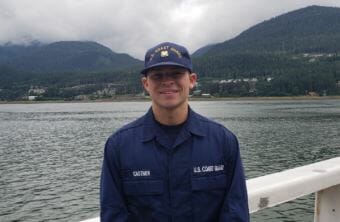
U.S. Coast Guard Seaman Colby Castner
U.S. Coast Guard Seaman Colby Castner poses for a picture on the deck of the cutter Douglas Munro in Juneau on July 18, 2018. Castner had recently rescued four kayakers stranded in Glacier Bay.
(Photo courtesy U.S. Coast Guard)

A young member of the Coast Guard participated in his first rescue mission on July 15 after the cutter Douglas Munro picked up an emergency beacon while on patrol in Glacier Bay.

Four kayakers were paddling in Reid Inlet when strong gusts coming down from a nearby glacier sent one of the paddlers tumbling into the frigid water. Another got separated in the waves. The group ended up trapped and freezing on the rocky shore. The kayakers activated their emergency beacon. The Douglas Munro, which was in a nearby inlet, moved to respond.

“We received the notification and we spotted an overturned kayak in the water,” said Coast Guard Public Affairs Officer Jacob Marx.

Three Coast Guard rescuers boarded a small boat and set out from the Douglas Munro to find the paddlers.

“I was mainly looking for one person,” said Seaman Colby Castner. “When I saw three people waving their arms frantically as we approached, I knew it was a lot bigger than I anticipated.”

This was 22-year-old Castner’s first rescue mission, but he was prepared.

Castner said when they arrived, the kayakers were in rough shape.

“They had flotation, which was really good,” he said. “But with that water temperature and then the air and that wind chill — easily they could’ve succumbed to hypothermia very quickly.

The small boat approached the shore but barnacle-coated rocks prevented the rescuers from reaching the kayakers. Castner had to jump into the 50-degree water and swim out to them. The paddlers got back into the water and Castner had to “buddy tow” them individually back to the boat.

“You put your arms around them to try to just hold on to them as hard as you can, and you swim them back. So you’re not only swimming yourself back but you’re swimming them back as well,” he said.

He had to do that multiple times, one for each person and again for their kayak and gear. The fourth kayaker was also safe 300 yards down the shore.

The Coast Guard helps bring a rescued kayaker aboard the Douglas Munro in Glacier Bay on July 15, 2018.
The Coast Guard helps bring a rescued kayaker aboard the Douglas Munro in Glacier Bay on July 15, 2018. (Photo courtesy U.S. Coast Guard)

Aboard the Munro, the group was shaken but unharmed. Castner said without their emergency beacon, they may not have been found at all.

“The number one thing was that they had the EPIRB: Emergency Position Indicating Radio Beacon,” he said. “It’s almost scary to say that might have been the only reason that they were found.”

The group was taken to Juneau the next day. Castner said the rescue was both humbling and rewarding.

Castner is from Clearwater, Florida. He joined the Coast Guard last year to specialize in search and rescue. He’s been training with the guard’s rescue swimmers since, following an intense regimen of long days in the gym and a lot of swimming. He plans to go to aviation survival technician school, to become a member of the guard’s elite rescue swimmer unit. The training is relentless and only around half of trainees make it through. But, Castner is undeterred.

“Everything I’ve trained for was exactly for this moment,” he said. “This is why I joined the Coast Guard, to be able to do this kind of stuff. I would never wish that it has to happen, but if it has to happen, then I definitely want to be the person to go out there and get them.”

VA’s Caregiver Program Still Dropping Veterans With Disabilities

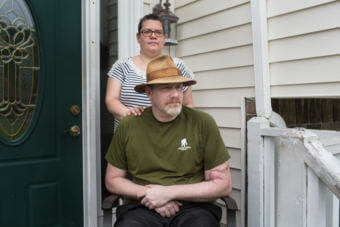
George Wilmot gets lost easily, forgets things — like a pot on the stove — and sometimes falls down without warning. His wife, Jenn, hasn’t been able to work outside the home because taking care of George is a full-time (Photo by Eva Verbeeck for NPR)

In the early days of the Iraq War, troops were riding around in Humvees with almost no armor on them. There was a scandal about it, and within a few years the trucks got up-armored with thick steel plates, which solved one problem but created another.

“Some genius thought about up-armoring. Good! But they didn’t do anything with the brake systems,” says George Wilmot, who was riding an armored Humvee in 2009, leaving a hilltop base in Mosul.

“We took some small arms fire … my driver took us off a cliff,” says Wilmot.

Jenn Wilmot shows a picture of George after his accident. He was thrown free from the gunner’s turret as his Humvee tumbled off a cliff in Iraq. He survived, but with a brain injury, PTSD and a left arm that still looks sewn-on. (Photo by Eva Verbeeck for NPR)

Wilmot was thrown free from the gunner’s turret as the Humvee tumbled. He survived, but with a brain injury, post-traumatic stress disorder and a left arm that still looks sewn-on. The Department of Veterans Affairs rates him 100 percent disabled. George gets lost easily, forgets things — like a pot on the stove — and he falls down hard sometimes, without warning. His wife, Jenn, hasn’t been able to work outside the home because caring for George is a full-time job.

“If he knows I’m going somewhere and I’m not going to be here, he’ll hang out in the bedroom because it’s a short distance right to the bathroom,” she says. “That’s not how you should live, though.”

The Department of Veterans Affairs’ Program of Comprehensive Assistance for Family Caregivers seemed a perfect fit for the Wilmots. It pays a stipend to family members or friends of a post-Sept. 11 veteran — often a wife or mother — who provide care. But after two years on the program, the Wilmots were dropped, even though they say George’s condition hasn’t improved.

NPR spoke with the Wilmots last year for a report that found some VAs across the country were dropping caregivers off the program while most other VAs were adding. After that report, the VA reviewed the program and made several changes to improve and standardize it. But a year later, most of those VAs are still shedding caregivers. And many who were dropped before the improvements say they can’t get back on, even though they say their veterans still badly need assistance.

The stipend ranges from a a few hundred to a couple of thousand dollars a month depending on the severity of the disability and the market rate for caregivers.

Vets love the program not only for the stipend, but also for the recognition of the care their families provide. One study estimated the care to be worth billions of dollars.

The numbers looked arbitrary from city to city, which was bad luck for the Wilmots — they go to the Charleston, S.C., VA, which dropped 94 percent of its caregivers in three years.

After the NPR report last year, the VA briefly paused all revocations — that is, it stopped kicking people off the program — and carried out a strategic review. Meg Kabat, who directs the program, says the pause allowed the VA to better oversee and standardize it.

“We were able to issue a directive. It’s on the VA website, so it’s there for caregivers, veterans, advocates — one policy that is followed by every medical center across the country,” says Kabat.

Continuing disappointment

After the pause, veteran families like the Wilmots thought the program would be fixed. Jenn Wilmot says the Charleston VA encouraged her to reapply, and then rejected her.

Current VA statistics suggest the Wilmots aren’t alone — the Charleston, S.C., VA is still down 93 percent from 2014. There are only 13 approved caregivers on the program there. The South Texas VA had 342 in 2014. Last year it was down to 177. Now there are only 40. Northern Arizona kept cutting; so did Puget Sound. Fayetteville, N.C., had 570 caregivers in 2014; 350 have been cut, including Ashley Sitorius and her husband, William.

Ashley Sitorius says she knew during William’s deployments to Iraq and Afghanistan that he could come home injured.

“I thought, ‘He’s serving our country, he’ll most definitely be taken care of,’ ” says Ashley. She was kicked off the program in 2015.

“They just said he wasn’t clinically eligible anymore and he didn’t need a caregiver. And honestly, he’s gotten worse. I wish he was better,” she says.

Last year, after the program pause, Sitorius applied again and got rejected. She appealed to the regional office and got rejected again in March of this year.

VA works to set things right

Kabat, the program’s director, says some VAs are still correcting the error of letting way too many people in at the beginning. And she says the demographics vary from state to state, and that the number of new disabled veterans has dropped as the wars in Afghanistan and the Middle East have wound down.

“It’s not surprising to me that there’s a group of veterans who are participating in the program for a period of time and then are discharged,” says Kabat.

Once caregivers get in the program they start using a lot of other VA services, too. Many vets improve and graduate out — which is the goal, says Kabat.

But for some veterans that goal may be out of reach.

(Top) Britnee Kinard’s husband, Hamilton, has a brain injury and PTSD. She got kicked off the program by the Charleston VA in 2014. (Left) Hamilton’s daily medication. (Right) His uniform in the closet at their home in Richmond Hill, Va. (Photos by Eva Verbeeck for NPR)

Britnee Kinard takes care of her husband, Hamilton. He has a brain injury and PTSD, among other things. She got kicked off the program by the Charleston VA in 2014. She sees her husband deteriorating. He needs help with bathing and toileting. She’s dreading the day when she’ll have to take away his car keys.

“I try my hardest not to pull his, quote, man-card,” says Kinard. “I want him to be as independent as possible. But the reality of it is, the more his health progresses, the less independent he is and I’m trying not to take it from him.”

The VA says it’s still standardizing the boards that evaluate applications, and last year it audited hundreds of the cases of people removed.

Hamilton Kinard can’t use his legs some days and needs help with bathing and toileting (Photo by Eva Verbeeck for NPR)

But some of those caregivers have been on the phone with their senators. Last month, Republican Dean Heller of Nevada and Democrat Bob Casey of Pennsylvania sent a letter to the VA asking that all of the caregivers who were kicked off before the program was revised last year get a second look.

“The veterans and their caregivers deserve to have their cases reviewed and use the same improved procedures,” says Casey. “Caregivers should not be treated differently because their case happened to come up for review a week before or a week after the time when the VA froze discharges.”

The VA’s Acting Secretary Robert Wilkie responded that the VA is working to improve the clinical appeals process so veterans and their caregivers can get back in.

Sitting with her disabled husband, George, Jenn Wilmot says her last appeal was exhausting.

“Does he need it?” she says. “Oh yeah, I know he does. But it’s just too tiring to fight.”

She might be up to it, Wilmot says, if she weren’t working full time taking care of her veteran.

Copyright 2018 NPR. To see more, visit http://www.npr.org/.

Hawaii Volcano’s Lava Spews ‘Laze’ Of Toxic Gas And Glass Into The Air

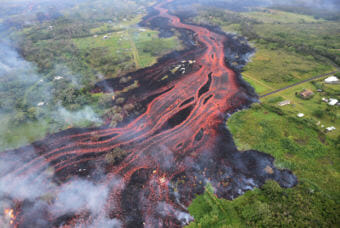
Lava flows from fissures near Pahoa, Hawaii, on Saturday. (USGS/AP)

Lava from the Kilauea volcano is pouring into the Pacific Ocean off of Hawaii’s Big Island, generating a plume of “laze” – which Hawaii County officials describe as hydrochloric acid and steam with fine glass particles — into the air. Officials say it’s one more reason to avoid the area.

“Health hazards of laze include lung damage, and eye and skin irritation,” says the Hawaii County Civil Defense agency. “Be aware that the laze plume travels with the wind and can change direction without warning.”

The U.S. Coast Guard is monitoring the area to help keep people away from the coast; the county says that “only permitted tour boats are allowed in the area.”

Two lava flows are now entering the ocean, and emissions of sulfur dioxide have tripled downwind of at least 20 fissure vents, according to the civil defense agency.

“There continue to be explosions and earthquakes from the volcano’s summit — many are saying it sounds like a war zone,” reports Jackie Young of Hawaii Public Radio.

“As soon as the generators go off, it’s just booming,” Big Island resident Corey Hale says. “It’s really loud booming.”

Hale has lived in Lanipuna Gardens for about three years. She evacuated her home on May 3, the day of the first big eruption. Nearly every day since then, she and her cat have been staying in the parking lot of the community center in Pahoa.

Based on the latest information she has, Hale says her land is surrounded by lava on three sides but hasn’t yet been consumed by the flows.

“It’s been scary,” she says. “None of us think that there’s going to be some sudden crazy random eruption here in the parking lot, but it’s just scary to be so close to such a powerful natural event, and feeling the ground shaking all the time and see the red of the sky. And then just not knowing — you know, the not knowing.”

Late Saturday night, explosive eruptions at Kilauea’s crater sent an ash cloud up to 10,000 feet into the sky, according to the U.S. Geological Survey. The explosions registered as the equivalent of a 5.0 magnitude earthquake, the agency says.

Residents are also being warned of possible new evacuations, particularly in cases where lava flows threaten to cut off arterial roads. A lava flow crossed one of those roads, Highway 137, on Saturday.

Despite the disruption to her life, Hale says she has also found beauty in the eruptions.

“It’s an amazing experience to be on the ground watching Pele do what she does,” she says, referring to Hawaii’s goddess of volcanoes. “This is a beautiful, amazing event, to be here at the birth of new lands. And there’s been sadness. And you know, there’s grief for losing what we had and what it was. But we aren’t sad. To live out here you gotta be resilient or you don’t make it.

When asked whether she will try to live again on her property after the eruptions have finally stopped, Hale says, “Absolutely. Absolutely.”

In its latest update on the overall status of Kilauea, the USGS says, “Seismicity and deformation continue at the Summit. Deflation is ongoing and additional earthquakes are expected as long as the summit continues to deflate.”

Copyright 2018 NPR. To see more, visit http://www.npr.org/.

Alaska governor calls for more defenses amid N. Korea threat

FAIRBANKS, Alaska (AP) — Alaska Gov. Bill Walker says he didn’t think North Korea would be able to strike the state with a nuclear warhead until 2020. But spiraling rumors about the country’s missile capabilities and its leader Kim Jung Un’s recent comments — coupled with President Donald Trump’s statements — have led to him saying the state needs to expand its military presence.

The Fairbanks Daily News-Miner reports that Walker said earlier this week to Politico he was concerned about North Korea’s threats to the U.S. and its claims that missiles can hit Alaska. But he says “no one’s hiding under the desk.”

U.S. Sen. For Alaska Lisa Murkowski says the state has been diligent and has a Long Range Discrimination Radar under construction, which will give missile defenders a better look at what is happening over the Pacific Ocean.

Site notifications
Update notification options
Subscribe to notifications