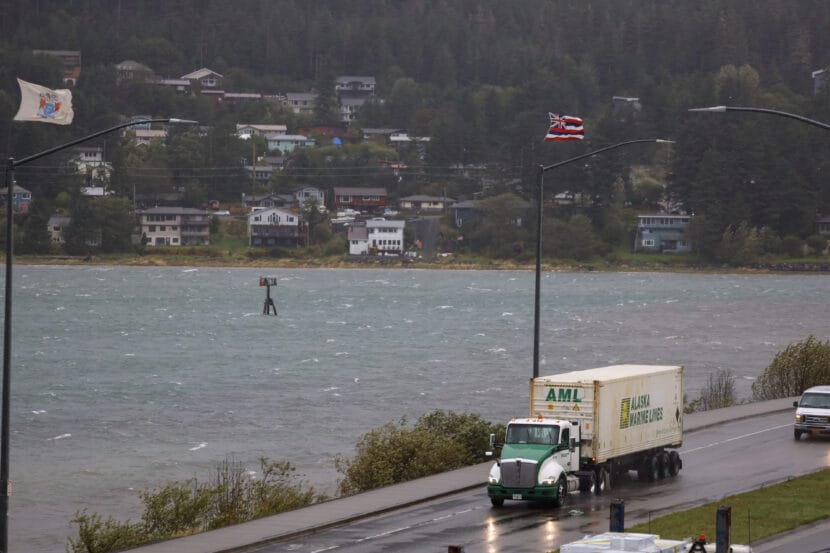
Wind blows the water in the Gastineau Channel on Wednesday, Sept. 17, 2025. (Photo by Clarise Larson/KTOO)
This story has been updated.
A storm moving through Southeast Alaska is causing high winds that will continue into Wednesday evening in Juneau. It’s resulting in power outages and fallen trees. Multiple cruise ships have canceled port calls.
The National Weather Service issued a high wind warning early Wednesday morning, which is in effect until 7 p.m. Brian Bezenek, the lead meteorologist at the Juneau NWS office, said sensors have reported gusts reaching up to 60 miles per hour downtown.
“We’ve got some very gusty and strong winds moving through the area that have been knocking down a few trees here and there, as well as some other minor damage around town,” he said.
Three cruise ships that were scheduled to arrive in Juneau canceled their stops ahead of the storm Tuesday night. One ship, the Caribbean Princess, chose to stay in Juneau overnight and remains in port this afternoon. The Viking Orion cruise ship was scheduled to arrive in Sitka today, but instead diverted course to Juneau due to the winds.
Matt Creswell, the city’s harbormaster, said local tugboats helped the ship moor this afternoon.
“All cruise ships visiting Juneau are able to have tugs on standby at any time they want,” he said. “That’s a common thing that if you need a tug, it’s always manned and ready to go if the ships need it.”
Alaska Electric Light & Power reported an areawide outage due to downed trees across town. The City of Hoonah also reported outages.
Bezenek said the heavy winds are expected to head north and through Juneau later this evening.
“It’s drifting north, and it should be jumping inland across the mountain range through today,” he said. “We’ll probably have the gusty winds in the Juneau area continue for another couple hours, and then we’ll see this wind band probably pushed north through the Lynn canal area.”
The Juneau School District reported at noon that all schools have been impacted by the power outage, but classes are continuing as regularly scheduled.
This is a developing story. Check back for updates.
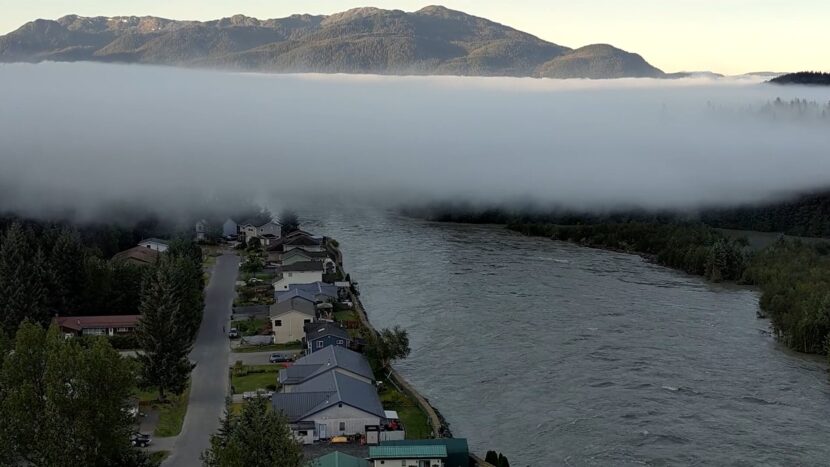
Drone image of Marion Drive during the 2025 glacial outburst flood on August 13, 2025. (Photo courtesy of Alaska DOT)
Listen to this story:
During Juneau’s record-breaking glacial outburst flood last month, the Alaska Department of Transportation completed one of its most complex drone missions to date.
A handful of DOT drone pilots filmed Juneau’s temporary levee consistently during the major flood stage of the event, including overnight footage using infrared cameras. The agency livestreamed that footage to keep emergency managers informed as floodwaters rose, crested and receded.
Patrick Dryer, an avalanche and geohazard specialist at DOT in Juneau, said this was a new feat for the department.
“We were able to essentially monitor this remotely, without having personnel, you know, in the field for a 12-hour period there,” Dryer said.
He said they were able to do that because the drones they used, called Skydio X10, connect to Starlink and wireless broadband and can fly long distances in urban areas.
Christopher Goins, a regional director at DOT, said that observing a disaster in real-time without putting staff in danger wouldn’t have been possible a few years ago.
“The world is suddenly changing for us,” Goins said. “This is a big deal.”
He said that surveillance was focused on infrastructure — the HESCO barriers that make up the temporary levee and bridges over the river — not on people.
People did appear in the livestream incidentally, “whether that was being on the barriers, hanging out behind the barriers, laser pointing the drones,” Goins said.
Goins said that if the levee broke — which would have triggered a flash flood — the drone teams would have pivoted to assist rescue operations. The drones are equipped with thermal cameras that can pick people out, even in the dark.
“If we saw somebody in the water, we were to stay with them,” Goins said.
Then they would call Capital City Fire/Rescue and hover there until rescue arrived.
Goins said DOT uses drones regularly for construction and maintenance, so he hopes to expand the department’s capacity to help local emergency managers in the region quickly respond to disasters like floods, landslides and avalanches.
Correction: An earlier version of this story said the flood happened earlier this month. The flood happened in August.
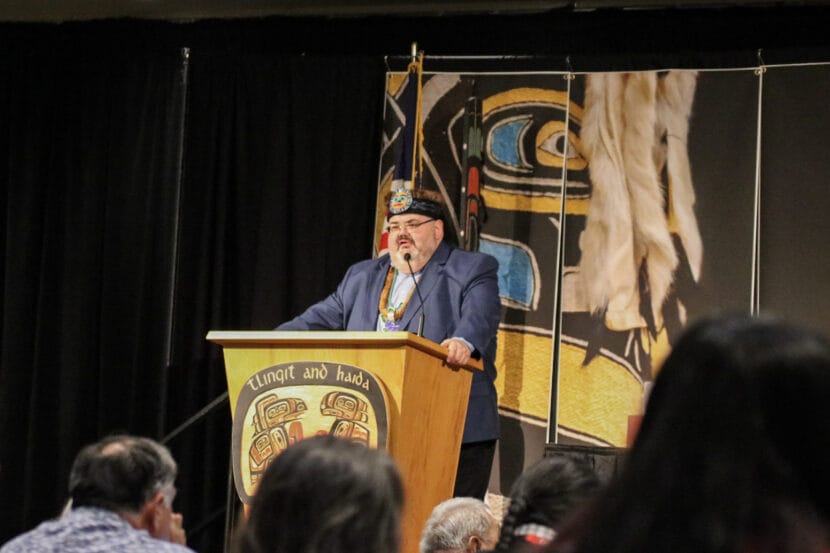
Chalyee Éesh Richard Peterson, president of the Central Council of the Tlingit and Haida Indian Tribes of Alaska, speaks at the 90th annual Tribal Assembly in Juneau on Wednesday, April 18, 2025. (Photo by Clarise Larson/KTOO)
The Central Council of the Tlingit and Haida Indian Tribes of Alaska’s executive council says it has concluded its review of abuse allegations against its president, Chalyee Éesh Richard Peterson.
He returned from a brief personal leave last week. His time away from his role coincided with the wide circulation of sexual abuse accusations made by his former fiancée on social media.
On Friday morning, the tribe’s executive council — which includes the president — hosted its regular monthly meeting.
The tribe’s first Vice President, Ku.seen Jacqueline Pata, briefly acknowledged the allegations. Pata did not directly identify Peterson in her remarks.
“Tlingit and Haida has been reviewing an employment matter with the assistance of outside counsel following a social media post concerning the private personal lives of current and former employees,” she said.
Tlingit and Haida is Alaska’s largest tribal government. Peterson has been its president for more than a decade. He attended the meeting on Friday and did not speak to the allegations during his presidential report.
Pata originally informed Tlingit and Haida staff in an email earlier this month that the tribe’s executive council was aware of the online accusations. She wrote that the council was taking the matter “very seriously” and initiated a review. Pata served as acting president in Peterson’s absence.
Pata said the review focused on whether inappropriate conduct occurred in the workplace and whether the tribe has effective measures to uphold workplace respect and accountability. She said the council also conducted a broader review of the tribe’s policies, procedures and reporting mechanisms. She said that review led to the council adding a third-party reporting system and additional training to its policies and accountability systems.
“With the review of this matter now concluded, we are confident in moving forward with strengthened policies and supports in place,” she said. “Tlingit and Haida remains committed to providing a respectful and welcoming workplace that honors our traditions and culture and reflects tribal values.”
The meeting was open for public comment. Multiple tribal members testified, asking for transparency regarding the allegations and what the tribe’s executive council is doing to address them. Stláay Cloud-Morrison testified that she is a survivor of sexual assault, and said the allegations made her think about what the tribe owes its citizens.
“It’s deeply troubling when serious complaints are not handled with [the] honesty and respect they deserve,” she said. “Only through genuine transparency can our tribe demonstrate respect for survivors and a real commitment to healing.”
Following the accusations earlier this month, local Alaska Native artist and activist Chloey Cavanaugh gathered more than 350 signatures demanding Tlingit and Haida hire an independent, trauma-informed investigator to review policy and leadership behavior. She testified at the meeting on Friday — and said the issue raised broader questions about accountability in tribal government.
“I realized through this process that there’s really no way for us tribal citizens to contact our delegates and talk to those that represent our communities to be able to voice our complaints or things that we’re seeing that we don’t like,” she said.
The tribe’s executive council is required to adhere to a code of conduct adopted by the tribe.
The code states that members must not engage in “any form of sexual harassment, coercion, or misconduct” and that members are required to self-disclose if they believe their actions fall short of council standards and may negatively impact the perception of the tribe. The code states that violations may result in disciplinary action, up to and including removal from office.
No criminal charges have been filed against Peterson as of Friday.
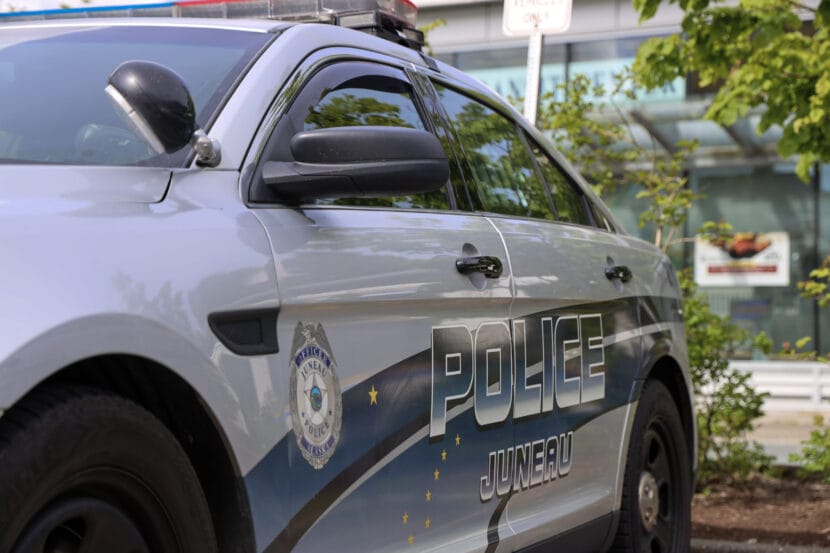
A Juneau Police Department vehicle park in downtown Juneau on Thursday, June 13, 2024. (Clarise Larson/KTOO)
The Juneau Police Department has released the name of the officer who slammed a man to the ground last month during an arrest. The department says it also plans to release the body-worn camera footage from the incident at the end of this month.
The officer’s name is Brandon LeBlanc. He started his position in Juneau last fall. The department placed him on paid administrative leave following the arrest.
The department says LeBlanc has 17 years of law enforcement experience. Before beginning his position in Juneau, LeBlanc worked as an officer in Louisiana.
While there, court documents show that a man sued LeBlanc in 2016 for excessive force and battery, among other accusations. The man claimed he received a broken jaw and was unlawfully tased by LeBlanc during an arrest.
LeBlanc testified during the trial that the man was punching another officer, and that he tackled and tased him when he resisted arrest. A jury found LeBlanc not guilty.
During the incident involving the Juneau man last month, witness Ibn Bailey recorded a video of the arrest that circulated widely online. Later, Bailey said the officer responded in “the most professional manner, given the circumstance.”
The video showed LeBlanc attempting to handcuff the man before slamming him to the ground. The man appeared to lie unconscious for the remainder of the video and was later medevacked out of town with a head injury.
Dozens of Juneau residents gathered at the police station days after to protest the officer’s actions. The man’s family has publicly identified him as Christopher Williams, Jr. They say he plans to sue the department.
The Juneau Police Department requested an independent investigation by an external agency to review LeBlanc’s use of force. That investigation is still ongoing.
Once it’s finished, the state Office of Special Prosecutions will then review the case to determine if LeBlanc was justified in his response. The city says it will also conduct an internal investigation of the incident to examine whether his actions aligned with the department’s current policy.
In May, the Juneau Assembly passed an ordinance mandating that the Juneau Police Department release body-worn camera footage no more than 30 days after a city police officer’s actions cause serious injury. That means the footage will be released on Aug. 29.
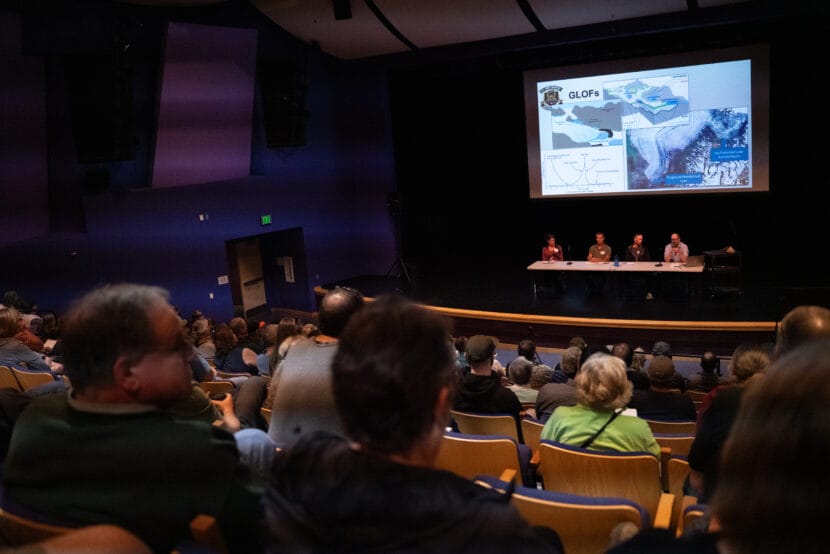
Erin Stockdale, Curtis Lee, Mike Records and Leif Hammes from the U.S. Army Corps of Engineers present the federal process to come up with a long-term flood protection solution for Mendenhall Valley on July 30, 2025. (Photo by Alix Soliman/KTOO)
Listen to this story:
As the next glacial outburst flood looms over Juneau’s Mendenhall Valley, around 200 residents filed into the Thunder Mountain Middle School auditorium last night to talk about a permanent solution. Officials from the U.S. Army Corps of Engineers said it’s years away. But residents in the flood zone said they need a solution sooner to feel safe in their neighborhoods.
Dominic Walsh’s home on Northland Street flooded last year. The temporary levee the city put up this year is meant to protect his home until there’s a permanent fix, but he doesn’t feel confident in that.
“I don’t feel any safer with the HESCO barriers, maybe a little bit, but not really,” he said.
This is the first time the levee will be put to the test. Although city officials said they are confident the levee should work properly, they are urging residents in the flood zone to evacuate when the flood warning is issued.
Walsh said he’s spent all year recovering from the last flood and preparing for the next one, and it’s challenging to imagine that he’ll be living with that anxiety for several more years while the federal process unfolds.
Craig Loken lives on Emily Way, a street that got hit hard by the flood last August. He said the Army Corps’ slow approach is painful to watch.
“If it takes 10 years, there won’t be anybody left in the Valley to benefit from all these studies,” he said.
His family has lived in the Valley for three generations. Loken said they are thinking about moving away, depending on how this long-term solution pans out.
The Mendenhall Glacier and Lake are on federal land, so anything built there is under federal jurisdiction. The Army Corps is starting with a technical study to gather all of the physical data about the baseline conditions in the Valley. Congress allocated $4.75 million to the study and Army Corps officials said it will take a few years to finish.
That study will inform another report called a feasibility study. That’s where the Army Corps weighs each option and picks one. It could take another couple of years and millions of dollars more.
After that, engineers have to design the solution they pick, which can take another couple of years. Then the Army Corps has to build it.
Leif Hammes is chief project manager in the civil works branch of the Army Corps in Alaska. During Wednesday’s meeting at Thunder Mountain Middle School, he explained that the building timeline depends on how big the project is, but that this is a top priority in his office.
“We do look for ways to go faster, save time, get us there quicker, but from sort of where we are today to physical construction is multiple years — you know, six, seven, ten-ish years is not an unreasonable timeline,” Hammes said.
Added together, Mendenhall Valley residents can expect a decade or more before there’s a permanent fix.
Hammes said that Army Corps staff can’t change the agency’s process because it’s grounded in federal laws.
But Erin Stockdale, chief of the planning section at the Army Corps, told residents to speak up and tell their stories since Congress has the power to make things move quicker.
“The ‘just build it’ avenue is not common, but I will say the squeaky wheel gets the grease,” she said.
Lots of ideas were floated, including a tunnel through the ice, a lake tap at the bottom of Suicide Basin and a permanent levee. At this stage in the process, Hammes said the Army Corps isn’t ruling anything out yet.
But one idea got more attention at the meeting than any other: a dam on Mendenhall Lake.
Dave Hanna has lived in Juneau his whole life. Although his place on Auke Lake isn’t in the flood zone, he said glacial outburst floods are the most devastating issue Juneau is facing. And he thinks a dam is a simple fix. He went up to the microphone and told the Army Corps as much.
“If you put a dry dam across the outlet of the lake, it would serve as a pedestrian bridge,” he suggested. “Find out what you’ve got to build on, and then figure out how to build it, because we can’t wait seven years.”
The crowd erupted into applause. Many residents agree with him.
Scientists are beginning to research other lakes farther up Mendenhall Glacier that might release outburst floods in the future. No one knows how big the risk is yet, but it could narrow down the options for a permanent solution.
That’s a major reason Hanna is pushing for a dam.
“Anything we do at Suicide Basin is probably not the correct thing to do, because it doesn’t address future basins,” Hanna said.
Bob Deering lives along the Mendenhall River and is a retired engineer who once worked at the Army Corps. He thinks a dam is the only viable solution, and said that the process the agency laid out is too slow.
“Frankly, it’s unacceptable,” he said. “I mean, everybody’s going through all this stress right now, with the flood, you know, looming above us, and we’re going to go through that for another 10 years?”
Suicide Basin is expected to be full around mid-August, but National Weather Service forecasters don’t yet know exactly when it will unleash the next flood.
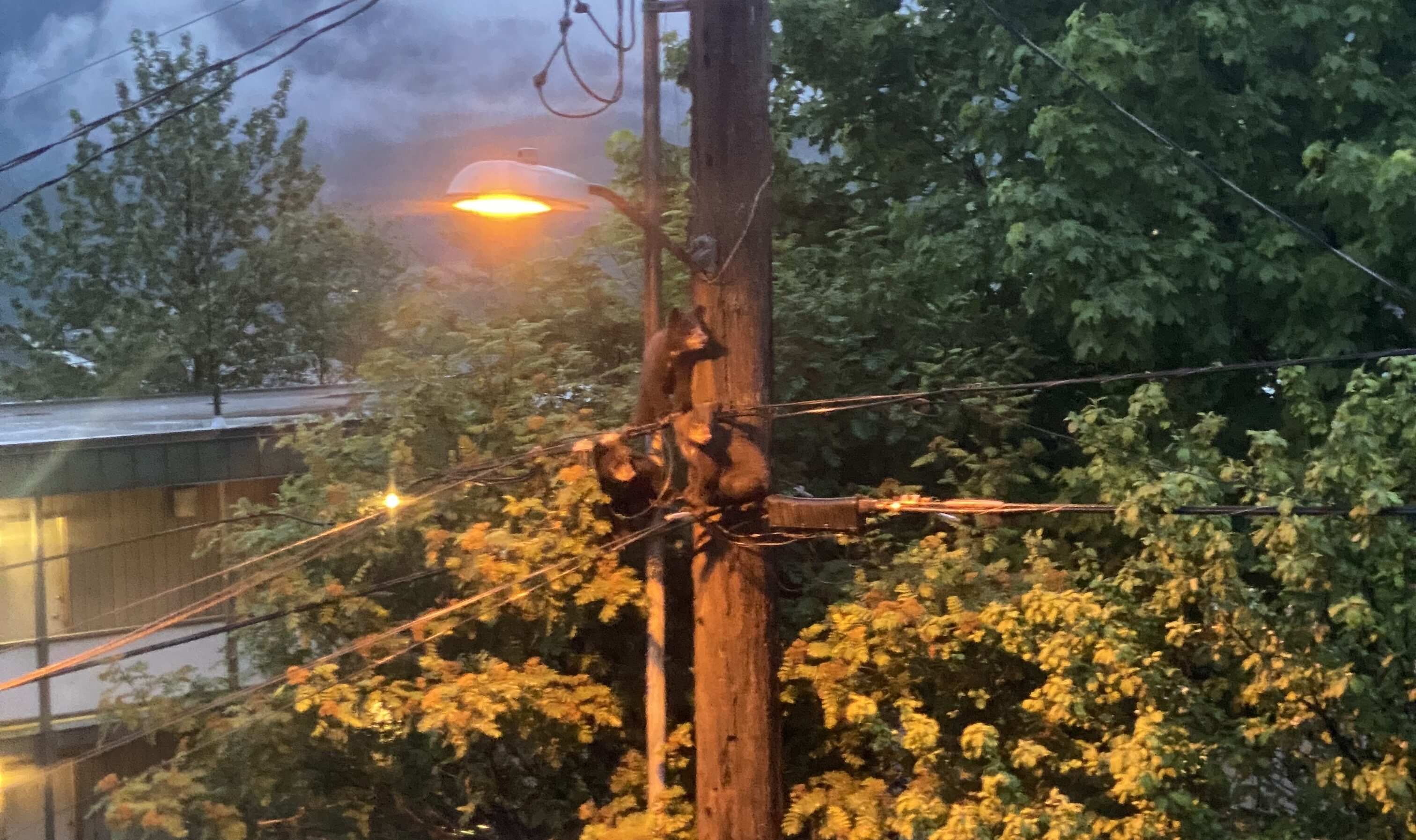
Three bear cubs climbed a Gold Street telephone pole on June 29, 2025, weeks before the incident. (Photo by Claire Stremple/KTOO)
Two black bear cubs were electrocuted to death after climbing a utility pole in downtown Juneau Monday night, temporarily knocking out power in part of the Flats neighborhood.
Juneau residents have seen the family – three cubs and a mother bear – wandering downtown in recent weeks.
Tara Thornton witnessed the incident on West 12th Street around 11:00 p.m.
She said she heard people hollering and saw a car turn around in her driveway, so she went outside and saw that a bear had made a mess of the trash. As she and her husband cleaned up, they heard a zap.
“Moments later, we see a bear cub fall from the top of the telephone pole,” she said.
The cub died. Thornton said people gathered around to see what was happening, which didn’t help the situation. She and her neighbors tried to direct traffic away from the scene so another cub would feel safe to climb down.
Meanwhile, she said the sow was pacing nearby and trying to carry both her dead cub and its wailing sibling away from the crowd.
Roy Churchwell, Alaska Department of Fish & Game’s regional management coordinator, and his colleague arrived at the scene after the first cub died. They managed the onlookers.
“We’d ask them to go into their houses and kind of quiet things down, and that was happening,” he said.
In situations like this, he said the best way to protect bears is to give them space.
But then, the cub that was still up on the utility pole hit the transformer. The electric shock killed it instantly and knocked out power in part of the Flats neighborhood.
Churchwell said it sounded like a gun went off.
Thornton said this could have been prevented. Now, she wants to see metal sleeves or other barriers go up on the utility poles in town to keep bears from climbing to their deaths.
Churchwell said a third cub survived the ordeal and appeared uninjured with its mother when he was called to respond to the sow chasing someone in the Evergreen Cemetery Tuesday morning.
Close
Update notification options
Subscribe to notifications
Subscribe
Get notifications about news related to the topics you care about. You can unsubscribe anytime.