Alaska’s Marine Highway System wants a court to order the fast-ferry builder to provide new engines for the ships.
State officials say engines on the Fairweather and Chenega are wearing out far faster than their warranties promised. Replacing the eight engines could cost in the range of $20 million.
The state filed a lawsuit last year, but continued talking to the manufacturer about a solution.
Captain Mike Neussl says the state is now asking the court for a preliminary injunction to force action before the engines wear out.
“If that happens, those vessels could be out of service before there’s an ultimate resolution. That would mean the state would lose use, and state residents and communities would lose use, of those vessels prior to the ultimate decision on that lawsuit,” he says.
He says quick action is needed because making new engines will take about a year.
The engines have already undergone repairs. Neussl says that has extended their operating life. But the repairs are not permanent.
The lawsuit and injunction motion are against Derecktor Shipyards, which build the ship, and subcontractors that built the engines. Derecktor officials could not be reached for immediate comment.
The injunction motion filed in Superior Court does not specify that new engines be built by the same manufacturer. But Neussl says that’s the likely solution.
“We have looked at alternatives, what other engines are out there that we could replace these engines with. And to be honest with you, there’s not any other diesel engines in the market place that meet the power-to-weight ratios that these engines have and would fit in the assigned space and have the correct weight to be used in these vessels,” he says.
The Fairweather, built in 2004, is based in Juneau and sails to Sitka and Petersburg. It’s scheduled to begin Angoon service next year. The Chenega, built in 2005, is based in Cordova and runs to Valdez and Whittier.
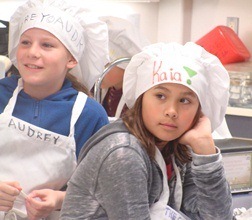
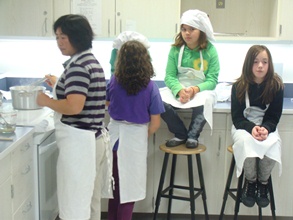
What makes dough rise? How do you preserve milk? Twenty-seven young chefs are learning the answers to those questions and more this week at a Juneau Economic Development Council summer camp designed to teach kids the science of cooking. Casey Kelly has more.
Young chefs learn about the science of cooking at the Juneau Economic Development Council's Kitchen Chemistry camp. (Photo by Casey Kelly/KTOO)
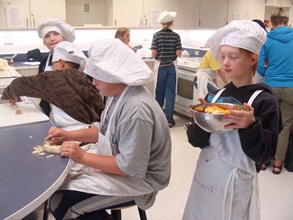
Its day three of the Kitchen Chemistry camp and students are making mozzarella cheese in the culinary classroom at Thunder Mountain High School. Working in groups of four or five, they start by warming a gallon of milk and just over a teaspoon of lime juice – a substitute for citric acid – in a large pot on the stove. But most of the kids are a little unsure about the next step.
“After I think we cook it, we just gotta wait awhile or bake it or something,” says Hunter Hill, a fifth grader at Gastineau Elementary School. He says he signed up for the camp because he really likes cooking at home – mostly desserts.
“I like making crepes for my family that I get from a library book. And yeah, other than that, I like making cookies, brownies and cake, stuff like that,” Hill says.
JEDC Education Specialist Bob Vieth says the purpose of the cheese making exercise is to teach kids one way to preserve milk. During the week they also learn how to preserve cucumbers by pickling them, about leavening agents by making pizza dough, and about sweeteners by making fudge.
Making mozzarella cheese at JEDC's Kitchen Chemistry science camp. (Photo by Casey Kelly/KTOO)
“And along the way we’ve been trying to emphasize the science aspects and the chemistry aspects of the various cooking techniques that they’re using,” says Vieth.
Simon Smith learned what happens when you use baking soda instead of baking powder to make scones.
“The whole class tasted them and wasn’t so good,” Smith says.
Vieth admits there have been a fair number of failures. All the kids are going into either fourth or fifth grade, but he says some of them are pretty good chefs already, and they’re learning advanced science years before they would in school.
Budding chefs at JEDC's Kitchen Chemistry science camp. (Photo by Casey Kelly/KTOO)
“They’re learning concepts and vocabulary terms here that they normally wouldn’t be exposed to until high school chemistry,” Vieth says. “So when they do get them in chemistry, they’ll say ‘Oh yeah, I remember that from the cooking class.'”
Sophia Harvey says there’s another benefit of going to a cooking summer camp.
“I like eating the stuff after,” Harvey says.
Kitchen Chemistry is the last of this year’s JEDC Summer Camps. Previous camps include building underwater gliders, rocketry, and LEGO robotics. All the camps are part of JEDC’s STEM education program, which stands for Science, Technology, Engineering and Math. In Juneau, I’m Casey Kelly.
You might think we’re trying to sell you the moon with this next story…
A long lost piece of moon rock, given to the State of Alaska by President Richard Nixon more than 40 years ago, is now the subject of a legal battle between the state and a former resident turned Deadliest Catch boat captain, who claims to have found it when he was a teenager.
Casey Kelly has more on this truly bizarre tale.
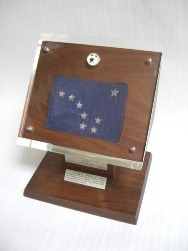
This Apollo 11 moon rock was given to the State of Alaska in 1969 by President Richard Nixon. Until recently, it was believed to have burned in a fire. (Photo courtesy Alaska State Museum)
From 1969 through 1972, NASA’s six Apollo missions returned to Earth with hundreds of pounds of moon dust. The Nixon White House mounted samples of the dust onto plaques and called them Goodwill Moon Rocks – given to all 50 states, hundreds of countries, and a few individuals. The moon rock Alaska received from the 1969 Apollo 11 mission ended up at the State Museum in Juneau, which loaned it out to other facilities until it went missing in the early ‘70s.
“I kinda figured we’re never going to find this moon rock,” says Elizabeth Riker, a University of Phoenix criminal justice graduate student from Detroit. As part of a class assignment she began investigating Alaska’s missing lunar fragments. Last August she wrote about it for the Capital City Weekly.
“I got quite a few emails from citizens in Alaska, asking me questions and saying they remember seeing the moon rock when they were in elementary school,” says Riker. “But obviously they all said this was back, late ‘60s, 1970, that time frame. But nobody had seen it since.”
So, what do moon rocks have to do with criminal justice? Riker’s professor, Joe Gutheinz is a retired Senior Special Agent with NASA’s Office of Inspector General.
“I would conduct criminal investigations and civil investigations impacting NASA,” says Gutheinz. “And in 1998, I went undercover in Operation Lunar Eclipse to recover the Honduras Goodwill Moon Rock.”
Gutheinz says there’s no shortage of missing moon rocks, so the investigation assignment is one he commonly gives to his students.
“About 160 moon rocks are missing that were given to the nations of the world,” he says. “And we’ve also determined that 18 Apollo 11 moon rocks given to the states and nine Apollo 17 Goodwill Moon Rocks given to the states are also missing. Lost, destroyed, or stolen.”
In December, a man named Coleman Anderson filed a lawsuit against the state seeking clear title to Alaska’s Apollo 11 moon rock. Anderson claims his step father was the curator of the State Transportation Museum in Anchorage when it was destroyed by arson in 1973. In the days after the fire, Anderson – 17 at the time – says he found the moon rock in a trash heap. Daniel Harris is Anderson’s Seattle-based attorney.
“The curator of the museum, basically signed off on him taking them,” Harris says. “And they sat in Coleman’s basement or wherever for about 30 years and then he read about somebody having sold moon rocks and he said, ‘Boy, maybe I have something of value here.'”
According to Harris, Anderson currently resides somewhere in the southern United States and hasn’t lived in Alaska for several years. But he was the captain of a Bering Sea crab vessel – even appearing in season one of the reality show Deadliest Catch.
On the black market moon rocks have been known to go for millions of dollars. So, if Anderson is awarded ownership, he could sell the Alaska rock for quite a bit of money. But Harris says his client is interested in cutting a deal with the state.
“We’re very open to ideas as to how a compromise could be reached,” Harris says.
The moon rock Anderson claims as his hasn’t been authenticated. Nevertheless, the state has filed a counterclaim against him charging that he trespassed and assumed ownership of state property without permission. In addition, the state is seeking return of the moon rock and its plaque, and damages for the years in which residents lost use of them. Bob Banghart is chief curator of the Alaska State Museum.
“I think that would be appropriate, if it turns out to be the real thing,” Banghart says of having Anderson return the moon rock. “It would be part of the mission for us. We don’t like to lose things, no matter how it occurs.”
Retired Special Agent Joe Gutheinz – now an attorney in private practice – agrees.
“And I’m not talking about the law. I’m talking about morality here,” Gutheinz says. “And my opinion: That moon rock was given to the children of Alaska.”
Remember that Honduras moon rock Gutheinz recovered in 1998? It was the subject of a 5-year court battle before a judge ordered it to be returned to the US government, which gave it back to Honduras. Whether Alaska gets its moon rock back remains to be seen.
The State of Alaska today (Friday) released thousands of pages of e-mails Sarah Palin sent and received during her time as governor. The national media descended on Juneau earlier this week in anticipation of the release, which comes nearly three years after the initial public records request. KTOO’s Casey Kelly has more.
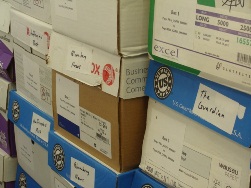
Boxes of former Governor Sarah Palin's emails sit in a Juneau office building waiting for the national and international press corp to pick them up. (Photo by Casey Kelly/KTOO)
Reporters, camera men and bloggers from nearly every major national news organization crammed into the third floor hallway of the Court Plaza Building – known in Juneau as the Spam Cam. About a dozen dollies lined the hall, piled five feet high with boxes of documents.
When the time came, Governor Sean Parnell’s Spokeswoman Sharon Leighow released them to the media.
“It’s all yours, let ‘er rip,” Leighow said.
Each set of six boxes contained more than 24-thousand pages of Palin’s e-mails. Leighow – who also worked for Palin – says the documents were culled from the state accounts of 55 current and former Alaska officials, whom Palin emailed using her private Yahoo account.
“Employees who had frequent communication with the governor. For instance, the lieutenant governor, the chief of staff, deputy chief of staff, her press people, special assistants.” said Leighow.
The state is charging $725 for a complete copy of the records to cover the cost of printing. Governor Parnell’s office will only make one public review copy available throughout the entire state. That frustrates Republican Activist and Palin critic Andree McLeod, who says the state should have made the records available electronically.
“It would have lowered the barriers of the access for information, which technology does. It democratizes information. But the Parnell administration has not caught up with that yet, and I don’t believe they’re interested in doing so,” McLeod said.
Some state lawmakers have ordered copies that will be available to the public in Anchorage, Fairbanks and Kenai. And many of the news organizations that paid for the documents have already posted them online.
MSNBC.com, working with a team of Juneau volunteers, has hired electronics investigation company Crivella West to sort through the records. Co-founder and CEO Arthur Crivella says within minutes of them being posted on the web, they’re sent to computers at the company’s headquarters in Pittsburgh. The computers then study the e-mails for language that may be interesting to Crivella’s trained researchers.
“Essentially we’re looking for personal language, we’re looking for emotional language,” says Crivella. “Where anybody in their administration is emotional about something, alarmed, the language of deception.”
MSNBC.com Investigative Reporter Bill Dedman admits the document dump could be complete waste of time. But he says someone has to vet Palin with her profile as a national political figure.
“Some of what we get out of public records like this is not some blockbuster scandal. I don’t think it’s about that at all,” said Dedman. “I do think that you get some sense of tone, of character.”
The documents were first requested in 2008 by news organizations following Palin’s vice presidential bid. Palin resigned in July 2009 after 966 days in office. It took 997 days to fulfill the records request.
Basketball is king in rural Alaska, and nowhere is that more evident than Juneau’s annual Gold Medal tournament now in its 65th year.
Organized by the Juneau Lions Club, the annual Spring Break competition brings together teams from all over Southeast – from Metlakatla in the south to Haines in the north. Over the years intense rivalries have formed between villages, as well as larger communities like Juneau and Sitka. But behind the rivalries, the players have genuine respect for each other.
Casey Kelly reports.
Ask a Gold Medal old timer who some of the best players in tournament history are, and you’re likely to get a rapid fire response.
“Guys like Scudero and Stigen, my brother Mike,” says Jim Jensen from Yakutat, who’s playing in his 41st Gold Medal tournament.
In case you missed it, the guys he mentioned were Jerry Scudero from Metlakatla, Greg Stigen from Haines, and Mike Jensen from Yakutat. All three have been inducted into the Gold Medal Hall of Fame. And for tournament fans, they might as well be Michael Jordan, Magic Johnson and Larry Bird.
“The only time we get to see a lot of these guys is here at Gold Medal,” says Jensen. “It’s just a great tournament. Myself, I think it’s the best in Alaska.”
Years ago, State Senator Albert Kookesh from Angoon was quoted as saying “Muslims go to Mecca, Tlingits to Gold Medal.” A 1993 inductee into the Gold Medal Hall of Fame, Kookesh played in the tournament for 29 years. Bad knees forced him to give up basketball a few years ago – a result, he jokes, of too much dunking the ball when he was a kid. But he still tries to go as many Gold Medal games as he can.
“People yelling, ‘Hoonah, Hoonah, Hoonah,’ or you know ‘Angoon’ or ‘Kake.’ I mean there’s just enthusiasm,” says Kookesh. “I’ve gone to a lot of tournaments in my life, but you don’t see the enthusiasm in the hall where you’re almost rocking the gymnasium off of its foundation when people get excited.”
Kookesh says his favorite tournament was 1983, when Angoon beat Klukwan to win its first championship. At the time he says it was unusual for two village teams to make it to the championship game, which was usually dominated by larger communities like Juneau and Sitka.
“We just had a group of young guys from our village and everything just clicked,” says Kookesh. “And we shot good and we played good defense and everything just worked.”
He says what he enjoyed most about playing in the tournament – and misses most now – is the competition.
“The rivalry is intense,” he says. “You don’t want to get beat by Yakutat if you’re from Angoon, and you don’t want to get beat by Hoonah if you’re from Kake.”
Of course, all good sports rivalries need crazy fans.
“I’m just rooting with the crowd right now,” shouts Tracey Turnbull of Juneau. “Go Yakutat!”
Turnbull has been to more than a dozen Gold Medal Tournaments, and says it has the best sports atmosphere in Alaska.
“It brings people from all over Southeast Alaska and families from different communities and friends, you know people play basketball together high school, and they just continue to play with each other and against each other,” she says.
Championship games for this year’s tournament will be played over the weekend, and Yakutat’s Jim Jensen says it may very well be his last Gold Medal. He’s not getting any younger, and after 41 years it’s harder to get up and down the court. Then again…
“I threatened to quit last year, because it’s just too hard on my body,” Jensen says. “But they start practicing and I show up, you know?”
Twenty-one teams in three different brackets are playing in this year’s Gold Medal Tournament.
Proceeds from ticket and merchandise sales go to the Juneau Lions Club’s scholarship program, as well as local charities. Each team also gets a little travel money.
Championship games for this year’s Gold Medal Tournament start at 4 p.m. Saturday. First up is the “M” or Master’s bracket game, followed at 6 p.m. by the “C” bracket game, and the “B” bracket championship at 8 p.m. All games are played in the Juneau Douglas High School gym.
Close
Update notification options
Subscribe to notifications
Subscribe
Get notifications about news related to the topics you care about. You can unsubscribe anytime.