Syndicated

Federal cuts could threaten ferry repairs

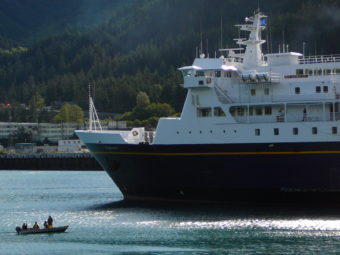
The ferry Lituya undergoes repairs at Ketchikan's shipyard. Photo by Ed Schoenfeld

The Alaska Marine Highway System could be another casualty of federal budget battles. Money used to repair and maintain the aging ferry fleet could become much tighter in the near future.

The small ferry LeConte needs renovated crew quarters, upgraded wiring and a new coat of paint – plus engine and other work. That’ll cost nearly $9 million.

The mainliner Columbia has to have new engines. That’s expected to run around $25 million. And the list goes on.

How does it get paid for? Alaska Marine Highway chief Mike Neussl says a lot of the money comes from the U.S. government.

“There is a real potential that our federal funding will decrease. And we will need to make that up somehow, either through state general funds or changing the amount of maintenance that we do or saving money someplace else,” he says.

Neussl says the state gets about $17.5 million each year from the Federal highway and transit agencies. A state match brings it up to about $22 million. Still other appropriations come our way from Washington, D.C.

Congress last month voted to extend highway funding, including marine highways, for another six months. And the program’s formulas, including ferry set-asides, will remain.

But that’s expected to change.

Alaska’s Congressional delegation is optimistic, but realistic.

“Anything that’s been subsidized by federal dollars is under a threat,” says Representative Don Young, a member of the House Committee on Transportation and Infrastructure.

He’s watching a ferry-funding bill being pushed by Washington state Congressman Rick Larsen. Young has cosponsored similar measures in the past.

“This time I didn’t because I want a better formula for Alaska. I’ve told him, ‘You put my formula in there that we had before, and I’ll be very supportive of it,’ ” Young says.

There’s also Senate ferry legislation.

Senators Lisa Murkowski and Mark Begich cosponsored the measure with Washington state’s Patty Murray.

“As one from the Pacific Northwest, she understands that ferries are not necessarily a luxury. This is not a cruise ship that you’re putting your car on. This is our transportation system,” Murkowski says.

Murray is in a good position to support ferry funding.

She chairs the transportation panel of the Senate Appropriations Committee, which assembles highway and ferry budgets. She also co-chairs Congress’ debt-reduction super-committee.

Begich says the ferry bill may not pass on its own. But it could advance marine transportation.

“Making sure we have a piece of legislation out there is critical so we create kind of a marker so when we get into the highway transportation bill, this is one of the items that needs to be discussed,” Begich says.

The Parnell administration is also watching for funding declines. But it’s not sounding the alarm.

“The boats will be safe and in good condition to run,” says Randy Ruaro, the governor’s deputy chief of staff. He says the state may have to chip in more. “In the last several years we’ve seen some supplemental requests for some maintenance and rehabilitation work. And I think the Legislature has approved those on each occasion.”

Less federal money would bring more legislative requests.

There’s about $16 million for ferry terminals in Kodiak and Prince Rupert, $4.5 million for emergency evacuation slides — and the list continues.

Advisory panel chimes in on transportation plan

The mainline ferry Kennicott pulls out of Whittier as fishermen watch. Ed Schoenfeld photo.

Alaska’s ferry advisory panel wants a few changes in Southeast’s transportation system.

The Marine Transportation Advisory Board met in Juneau Friday (Oct. 14,) to weigh in on the Southeast Alaska Transportation Plan. That document is being reworked, and options include dropping mainline vessels, ending cross-gulf and Bellingham service, and building more roads.

Panel members liked plans to continue developing a new line of short-distance ships. Robert Venables of Haines is the advisory board’s president.

“There seems to be good support for two Alaska Class vessels, with a third maybe on the far horizon, with one in upper Lynn Canal and one down in the Gateway concept, between Ketchikan and Prince Rupert,” Venables said.

New ships in northern and southern Southeast could leave other communities with less service. Board member Gerry Hope of Sitka called for continued use of long-distance, mainline vessels.

“There’s the Mal, the Mat, the Taku, as old as they are, and then the Tusty, that is in bad shape. We need to provide that class of ferries an opportunity to be replaced,” Hope said.

Marine Transportation Advisory Board
members backed replacing one mainliner. They also voiced support for continued sailings to Bellingham, Washington, and Southcentral Alaska.

They are also interested in roads that would shorten ferry routes. That includes one from Sitka across Baranof Island. But it does not specify a highway up Lynn Canal.

The advisory board wants to explore plans for a new terminal at the end of an existing road to Berners Bay, north of Juneau. That would shorten travel to Haines and Skagway.

But members worried about how walk-on passengers would get to the site, about 30 miles north of Juneau’s Auke Bay terminal.

City planner Ben Lyman said that would be difficult.

“There’s no way that we can have a fixed-route bus service that goes to the ferry terminal and turns around at every half-hour or every hour when the ferries are coming in at 2 in the morning or 6 in the morning and not when there’s any ferries there,” Lyman said.

The board’s official comments on the transportation plan will come in a letter drawn up based on discussion at the meeting.

Sealaska defaults on part of California casino land

Sealaska has lost some its California casino land to foreclosure. But the regional Native corporation says it won’t hinder the project.

Sealaska has been working for several years to build a hundred-million-dollar-plus hotel and casino project about 85 miles north of San Francisco. Its partner is the Cloverdale Rancheria, a Pomo Indian group.

It lost two acres to foreclosure this week. The corporation’s Rick Harris says it’s a small part of a 65-acre project. A recent study showed it was not needed.

“What we chose to do is try to negotiate a better price because the property wasn’t going to be used for casino property. The individual who owned it was not interested in any further discussion, so we felt that it was not necessary for the project. So we chose to let it go and it just goes through the normal structured foreclosure process,” Harris says.

Sealaska bought the two acres for $1.3 million, according to the Santa Rosa Press Democrat. The newspaper reports the corporation owed just under $1 million when it defaulted on the land and it reverted to the previous owner.

The Press Democrat, about 30 miles south of Cloverdale, has covered the casino extensively. Some residents strongly oppose the project, saying it would create too much traffic and change the town’s character.

Harris says any money lost in the foreclosure will ultimately be recovered.

” We did invest some initial purchase price on the property. But it’s included as part of the overall gaming project. And as Sealaska is repaid, we’ll cover our investment,” he says.

Sealaska’s 2010 financial report, issued earlier this year, shows gaming operations losing more than $7 million during the previous two years.

The same report also said the corporation moved to end some agreements with its tribal partners in Cloverdale. But Harris says the project continues.

“We have agreements with the tribe to go forward with how to secure the financing for the project. And based upon that financing, that will help chart the course for the future,” he says.

The corporation earlier invested about $15 million in a San Diego-area casino run by the San Pasqual Indian Band. It made a sizable profit from that investment.

13Foreclose AM/AM/AM/MID/PM

3-cut wrap, about 2:20 Schoenfeld, 10/13/11

Sealaska has lost some its California casino land to foreclosure. But the regional Native corporation says it won’t hinder the project.

Sealaska has been working for several years to build a hundred-million-dollar-plus hotel and casino project about 85 miles north of San Francisco. Its partner is the Cloverdale Rancheria (RANCH-ur-ee-ah), a Pomo (POE-moe) Indian group.

It lost two acres to foreclosure this (last) week. The corporation’s Rick Harris says it’s a small part of a 65-acre project. A recent study showed it was not needed.

13Foreclose, 22 seconds: What we chose to do is try to negotiate a better price because the property wasn’t going to be used for casino property. The individual who owned it was not interested in any further discussion, so we felt that it was not necessary for the project. So we chose to let it go and it just goes through the normal structured foreclosure process.

Sealaska bought the two acres for $1.3 million, according to the Santa Rosa Press Democrat. The newspaper reports the corporation owed just under $1 million when it defaulted on the land and it reverted to the previous owner.

The Press Democrat, about 30 miles south of Cloverdale, has covered the casino extensively. Some residents strongly oppose the project, saying it would create too much traffic and change the town’s character.

Harris says any money lost in the foreclosure will ultimately be recovered.

13Foreclose, 13 seconds: We did invest some initial purchase price on the property. But it’s included as part of the overall gaming project. And as Sealaska is repaid, we’ll cover our investment.

Sealaska’s 2010 financial report, issued earlier this year, shows gaming operations losing more than $7 million during the previous two years.

The same report also said the corporation moved to end some agreements with its tribal partners in Cloverdale. But Harris says the project continues.

13Foreclose, 10 seconds: We have agreements with the tribe to go forward with how to secure the financing for the project. And based upon that financing, that will help chart the course for the future.

The corporation earlier invested about $15 million in a San Diego-area casino run by the San Pasqual (PASS-kwall) Indian Band. It made a sizable profit from that investment.

###

Fast ferry builders, AMHS trade shots in dispute over engine problems

FVF Chenega in Prince William Sound. Photo by Ed Schoenfeld/CoastAlaska

The Alaska Marine Highway System says the engines being used in their two fast ferries are defective and builders of the ships knew it when they delivered the ships only six years ago. But the ferries’ builders say it’s not their fault, and they shouldn’t be obligated to replace the engines when the warranty doesn’t cover it.

Judge Philip Pallenberg enters the courtroom lugging a stack of files and documents easily a foot high. He’s about to get handed a few more accordian folders that will extend that by several more inches.

“I think the state fired the opening salvo in this naval battle,” said Pallenberg. “So, I think the state should go first.”

October 7th’s skirmish in Juneau Superior Court was over the engines installed in the state’s fast ferries Fairweather and Chenega, relatively new ships with diesel-powered jet drives that push the catamarans at a nice 32-knot clip. That’s about twice the speed of the ferry system’s standard mono hulls.

State attorney Dana Burke is leading the attack for the ferry system. But he runs out of time during oral arguments to carefully cite excerpts of contract documents and internal memos. Burke says manufacturers of the fast ferries knew the engines were defective, almost as soon as they were installed. He said they breached warranties that called for repairs and – if necessary – replacement of the engines. For both ships, all eight engines have been valued at $20 million.

“And we cannot wait,” said Burke. He said both the Fairweather and Chenega are in danger of being decertified from passenger service in the very near future.

Burke wants the ship and engine builders’ liability extended to the engines’ defects, especially when they admitted to using the wrong kind of coolant (that accelerated corrosion in the engines).

Burke said that MTU instructed the state to stop using Power Cool 3000 because it might degrade a layer of molybdenum in the crank case cylinder bores.

David McMahon representing Robert Derecktor Incorporated said the state was not entitled to any more rights after expiration of a standard year-and-a-half warranty.

“These two vessels have been operated on an uninterrupted basis since they went into operation,” said Burke.

But Derecktor Shipyard is only one of the parties in the state’s lawsuit. The state’s real target is MTU Friedrichshafen and MTU Detroit Diesel, the German company that built the engines and the American company that did the subsequent repairs.

Jon Dawson, who has already been prepared for a response, said they already have a potential repair of an interstitial ring that they’ve been trying to install.

“Scare mongering and hyperbole aside, the principle issue in this case involves only one component of these engines: the engine block,” said Dawson.

Dawson said there are clear factual issues at what caused the faster-than-expected deteroriation; instead of the coolant – perhaps the Alaska environment, improper maintanence by ferry crews, even excessive vibration caused by a misaligned installation by the shipyard.

“You can’t wave a wand and resolve this wear issue when you don’t know what’s causing it,” said Dawson.

Dawson also says the engine warranty was assigned to Derecktor – the general contractor, not the final buyer of the vessels, or in this case, the state ferry system. And it did not include replacement of the entire engine, beyond the engine block.

But the plantiffs always have the last word in any courtroom argument.

“Something’s wrong with these engines. They’re lemons,” said Burke. “These were defective beyond delivery and someone is responsible.”

October 7th’s hour-and-twenty minute oral arguments focused not on any factual disputes, but primarily arcane and esoteric interpretations of liability and warranty law. It will be sometime before Judge Philip Pallenberg issues an opinion.

Timber task force pushing for jobs

Alaska’s Timber Jobs Task Force is looking for ways to increase logging and milling employment. It recently held its fifth meeting in Coffman Cove, on Prince of Wales Island.

Governor Sean Parnell created the timber task force earlier this year after pulling out of the larger and more diverse Tongass Futures Roundtable.

One of the panel’s goals is to figure out ways to increase the amount of forest acreage that can be logged and milled.

Member Elaine Price, of Coffman Cove, is optimistic.

“There’s a market and there’s a demand, but getting a supply to create these jobs is a problem. And hopefully the governor will be able to do something about that,” Price says.

The panel met earlier this month in Price’s hometown.

State Forester Chris Maisch says members continued their examination of the realities of what’s left of the timber industry.

“We had a report on the U.S. Forest Service timber program as it exists under the 2008 Tongass Land Management Plan and some of the difficulties in terms of the amount of volume that’s being produced by the program – or the lack of it,” he says.

Timber task force members also heard about the Forest Service’s sale process.

They also expected to hear suggestions from the public, in person and through a teleconference link. But Maisch says no one testified.

“I think people haven’t had time to digest the first work products the group has put out. I expect that we’ll get more input as that becomes more widely known and available to people,” Maisch says.

The task force has already sent one background research report to the governor. It’s working on more, on available timber volume and products that can be manufactured from Alaska wood.

Maisch says the focus is on Southeast.

“But it is statewide in its charge and in different parts of the administrative order, the different tasks that are enumerated, address different parts of the state. But the majority of those tasks are focused on the Tongass,” he says.

He says the task force may recommend additions to the Southeast State Forest, established about two years ago. It also could suggest creating new state forests, which are largely managed for timber harvests.

Critics say the state and industry should have stayed in the Tongass Futures Roundtable. There, they could have continued meeting with environmentalists and other logging opponents, avoiding lawsuits and appeals that slow or block timber sales.

The governor’s office and others who withdrew say the roundtable wasn’t getting anywhere. Price, whose hometown is a former logging camp, hopes the task force will succeed.

“In Southeast Alaska we have some high unemployment in some of the rural communities. And the timber industry could solve some of that if there was a supply again,” Price says.

The next meeting is in December in Fairbanks. Members will look at woody-biomass projects in the Interior. The state Board of Forestry will meet around the same time and Maisch says he’s planning a joint session.

Hear earlier reports:

State forms timber panel, quits Tongass Roundtable

Tongass roundtable loses members from four towns

ANB, ANS adopt joint constitution

The Alaska Native Brotherhood and Sisterhood are becoming closer. The longtime Southeast advocacy groups voted last week to work under the same, updated constitution. Before, they were separate.

A year ago, the Alaska Native Brotherhood began revising its constitution and mission statement. They hadn’t been significantly changed for decades.

The updated version went before last week’s Grand Camp Convention in Klawock, on Prince of Wales Island. Delegates voted to approve the changes – and make them also apply to the Alaska Native Sisterhood.

“We’ve had two different constitutions, for ANB and ANS. So now this one governs both. They’re distinct bodies yet. They’re not merged,” says Dennis Demmert of Klawock, the new president of ANB’s Grand Camp, the Brotherhood’s regional organization.

“The way we do business will be pretty much the same. We’ll continue as two separate organizations, but we’ll have a single mission,” he says.

There was opposition, some of it strong.

But new Sisterhood Grand Camp President Mary Brown of Klawock says two-thirds of the delegates voted in favor.

“I feel that we are now working together as a whole and the only thing we can do from the last day of convention is to take each positive step forward to better the health, education and welfare of the people of Alaska,” Brown says.

Other changes brought the constitution and mission into the present. Demmert says some parts were outdated.

“In the earlier days there was interest because we didn’t have citizenship and we wanted citizenship. We did not have civil rights and we wanted that. And we wanted land. So those were things that were goals that have been accomplished,” Demmert says.

Earlier rules also restricted membership to Native people. The new document removes that requirement.

“A lot of non-Native people have been interested in what we’re doing. A lot of non-Native people have joined. The local camps have kind of ignored that provision, but the provision was there,” he says.

Leaders hope some of the changes will help broaden membership. James Williams of Klawock is ANB’s new Sergeant of Arms.

“We have to concentrate on how we’re going to reach our young generations to participate in this organization. Because they’re next in line, just like they told us when we were joining,” Williams says.

This year’s convention was the Brotherhood’s 99th, and focused on history. Next year it will be where the first camp, or chapter, set up shop.

“It’ll be in Sitka, and it’s going to be a very major celebration, given that we’re going into the next 100 years” says Ketchikan’s Richard Jackson, the previous ANB Grand Camp president. He didn’t run for re-election.

He says this year’s attendees heard about the organizations’ past from author Peter Metcalfe and history professor Stephen Haycox.

The Alaska Native Sisterhood formed a few years after the Brotherhood. But ANS President Mary Brown says it will be part of the ANB’s anniversary.

“As far as we’re concerned we’re one. It doesn’t matter what year we started up. But right from day one of the ANB, the sisters have been there and supported them 100 percent and we will continue to do so. We will celebrate the 100th year together,” she says.

Those at the meeting also expressed support for landless Natives, who live in communities without Native corporations. They also backed stronger subsistence rights and expressed concerns about the growing number of suicides.

The convention also recognized longtime leader Walter Soboleff, who died earlier this year at the age of 102. His position within the ANB was grand president emeritus. His successor has not been named.

Site notifications
Update notification options
Subscribe to notifications