Syndicated

Celebration of life for Pugh, Jr. set for Friday

A memorial service for John Pugh, Jr. will be held Friday in Juneau.

The son of University of Alaska Southeast Chancellor John Pugh and former state Corrections Commissioner Margaret Pugh died this week in scuba diving accident at the age of 35.

Pugh is also survived by his wife, Myra, and daughter, Sophia. A scholarship fund has been set up for Sophia. Donations can be sent to the University of Alaska Savings Plan or the UAS Chancellor’s office with a note indicating what the donation is for. The family suggests additional donations be made to Discovery Southeast.

John Pugh, Jr. graduated from the University of Oregon in 1998 with a degree in marine biology. He owned the Scuba Tank diving shop in Juneau and was involved in commercial dive fisheries in Southeast Alaska for many years. He died Monday while preparing for the sea cucumber fishery to open near Funter Bay on the westside of Admiralty Island.

Friday’s memorial service will be held at 4 p.m. at Northern Light United Church.

Salmon virus fears voiced, caution advised

Scientists and fishermen are following news of a deadly fish virus found in British Columbia salmon. It’s a scary situation, but it may not be as bad as it sounds, at least for now. And it’s not a threat to people who eat salmon.

Infectious salmon anemia
has badly damaged populations of farmed Atlantic salmon. So when scientists found the virus in a pair of wild, Pacific sockeyes, they were worried.

Should they be?

“It’s not a time to panic or overreact. I think some folks have been a little bit overly concerned about it,” says Ted Meyers, chief pathologist for Alaska’s Department of Fish and Game.

If confirmed, he says the virus, found in two central British Columbia fish, needs to be watched, and understood. That’s because it is a deadly disease that affects the blood and internal organs of salmon.

“Basically, they develop an anemia and they hemorrhage. And it can kill market-size fish,” he says.

The virus has badly damaged captive Atlantic stocks in Chile, Norway, Scotland and eastern Canada.

Pacific salmon are different, and Meyers says several thousand earlier tests by the British Columbia government showed no presence in wild fish.

But he warns this disease adapts.

“It’s possible that some of these viruses could mutate to potentially affect Pacific salmon. But that would probably occur under situations where there’s a selective pressure, like a hatchery situation or a pen farming situation or something of that nature,” Meyers says.

That’s what happened
to farmed Pacific cohos in Chile in the late 1990s. Infectious salmon anemia spread quickly through cohos raised in net-pens along with Atlantic salmon and rainbow trout.

“We shouldn’t underestimate the power of viruses,” says Dale Kelley, who heads up the Alaska Trollers Association.

The Juneau-based group is among commercial fishing organizations that want action.

“It’s a pretty scary situation for us all and we want to put it into context. We would like to continue to urge the Canadians and other fisheries professionals to make sure that they’re doing as much as fast as they can,” she says.

Some politicians agree. Alaska Senators Lisa Murkowski and Mark Begich have joined Washington Senator Maria Cantwell to ask Congress to require U.S. agencies to become involved. They want an emergency research effort to calculate how much of a threat the virus may pose.

Canadian officials have stepped up their interest. But they say they will decide on an action plan after they confirm identification of the virus.

Kelley says the initial diagnosis came from a lab that specializes in infectious salmon anemia. So, she asks, why wait?

“What we’ve seen out of Canada is a press release that says, if our tests, a few weeks down the road, come up with a finding of ISA, then we’ll be bring people together and then we’ll talk about what to do,” Kelley says. “It seems like there’s probably some information they could be gathering up, before winter hardens everything up, to at least give them a boost on sorting out the extent of the problem.”

Those concerned assume the virus came from Atlantic salmon in British Columbia fish farms. It appears to be the same European strain found in Norway and Scotland.

The fear is close quarters could quickly spread the illness, which could further spread it to wild stocks. Those fish could then carry the disease up the coast into Southeast, and other Alaska waters.

Other pathogens attack Pacific salmon, and some are widespread.

One, known as the IHN virus, also causes hemorrhaging and organ failure.

State pathologist Ted Meyers says it’s common in Alaska sockeyes. It’s adapted to live in Chinook, chums and steelhead down south. But in this state, it hasn’t crossed those boundaries.

“We’re always concerned about this virus potentially mutating and being able to affect other species. But so far our hatcheries have been following a sockeye salmon culture procedure, which really mitigates or reduces the risk from this virus,” Meyers says.

He says the hatchery procedure has been in place for close to 30 years and it’s been successful.

The salmon viruses pose no threat to people. But some fisheries advocates worry consumers won’t understand that, and word of the latest problem could hurt salmon sales.

Stone reappointed deputy commissioner

David Stone (Photo courtesy City and Borough of Juneau)

Juneau Deputy Mayor David Stone is back in his old job at the Alaska Department of Labor.

Commissioner Click Bishop today (Tuesday) renamed Stone deputy commissioner, a position he held prior to last fall’s state election. In December, Stone accepted a job as chief of staff for newly-elected Lieutenant Governor Mead Treadwell. He rejoined the Labor Department earlier this year as an assistant commissioner.

Greg Cashen – who had been executive director of the Alaska Workforce Investment Board – will take over Stone’s assistant commissioner job, Bishop announced.

Jeff Selvey is the new director of the Workforce Investment Board, which helps plan employment training programs in Alaska. Selvey is a longtime educator in Alaska, and previously worked as the board’s career and technical education coordinator.

Alaska ranks first among states for gun deaths

Alaska ranks first in the number of deaths caused by guns, according to 2008 data released by the CDC.

A corresponding analysis indicates the states with the highest rates also had the highest gun ownership. The Violence Policy Center in Washington, D.C. says those states have lax gun laws.

The CDC has been collecting data on violent deaths in Alaska since 2003, according to its website. The latest data available is from 2008. The CDC did its last survey of gun ownership by state in 2002.

Kristen Rand is the Legislative Director for the Violence Policy Center, which analyzed the CDC data.

“These numbers include all gun death categories which are homicide, suicide, and unintentional, so that would include the gun hunting accident, cleaning your gun accidents. So anyone who dies of a gunshot wound in the United States would be included in these numbers,” Rand says.

She says the 2008 numbers indicate that 60.6 percent of Alaskans owned guns, and 20 of every 100-thousand people died by gunshot.

Mississippi ranked second with 19 deaths by firearm per 100-thousand people, followed by Louisiana, Alabama, and Wyoming.

According to the Violence Policy Center, more than 30-thousand Americans die annually in gun suicides, homicides, and unintentional shootings.

Song of 1652

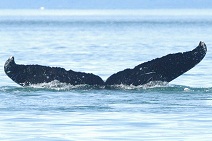
1652 - UAS Sitka Fluke ID Catalog

Biologists in Glacier Bay earlier this month recorded whale song that they believe came from one particular humpback, a male called 1652 that has not been observed singing before. He’s been identified as number 1652 because of his very distinctive fluke shape and markings (see picture right). Every summer since 2000, he’s believed to be one of 200 whales that now feed during the summer in Glacier Bay, before heading off for the winter breeding season in the warmer waters of Hawaii. Scientists say song is not usually observed or heard in Southeast Alaska. Vocalizations are usually in the form of simple contact or coordinating feeding behavior.

Whale biologist Chris Gabriele describes how they made the link to 1652 in this interview along with some of the sound of the recording.

We have more links that include the page where the National Park Service posted recordings of #1652, other sounds recorded in Glacier Bay, a Fluke ID Catalog of humpbacks in Glacier Bay, and another interview that Gabriele did a few years ago.

AWARE hopes CBJ backing will help secure shelter funds

AWARE’s effort to build a new extended stay shelter for victims of domestic violence and sexual assault could get a boost from the City and Borough of Juneau.

The CBJ Assembly Human Resources Committee last night (Monday) recommended the city partner with AWARE to apply for up to 850-thousand dollars in federal pass-through money for the project.

Since 2007, the Juneau nonprofit has been planning a six-unit residential shelter, with four 2-bedroom apartments and two efficiencies. Executive Director Saralyn Tabachnick says the facility would serve as transitional housing for women and families who utilize AWARE’s emergency shelter. “Transitional” meaning four months to two years.

“We say that we’re a 30 day program, and the reality is for people trying to find housing in Juneau, it’s very difficult no matter what your means are. So we often extend the 30 days,” says Tabachnick. “And it would be helpful to have transitional housing – some longer term safe shelter where they can continue to build stability and safety.”

If approved by the full assembly, the city would partner with AWARE to apply for a grant through the state’s Community Development Block Grant program.

The grant – combined funds already secured by the organization – would help AWARE complete planning and start construction, estimated at 3.5-million dollars.

Tabachnick says a long-term domestic violence shelter has been a need in Juneau and all of Southeast for as long as she can remember.

“This is a regional need. There is not a transitional housing facility for domestic violence survivors in all of Southeast Alaska,” Tabachnick says. “Our service area is Juneau and then nine northern communities in Southeast Alaska: Haines, Hoonah, Klukwan, Skagway, Gustavus, Elfin Cove, Pelican, Yakutat, and then Tenakee Springs.”

Community Development Block Grant applications are due in December 2nd. Proposals from around the state are judged by the Alaska Department of Commerce, Community and Economic Development, and funds will be awarded early next year.

Site notifications
Update notification options
Subscribe to notifications