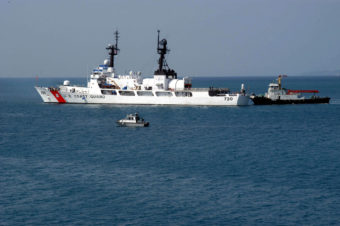
The U.S. Coast Guard Cutter Sherman (WHEC 720) leaves the White Beach Naval Facility, Okinawa in 2006. (Public domain photo by Senior Chief Journalist Melinda Larson)
The Coast Guard Cutter Sherman had to return to Dutch Harbor a few days early this week. The cutter and its crew were forced to turn back from a regular patrol in the Bering Sea when one of the ship’s diesel engines malfunctioned.
The vessel’s public affairs specialist Alex Oswald says the coast Guard Cutter Sherman has a long history. It was first launched in 1968. “So the ship’s very, very old.” Oswald is a Junior Officer on board. “It’s actually on its way out. This class of ship is call the legend class cutters and they’re in the process of being replaced. This one is one of the last ones t be decommissioned.”
The Sherman has two turbines and two main diesel engines. Oswald says one of those engines failed. “I can’t disclose the specifics of what happened, but basically we just had a problem with the engine. We couldn’t get it to work the way we wanted it to, so we shut it don completely and we were just operating on one engine, so we had to come into port to fix the problem.”
Oswald says equipment was shipped into Dutch Harbor as part of the repair work. He wasn’t able to say if some of that work was contracted locally.
The Sherman is home-ported in San Diego. In 2001, it became the first Coast Guard cutter to circumnavigate the globe. The ship and its crew are in Alaska this summer to enforce fisheries regulations and provide search and rescue support. They are slated to depart again Monday.
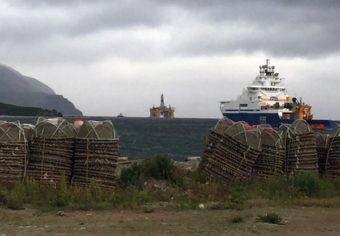
The Polar Pioneer drill rig arrives in Dutch Harbor. (Photo by Emily Schwing, KUCB/Unalaska)
Billions of dollars worth of drilling equipment and support vessels operated by Royal Dutch Shell are sitting out in the Bay in front of Dutch Harbor this week. The company has plans to take most of that equipment north for exploratory drilling operations later this summer. Many of the local businesses are benefiting from the oil giant’s presence.
Dutch Harbor is a busy place this time of year.
“The flights are all full, the hotel is full, vehicles – trucks for rent – companies that rent vehicles – they’re all rented,” says City Mayor Shirley Marquardt.
Marquardt says the bustle isn’t unusual. She compares it to the uptick in business the community last saw when the pollock fishery took off in the 1980s and 90s.
“… And you had the big at-sea processor fleet show up, these big boats participating in this massive fishery and they’re all coming into town and said ‘we need everything,’” Marquardt says.
But this year, much of that business can be attributed to oil giant, Shell. Over the next two years, Dutch Harbor will serve as a logistics hub as the company carries out its exploratory drilling plans further north in the Chukchi and Beaufort Seas.
Spokeswoman Megan Baldino says 15 company personnel have been in Dutch Harbor for at least the last two weeks. Now that one of the company’s drill rigs is moored in the bay just out front of town, Baldino says up to 35 people will arrive daily.
“On any given day the numbers could be lower or higher,” Baldino says.
Because flights to and from the island are limited, the company has chartered flights with Anchorage-based Ravn Alaska. Charlotte Siegreen is Ravn’s spokeswoman.
“It’s usually around one or two a day for the next couple of weeks,” Siegreen says.
Currently, only one commercial carrier provides regular service into Dutch Harbor. Siegreen says it’s not yet clear if Ravn will also consider regularly scheduled flights after its contract with Shell ends.
“We don’t have an immediate plans to make any scheduled service changes, but we’re always looking. I can say that,” Siegreen says.
With the influx of so many people, Shell has booked a block of rooms at the Grand Aleutian Hotel.
Lori Smith is the General Manger of Hospitality for Unisea, the seafood producer that owns two hotels in town. She says the oil company has been careful to relinquish rooms it is not using to free up space in a community where temporary housing is extremely limited. Marquardt says her administration has worked closely with Shell on that issue.
“We’ve been very up front and very honest with Shell from day one,” Marquardt says. “If people are going to live here full time, if (they’re) not going to hire people who live here to do the work, do not come into town and jack up prices and kick people out of their homes.”
Marquardt says so far, housing prices have remained stable. She says it’s she doesn’t know how the job market might change.
“It’s too early to tell,” She says. “When they were here the last time they did hire a lot of local folks for security and logistics and running around.”
Baldino says Shell hasn’t yet made any direct local hires, but they have contracted with a number of local businesses.
“Thee are some areas where we bring in people who we have trained to really specific competency requirements, but in the future there are plans to train and utilize local staffing so we can meet those needs locally,” she says.
The city doesn’t have a system to attribute tax revenue directly to the oil company’s presence, but city officials say they expect an uptick in revenue collected from both bed and fuel taxes.
The Polar Pioneer drill rig arrives in Dutch Harbor. (Photo by Emily Schwing, KUCB/Unalaska)
The Transocean Polar Pioneer, a drill rig contracted by Royal Dutch Shell, has arrived in Dutch Harbor. The oil company plans to use the port as a hub this summer as part of their exploratory Arctic drilling effort.
There’s very little opposition in the tiny Alaskan town in comparison to that in Seattle, where some environmental activists went so far as to chain themselves to one of Shell’s Arctic drilling support vessels last month.
When the Polar Pioneer left Seattle, hundreds of protestors turned out in kayaks. They waved signs and tried to keep the drill rig from departing. But when it arrived nearly two weeks later in Dutch Harbor, a tiny fishing outpost in the middle of Alaska’s Aleutian Chain, it was greeted only by a brisk, nighttime wind.
There are no anti-Arctic drilling signs, no banners, and no protestors in kayaks. Mayor Shirley Marquardt says that’s for good reason.
“You know down in Seattle, there’s harbor boats and rescue boats and people to pull you out of the water all over the place,” Marquardt said. “You don’t have that here. And the water is tremendously brutally cold even in the summer and it doesn’t take much.”
The real reason no one is out protesting is because most people here are working either on fishing boats, or at one of the local fish processors. More fish come through Dutch Harbor than any other port in the nation.
People also work a myriad of other jobs outside of fishing from construction to security.
“We’ve always had a healthy, wealthy place to live because we depend on the sea,” Susie Golodoff said. She has lived here for 40 years. She teaches at the school and fishes with a gillnet right out her front door. The resident naturalist in town, she’s the person everyone asks when they want to identify a bird or a plant. She’s not quite sure why her neighbors aren’t more concerned about the oil rig or Shell’s summer plans.
“I’m kind of baffled to tell you the truth. I think part of it is that we’re kind of short term community with people from other places and people just think as far up as their as their next catch delivery, so there’s just a little bit of a disconnect maybe,” Golodoff said.
Currently, giant boats are at sea harvesting pollock, the kind of fish that’s eventually processed into things like fish sticks. Smaller vessels are out targeting species like halibut, and Dungeness crab for fine dining. Trucks are driving to and fro, filled with gravel and construction crews are furiously working on countless projects.
The sight of a giant yellow and blue drill rig towering over emerald green islands and squat gray buildings isn’t new in Dutch Harbor. In 2012, the company brought a different rig here and then sailed it nearly 1,000 miles north to the Chukchi Sea. That mission ended in near disaster when it ran aground.
But no one is talking about that accident or the possibility of something worse. James Buskirk is the captain of the fishing vessel Destination. He was among a number of people running quick errands at the local grocery and supply store.
“Well, geographically the Chukchi Sea is a long way from the eastern Bering sea where we do all of our fishing,” Buskirk said. “So no, I don’t have any direct concerns. The possibility of an accident is always there whether they’re drilling on land or under water.”
Mayor Shirley Marquardt understands the worst-case scenario, and she and other local officials have met with Shell a handful of times to discuss safety and logistics.
“So, we’ve been able to kind of talk to Shell and their folks and say, ‘You know, we’ve seen this happen before and it didn’t work out so well,’” Marquardt said.
Shell is still awaiting federal approval before it can send the Polar Pioneer and its support vessels nearly 1,000 miles north through the Bering Strait. Until then, the rig is moored just outside the local port as fishing boats chug past to offload their catch and head back to sea for another round.
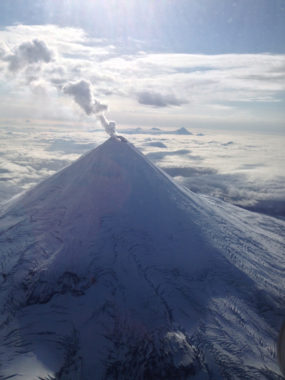
Shishaldin Volcano with a typical steam plume, pictured on Sept. 14, 2013. (Photo by Joseph Korpiewski/U.S. Coast Guard)
Two volcanoes in the Aleutian chain have been showing signs of activity for years, but recent satellite images prompted the Alaska Volcano Observatory to raise its alert level and aviation color code.
Satellite imagery shows elevated surface temperatures in the summit crater at Cleveland Volcano, roughly 140 miles west of Dutch Harbor. John Power is the Scientist in Charge at the Alaska Volcano Observatory.
“So, we’re seeing warm ground, increased thermal activity at the summit. Some of the radar images that we have suggest that new lava has been extruded forming a small lava dome in the volcano summit crater.”
Scientists at the AVO have raised the alert level for Cleveland to ‘advisory.’ The aviation color code has also been set to yellow.
“We have heightened the alert levels at Cleveland so that folks are aware that there is the possibility of increased hazards associated with any eruptive activity that might occur beyond what’s apparently already gone on.”
Cleveland volcano has been extremely active for the past decade. Power says it’s one of the most active volcanoes in the Aleutian Chain. But the majority of that activity has come in the way of small, long-term, low-level eruptions.
A similar scenario is playing out roughly 125 miles to the east of Dutch Harbor at Mt. Shishaldin.
“What we see there is Shishaldin has a very deep summit crater and down in the bottom there’s activity going on. We see increased temperatures again in satellite imagery and we believe that there’s active magma pooling deep inside that summit crater.”
Shishaldin is the tallest volcano in the Aleutians, towering more than 9000 feet above sea level. The alert level there is currently set to ‘watch.’ The aviation color code is orange. Power says the volcano occasional emits small amounts of ash. He says Shishaldin has been in a low-level state of eruption for over a year.
Despite the recent increase in activity, Power says there’s no indication of any major eruptions from any of the volcanic centers throughout the Aleutian Chain.
This symmetrical, 1,730-m (5,676 ft)-high stratovolcano has been the site of numerous eruptions in the last two centuries. (Photo courtesy of USGS)
The Cleveland volcano in the east central Aleutians is showing signs of heating up. The Alaska Volcano Observatory reports that increased surface temperatures and ash indicate the volcano has entered a period of unrest. According to the release, the alert level for Cleveland was bumped up to advisory, meaning the possibility of explosions has increased.
The Cleveland volcano is located on the uninhabited Chuginadak Island about 45 miles west of the community of Nikolski. Its last major eruption was in 2001 and it has been active intermittently since then.
Aleutian sockeye has found a new niche market through the organic food delivery company Full Circle Farms.
Full Circle’s main business is sending out boxes of organic fruits and vegetables to its customers in California and the Pacific Northwest. In recent years they’ve added a selection of other groceries. And now, for $9.35 per 6 to 8-ounce fillet, Full Circle subscribers can get Aleutian sockeye salmon in their weekly box.
‘Aleutia’ is a non-profit, community-based brand of sockeye harvested by some 30 fishermen around the eastern Aleutians and western Alaska Peninsula. It was started back in 2001 by a group of fishing families hoping to get better prices. One of those fishermen, Aleutia’s Vice President Danny Cumberlidge, says the organization has always emphasized quality rather than quantity.
“We were some of the first to start with slush ice… we started the live bleeding, the slush ice, any capacity under 1000 pounds,” he says.
Cumberlidge says icing the fish and treating each one with care makes for a higher-quality product, and his market seems to agree. Last year Aleutia reached out to Full Circle Farms’ product manager Debra Dubief. She says gets phone calls from people wanting to sell their products all the time.
“After speaking with people from Aleutia, I loved their story but I said, ‘the thing is, it has to be an amazing product, like all of our products have to be.’ She sent me a few samples, we all tasted it, it was wonderful, taken care of pristinely, some of the best frozen salmon I’ve ever had,” Dubief says.
Its second major selling point for Full Circle was convenience. Dubief says Aleutia salmon arrives frozen, so customers don’t have to cook it up that same night. And it comes in individual portion sizes.
“Aleutia does a really good job of portioning to our size needs, and that’s something that’s unique to FCF … we can’t sell fish by the pound, we need to sell it by the unit. So they cut everything to our specifications, wrap it perfectly, it’s a beautiful product,” Dubief says.
And when a customer unwraps that fillet, Full Circle hopes they’ll think about the story behind it.
“We aren’t making a lot of money on this, we’re giving it back to the community. That’s our structure. We are not a cannery. We’re a niche market, high-quality organization,” Cumberlidge says. “If we get a little better price, we give that back to our fishermen.”
Full Circle says their customers want to know that their food is good, not only for their health, but good for the land and sea and the people who produce it. And that, says Cumberlidge, lines up with Aleutia’s mission.
“The biggest thing I think it does is it puts more pride back into the community and the fisherman,” Cumberlidge says. “When I started fishing at eight years old you were proud to be a fisherman. You know, we’re instilling more of that pride back into the young people that, hey, I do a good thing, I feed the world.”
Close
Update notification options
Subscribe to notifications
Subscribe
Get notifications about news related to the topics you care about. You can unsubscribe anytime.