Aleutians

Hong Kong to LA flight diverts to Aleutian island

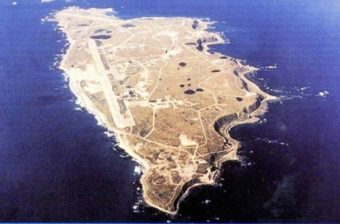
Eareckson Air Station, on Shemya Island. (Public Domain photo by U.S. Air Force)

Update 12:10 p.m.

A Cathay Pacific flight from Hong Kong to Los Angeles made an emergency landing at an Aleutian Islands military airport early Wednesday morning due to smoke inside the plane.

Ian Gregor, a spokesman with the Pacific Division of the Federal Aviation Administration, says Flight 884 “declared an emergency and diverted to Eareckson Air Station in Shemya,” at the far western edge of the Aleutian chain.

Airlines officials described the emergency as “smoke detected in the aircraft.”

A Cathay Pacific Boeing 777-300ER landing at Hong Kong International Airport. (Creative Commons photo by Aero Icarus)

The Boeing 777, which was carrying 276 passengers and 18 crew, landed without incident around 3:30 a.m. AKST, says Cathay Pacific spokeswoman Jennifer Pearson.

Air Force Col. Frank Flores — the regional commander for Eareckson and 20 other installations in the Pacific and Alaska — says the air station has a single 10,000-foot long asphalt runway with a modern instrument landing system.

“And it can handle a (Boeing 777); it can handle our larger aircraft. It was built up in the 40s to handle bomber and reconnaissance aircraft, and we’ve maintained it primarily as a divert runaway,” Flores says.

Old aircraft revetments, buildings and two other runways on the island date back to World War II and are mostly abandoned. An operational crew of about 120 people contracted through the Air Force was on the ground to handle the emergency landing. Flores says planes land at the base every day or so.

“We have a contingent of people who will respond to any aircraft arrival … (that) requires us to mobilize firefighters, airfield mangers and airfield personnel … (or) receive passengers and cargo,” Flores says. “When this airplane came in, an announcement was put over the net and all those people assembled in the airfield just like they would for any other arrival.”

Though it’s still unclear what grounded the flight beyond the smoke in the aircraft, Flores says the plane appears to have been “fixed” and could be in the air by noon Wednesday.

When it does leave Shemya, the airline says the plane will fly to Anchorage where another Cathay Pacific plane will take passengers to Los Angeles.

The Cathay Pacific flight is operated jointly with American Airlines and South America’s LAN Airlines.

Original story:

A Cathay Pacific flight traveling from Hong Kong to Los Angeles early Wednesday morning made an emergency landing at an Aleutian Islands military airport.

Airline officials say smoke detected in the aircraft caused Flight 884 to divert to the Eareckson Air Station on the island of Shemya Wednesday  around 5:30 a.m. AKST

Officials say as of 7 o’clock this morning the Boeing 777 aircraft was safely on the ground and all passengers and crew were safe.

Messages to Eareckson Air Station—under control of the U.S. Air Force—have not been returned as of this morning.

The airline says preliminary information shows that 276 passengers and 18 crew were onboard the plane. The flight was operated jointly with American Airlines and South America’s LAN Airlines.

Dead fish, wildlife in Aleutians may be victims of toxic algae outbreak

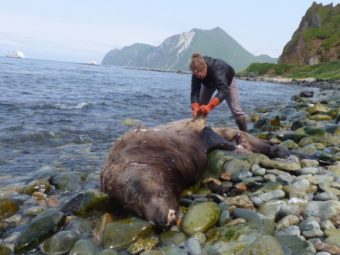
Melissa Good with UAF Alaska Sea Grant collects a sample from a Steller’s sea lion carcass by Unalaska’s Summer Bay. (Photo by John Ryan/KUCB)

Scientists have been receiving reports of dead and dying mammals, birds and small fish in the Aleutian Islands.  They think the killer might be toxic algae proliferating in unusually warm ocean waters.

“All the signs are that we’re having a major harmful algal bloom event,” Bruce Wright with the Aleutian Pribilof Islands Association said.

Wright said it could be the algae that cause paralytic shellfish poisoning; the algae that generate domoic acid are another possible culprit.

Melissa Good with University of Alaska Fairbanks has been looking for the microscopic green suspects around Unalaska.

“They’re a suspected cause for some of the mass deaths we’ve been seeing–the 10 fin whales that were spotted dead off of Kodiak Island; I know Adak has seen a lot of dead birds, King Cove, I believe [birds in] False Pass have been washing up. We don’t know the cause of that yet either,” Good said. “In the past, we’ve seen incidences where sand lance, a little plankton-eating fish, was accumulating these high toxins from these algae in their system. The birds were eating sand lance, these small forage fish, and were dying. No one that I know of is sure what happened.”

This week, Good has been taking water samples around Unalaska and shipping them off to labs for full analysis. Even just looking in her microscope on the desk in her office on Thursday, she found large numbers of the domoic acid algae in one of her recent water samples.

She’s also sampled the stomach and flesh of a Steller’s sea lion that washed up dead recently on Unalaska’s Summer Bay, north of the town landfill.

“I didn’t see anything external that looked like a cause of death.  Sometimes, there’s gunshot wounds, ship strikes. Those things can be very obvious,” she said after looking over the 10-foot carcass on Thursday.

She thinks toxic algae might have killed this sea lion. One that washed up dead last year near here had very high levels of PSP.

In addition to the stomach, scientists sometimes study fluids in the eye for algal toxins and the whiskers. But eagles had already gotten to the eyes, and someone, Good presumed an Alaska Native with permission to use part of the protected species for materials to decorate a traditional bentwood hat, had removed the whiskers.

Melissa Good with UAF Alaska Sea Grant points out domoic acid-generating “pseudo nitzschia” algae. (Photo by John Ryan/KUCB)

Standing next to the fresh carcass, Good said people in the Aleutians should be wary of eating clams or mussels right now.

“We just don’t know if they’re going to be toxic or not,” she said. “You’re taking a lot of risks there.”

Unlike bivalves (such as mussels and clams), crabs don’t retain the toxins in their meat, but in their digestive tracts. Scientists warn people to remove the dark viscera from crab before cooking it.

Shellfish in King Cove and False Pass recently have tested for twice the level of toxins that the U.S. Food and Drug Administration says is safe.

Potentially harmful algae are always present in seawater, but it’s only when they bloom into dense concentrations that they can cause much harm to the things that eat them.
One of the largest harmful algal blooms ever recorded has been taking place this year from California up through British Columbia.  Officials in three states have closed beaches to razor clamming and other types of shellfish harvesting.

Researchers think the West Coast bloom, and recent events in Alaska, are related to unusually warm water temperatures.

“We are seeing large blooms throughout Alaska, of different species,” Good said. “When you get warmer water temperatures, they became more prolific, they bloom. You’re getting a high concentration of algae.”

Good says paralytic shellfish poisoning appears to be getting more common in the Aleutians due to increasing water temperatures.

She’s waiting for results on her samples for more conclusive answers. She and Bruce Wright both ask anyone noticing sick or dead predators in the Aleutians to report them. And if you see dead sand lance fish, put a half dozen in a zip-lock bag, freeze it and send it to them.

Explosion shakes Aleutians’ Cleveland Volcano

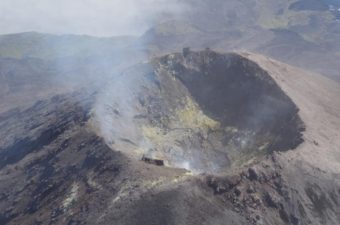
Crater of Cleveland Volcano in July 2014. Pavel Izbekov, Alaska Volcano Observatory / University of Alaska Fairbanks photo.

An explosion shook Cleveland Volcano in the east-central Aleutian Islands at 8:17 a.m. Tuesday morning.

It’s the volcano’s first explosion since November.

Kristi Wallace with the Alaska Volcano Observatory in Anchorage called it “a small, discrete, short-duration event.”

“We aren’t certain whether or not a significant ash cloud was produced, likely not, mostly because it was short duration,” she said.

Clouds blocked the satellite view of the volcano Tuesday morning, and scientists haven’t received any reports from local pilots yet.
Grant Aviation said its flights in the area have been grounded because of fog.

The National Weather Service has put out an alert on the possibility of an ash cloud heading to the north and east, likely below 20,000 feet altitude.

The Alaska Volcano Observatory has raised the alert level for the volcano from yellow to orange, meaning an eruption is underway with only minor ash emissions.

“This is pretty common for this volcano,” Wallace said. “Typically, you have one explosion and maybe nothing for months. Sometimes we have maybe a couple over a week-long period. So we’ll just wait and see.”

Since its last major eruption in 2001, Cleveland Volcano has been active occasionally, with small lava flows and ash clouds generally staying below 20,000 feet. Eruptions in 2001 sent ash clouds, which can threaten airplanes that encounter them, as high as 39,000 feet above sea level.

Cleveland Volcano is on uninhabited Chuginadak Island, about 45 miles west of the village of Nikolski, 150 miles southwest of Unalaska and 940 miles southwest of Anchorage.

The volcanic cone towers 5,676 feet above the Bering Sea.

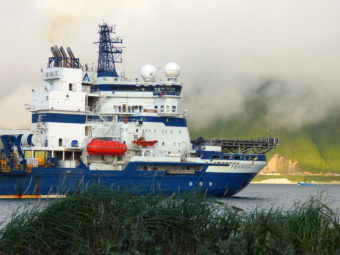
Shell ship Fennica heads to Oregon for repairs

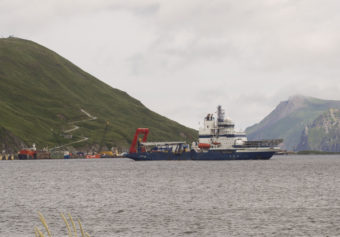
The Fennica leaving Dutch Harbor for Oregon on Sunday. (Photo by Pipa Escalante/KUCB)

A key ship in Shell Oil’s Arctic drilling fleet left Alaska on Sunday.

The icebreaker is headed south to Oregon for repairs after a three-foot gash was discovered in its hull.

The icebreaker, called the Fennica, hit an uncharted rock as it was leaving Dutch Harbor for the Chukchi Sea.

It had to return to port for temporary repairs. That was two weeks ago.

Now, the Fennica is making a week-long journey to Portland, Oregon, for a more permanent fix.

Shell wouldn’t say how long those repairs could take.

The company can only drill during the brief Arctic summer, and it cannot drill for oil without an oil well capping device that’s on board the Fennica.

Two Shell oil rigs are already on their way to the drill site in the Chukchi Sea.

U.S. officials have not said whether the missing icebreaker will influence their decision on two final permits that Shell needs to begin drilling.

Shell finds fracture in hull of icebreaker

MV Fennica. (Photo courtesy of Shell)

An icebreaker leased to Shell had to return to Dutch Harbor early Friday morning after its hull was found to have a rupture. The MV Fennica carries the company’s capping stack — a critical piece of safety equipment for Shell’s plan to drill two wells this summer in the Chukchi Sea.

Coast Guard spokesman Shawn Eggert says the ship’s crew noticed the problem around 3 a.m.

“The Motor Vessel Fennica was departing from the port of Dutch Harbor, Alaska when the crew discovered that they had water coming in to their Port No. 4 ballast tank. At that point they returned to port and tied up at the Delta Western dock,” he said. “Divers there discovered a one-inch wide by three foot long fracture in the ship’s hull.”

Eggert says the Coast Guard has begun an investigation into the cause and will examine Shell’s proposal to repair the ship. The spokesman says a marine pilot, an expert in local navigation who maneuvers a vessel as it leaves or enters a port, was on board at the time the breach was discovered.

A Shell spokesman, in an email, describes it as a “small breach.” He says the vessel was in charted waters at the time. Whether the damage will delay Shell’s plans for the already short Arctic drilling season is unclear. The spokesman says that will depend on the extent of the required repairs.

If the final permits for the Chukchi operation are approved, the government would require Shell to have the Fennica nearby, with the capping stack ready to deploy within 24 hours of a blowout. The Fennica is a 380-foot Finnish-owned multipurpose icebreaker. Shell is also leasing its sister ship, the Nordica, for ice management.

If Shell is able to return to the Chukchi, it will be the first time since its 2012 season, which was plagued with shipping and towing problems.

Caribou emigrate from Adak; feds struggle to stop the spread

Caribou on Adak in 1985. (Credit: USFWS)

Every summer, a team of federal exterminators set up shop in the southwest corner of the state. Their job is to root out non-native animals that might disturb the Alaska Maritime Wildlife Refuge.

In addition to the usual rats and foxes, the refuge managers decided to target a new pest this season.

It’s no mystery how caribou wound up on Adak Island. They were imported in the late 1950s so Navy personnel would have something to hunt.

Nowadays, the Navy is gone and the island is a prime spot for big game hunters. But not enough of them, says Steve Ebbert.

He’s a wildlife biologist for the Alaska Maritime National Wildlife Refuge. As he stands on the deck of their research vessel, sailing less than a half mile from the rocky shores of Adak, Ebbert says the caribou herd is now seven times its former size. And it’s starting to spread.

Ebbert points to a gently sloping beach just across the way on Kagalaska Island.

It’s not clear when the caribou started to swim across the channel to Kagalaska. But Ebbert thinks he knows why. The island is still covered in thick, white lichen — the same plant that used to grow naturally on Adak.

If the caribou are willing to travel for food, Ebbert says they probably won’t stop at Kagalaska when there even more islands to graze on nearby — all federally protected, refuge land.

After an environmental assessment, the U.S. Fish and Wildlife Service decided the best way to prevent that outcome was to organize a hunt on Kagalaska.

The team bagged nine male caribou. But Sen. Lisa Murkowski isn’t impressed with their haul.

The hunt cost $58,000, plus another $13,000 to butcher and salvage the meat. That part was specifically requested by Murkowski and other officials. But going forward, the senator wants to see a different approach.

The Senate Appropriations committee recently (on June 18) approved a new rule that would keep the refuge from using federal money to sponsor more caribou hunts at Kagalaska.

A similar ban would apply to two other islands, where wild cows have escaped from old ranches. Murkowski and her colleagues also suggest a $2 million cut in funding the Fish and Wildlife Service but a million-dollar bump for the refuge system’s budget. The entire package has been sent to the full Senate for consideration.

Elaine Smiloff has lived and hunted on Adak Island for years. She had her own doubts about trying to control the spread of caribou.

But Smiloff also says that this year, it got harder for local hunters to track down caribou in their own backyard. Without a boat — which most residents don’t have — their options seemed to shrink.

Usually, Kagalaska wouldn’t be one of them.

That’s one reason why Smiloff jumped at the chance to help federal hunters move huge slabs of meat off that island. More than a half-ton was distributed to local families.

Smiloff would be glad to help get more. But wildlife managers haven’t decided if they’ll try to conduct another hunt before the Senate takes action on the proposal to shut it down.

For now, the Alaska Maritime refuge is more focused on finding out if the first big control effort was a success.

They may have a chance to investigate in August, when refuge staff are scheduled to sail past Kagalaska aboard their research vessel.

Eventually, Steve Ebbert says he wants to find a method for tracking the number of caribou that reach the island. First, he’d have to mark them — with paintballs, or by branding.

But then again:

“You’re capturing the animals, drugging the animals in the case of branding, and marking them permanently — and just releasing them? It doesn’t seem as efficient. If you can shoot them with a dart, you can shoot them with a rifle,” Ebbert says.

The biologist says he wouldn’t call that hunting — more like counting. By elimination.

Site notifications
Update notification options
Subscribe to notifications