Aleutians

Aleutians monument labeled threat, derided as ‘straw man’

Alaska Rep. Don Young oversees a Thursday House Committee on Indian and Alaska Native Affairs hearing on Sealaska land-selection legislation. Image courtesy the committee.
Rep. Don Young. (KTOO file photo)

Alaska Congressman Don Young and other Republicans on the House Natural Resources Committee Tuesday morning attacked the idea that President Obama might create a marine national monument around the Aleutian Islands, with unknown effects on the fishing industry. But the administration has given no sign it’s considering the notion.

At a subcommittee hearing, Congressman Young said a marine national monument around the Aleutians would be terrible for the fishing industry.

“I’ve watched this over and over: The creeping cancer of the federal government overreaching,” Young said. “The worst managers of any resource is the federal government. They do not manage. They preclude.”

The idea of protecting the waters of the Aleutian Chain came from environmentalist and retired UAA professor Rick Steiner. Last year, he proposed a massive marine sanctuary, covering all the federal waters of Bristol Bay and thousands of miles of the Bering Sea. The National Oceanic and Atmospheric Administration killed the idea, saying it lacked local support. That seemed to be the end of it, except that Steiner launched an online petition telling President Obama he should create an Aleutian national monument instead. (Under the Antiquities Act, the president can just declare a monument on his own.) Steiner’s plea to Obama, on thepetitionsite.com, has attracted more than 100,000 supporters, many from foreign countries. Steiner was not invited to the hearing to defend his idea.

Chris Oliver, director of the North Pacific Fisheries Management Council, was an invited witness. He says his council is doing a great job preserving Bering Sea resources, including fish habitat, in part by closing vast areas to fishing.

“We have 1.3 million square nautical miles that we manage,” he told the panel, “and two-thirds of that area, about 665,000 square miles of it, is closed to all or most fishing activities.”

The top Democrat on the Water, Power and Oceans Subcommittee, Jared Huffman of California, says the fist-shaking and the mobilized defense are unnecessary.

“We do a lot of straw-man chasing here in the committee,” Huffman said. “We will hear rumors and sometimes even concoct threats towards industries and then have entire hearings that are about knocking down those straw men.”

Huffman then turned to the only Administration witness, Holly Bamford, an acting assistant secretary at the National Oceanic and Atmospheric Administration.

Huffman: To your knowledge, is the Administration considering a national monument designation in the Aleutians?

Bamford: I have not been part of those discussions. To my knowledge, no.

Huffman: And I’ve seen no evidence of it either, but it’s one of many (politically) useful straw men that we see.

It’s not clear that a marine monument would be closed to commercial fishing. Bamford says that would depend on the management plan.

The president’s power to protect areas of land and water by declaring them National Monuments disturbs the Alaska delegation to Congress. All three lawmakers have proposed bills to curtail that authority. One by Young would ban any marine national monument off Alaska’s shores.

At the hearing, Young denied the threat to the Aleutians is a political figment and predicted the administration will declare monument status for the area.

“They say it’s a straw man. Baloney,” Young said. “I know when they propose something it’s going to be attempted by.”

Asked about the president’s intentions for the Aleutians, a White House spokeswoman said she has no announcements to make at this time.

As for Steiner, he still says Alaska’s federal waters deserve some form of permanent protection, but he got no response from the White House to his petition. He says he did meet with one Administration official this spring who advised him not to expect anything so bold.

“But we remain hopeful they may reconsider,” Steiner said by email.


Aleutian Islands’ ancient villages, volcanoes slowly reveal their secrets

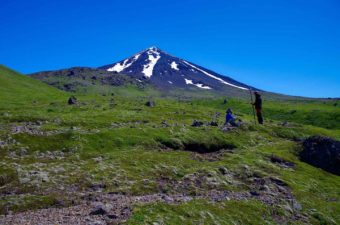
Whitman College geologists studying Mt. Carlisle. (Photo courtesy Kristen Nicolaysen.)

Scientists flock to the Aleutians every summer to study the islands’ rich wildlife, long history and active volcanoes.

For the past two summers, an interdisciplinary team has visited the Islands of the Four Mountains, in the central Aleutians, to study how resilient the earliest settlers had to be to live there thousands of years ago.
Among many finds this summer, archeologists dug up two slate ulus on one of their digs on Chuginadak Island. They think the find means these ancient seafaring people were somehow trading or acquiring goods from as far as Kodiak, 700 miles away. There are no known sources of slate in the Aleutians.

“We think the source of slate is from Kodiak,” archeologist Virginia Hatfield with the University of Kansas said. “We know people of Kodiak were using slate to make ulus.”

With their steep shorelines, limited freshwater and rumbling volcanoes, the Islands of the Four Mountains can seem a harsh place for human habitation. But what seems harsh to modern humans—like cliff-lined shores where landing a boat would be difficult—could have provided an advantage in the distant past.

Qawalangin Tribe of Unalaska president Tom Robinson. (Photo by KUCB/John Ryan)

“You can stand on those high cliffs and you can survey for game. You can survey for other people,” University of Kansas archeologist Dixie West said. “It just depends on your point of view.”

The earliest Unangan (or Aleut) people had to be resilient to survive volcanoes, tsunamis, fierce storms and a changing climate. Researchers are attempting to piece together how quickly people returned to villages once they were buried in volcanic ash.

Qawalangin Tribe of Unalaska president Tom Robinson said his ancestors picked their village sites carefully, facing away from the open Pacific Ocean, to avoid at least one kind of threat.

“If you notice, all of our village sites are predominantly on the Bering Sea side and, therefore, were protected from tsunamis,” he said.

The Aleut Revolt

Archeologists this summer also turned up likely evidence of one of the pivotal moments in Aleutian history: the Aleut revolt in the Fox Islands and the Islands of the Four Mountains and Russian fur traders’ brutal response.

“The Russians came back in 1764 and, according to ethnohistory, they destroyed all of the villages in the Islands of the Four Mountains,” Dixie West said. “In one archeological site, we have found beads, we’ve found iron, and we’ve found a musket ball.”

“We won the first round and they came back,” Tom Robinson said, “and that was the turning point of our history of what else happened to us along the way.”

The Islands of the Four Mountains are uninhabited today, but they had been home to early Unangan people for at least 7,000 to 9,000 years. They remain sacred to people throughout the Aleutian chain.

“It’s a regional spiritual area that we hold dear to our heart,” Robinson said.

He said he had not heard about the researchers digging into his people’s past until asked about it for this story.

“This is the first we heard about it,” Robinson said. “I checked with my staff, and we haven’t been consulted.”

“If I was to dig up their ancestors, they’d probably have a problem with it,” he said.

Virginia Hatfield with the University of Kansas said researchers got written permission from the landowner, the Aleut Corporation, and met with Ounalashka Corporation officials in Unalaska. She said they tried to contact the Qawalangin Tribe as well as people in Nikolski, the closest surviving village to the archeological sites, but received no response. Researchers also gave presentations at the Museum of the Aleutians in Unalaska before they started their work last year.

Difficult Fieldwork

Doing archeology or geology is tough in the Islands of the Four Mountains—and not just because of the remoteness or the weather or the risk of a volcano exploding. You can’t use radiocarbon dating to pinpoint when something happened in the past if there’s no carbon-containing material around.

“In the Aleutians, there are no trees, no shrubs in that area, so it’s very difficult for us to figure out when a particular volcanic eruption happened or when a particular tsunami happened,” geologist Kirsten Nicolaysen with Whitman College in Walla Walla, Washington, said.

University of Kansas archeologist Dixie West with Herbert and Cleveland volcanoes in the background. (Photo courtesy Kristen Nicolaysen)

Nicolaysen said archeologists and geologists working together can answer those questions. They can find where ash covers an ancient village’s garbage pile—filled with organic material—and piece together enough carbon to date an eruption.

The scientists have had to be a little resilient themselves. Cleveland Volcano on Chuginadak Island exploded while they were approaching it by boat. The big volcano kept rumbling while they were working in its shadow.

“At night, when we were sleeping in our tents, we could hear that volcano moaning and groaning,” Dixie West said.

She said it was unnerving, but there were no problems.

“We’d been around volcanoes enough doing the research that we do to know when we should run or when we should hunker down,” West said.

Once they were camped on the island, a big earthquake struck.

“We’d just finished dinner, and suddenly this earthquake starts happening. It was incredibly exciting,” geologist Nicolaysen said.

She said they very quickly turned their attention to the steam plume rising from Mt. Cleveland.

“It was crucial for us to know, was that earthquake affecting the volcano or related to the volcano because if so, we needed to respond to that very quickly,” Nicolaysen said.

Quick communication by satellite phone with the Alaska Volcano Observatory revealed that no evacuation was needed: The quake was driven by plate tectonics, not by the volcano they were having dinner on. Nor did it cause any ocean tsunamis.

“It was very long lasting where we were and actually caused water in ponds and the fuel in the fuel drums to seiche back and forth, to shake back and forth, and we could hear this,” she said. “Little pond tsunamis.”

Aftershocks kept giving them some trouble. Nicolaysen said the researchers couldn’t even feel some of them directly, but they’d get dizzy.

“Sometimes when I was on quite steep cliffs, trying to obtain our geologic samples,” she said. “That was a little strange, writing in my notebook, “Very dizzy, feeling sick. Time to go.”

Last year, members of the same research team helped AVO put the first seismic monitoring instruments on Cleveland Volcano. Now the region can have better warnings when that volcano explodes, as it did this summer.

Still, very little is known about the volcanoes of the Aleutians. Mt Carlisle, Mt. Tana and Mt. Herbert—the other three main volcanoes of the Islands of the Four Mountains—had never been studied before the summer of 2014, when the interdisciplinary research team arrived there, according to Nicolaysen.

“This is completely undiscovered territory and very exciting science to do,” she said.

This summer, AVO scientists put a dozen new sensors on Cleveland Volcano and the first instruments ever on Herbert and Carlisle.

The Qawalangin Tribe continues to aim for resilience in the face of environmental threats of uncertain severity. In September, the tribe advertised to hire a climate change planning coordinator. The goal: to help the tribe adapt to a climate that is changing much more rapidly than it did in prehistoric times.

Women’s traditional chin tattoos are making a comeback in Alaska


More and more Inuit women are getting face tattoos.

The traditional practice dates back centuries but was banned by 19th and 20th-century missionaries. Now it’s coming back. Though the techniques and customs were nearly lost, a new generation is using tattoos to reclaim what it means to be a Native woman in the 21st century.
In the backroom of a small Anchorage tattoo parlor, Maya Sialuk Jacobsen uses a thin needle to pull an inky thread through the skin on her friend’s wrist.

“I use the exit hole as the entrance for the next stitch,” Jacobsen explained, bent over her work as a small crowd observed.

The friend is Holly Mititquq Nordlum, organizer of a weeklong series of tattoo-related events called Tupik-Mi. Compared to the sting of a tattoo gun, the stitches hardly register, and Norldum looks unfazed, greeting and bantering with observers cycling in and out of the cramped room.

“It’s loose,” Nordlum said, nodding at the flesh on her arm. “I put on a few pounds so she’d have something to work with.”

“Her skin is so much better than my husband’s skin,” Jacobsen laughed. “She has really lovely skin to tattoo.”

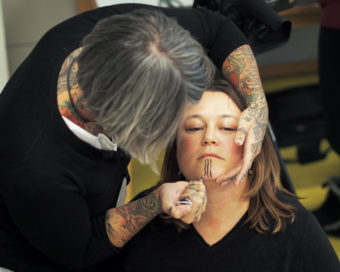
Maya Sialuk Jacobsen of Greenland gives a henna tattoo to a friend’s chin during an event at the Anchorage Museum, part of the Polar Lab’s Tupik-Mi series on traditional tattoos. (Photo by Zachariah Hughes/KSKA)

Jacobsen is one of the few Inuit women who knows how to give tattoos through traditional methods like sewing and poking in dabs of dye. She’s candid about the fact that the equipment has changed. Instead of whale sinew, she uses cotton thread; rather than coloring with soot, she uses tattoo ink. But much like rifle hunting compared to harpooning, she sees her modern tools simply as superior means towards traditional ends: inscribing the skin with meaningful marks.

Jacobsen has spent years cobbling together a body of knowledge about what the practice meant before Danish colonization in her native Greenland almost three centuries ago.

“There is no short answer,” Jacobsen says, adding, “it’s also a very Western, academic way of thinking.”

Jacobsen’s son Benjamin came with her from Greenland, and shows off self-administered henna designs made of different traditional patterns, but reconfigured. (Photo by Zachariah Hughes/ KSKA)

Outsiders have looked at Inuit tattoos as having legible meanings embedded within stable rituals, like clear markers signifying marriage or adulthood. But not only did those cultural foreigners import concepts of their own–like marriage–but also a sense of fixity to a practice Jacobsen says was much more fluid and interpretive. “I can’t tell you a triangle means an iceberg,” she explained dryly. That’s partly because the historical record is unreliable, but also because symbols were not nearly so firm.”

You can’t understand tattooing, she believes, without understanding the lives of Inuit women.

While working as a tattoo artist in Europe, Jacobsen was diagnosed with fibromyalgia, which made it difficult to wield the heavy, vibrating drill that is the trade’s standard instrument. So she started poking, and from there stitching. But as she tried learning more about how Inuit women had traditionally been marked, the few historical accounts all came from European adventurers and missionaries.

“I assure you, they did not really know what tattooing was,” Jacobsen says with a wry smile.

But then came the mummies. A group of 15th century Inuit women discovered during 1972 at the Qilakitsoq (“little sky”) grave-site in Greenland, preserved tattoos and all. Jacobsen found a book about them, studied the designs, and realized the marks on their foreheads, cheeks, and chins were similar to the tight stitches she’d learned as a girl. It was her first primary source.

“I have, like, literature, and then I have, what I call ‘from the horse’s mouth,’” Jacobsen says, “and that is the mummies.”

Tupik-Mi, Jacobson and Norldum’s project, is part of an effort within the Urban Interventions series in the Anchorage Museum’s Polar Lab.

“Tupik means tattoo,” explained Nordlum, who is Inupiaq, “and then ‘mi’ is a shortened version of muit, which means ‘people.’ In Kotzebue, we say ‘Qikiqtaġrumuit’ which means, ‘We’re the people from Kotzebue.’”

Nordlum was introduced to Jacobsen over Facebook after she couldn’t find anyone to give her a traditional tattoo in Alaska. A friendship blossomed, and they arranged the first in what they hope will be yearly Tupik-Mi events.

In addition to a lecture and live tattooing demonstration, the women also hosted a light explanation of traditional tattoos for high schoolers before letting them apply tube after tube of henna to their appendages.

Nordlum squeezed a tight formation of dots and lines onto the back of an 11th grader’s wrist.

“She’s making my initials with the Inuit designs,” says Ben Hunter-Francis.

The West High junior says he has plenty of time to decide whether or not he’ll get a tattoo. But if he does, he’d like it to be attached to his Yup’ik roots in the Lower-Yukon community of Marshall.

“Just to make my heritage proud, and make my family proud,” Hunter-Francis says, “that I’m connected with my heritage in some way.”

Traditionally, tattooing was the province of women. They were the ones who wore them, and exclusively the ones to administer them. But as Nordlum finished Hunter-Francis’s wrist, she explained that the practice isn’t bound in place by history.

“In modern culture, men getting tattoos is not a rarity. We are contemporary people working in modern times, so although it was a rarity traditionally, now it isn’t,” Nordlum says, not letting up her hold on Hunter-Francis’s arm.

“Culture is not a set thing, it is a living breathing thing that changes as time goes, and we’re just adapting … like skin.”

Holly Mititquq Nordlum shows off her partially complete tattoo during a live demonstration at Anchorage’s Above The Rest studio. Each horizontal line is 40 individual stitch marks through the first layer of skin. Before starting the stitches, Jacobsen poked the basic design of three bird feet rising from the lines. Nordlum’s Inupiaq name, Mititquq, means ‘a place where birds land,’ and she celebrates big life goals with bird feet tattoos, like the two on her opposite wrist, done with a tattoo gun. (Photo by Zachariah Hughes/ KSKA)

If plans go ahead, Tupik-Mi will expand next year to train a handful of Alaskans in traditional tattooing methods. By the third year, the hope is to hold workshops in Canada and Greenland, growing tattooing capacity across the high north.

“The idea,” Nordlum explains, “is for Iñupiaq, Inuit, Yup’ik women to feel proud of who they are. To feel strong. To create a sisterhood. To belong to something bigger than yourself, so that you’re safe and you’re supported by all these other women.”

Nordlum was a few days away from getting lines tattooed on her chin, one of the most visible and common styles across a wide array of indigenous Arctic communities. She says more women in Alaska are opting for chin tattoos, to the point where she brushed off the suggestion it was a bold decision to get one

“I don’t feel very brave here because there’s so many of us,” Nordlum says.

Permanence is part of why tattoos carry so much weight, and Nordlum sees the resurgence in women’s chin tattoos as putting forward a permanent, proud Native identity for all to see.

Jacobsen had her own chin lines laid down by her partner just two months ago. Soon after the process began, she felt a visit from her late mother.

“My mind was just wrapped around all of these thousands of fore-mothers I must have had that had tattoos,” Jacobsen says, her words growing softer. “My heart was beating so hard, and I cried, and I was shaking.”

Four thin lines that would have normally taken a few minutes took hours. “It was definitely very, very emotional,” she says.

Jacobsen is sharing that intimate experience with Nordlum, dot-by-dot, as she pokes a tattoo into her friend’s chin.

Massive seabird die-off hits Kodiak

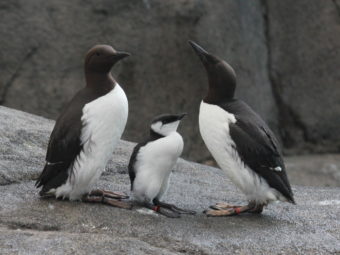
Common Murre ( Uria aalge), also known as Common Guillemot. Photographed at Alaska SeaLife Center in Seward, Alaska. (Creative Commons photo courtesy of Dick Daniels)

Kodiak Island residents have been reporting a large number of common murres washing up dead on local beaches.

The small black and white seabird usually establish breeding colonies on the Alaska Peninsula and in the Aleutian Islands.

Kodiak National Wildlife Refuge bird biologist Robin Corcoran said there are a few colonies on the island, but they’re less than 200 birds.

Corcoran said the refuge first started receiving reports in April and May about a handful of murre die-offs.

“They were showing up in places where people don’t normally see them. These are birds that are usually pretty far off shore,” she said. “We were getting all these reports of them being seen close to shore, foraging.”

Corcoran said more and more reports of dead birds started coming in August. She said some beaches have a large number of carcasses; there are over a hundred on the shores of Pasgashack.

She said she doesn’t know what could have caused the deaths, but it could be related to the birds’ inability to catch fish because they’re currently going through a flight feather molt stage.

“They spend about 70 days where they can’t fly, and so the die-off seems to coincide with this flight feather molt where they’re flightless and it might be that they don’t have the mobility to move to locations where they can find the forage fish,” Corcoran said,

Making things worse is that the birds are in a mostly unfamiliar territory. No one knows why they’re congregating on Kodiak Island. Corcoran hypothesizes that colony abandonment in other areas could be a factor.

Corcoran said 2012 the last year they saw a major bird die-off, that time of both murres and grebes in January through March. They collected carcasses and sent them to the National Wildlife Health center in Madison, Wisconsin, where they ruled starvation as the cause of death.

The carcasses they’ve sent this year have been emaciated. Corcoran said the murres’ plight it could be connected to recent whale die-offs.

“[We’re] looking into the possibility of harmful algal blooms. … It could be related to the warm ocean temperatures having an impact on forage fish populations,” she said.

Corcoran said refuge survey data indicates that several other bird species’ numbers have declined, like the pigeon guillemot and the marbled murrelet. She said she’s read about the die-off reaching Homer, as well as along the Alaskan Peninsula and into the Aleutians.

Cruise ship nearly doubles Unalaska’s population (for a day)

The Celebrity Millennium and another smaller cruise ship doubled Unalaska's population for a day when about 3,800 people disembarked from the vessels. (Photo by John Ryan/KUCB)
The Celebrity Millennium and another smaller cruise ship doubled Unalaska’s population for a day when about 3,800 people disembarked from the vessels. (Photo by John Ryan/KUCB)

The biggest cruise ship ever to visit the Aleutian Islands pulled into Unalaska’s Dutch Harbor Tuesday morning. The floating city known as the Celebrity Millennium disgorged about 2,500 passengers and 1,000 crew. In tandem with nearly 300 passengers in town from the much smaller Le Boreal, the two cruise ships nearly doubled the population of Unalaska for the day.

For many towns in southern Alaska, the arrival of a mega cruise ship would make for an ordinary or even a slow day for tourism. Juneau can handle five big cruise ships at once. But those towns along the main cruise corridors have the infrastructure for a deluge of wandering pedestrians seeking entertainment. Unalaska does not.

Starting about 10 a.m., passengers walked down the ramp from the Millennium onto an industrial dock.

The floating city’s P.A. system blared a welcome to Dutch Harbor and safety messages at its passengers. They learned, as they prepared to walk off the ship for the first time in three days, that Dutch Harbor isn’t really set up for pedestrians, let alone large numbers of them.

“When leaving the dock and heading away from the airport, there is no paved walk area. Please be very mindful of industrial traffic,” the announcer advised.

A small number of passengers started a long and windy walk into the center of town despite the lack of sidewalks. Many more hopped on board the buses, taxis and rental cars lined up at the dock.

Unalaska Fire chief Zac Schasteen said there were no problems with tourists wandering into the wrong areas of the nation’s busiest commercial fishing port.

The arrival of the supersize ship sent town officials and many volunteers into a flurry of activity, especially in the past month, after officials learned there would be hundreds more passengers than they’d first been told.

“We’ve been kind of sounding the alarm, so to speak, for at least a year,” Cathy Jordan with the Unalaska Convention and Visitors’ Bureau said. Despite an “overwhelming” number of visitors, Jordan said the day went smoothly.

“I am just thrilled with the outpouring of support from the community,” she said.

An estimated 200-300 of the passengers showed up at a crafts and souvenirs market set up inside the town gym. Local artist Carolyn Reed said she sold enough postcards and jewelry to be worth her time, but it wasn’t a huge boost to her business.

Across the street, the Unalaska School District charged $10 a head for a program of traditional Unangan, or Aleut, culture. Patty Gregory-Lekanoff showed off bentwood visors and other traditional clothing to the dozens of visitors sitting on bleachers in the high school gym.

“What I’m wearing feels like wax paper, but this is the intestine of a walrus,” she said. Unangan dancers performed, and young athletes performed high kicks and other Native Youth Olympics events.

Electronic Limits

Unalaska’s physical and electronic infrastructure wasn’t built to handle many hundreds of tourists showing up at once.

The Millennium started in Vancouver and is headed to Shanghai by way of Japan.

Unlike Unalaska, the giant ship has its own movie theater, a spa and an internet café.

Unalaska officials asked the ship to have its passengers put their phones in airplane mode while they’re here. Otherwise, their quest for connection might overwhelm Unalaska’s phone system.

Passenger Bob Knobbe from Saskatchewan said word did trickle down to the passengers. He showed a reporter that his phone was indeed in airplane mode.

Other passengers could be seen in walking through town, tapping and staring at their phones.

Parts of Unalaska had internet service outages in the afternoon, but it’s hard to know if that was because of the large number of visitors, or just another day in Unalaska, where cell service is often unpredictable.

A warming Arctic could lead to more ships passing through the Aleutians for business and pleasure. If so, Unalaska will face choices about what kinds of ships it wants to welcome and whether to embrace industrial-scale tourism as well as industrial-scale fishing.

Judge: National Environmental Policy Act probably doomed King Cove road

King Cove road, Izembek National Wildlife Refuge, Cold Bay map

A federal judge in Anchorage has ruled against a group from King Cove seeking an emergency road to Cold Bay.

Judge H. Russell Holland says Interior Secretary Sally Jewell’s 2013 decision to reject an 11-mile road through the Izembek National Wildlife Refuge is in keeping with the National Environmental Policy Act, known as NEPA. The judge says that, given the sensitive nature of the lands in the proposed road corridor, the need to follow NEPA probably doomed the project. “Perhaps Congress will now think better of its decision to encumber the King Cove road project with a NEPA requirement,” he wrote.

Sen. Lisa Murkowski says she was disappointed in the decision, but she’s already working on a Congressional solution. She has inserted a rider in a spending bill that would allow a land exchange and take the road decision away from the Interior secretary.

King Cove residents want a road to reach Cold Bay’s long, paved runway, to allow medical evacuations in rough conditions.  King Cove Mayor Henry Mack spoke of the need in a call to APRN’s Talk of Alaska this week.

“We would love to get our sick grandmas and grandpas and young children who need (it) to get out safely, instead of waiting in a clinic in miserable nights in bad weather,” he said. “Why, we could drive over there.”

The city joined with local tribes and the Aleutians East Borough to bring the legal challenge. They say they’re evaluating their next legal move.

Environmental groups argue that a road would diminish important waterfowl habitat. They say most of the world’s population of Pacific black brant and emperor geese rest and feed in the Izembek Refuge during migrations. Tim Woody, spokesman for the Alaska branch of The Wilderness Society, says their position does NOT amount to placing bird needs above human needs.

“Everyone is respectful of King Cove’s concerns and their need for emergency transportation,” Woody said, “but we need to start looking for a solution that meets their needs while keeping the wilderness of the refuge intact.”

Woody says other transportation methods – like helicopter service or a ferry — might serve the community better. Road proponents say those alternatives aren’t realistic.

Site notifications
Update notification options
Subscribe to notifications