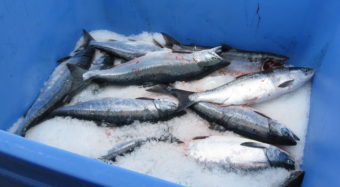
A new Pacific trade deal could make Alaska sockeye a little more affordable in other countries.
The Trans-Pacific Partnership is an agreement between 12 countries, including the United States, Japan and Vietnam — among others, though notably not China — that will eliminate some trade barriers over the next several years.
Alaska Seafood Marketing Institute Executive Director Alexa Tonkovich said if the agreement is enacted, it could be good news for Alaska seafood exports, including Bristol Bay sockeye.
“Currently the sockeye salmon tariff to Japan is 3.5 percent. With the TPP, it will be eliminated immediately for both fresh and frozen. For other types of salmon, it’s also 3.5 percent, and it will be gradually reduced and then eliminated in the sixth year.”
Tonkovich said 3.5 percent might not sound like much, but it adds up.
“When you think about the volumes of sockeye that go to Japan, it really is one of our main stable markets for sockeye salmon, in particular Bristol Bay sockeye salmon, which is a lot of the volume of export. That could be, over the course of the season or over the course of several years, quite a bit of money,” Tonkovich said.
Alaska salmon isn’t the only product that may see a boost. Tonkovich said it could also increase the repackaging of pollock, salmon and other Alaska seafood that occurs in Vietnam, and help other exports.
The 2,700-page agreement was recently released, and still must be signed by the president and approved by Congress.
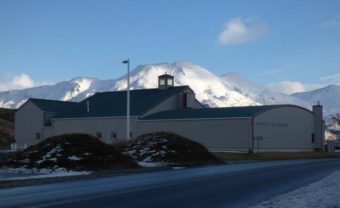
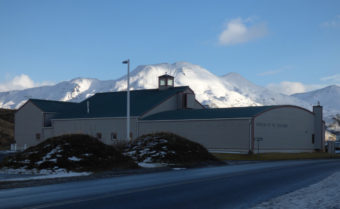
Unalaska’s Museum of the Aleutians. (Photo by Greta Mart/KUCB)
The head of Unalaska’s Museum of the Aleutians resigned this week after being reprimanded for breaching museum protocol.
Executive director Zoya Johnson’s resignation was the latest development in a chain of events that temporarily closed the museum and prompted questions over the security of items donated to the museum’s collection since the late 1990s.
Johnson delivered her notice prior to a museum board meeting on Monday, Nov. 9. The board continued that meeting on Nov. 13, and voted early Friday afternoon to accept Johnson’s resignation.
Johnson has been the museum’s executive director since 2004. She also sits on the Unalaska City Council.
In mid-October, the museum’s board placed Johnson on paid administrative leave and closed the museum’s doors after a 19th century Russian Orthodox bible and two other religious books from the museum’s collection were found in Johnson’s home. The items had apparently been in her personal possession since 2009.
On Oct. 29, the museum’s board voted 5-2 to reopen the museum to the public, reinstate Johnson, and place a letter of reprimand in her employee file. At that meeting, the board also asked Johnson to write a letter of apology to the community.
On Friday, Johnson promised to email her letter of apology to the board. Board member and Unalaska City Manager David Martinson said he would distribute the apology letter to the community upon receipt.
Before announcing that Johnson’s official last day of work would be Nov. 20, board member Suzi Golodoff read out loud the letter of reprimand to Johnson, who was present at the meeting. The letter rebuked Johnson for her “failure to safeguard specific collection items,” but thanked Johnson for her 11 years of service as museum director.
The board agreed to hold another meeting in the near future to discuss Johnson’s severance package. On Monday, Martinson said he is unsure if the museum will remain open to the public through the current transition.
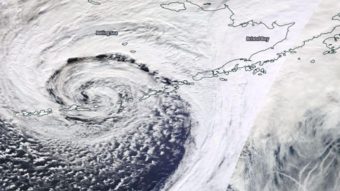
A MODIS satellite image from NASA, showing a storm over the Aleutian Islands on Nov. 4, 2015.
A powerful windstorm blew through Unalaska on Wednesday, closing schools and causing minor damage.
Meteorologist David Kochevar at the National Weather Service office in Anchorage said his agency clocked wind speeds of 91 mph at the Dutch Harbor Airport around 6:30 a.m. A wind gust clocking in at 93 mph hit the Akutan airport at 6:35 a.m.
Sustained gusts blew over 70 mph on Captains Bay throughout Tuesday night.
Wednesday morning, Unalaska Deputy Police Chief Mike Holman said the public safety office responded to calls about windows breaking out, a container flung across a roadway and a streetlight that blew down near the South Channel Bridge.
90-plus mph winds early Wednesday ripped off part of this Trapper Drive home in Unalaska. (Photo by Greta Mart/KUCB)
One person was treated at the clinic for glass in the eye from an imploding window. A window also blew out at the Harbor office. Holman said high winds damaged the roof of a home near the base of Haystack Hill.
Wednesday afternoon, neighbors gathered at a home on Trapper Drive to help the homeowner patch gaping holes in his roof. Earlier in the morning, high winds blew off a large section of the home’s roof and blew out the two-car garage door.
The Unalaska School District announced Tuesday afternoon schools would close Wednesday due to a threat of severe weather. Eagle’s View Elementary and Unalaska City School were expected to resume classes Thursday.
With crab season under way in the Bering Sea, some 70 crab boats are bobbing around Alaska’s Bristol Bay and the Aleutian Islands. About a dozen of those boats have a fisheries observer on board. The observers keep tabs on what the boats haul up from the deep.
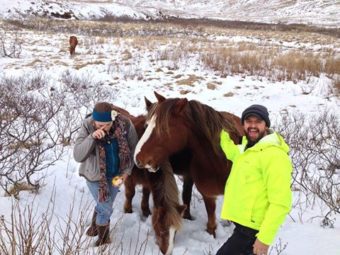
Keith Davis and a friend with Unalaska Island’s wild horses in 2013. (Photo courtesy of Lynn Goodman)
Keith Davis was supposed to be one of those observers, but he went missing in September while working on a boat off the coast of South America.
Davis has been a fisheries observer for more than 15 years. His employer says he was planning to return to Dutch Harbor this winter to do more observing work.
But Davis vanished while working on a transshipment vessel about 500 miles off the coast of Peru. He disappeared one afternoon while a boat was offloading tuna to the Taiwanese ship that he was working on. The ship sailed under the flag of Panama.
The Panamanian government, the U.S. Coast Guard and the FBI are investigating his disappearance. Lynn Goodman is a fisheries observer and a friend of Keith Davis. She says she “absolutely” believes fouls play is at hand.
“I met Keith in our Dutch Harbor bunkhouse while we were both observing on crab boats,” she said.
She says Davis was exceptionally safety conscious and there’s no way he would have been on board a ship without a life jacket, let alone just fall off unnoticed.
Fisheries observers are a tight-knit community. They’re sort of gypsy biologists. They often pursue their work all over the world, wherever governments need somebody to make sure fishing boats aren’t hauling up too many of the wrong things. Davis worked several seasons out of Unalaska’s Dutch Harbor.
“He really loved it there,” she said. She added: “Alaska’s about the best assignment in terms of safety that we get.”
Observers spend days or weeks at sea, often alongside crew members who may not welcome the inconvenience or intrusion of somebody collecting data on their work.
America’s top fisheries official this month said she understood that tensions were on the rise between observers and the fishermen they observe. NOAA Fisheries head Eileen Sobeck said threats to observers will not be tolerated.
When he was between boat trips out of Dutch Harbor, Davis would play his ukulele at the open mic night at the Grand Aleutian Hotel. He also took his ukulele out to sea with him.
“This song, I originally wrote it out at sea here, on a transshipment vessel,” he says.
He tells the camera he wrote the song in honor of several observers who died at sea.
He sings.
“Must’ve been his time to go
Something we’re not meant to know
Has left us his legacy
Allowing us all to be free”
Some say he’s lost. Maybe he’s found
I asked Goodman if Davis’s friends still have hope that he’s alive somehow.
“I think it’s highly unlikely he’s still out there somewhere,” she said. “If he were, we’d have heard from him by now. I have to say this, though. If anybody could still be alive, it would be Keith. He’s very, very, very resourceful.”
Now his family and friends are in a kind of limbo. They can’t be sure whether to keep up hope that he’s alive. Or else to accept that the song he wrote for other observers now applies to him as well.
A Shell Oil icebreaker gained two passengers in the middle of the Pacific Ocean on Tuesday. French sailor Manu Wattecamps-Etienne dove onto the icebreaker in 20-foot seas, about 12 hours after sending out a distress signal. He made the desperate jump — with his cat — about 350 miles southeast of Alaska’s Dutch Harbor.
Coast Guard video of the rescue shows the 30-foot sailboat bobbing like a cork next to the 270-foot Tor Viking II. The Frenchman clings like a koala to the rigging at the bow of his boat as it whips him around in nearly 50 mile-per-hour winds.
With a big backpack on and his cat stuffed inside his jacket, Wattecamps-Etienne times the waves just right. He dives over the rail of the icebreaker, landing headfirst with his feet flopping up in the air.
Wattecamps-Etienne was sailing south after crossing the Northwest Passage in the Arctic Ocean this summer. His boat, La Chimere, passed through Nome about a month ago.
The Tor Viking, a bumblebee-striped icebreaker tug, is part of Shell’s Arctic drilling fleet.
It was escorting Shell’s Polar Pioneer rig to Washington state after Shell gave up on its hunt for oil in the Arctic Ocean in September.
Tuesday morning, the Shell ships heard the Coast Guard’s broadcast call for help from any vessels near the struggling sailboat. The Coast Guard also sent a C-130 plane from Kodiak and the cutter Munro from Dutch Harbor to assist the mariner.
“He reported that he had no rudder or rigging and was taking on heavy seas,” Coast Guard Petty Officer Lauren Steenson in Kodiak said.
Steenson said the crew of the Tor Viking had to do some challenging maneuvering to get close to the tiny sailboat in the rough seas.
“The man was holding on to the rigging at the very front of his sailboat and almost fell, which was kind of scary,” she said. “But when one of the big waves came and pushed him toward the boat, he kind of made a leap of faith onto the Tor Viking and made it.”
On Facebook, Wattecamps-Etienne said he’s now en route to Seattle on board the Tor Viking.
Marinetraffic.com lists the Tor Viking’s destination as Port Angeles, Washington, where Shell has said the Polar Pioneer is going. Shell spokeswoman Meg Baldino did not respond to interview requests for this story.
“I am sad to tell you that La Chimere is lost,” Wattecamps-Etienne told his Facebook friends.
He said his whole life was on his sailboat. Without it, he said he feels useless and without purpose, like a soccer player who’s just lost a leg.
“Last night, I was battered by a wave, boat upside down. The boat finally righted itself, full of water, everything on the deck was destroyed, none of the instruments worked and the water kept getting in despite the pump which turns… I abandoned my boat this morning after several more capsizes, followed by a physically demanding rescue. From now on, I am a captain without a ship. I lost everything, all my life was on my boat. Worse than that, I am starting from below zero since I still have to pay off Euros for a boat that is no more… I feel like a soccer player who just lost a leg: useless and without purpose. I will have to wait years and years before being able to walk on the deck of my own boat.”
With translation help from Cyrielle Willa and Liz Ruskin.
Personal from The US Fish and Wildlife Service research boat R/V Tiglax visit the World War II memorial constructed by the Japanese government honoring American and Japanese soldiers on Engineer Hill on Attu Island on Wednesday, June 3, 2015. (Photo by Bob Hallinen/Alaska Dispatch News)
It’s been seven decades since U.S. soldiers recaptured Attu Island from Japanese forces, setting off one of the bloodiest battles of World War II.
Once they recovered the most remote island in the Aleutian Chain, American forces transformed it, briefly, into a strategic hub. But that decades-old infrastructure has been crumbling under influence of harsh winds, weather and time.
Now, Attu is scheduled for what may be the first of many stages of cleanup — but it’s unlikely the military will ever be able to turn back the clock to a time before conflict.
Long before the war, Attu was home to a small village. It was also a haven for birds.
“These common eiders, they just make this cooing — rrr, rrr. On a day like this, it carries across the water,” said Jeff Williams, assistant manager for the Alaska Maritime National Wildlife Refuge, standing on the shore of Attu’s Casco Cove in early June. The sun shone brightly, with only the barest breeze pushing its way through tangles of beach grass.
Attu has been a refuge for wildlife since 1913. President Theodore Roosevelt set it aside, along with a handful of other islands that were important to seabirds and marine mammals. But refuge status didn’t stop the military from using those lands during World War II.
There are now more than 20 former defense sites located within the Alaska Maritime National Wildlife Refuge. Attu is the most remote — nearly 1,500 air miles from Anchorage — and one of the most deeply affected. Besides collapsed Quonset huts and spent shells, the tundra is covered with rusting tank farms, decaying fuel barrels and miles of pipeline.
This summer, Williams and a few volunteers for the U.S. Fish and Wildlife Service stopped to check on one of the worst areas — a field of above-ground storage tanks near an area called Navy Cove.
“I mean, you can see the valve right there, just coming out,” Williams said, pointing to a viscous puddle of black liquid that had oozed from one tank. “It’s a direct source.”
Biologist Jeff Williams checks the eggs in an Aleutian Canada goose nest on Attu Island. (Photo by Bob Hallinen/Alaska Dispatch News)
The bodies of at least a half-dozen birds dotted the puddle; their decaying wings jutting out at odd angles — “almost like the La Brea tar pits.”
“It’s not as thick — only a few inches thick. But it’s just enough,” Williams said. He gestured to-ward the edge of the puddle. “See a carcass right over here?”
Over the years, investigators for the Fish and Wildlife Service have found the remains of many more birds trapped in this puddle. It’s the most obvious example of a much broader problem, as infrastructure built to support the Attu Naval Station and the Attu Army Air Base disintegrates.
Both facilities closed in the years following World War II. The naval station came back into use in 1959 amid rising hostility between the United States and the Soviet Union. Within a decade, it had closed again, though, and the military returned all but a sliver of its 82,400-acre reservation to the wildlife refuge. (The remaining 1,800 acres were kept for the U.S. Coast Guard, which continuously maintained a navigational station on Attu until 2010.)
Fish and Wildlife and federal contractors have conducted multiple site studies and reviewed as-built blueprints over the years, but they’ve never determined just how many gallons of petroleum products are still here. There have been some attempts to remove them: Williams said the Navy tried to decommission some of the fuel tanks they installed when the base finally shut down.
“They burned a lot of them. There are pictures of guys with flamethrowers going right up to the tank. It’s really remarkable to see flamethrowers going on gunk like this, just igniting it and black flames flying up,” Williams said. “You know, I think we’ve changed some since then.”
Abandoned tanks on Attu Island are inventoried as the US Fish and Wildlife Service research boat R/V Tiglax stops at the western most of the Aleutian Islands on Wednesday, June 3, 2015. (Photo by Bob Hallinen/Alaska Dispatch News)
When the Army Corps of Engineers arrives on Attu in summer 2016, their operations will look much different. The agency has hired Bristol Environmental Remediation Services, LLC — a subsidiary of the Bristol Bay Native Corporation — to remove old storage containers and polluted soil from two sites, including the leaky tank farm.
“We are also aware of a pallet-sized pile of old lead batteries,” said Army Corps project manager Andy Sorum. “And we’re going to target not only the remains of those batteries, but the contaminated soil around it.”
The Army Corps received an extra burst of funding from Congress for this work. The price tag is $10 million; at least 40 percent of that covers a season’s worth of logistical expenses. “There’s nothing easy about getting heavy equipment to Attu and removing the volume of potentially contaminated material that we’re dealing with here,” Sorum said. He expects to deploy a mix of barges and aircraft, since Attu’s runways are still operable.
Sorum also hopes to clean up other sections of the island down the road, working with federal site managers and the Alaska Department of Environmental Conservation on details.
But there are limits to what the Corps can do. Ken Andraschko oversees environmental restoration at old defense sites for the Army Corps of Engineers in Alaska. He said his teams will focus on chemical hazards; munitions and explosives expended during the war are beyond the scope of their program as outlined by Congress.
“Anything that’s actually in a battlefield, anything that was released as part of the battlefield would be ineligible, because that’s defined as an Act of War,” Andraschko said. “And under our program, that is exclusively forbidden for us to go address.”
A cormorant comes in for a landing near a rookery. (Photo by Bob Hallinen/Alaska Dispatch News)
The battlefield was confined to the easternmost corner of Attu, but it casts a long shadow. American forces invaded by sea and slowly charged inland, through fog and frigid rains. Cut off from reinforcements, many Japanese soldiers decided it was more honorable to perish in battle — or by suicide — than to surrender. About 2,900 men are believed to have died over the course of 18 days.
Now, the battlefield is a national landmark and part of a national monument to World War II in the Pacific Theater. “It’s not like your typical Civil War battlefield or your European battlefield where everything’s manicured,” said historian John Cloe. “These things are in a real wild state.”
Cloe knows that firsthand. After retiring from a long career as a reservist and Air Force historian, Cloe is now a guide for a California-based company called Valor Tours. He’s been leading small groups of World War II buffs on sailing trips to Attu since 2013.
When it comes to cleaning up the island, Cloe is strongly in favor. “Go to a Civil War battlefield — you don’t see a lot of junk lying around, do you?” he asked. “It’s unsightly, all this twisted metal lying around. It has very little historical relevance. Somebody needs to look at it and make sure, though.”
It’s still being debated, but that twisted metal may stay put. The federal agencies responsible for managing Attu Island aren’t as concerned about debris, so long as it doesn’t leach chemicals or harm wildlife.
A tufted puffin returns to its nest as the US Fish and Wildlife Service research boat R/V Tiglax stops at Attu Island the western most of the Aleutian Islands on Thursday, June 4, 2015. (Photo by Bob Hallinen/Alaska Dispatch News)
The wreckage wasn’t enough to keep Aleutian cackling geese at bay. This summer, their high-pitched honks rang out from the shoreline all the way up to Attu’s mountain passes. The entire species was nearly extinct before the Fish and Wildlife Service launched a huge effort to bring the cackling goose back into its old nesting grounds on the refuge.
“We didn’t bring these birds to Attu,” said Billy Pepper, captain of Fish and Wildlife’s research vessel. “All we did was remove the fox from here — and all of a sudden we come here one year and hear the [honking] just like you’re hearing right now. It’s like, wow. Now they’re everywhere. It just goes to show you what a little bit of work can do.”
Pepper sailed to the island in June to drop off researchers who wanted to study the island’s birds. As they went about their work, the captain jumped on a four-wheeler and set off down old military roads with a few other Fish and Wildlife employees. They arrived at a small interpretive site the agency installed for the 70th anniversary of the Battle of Attu.
There are a few signs explaining the significance of the Aleutian Campaign during World War II and the bravery shown by Army Private Joseph Martinez, who died leading an assault on a rocky hillside pocked with enemy foxholes.
Pepper sat on a small bench looking out at Engineer Hill, where the final fight took place.
“If you can try to let yourself run with the thought of what that would have been like for a 19-year-old kid, it’d be a lot,” Pepper said, shaking his head. “But they did it. And now it’s kind of gone full circle. It’s back to birds. A little interpretive site here, but it’s mostly birds.”
Close
Update notification options
Subscribe to notifications
Subscribe
Get notifications about news related to the topics you care about. You can unsubscribe anytime.