Museum of the Aleutians’ Oct. 12 board meeting. Board members (at table, L-R) Melissa Good, Sharon Svarney-Livingston, Eilleen Scott and executive director Zoya Johnson. (Photo by Greta Mart/KUCB)
The Museum of the Aleutians in Unalaska remains closed after the discovery of museum materials–including a Russian Orthodox Bible from 1801–at the executive director’s house disrupted normal operations last week.
The museum’s board of directors voted Oct. 12 to close the museum and place executive director Zoya Johnson on paid administrative leave.
In a statement issued Friday, the museum’s board said it completed an investigation and found that “no criminal intent was exercised” by Johnson. The Unalaska City Council member has served as the museum’s executive director for the past 11 years.
The board said it closed the museum to allow for a review of its policies as well as best practices at museums around the state. The board did not say when it plans to reopen the museum.
The allegations arose after a museum employee house-sat for Johnson in September. Ingrid Martis said she often house-sat for her boss over the past five years. This time, she went into a room that had always been locked before.
On loan from Anchorage
“This time around, I run into three books that were on loan from the Russian Orthodox Museum in Anchorage since 2008,” said Martis.
Martis said she opened one of the books, a Russian Orthodox Bible from 1801.
“And opened the page and saw the loan agreement, which was – I had to sit down for a moment. Maybe she forgot, maybe I should take these books and return them to the museum right now,” Martis said. “And then I’m thinking, well, I can’t take anything from this person’s house, that would be theft, but I need to talk to someone about it.”
Martis took her concerns to museum board chair Sharon Svarney-Livingston. Svarney-Livingston and board member Eileen Scott accompanied Johnson to her home to retrieve the 19th-century religious books.
According to Martis, when the board members initially came to the museum and asked Johnson about the books, Johnson denied they were in her home.
“The facts were that, yes, the books were in my house,” Johnson said on Friday. She said she had forgotten about them.
The books had been part of a 2008 exhibit at the Museum of the Aleutians on the history of the Russian Orthodox mission in Alaska. Johnson said when the exhibit came down, she was supposed to courier the books back to the Russian Orthodox Museum in Anchorage. She said it is common in the museum world for staff to hand-deliver items between institutions.
But in 2009, the Russian Orthodox Museum closed its doors for good.
The books never made it back to the Museum of the Aleutians’ collection storage room. Johnson said she forgot about the books in the wake of her husband’s death in 2009.
“It was a time of, extremely hard time for me, of grief and personal tragedy for me. People who live here know I lose my husband in an accident and they know that I have a very hard time,” said Johnson. “So if they haven’t forgotten anything in their lives, in a period like that, then they must be super-human.”
Martis starting working at the museum in 2010 as the collections manager. She said she documented that the three books were missing from the museum inventory shortly after she arrived and Johnson told her she did not know where they were.
Key staffers quit
Martis resigned from the museum four days after alerting the board of her discovery. She said she had planned to leave her job soon to return to her native France, but the current situation prompted a hasty exit.
Martis said when she saw the books in Johnson’s house they were on a shelf and appeared spotless. They did not have years of dust on them.
Museum collections manager Sara Strain also resigned in the aftermath of the discovery.
The museum’s board said on Friday it is satisfied with Johnson’s explanation of how and why the books were in her home for the past seven years.
“We all believe that Zoya didn’t take these books intentionally, but we do want to go through the right process on how we deal with this. Because many of us are new to the museum, we want to make sure we are taking the right steps,” board member Melissa Good said at the museum’s board meeting last week.
Interim Unalaska city manager Don Moore also voiced support for Johnson at that meeting.
“My opinion, and the opinion of the city, is that this is a very fine, well-run institution and go ahead and check with the other small town museums,” Moore said. “I have no problem with the investigation, but I hope the museum doesn’t stay closed for very long.”
“I thank my board for the vote of confidence,” Johnson said on Friday.
“I personally believe this was just a fluke, having known Zoya and the excellent work she has done,” board member Eileen Scott said. “I hate doing this.”
In its statement on Friday, the museum board said the allegations that Johnson had removed the books and a document listing them were “proven untrue during the investigation. Proper documentation was in the item file.”
The board also said it was taking action to close the museum and clarify policy to satisfy community members who had sent them letters of concern.
Longtime Unalaska resident and artist Ray Hudson, who now lives in Vermont, urged the board to work to restore confidence in the museum.
“It appears that the board condones the removal of priceless materials and appears to knowingly avoid oversight to safeguard what has been placed in its trust,” Hudson wrote in an Oct. 8 email to the board.
Anne Rowland, the museum’s first collections manager and curator when it opened in 1999, called on the board to take the allegations seriously.
She said she expressed her concern to Johnson and the board about the “obvious loss of control with collection documentation” in 2008. She said the current situation is a major problem for the museum.
According to the International Council of Museums’ ethics guidebook, no one associated with a museum should be permitted to take items from museum collections for personal use, even temporarily.
Unalaska deputy police chief Michael Holman said there will be no criminal investigation.
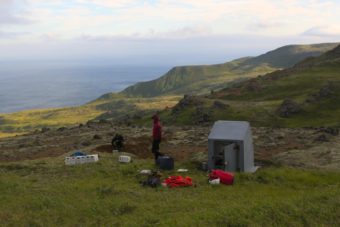
AVO seismologists work to repair a seismic station on Little Sitkin Volcano in the western Aleutians Islands. (Photo courtesy USGS)
This summer, Alaska Volcano Observatory scientists embarked on an ambitious project to repair seismic monitoring equipment at active volcanoes around Southwest Alaska. Now 176 of the Observatory’s 216 seismic stations are in working order.
A backlog of deferred maintenance and a lack of funding, coupled with the extreme environment, have caused some of the seismic monitoring stations to quit working over the past several years.
This summer, crews were able to repair stations at a handful of sites in Southwest Alaska.
“We were able to visit, importantly, Aniakchak Volcano on the Alaska Peninsula, restored some ground-based monitoring at the volcano there,” said Janet Schaefer, with the Alaska Volcano Observatory. “And we also did seismic repairs at Gareloi, Tanaga and Westdahl Volcanoes – those are in the Aleutian Islands.”
Shaefer says AVO was also able to fix stations at the recently-active Shishaldin Volcano.
Funding came from the U.S. Geological Survey’s Volcano Hazards Program.
Future funding is uncertain. But Schafer says the goal is to get more of their stations up and running.
“Wrangell Volcano is an example. It has been active recently,” Schaefer said. “And those stations are difficult to get to, so it would be nice to get there.”
A volcanic eruption is often preceded by hours, or even months, of seismic activity, which Schaefer says provides AVO with valuable data.
“So that we can detect those very small, small magnitude earthquakes that indicate fluid movement, either from an active hydrothermal system or gas or magma beneath the surface,” she said. “So, those are the first signs of unrest and those are what really help us to be on guard.”
And as more stations are brought back on line, AVO can more reliably monitor volcanoes and issue more accurate warnings to the public as hazards to communities and passing air traffic become apparent.
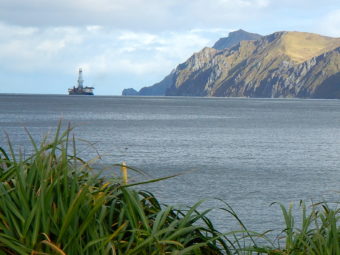
Shell spokeswoman Megan Baldino said the rigs are refueling and making crew changes during their brief stops in Dutch Harbor.
The Noble Discoverer steamed out of Dutch Harbor under its own power Monday afternoon; the Polar Pioneer remained anchored on the far side of Hog Island in Unalaska Bay.
Before this summer’s unsuccessful drilling season, Shell contracted with Seattle’s Foss Maritime to store the rigs at the Port of Seattle in the off-season.
While Baldino said the rigs’ final destinations are still being determined, they will not be returning to Seattle.
Protesters in kayaks as well as city and state officials tried to block Shell from parking at the Port. Last month, a city hearing examiner overturned the mayor of Seattle’s attempt to stop the Port from hosting Shell.
On Monday, King County Superior Court Judge Douglass North ruled against environmental groups that had sued the Port of Seattle over its plan to house the oil rigs. They opposed the project because of its twin risks of spilling oil in the remote Arctic Ocean and fueling runaway global climate change.
While Shell no longer faces legal obstacles to bringing its rigs to Seattle, the company is sending them to other ports in Washington state. The Noble Discoverer is headed to the Port of Everett to offload equipment and supplies. Baldino said the Polar Pioneer, towed by the Ocean Wind and Ocean Wave tugboats, will head to the Port of Port Angeles.
When a single tug towed Shell’s Kulluk oil rig from Dutch Harbor to Everett in 2012, the rig broke free during a winter storm in the Gulf of Alaska. The U.S. Coast Guard had to rescue the Kulluk’s crew by helicopter before the rig ran aground off Kodiak Island. The Kulluk wound up in a scrapyard in Asia.
“We’ve incorporated many, many lessons from our 2012 program,” Baldino said. “Safety is our first priority.”
Baldino said she had no new information to provide on the fate of the 400 employees who worked on the Arctic drilling project in Anchorage. As many as 3,000 Shell contractors were doing fieldwork on the project at any given time this summer.
Shell spent more than $8 billion and nearly a decade looking for oil in the Chukchi Sea, including $1.4 billion this year alone. The company is expected to provide more information on the financial implications of the failed venture when it discusses its third quarter financial results later this month.
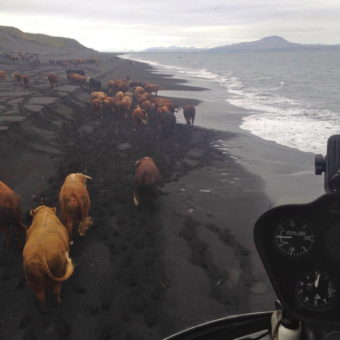
Herding cattle by helicopter in the Aleutians. (Photo courtesy of Curtis Norman)
For the first time in five years, helicopters and cowboys are rounding up cattle by the hundreds on Umnak and Unalaska islands. The Bering Pacific Ranches at Fort Glenn on Umnak Island are herding their tundra-roaming cattle to take them to market.
Alaska agriculture officials say the Bering Pacific is the state’s biggest cattle operation. It’s also the only one with cowboys herding by helicopter.
“Helicopters started working from Nikolski toward Ft. Glenn, pushing the cattle every moment they can that the weather would allow,” Julianne Tucker with Bering Pacific Ranches said.
Tucker said, this time of year, the weather’s “pretty sketchy” for herding by helicopter. But herding has to wait until calves are old enough to endure being separated from their mothers.
“With the wind and everything, sometimes helicopters can’t fly, but they are the most efficient for the terrain that we are working with,” she said. “The steep hills and the swamps.”
Tucker said the helicopters and the ranches’ five cowboys have rounded up about 550 cattle so far, with another 1,400 or more to go. She estimated the total cattle population at about 6,000.
After the roundup, the bulls will get put on a landing craft and taken across Umnak Pass to Chernofski Harbor on Unalaska Island. There, they’ll be transferred to the livestock carrier Falconia–a big white ship that’s been anchored across from the Unalaska Safeway this week. The Falconia is managed by a Danish company and flagged in Panama.
Oregon Tilth certified Bering Pacific Ranches as organic on Sept. 22.
Tucker said it’s been hard to find an organic slaughterhouse for their organic, free-range beef.
“Some people can only process 5 to 10 or maybe up to 20 cattle a day,” she said. “Well, we’ve got 2,000.”
The bulls will be taken to a certified-organic slaughterhouse in British Columbia. Tucker said she doesn’t know yet where beef will be sold from there.
“It seems too bad that here we have a resource out there on Umnak Island and we take all that beef and bring it down to Canada,” Danny Consenstine with the USDA’s Farm Services Agency in Palmer said. “I’m sure there’s Alaskans that would love to purchase that home-grown, high-quality Alaskan beef.”
“We need to produce more of our own food and not rely so heavily on food that’s flown up here or shipped up here,” he said.
Tucker said once the cattle go to the Canadian slaughterhouse, they become Canada’s product. She said they only learned this week that they can’t ship straight from Alaska to the Lower 48 with a foreign-flagged ship like the Falconia without violating the Jones Act.
But she said Bering Pacific is looking for ways to sell its product in Alaska in the future. She also said the Discovery Channel is interested in doing a show on the ranch.
Alaska’s only certified organic cattle operation in the USDA database for 2014 was the Sitkinak ranch near Kodiak. That ranch sells ground beef online for about $3 a pound.
Waves break against rocks near Buldir Island as researchers and supplies are ferried from the US Fish and Wildlife Service research boat R/V Tiglax to Buldir Island in the Aleutians during a trip from Adak Island to Attu Island on a weeklong research mission in southwestern Alaska, on Tuesday, June 2, 2015. Scientists on the R/V Tiglax conduct research in the Alaska Maritime National Wildlife Refuge. (Photo by Bob Hallinen / Alaska Dispatch News)
The night before Ryan Mong was scheduled to start his summer job on Buldir Island, the lanky 31-year-old ducked into the cargo hold of the federal research vessel Tiglax to make sure his supplies were in order.
“All these white boxes are the food that we’ve ordered from a distributor,” Mong said, gesturing past gently swaying piles of waterproof Pelican cases. “Packed up the things we really like — nutritional yeast, the Srirachas, the stuff you just always have a lot of back home.”
Mong was one of a handful of biologists hired by the U.S. Fish and Wildlife Service to work in the Alaska Maritime National Wildlife Refuge. They maintain nine field stations stretching from southwest Alaska to Saint Lazaria Island near Sitka.
Researchers and their supplies are moved from a beach to the beach in front of their camp on Buldir Island as the US Fish and Wildlife Service research boat R/V Tiglax is on a weeklong voyage in the Aleutian Islands on Friday, June 5, 2015. The researchers and their supplies were dropped off earlier in the week and they hauled some the there supplies to the camp across the rocky beach. When seas moderated the Tiglax returned to transfer the rest of their supplies. 5 people were dropped off on the island including to research biologists from Memorial University of Newfoundland. Scientists on the R/V Tiglax conduct research in the Alaska Maritime National Wildlife Refuge. (Photo by Bob Hallinen / Alaska Dispatch News)
But Mong and his colleagues — an adventurous couple, also in their 30s — signed up for a special challenge. Their job was to spend three months studying seabird nests on a windy speck called Buldir Island.
Located more than 300 miles west of Adak Island and 70 miles from the next nearest piece of land, Buldir is the most isolated island in the Aleutian Chain. It’s also the most pristine;the fox breeding operations that altered the ecologies of other islands never took here.
Without any threat from foxes, seabirds had free rein on Buldir. More species now build their nests among the island’s jagged rock faces than any other location in the Northern Hemisphere.
The Alaska Maritime refuge has been sending biologists into voluntary exile on Buldir each year since 1988. The program has become legendary among bird researchers such as Ryan Mong — and the scientist who first clued him in during a field season in Arizona.
“It was like, ‘Oh, you get to ride a boat for two weeks out to the end of the Aleutian Chain! And there are so many seabirds that they’re going to hypnotize you!’” Mong said. “So I immediately got on email, sent the resume off.”
It took three years and a stint at another Alaska Maritime research camp in the Pribilof Islands before Mong secured a spot on Buldir. “To describe it to family, I just call it National Geographic Syndrome,” Mong said. “You want to go to the wildest places, the places with the most species, and enjoy the show. And it’s quite a show.”
A skiff takes a wave over the bow as it returns for another load of supplies are moved to a research camp on Buldir Island as the US Fish and Wildlife Service research boat R/V Tiglax is on a weeklong voyage in the Aleutian Islands on Friday, June 5, 2015. The researchers and their supplies were dropped off earlier in the week and they hauled some the there supplies to the camp across the rocky beach. When seas moderated the Tiglax returned to transfer the rest of their supplies. 5 people were dropped off on the island including to research biologists from Memorial University of Newfoundland. Scientists on the R/V Tiglax conduct research in the Alaska Maritime National Wildlife Refuge. (Photo by Bob Hallinen / Alaska Dispatch News)
A “Swiss cheese” island
When the birds come back to roost on Buldir, it seems like there’s no number large enough to capture them all — and certainly not enough space. The island is just 4 miles long and two-and-half miles wide.
Nests are built on top of nests, filling every available nook and cranny.
Biologist Steve Ebbert has help getting into a dry suit as supplies and researchers are ferried from the US Fish and Wildlife Service research boat R/V Tiglax to Buldir Island in the Aleutians during a trip from Adak Island to Attu Island on a weeklong research mission in southwestern Alaska, on Tuesday, June 2, 2015. Scientists on the R/V Tiglax conduct research in the Alaska Maritime National Wildlife Refuge. (Photo by Bob Hallinen / Alaska Dispatch News)
“You might find like four or five burrows around this rock, and a storm petrel that’s nesting in the grass tussock on top and puffins underneath from different angles,” said assistant refuge manager Jeff Williams, pointing to an innocuous-looking boulder on the beach. “Swiss cheese just really describes it.”
Williams got his start doing the same kind of work as the field biologists he now hires on an annual basis — hiking over rocky beaches and dense clusters of ferns to find a handful of diverse seabird nests. The researchers go back again and again to find out how many eggs hatch over the course of the summer, and what happens to the chicks.
Over time, that data can be used to uncover population trends. Seabird populations are in precipitous decline worldwide, with flocks reduced by up to 70 percent. But the refuge hasn’t detected that trend in the Aleutian Islands. The biggest change seems to be in where birds go to build their nests, which is usually driven by the availability of food in the surrounding ocean. Those observations get sent along to the North Pacific Fishery Management Council, so they can get a read on the ocean ecosystem before they set fishing quotas.
Williams said that might be part of the appeal for researchers — seeing their work get some use in the real world, instead of going “into a filing cabinet.”
Supplies are ferried from the US Fish and Wildlife Service research boat R/V Tiglax to Buldir Island in the Aleutians during a trip from Adak Island to Attu Island on a weeklong research mission in southwestern Alaska, on Tuesday, June 2, 2015. (Photo by Bob Hallinen / Alaska Dispatch News)
There’s also the unique office environment to consider.
“If you think about it, every one of these birds poops,” Williams said. “There’s millions of them. So it’s like millions and millions of pounds of fertilizer coming onto this. It creates this vegetation that’s super dense and rank. I bring machetes and stuff for people to cut their ways through the paths.”
Williams also tries to set up the island’s radio antenna and make sure the rough wooden cabin and weather-port tents are in good shape. But this summer, a string of storms in the North Pacific Ocean almost disturbed those plans. It took days before the Tiglax, the refuge’s research vessel, could steer close enough to the island to launch an inflatable skiff and sail ashore. The ride was still choppy, and it wasn’t safe to land on the beach closest to the campsite.
That left the research team with no choice but to strap on frame packs and start carrying hundreds of pounds of fuel, food, and tools around the rocky point to their cabin. The crew of the Tiglax had to push on — conducting more research and checking on interpretive signs posted by Fish and Wildlife throughout the refuge.
The storms broke and the ship eventually turned back, unloading deckhands, biologists, and refuge staff to help haul the last boxes ashore. But it just as easily could have gone the other way. The rough arrivals are one of many reasons why Williams says any field worker who can handle Buldir “has earned their stripes.”
Biologist Jeff Williams, biologist Steve Ebbert and deck hand Andy Velsko return to the US Fish and Wildlife Service research boat R/V Tiglax after checking the conditions to land researchers on Buldir Island in the Aleutians during a trip from Adak Island to Attu Island on a weeklong research mission in southwestern Alaska, on Tuesday, June 2, 2015. Scientists on the R/V Tiglax conduct research in the Alaska Maritime National Wildlife Refuge. (Photo by Bob Hallinen / Alaska Dispatch News)
“Buldir’s a big life-changer”
McKenzie Mudge and Kevin Pietrzak had already been through the wringer before they were hired to spend a season on Buldir.
“Usually we say we do bird surveys because that’s something most people can understand,” Mudge said. “Nice and simple. We’re outside looking at birds.”
Night shift deckhand David Martindell and biologist Ryan Mong on the US Fish and Wildlife Service research boat M/V Tiglax pull in a substance crab pot with Tanner Crab in the Kuluk Bay area of Adak Island in the Aleutian, in western Alaska, on Sunday, May 31, 2015. (Photo by Bob Hallinen / Alaska Dispatch News)
In reality, Mudge and Pietrzak have spent the last six years studying bird migration and diet together. Since they first met at a research site in Antarctica, they’ve traveled from Chile all the way up to the North Slope.
“When you get to working in remote field camps like this, at least a third of your time is camp maintenance and trying to keep the building from falling down,” Pietrzak said. “It’s work, too — trying to figure out how to survive in a place like this. It’s not always easy.”
Mudge and Pietrzak are not the first scientists to fall in love under these conditions. There are several couples who met working for the Alaska Maritime refuge (Williams, the assistant manager, met his wife that way). But it’s not as common to find a couple that chooses to stay in the field.
“It’s different,” Pietrzak said with a laugh. “It’s kind of weird to go back down to Southern California and see my friends that have houses and families and kids of their own, and I’m like, ‘Well, I got to see a lot of the world. That’s really cool, right?’”
Katherine Robbins photographs the sunset from the US Fish and Wildlife Service research boat R/V Tiglax as sails from Adak Islands on a cruise to Attu Island in the Aleutian Islands, in western Alaska, on Sunday, May 31, 2015. Robbins from Memorial University of Newfoundland in St. John Newfoundland will be dropped of at Buldir Island where she will be studying Auklets. (Photo by Bob Hallinen / Alaska Dispatch News)
Eventually, Mudge said, they would like to put down roots — adopt a dog, make their own home. But first, they wanted to find out what Buldir had to offer.
“You know, everybody always says Buldir’s a big life-changer,” Ryan Mong said. “But you feel lucky getting to do it, because most people just get to come here once or so.”
As Mong spoke, he tugged on a pair of hip waders. It was early summer, and the camp was ready — time to push the inflatable skiff back out to sea so the Tiglax could continue on its way. I asked Mong if it bothered him that the field season he was about to start on Buldir could also be his last.
“I like living like that,” Mong said.
For two months, I didn’t hear another word from Mong or the rest of the camp.
It was to be expected. Besides a sluggish email connection and a satellite phone, there aren’t many opportunities to reach the outside world from Buldir. And there shouldn’t be any opportunity to post images of the island’s rolling green hills and endless views of the North Pacific to Instagram.
Captain Billy Pepper of the US Fish and Wildlife Service research boat R/V Tiglax stands on the back deck as he prepares to start moving researchers and their supplies s to their camp on Buldir Island in the Aleutian Islands on Friday, June 5, 2015. 5 people were dropped off on the island including to research biologists from Memorial University of Newfoundland. Scientists on the R/V Tiglax conduct research in the Alaska Maritime National Wildlife Refuge. (Photo by Bob Hallinen / Alaska Dispatch News)
“My season got cut short due to an injury to my finger,” Mong said after I messaged him about his posts on the social media app. “I was done checking all the burrows that I needed to check and I was making my way back down a hill — slipped, dropped the machete I was carrying, and it cut right into my hand, really deep.”
Mong tried to work through it, but medical advisors for the refuge suggested he leave. The damage wasn’t permanent. And McKenzie Mudge and Kevin Pietrzak took it all in stride.
Even though it was truncated, Mong said the experience was everything he’d hoped — the sheer variety of seabird species, the headiness of living in isolation, the camaraderie among his crew.
In fact, spending so much time with a couple like Mudge and Pietrzak got him thinking.
“I kind of need to go settle down with my loved one and make her mine for the long run,” Mong said. “So I decided out on Buldir that it’s finally time to propose to my girlfriend.”
Once he made it back to the Lower 48, Mong rode his bicycle across the West to Mesa Verde National Park in Colorado, where his girlfriend works as an interpreter. When he got there, the answer was yes.
The news that Shell Oil was abandoning its quest for oil in the Arctic Ocean came as a shock in Unalaska and around the state. Unalaska officials said the move won’t hit the city’s budget too hard. But local companies doing business with Shell are scrambling to figure out what it will mean for them.
Unalaska Mayor Shirley Marquardt said it will hurt the companies providing support to Shell’s Arctic effort in the short run.
“Our community will notice it; our business community will notice it because they utilized a lot of local businesses and hired a lot of folks. So, that’s too bad. I mean it was a real boon,” said Marquardt.
But she said the decision is a temporary setback.
“It’s not going to be too huge, I mean, we’re already…we’re an extremely busy port, we’ve been expanding for years, and that’s not…that’s not going to end,” said Marquardt.
Dutch Harbor port director Peggy McLaughlin says Shell wasn’t a frequent customer of the city’s facilities.
“In terms of, you know, the bottom line, I don’t see that it’s going to have a huge impact on us. We didn’t budget for it either operationally or in terms of revenue, so yes; we’ll probably see fewer port calls. But the city of Unalaska’s port facilities were not the primary place where they called,” said McLaughlin.
But Offshore Systems, Inc. is one of the primary facilities used by Shell. For OSI, the announcement was a disappointment. Spokesman Jim Butler says OSI officials are “in the dark” and “scratching their heads” right now about how much business they will lose. He also says the company will continue to provide support to Shell as it heads south from the Chukchi Sea.
Diane Shaishnikoff of Bering Shai Rock & Gravel says she and her husband don’t have “any idea at the moment” how it will affect their company.
Grand Aleutian general manager Laurie Smith said there’s no doubt the hotel’s occupancy rates will fall in the short term. She also said she was a little sad to hear the news; she and the staff had developed relationships with the many Shell personnel that used the hotel as a base. But Smith said the hotel will continue to have business without Shell. And that she’ll be able to get some long-deferred maintenance projects done now.
Not everyone in Unalaska was dismayed that Shell is abandoning the Arctic.
This summer, when Shell’s rigs stopped in Unalaska, Suzi Golodoff flew an anti-drilling banner. She said she got calls from far-flung relatives Monday morning celebrating the news.
“On a local level I’m really ecstatic that Shell has decided not to come here because as a community it’s just going to maybe spur us a little bit to say, boy you know, maybe there’s something wrong with this oil thing,” said Golodoff.
Golodoff said she hopes the community will look at developing other energy sources.
“Maybe we could do geothermal, maybe we could do hydro, we could do wind, we got, you know, these ocean passes right outside our door. We could be doing all kind of things. The technology is there,” she said.
Close
Update notification options
Subscribe to notifications
Subscribe
Get notifications about news related to the topics you care about. You can unsubscribe anytime.