Aleutians

Crews train to prevent repeat of Selendang Ayu grounding

U.S. and Canadian Coast Guard crews recently conducted a joint training exercise with the Emergency Towing System. Deployed to eight communities in coastal Alaska, the ETS can be used when tugs aren’t available to assist large vessels like disabled freighters and cruise ships that are in danger of running aground.

During the exercise that occurred during the annual Buoy Tender Roundup in Juneau earlier this month, the ETS was loaded aboard the USCGC Maple before it left Station Juneau. Earlier plans called for a Coast Guard H-60 helicopter to lower the towing system by sling to the Maple’s deck, but the helicopter was called away just before the training exercise.

Once out in the middle of Gastineau Channel, the Maple’s engines were disengaged while deck crews worked to unpack the package and extend lines to the Canadian Coast Guard vessel Bartlett.

Canadian Coast Guard vessel Bartlett takes a powered-down USCGC Maple in tow during a recent transit of Gastineau Channel. (Photo by Matt Miller/KTOO)
The ETS that was used in the Juneau exercise is normally stationed in Sitka and can be used to tow over 50,000 deadweight tons.

The system was developed after the freighter Selendang Ayu lost power and grounded off of Unalaska Island in December 2004. Six crew members were killed when the ship broke in half and spilled oil and its soybean cargo along the shoreline.
Related link: Alaska Emergency Towing Systems Project – ADEC

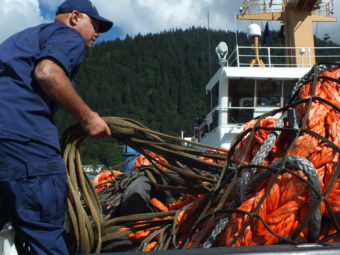
The Emergency Towing System consists of a messenger line, 10 inch main tow line, and a set of buoys in a package that can lowered to any vessel by crane or helicopter. (Photo by Matt Miller/KTOO)
The Emergency Towing System consists of a messenger line, 10-inch main tow line, and a set of buoys in a package that can lowered to any vessel by crane or helicopter. (Photo by Matt Miller/KTOO)
After use, the components of this Emergency Towing System will be dried out and repackaged for redeployment in Sitka. (Photo by Matt Miller/KTOO)
USCGC Maple pulls away from Coast Guard Station Juneau. (Photo by Matt Miller/KTOO)

Nuclear submarine pops up In Dutch Harbor

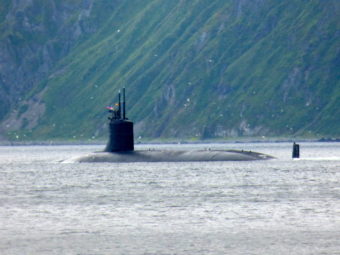
Crew members stand atop the USS Seawolf in Unalaska Bay, Alaska. (Photo by Pipa Escalante/KUCB)

A US Navy submarine pulled into Unalaska Bay near the town landfill Friday morning. The sub made no contact with the Port of Dutch Harbor, according to Harbor Master John Days.
It did communicate with the Royal Pacific, a boat hauling wastewater from the Unisea fish-processing plant, as they were crossing paths.

The USS Seawolf in Unalaska Bay on Aug. 14, 2015. (Photo by John Ryan/KUCB)

As is usual for Navy subs, the boat did not identify itself by name over the radio.

“Royal Pacific, this is a US Navy submarine. In approximately 5 minutes, I’m going to be turning around, so request port-to-port, hopefully get this turnaround completed,” an unidentified voice from the submarine called over the VHF airwaves.

“Roger, port to port. Okay, we’ll swing to the west side here then,” the Royal Pacific replied.

KUCB tried to contact Navy officials to find out something about the sleek black submarine’s visit to Unalaska. But email, phone and Twitter messages all went unanswered.

The tug Saratoga went out to the nuclear submarine. It transported two crew members to the sub and took two back to Dutch Harbor.

Tug captain Steve Devitt of the Saratoga said the submarine identified itself to him as the USS Seawolf. He said the crew told him the sub came up from “under the ice” because a crewmember had had a death in his family.

The USS Seawolf is homeported at Naval Base Kitsap on Washington state’s Hood Canal. It’s one of three Seawolf-class submarines. It was built in 1997 at an estimated cost of more than $2 billion.

The Navy calls the Seawolf “exceptionally quiet, fast, well-armed and equipped with advanced sensors.”

Each Seawolf has eight torpedo tubes and can hold 50 weapons in its torpedo room. The Seawolf subs are nuclear powered, but they do not carry nuclear weapons.

After making the crew change, the Seawolf headed quietly out to the Bering Sea, with only its conning tower sticking above the surface of Unalaska Bay.

The USS Seawolf returns to the Bering Sea from whence it came. Photo by John Ryan/KUCB)

Fur seal numbers boom on Aleutians’ remote Bogoslof Island

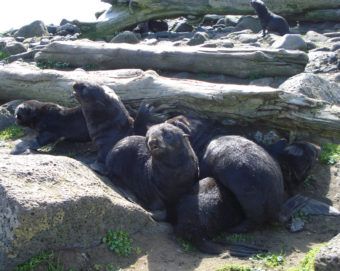
Northern fur seal pups on St. Paul Island, Alaska. (Photo courtesy of NOAA)

Northern fur seals have been declining for decades in their stronghold on St. Paul Island in Alaska’s Pribilof Islands, but their numbers are taking off on Bogoslof Island, a couple hundred miles to the south.

A team of scientists with the National Marine Fisheries Service has been camped out on isolated, mile-long Bogoslof, just north of the Aleutian chain, trying to piece together why.

Bogoslof is the top of a 6,000-foot volcanic cone about 50 miles west of Dutch Harbor. Only the top 300 feet of the cone rise above the Bering Sea.

“We first saw breeding animals there in the 80s,” Mike Williams with the National Marine Fisheries Service said. “Now we’re looking at a large portion of the Alaska population is on Bogoslof, where there weren’t any in the 80s.”

For centuries, most of the world population of northern fur seals has bred in the Pribilof Islands. Russian navigator Gavriil Pribylov even located the then-uninhabited islands in 1786 by following the barks of fur seals through the fog.

Commercial hunting of fur seals stopped in the 1980s, but the big St. Paul population has continued falling.

“We’re concerned about the decline, so we want to keep track of what’s happening with this increasing population versus the populations in the Pribilofs and be able to at least have some idea of how their populations are moving,” Williams said.

Williams said why the Bogoslof population is increasing is “the million-dollar question. “I wish we knew.”

A half million or more fur seals haul out onto the Pribilofs each summer. Many of them head down into the Aleutians other times of the year.

Scientist Bruce Wright with the Aleutian-Pribilof Islands Association, the federally recognized tribal organization of the Aleut people, said nobody knows why the Pribilof populations keep plummeting.

Only a small subsistence harvest of about 2,000 animals a year is taken. Wright said declining populations have made getting food harder in the Pribilofs.

“People out there have less access to that marine mammal, which they use for a food resource, so they’re suffering from that,” Wright said.

Scientists have lots of educated guesses but few answers about the decline – from the impacts of fisheries to climate change.

Is toxic food to blame?

Wright has a hypothesis of his own: toxic food.

Blooms of harmful algae can cover the ocean in a living layer full of toxic muck. This year has one of the largest harmful algae blooms on record in the North Pacific. It reaches all the way to the Aleutians. At least two different toxins have turned up in unusually high amounts this year: domoic acid and the toxin that causes paralytic shellfish poisoning.

The small fish that fur seals eat, like sand lance, can accumulate toxins from the algae. Wright said he wants to know if the Pribilof seals have been getting doses of poison when they feed in the Aleutians.

“But now we have this population off Bogoslof, in the Aleutian Islands, and I’m really interested to find out where those fur seals are feeding,” Wright said. “If they’re feeding in the Aleutian Islands, then that would help reject this hypothesis. But maybe they’re feeding out on the continental shelf of the Bering Sea and they’re not at risk, at least right now, of encountering toxic sand lance.”

Algae grow faster when the ocean is warmer. With warming ocean temperatures, it’s only a matter of time before we see big algae blooms in the Bering Sea and Arctic Ocean like we’ve seen in the North Pacific this year, according to Wright.

The NMFS fur seal researchers on Bogoslof are counting pups and females and putting satellite tags on a few of them to see where Bogoslof seals get their meals.


Dead herring, poison mussels found on Unalaska shorelines

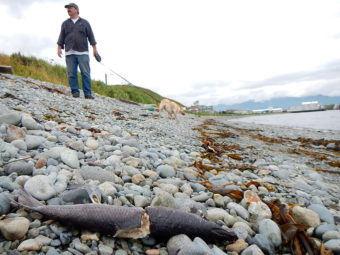
Caleb Livingston takes his dog Hazel for a walk on Unalaska’s Front Beach. (Photo by John Ryan/KUCB)

Hundreds of dead herring washed up on Front Beach in downtown Unalaska on Tuesday.

“Hundreds of herring floating in the water,” Caleb Livingston, who lives nearby, said as he was walking his dog Hazel on the beach. “But what really got my attention was the few that drifted on the beach were not being eaten by the eagles, or seagulls or terns.”

Scientists have been receiving reports of dead and dying whales, birds and the small fish known as sand lance in the Aleutian Islands.

A dead Steller’s sea lion washed ashore in Unalaska in July with no wounds or other obvious causes of death.

Researchers think the killer might be toxic algae proliferating in unusually warm ocean waters.

Mussels taken from two different bays in Unalaska this spring have had levels of the toxin that causes paralytic shellfish poisoning two to four times higher than the level considered safe by the U.S. Food and Drug Administration.

Livingston said he doesn’t think toxic algae killed the herring he saw on Front Beach.

“I’m guessing that somebody shoveled them off a boat,” he said.

Herring are used as bait by crabbers and longliners.

Boats shouldn’t do that in close. If they’re going to get rid of this stuff, they should do it further out,” Livingston said. “It’s probably not that harmful, other than critters like Hazel gobbling on it, but it is a form of pollution.”

Scientist Melissa Good with University of Alaska Fairbanks agreed, after a quick bit of beach forensics, that these dead fish were probably dumped in the water.

Dead herring on an Unalaska beach on Wednesday. (Photo by John Ryan/KUCB)

She said the herring had lost their scales, suggesting the fish had been poured through a chute en masse.

“Their fins are deteriorated while their eyes are intact,” Good said. “I think it’s probably bait fish that got dumped.”

Even so, Good said she would send herring that she and Livingston collected on the beach to an Alaska Department of Environmental Conservation lab for analysis.

This spring, Good collected mussels from Captains Bay and Summer Bay in Unalaska to see if they had the toxin that causes paralytic shellfish poisoning.

She just got the results back: Mussels had up to 3.3 parts per million of the potent PSP toxin. That’s four times higher than the FDA’s 0.8 parts-per-million limit.

“Anything above that is unsafe to eat,” Good said.

“I would suggest people take caution and probably not harvest mussels or any other clams or bivalves within the Unalaska area because we are seeing high toxin levels for the previous spring months,” she said. “It’s likely these levels are higher now, after the summer algal blooms.”

In an email, Bruce Wright with the Aleutian Pribilof Islands Association said butter clams tested in June at Sand Point, in the Shumagin Islands, just east of the Aleutians, showed even higher levels of the toxin.

One of the largest algal blooms ever recorded has been spreading throughout the Northeast Pacific Ocean, from California to Alaska. Scientists believe a giant blob of warm water is fueling the harmful algal bloom.

Helicopter crew, pregnant pilot deliver Aleutian Islands fishermen to safety

Mihey Basargin of Wasilla on the docks in Dutch Harbor after being rescued. (Photo by John Ryan/KUCB)

Two fishermen were rescued from their boat grounded off Unalga Island in the eastern Aleutians Tuesday.

A Coast Guard helicopter crew from Air Station Kodiak hoisted the men to safety about 1 p.m.. The two were flown to Dutch Harbor and did not require medical attention.

The owner and skipper of the Alaskan Catch said he’s glad he and his crewmate are unscathed, but his 35-foot boat is a total loss.

Mihey Basargin of Wasilla said he thinks there are about 200 gallons of fuel still on board.

The Alaskan Catch was heading from Dutch Harbor through Akutan Pass to longline for black cod on the south side of the Aleutian Islands chain.

Basargin said he was intentionally avoiding the middle of the waterway.

“The current is pretty strong in that pass, so you try to keep closer to the shore,” he said. “You lose speed in the middle.”

He said a submerged rock put “a pretty big hole” in his boat around 5 a.m.

“It was pretty quick,” Basargin said. “A couple of minutes, we were flooded.”

The two men put on their survival suits.

Meanwhile, Gavreel Reutov was fishing a couple of hours away on the Bering Sea in the Foreigner. He and Basargin have been friends since childhood in Homer.

The two boats had shared a slip in Dutch Harbor’s Carl Moses Boat Harbor the night before.

“We quit fishing and came back and see what we can do for these guys,” Reutov said.

Reutov heard and relayed Basargin’s distress call and motored toward his friend. He also continued to help the Coast Guard communicate with the Alaskan Catch throughout the morning.

The Foreigner and the helicopter arrived at the scene at almost the same time, nearly eight hours after the accident.

Coast Guard Aviation maintenance technician Joseph Garofalo hoisted the men in a basket, one at a time, onto the helicopter after the long flight from Kodiak.

“There was a tall cliff next to where they were,” Garofalo said. “We couldn’t get too close to them without risking our blades hitting the cliff.”

Garofalo said the top of the sea cliff was hidden in the clouds.

The helicopter’s pilot, Lt. Commander Kimberly Hess, said finding a break in the thick cloud cover, after refueling at Cold Bay, made finding the Alaskan Catch a lot easier.

But a 30-knot tail wind swirling along the cliff made her work more difficult.

“It was super windy,” she said. “But the truth is with that cliff there, I had a good visual reference. It’s much harder to hoist over the water. So with the cliff there, I had something to look at, which helps me stay still.”

Hess said the rescue went about as well as she could hope for, in part because once the Alaskan Catch ran aground, its crew did everything right.

“They did a great job. Those guys saved themselves really,” she said. “[They] called for help early. They put on their survival gear. They didn’t get off their vessel. They stayed warm. They stayed dry. They never got in the water. They never tried to climb up a cliff or something like that.”

Two weeks to go

Hess said few Coast Guard helicopter pilots are female, but she has a characteristic that’s even more unusual for a working helicopter pilot.

“I am almost six months pregnant,” she said in the Coast Guard’s Dutch Harbor office after the rescue. “You can fly up until the end of your second trimester, and I’ve got a couple of weeks left, then I’ll be done.”

“So my baby girl has saved three lives at this point,” Hess said and laughed. “She’s chalking them up.”

Hess also piloted the rescue of a man who had a stroke and seizures on the cargo ship Elsa about 150 miles south of Kodiak Island in July.

The Alaskan Catch rescue was the first for flight mechanic Joseph Garofalo. Hess said a celebration was in order after someone does their first rescue.

“If you’re not six months pregnant, you definitely go out and have a beer, but we’re going to have to come up with something else,” she said.

The crew agreed that milkshakes would make a good substitute.

There was little celebration down the road at the Carl Moses boat dock, where the Foreigner returned after helping with the rescue. Both boats’ crews squeezed onto the Foreigner at the end of a very long day.

Basargin said he was glad no one was hurt. He also said he didn’t know whether his insurance would cover the loss.

“We were parked in this same stall this morning,” Reutov said of the two friends’ nearly identical boats. “Now one of them is gone.”

Shell’s Arctic icebreaker returns to Alaska

The Fennica approaches the Delta Western Fuel dock in Alaska's Dutch Harbor on Tuesday. (Photo by John Ryan/KUCB)
The Fennica approaches the Delta Western Fuel dock in Alaska’s Dutch Harbor on Tuesday. (Photo by John Ryan/KUCB)

Shell’s Fennica icebreaker has returned to Alaska.

It docked at Dutch Harbor Tuesday evening after enduring repairs and protests in Portland, Oregon.

Shell began drilling the top of a well in the Chukchi Sea last week, but it does not have federal permission from the U.S. Interior Department to drill into oil-bearing rocks unless the Fennica is on site.

Shell’s bright yellow well-capping stack sits on the stern of the Fennica. It’s to be used in case a well blows out and other spill-prevention methods fail.

“Once the Fennica is in theater [in the vicinity of the Chukchi Sea drill sites], then we’ll engage in discussions with the regulator about that permit,” Shell spokeswoman Megan Baldino said.

The drill sites are more than 1,000 miles north of Dutch Harbor, the nearest deepwater port.

The Fennica went to Portland’s Vigor shipyard after tearing a three-foot gash in its hull on an uncharted rock in Alaska’s Dutch Harbor on July 3. The U.S. Coast Guard is investigating the incident.

Greenpeace activists suspended from a bridge across Portland’s Willamette River and climate-change activists paddling kayaks in the river managed to delay the Fennica’s departure from the shipyard by about 36 hours.

Shell has until the last week of September to finish its drilling for this year.

Site notifications
Update notification options
Subscribe to notifications