Interior

Ex-FBI agent faults Fairbanks police interrogation tactics

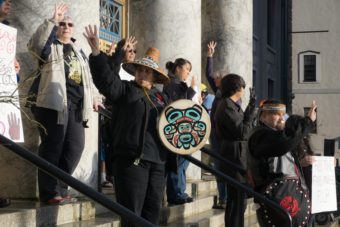
Protestors shouts out in support of the Fairbanks Four during Gov Bill Walker's address to the Alaska Federation of Natives convention. (Photo by Jennifer Canfield/KTOO)
Protestors shouts out in support of the Fairbanks Four during Gov Bill Walker’s address to the Alaska Federation of Natives convention. (Photo by Jennifer Canfield/KTOO)

A former FBI agent says Fairbanks police violated fundamental investigative protocol following the 1997 murder of John Hartman. Gregg McCrarry testified on behalf of petitioners George Frese, Marvin Roberts, Kevin Pease and Eugene Vent, the men known as the Fairbanks Four, convicted of the Hartman killing, who are seeking exoneration.

Testifying during an ongoing evidentiary hearing, criminal investigation and interview expert Gregg McCrarry faulted former Fairbanks Police detective Aaron Ring for narrowing the focus of the John Hartman murder after Eugene Vent was picked up downtown during the early morning hours after Hartman was found severely beaten on a nearby street.

“As a matter of fact, Detective Ring testified that he had no evidence to suggest that Mr. Vent or the others were involved at all when he began this very guilt-presumptive, accusatory interrogation of these young men.”

The state objected to the inclusion of McCrarry’s testimony, characterizing it as opinion.

Assistant attorney general Ali Rahoi challenged McCrarry’s assessment of the investigation, saying police talked to more than just Vent and the other Fairbanks Four.

“Isn’t it true that the Fairbanks Police Department conducted approximately 200 interviews in the course of their investigation?” she asks.

“I don’t know how many they conducted overall,” McCrarry replied.

“OK, and that’s because you only partially reviewed their investigative report,” Rahoi says.

“Correct.”

McCrarry contended the additional interviews were intended only to build a case against the Fairbanks Four, not look for other suspects. McCrarry is also critical of initial police questioning of Vent and Frese when they were drunk and sleep-deprived, as well as the use of false evidence to persuade confessions from the two, who said they could not remember what happened around the time Hartman was beaten on a downtown street.

McCrarry referenced an interview transcript in which detective Ring lies to Vent that police have conclusive evidence tying him to the crime scene.

“He says, ‘Your shoe print is right in that blood.’”

McCrarry says so-called “guilt-presumptive questioning” has proven yield false confessions, characterized by admissions like those made by Frese.

“All he did was feed back the information he was fed,” McCrarry says. “I didn’t see anything that would independently corroborate his involvement.

Also discussed at yesterday’s hearing is the potential testimony of a man who’s previously alleged involvement in the Hartman attack. The Fairbanks Daily Newsminer reports that attorneys argued over whether Jason Wallace, a former Fairbanks man serving life for an unrelated murder, should be granted immunity against prosecution for the Hartman attack.

Lockheed wins $800M contract for radar at Clear

 Clear Air Force Station. (Public domain photo by U.S. Army Corps of Engineers)
Clear Air Force Station. (Public domain photo by U.S. Army Corps of Engineers)

The Missile Defense Agency has awarded a contract of nearly $800 million to Lockheed Martin to install a sophisticated radar system at Clear Air Station, in the Interior.

The system, called Long Range Discrimination Radar, is intended to support the ground-based missile defense capabilities of Fort Greely.

According to Alaska’s congressional delegation, Alaska can expect to see nearly $300 million in military construction from that contract, with much of the work taking place at a Lockheed facility in New Jersey.

Fairbanks Four: Fear, confusion prompted false confessions

Two of the Fairbanks Four say they lied to police about some of what they did the October 1997 night John Hartman was attacked, but maintain they did so out of fear and confusion, not guilt.

Kevin Pease and Eugene Vent took to the stand Tuesday at an ongoing evidentiary hearing to consider whether they and two others also convicted of the crime, George Frese and Marvin Roberts, are innocent.

The Alaska Federation of Natives asks Gov. Bill Walker to free the Fairbanks Four at the organization's annual convention in Anchorage. (Photo by Mikko Wilson/KTOO)
The Alaska Federation of Natives asks Gov. Bill Walker to free the Fairbanks Four at the organization’s annual convention in Anchorage. (Photo by Mikko Wilson/KTOO)

Kevin Pease told the court he resorted to a lie about being with his girlfriend the night John Hartman was fatally beaten on a downtown street because he had not tracked the time during a rambling night of partying and travel around town.

“I lied because I was scared. I lied because I wasn’t there. And you know, it’s just…. I knew everything was not going right. And I did not handle the situation correctly.

Eugene Vent, who’d been drinking heavily during the night, including at a party with Pease, said he blacked out for part of it, before being picked up by police. During questioning Tuesday by his attorney, Pease admitted to lying to police about some of the events of the evening, saying he confessed to involvement in the Hartman attack after Police offered false evidence.

“Tellin’ me that there was blood… and that my footprints were in the blood — numerous times.

Vent said he reconsidered his confession after sobering up.

“I just realized that… I wasn’t with Marvin. I wasn’t with George…. um… I know I blacked out from 3:00 until I got arrested. And I just, I got a chance to think. And I just realized that there’s no way I could’ve done nothing like this.”

Tuesday’s testimony by Vent and Pease followed that of George Frese last week. Marvin Roberts has yet to take the stand.

UAF comes clean about disciplinary failures in sex abuse, rape cases

UAF is one of a few Land, Sea and Space Grant universities in the U.S. (Photo by Jimmy Emerson)
(Creative Commons photo by Jimmy Emerson)

The University of Alaska Fairbanks violated its own policy regarding sexual misconduct cases between 2011 and 2014. University students responsible for rape and other sex crimes were not expelled or suspended during that time.

It’s unclear how far back the improper punishment goes, but UAF said it is committed to turning that culture around.

The University of Alaska Fairbanks has found five instances of sexual misconduct when proper student disciplinary actions did not take place. Three of those cases involved rape.

Mae Marsh is Title IX coordinator at UAF. Her office handles sexual misconduct complaints. She said not properly punishing sexual assault offenders in the past sent the wrong message to students.

“Our silence was acceptance in some ways, but now we’re going back and we’re correcting that and that’s why we’re going public with it because we’re breaking the silence. You’re not alone anymore. This is it. We’ve got a new standard on how things are going to be on our campus,” Marsh said.

Marsh joined UAF in 2012. UAF hired two investigators to look into sexual assault complaints in 2014. Prior to that, complaints were investigated by Residence Life staff, since most complaints took place in the dormitories. Formal sanctioning was the responsibility of the dean of students.

“It’s not just that one person failed to do something. It was an entire system,” Marsh said.

UAF took other measures against the students found responsible of sexual misconduct between 2011 and 2014, like not allowing them in dorms or on campus. All five cases also went through the criminal process with Fairbanks police and the district attorney.

For the victims, Marsh said UAF provided counseling, medical assistance and academic help.

In 2011, the U.S. Department of Education put all colleges and universities on alert that sex discrimination, including sexual violence and sexual harassment, is prohibited by Title IX laws. The University of Alaska system is in the middle of an audit by Department of Education for possible Title IX violations.

It’s taken a few years, but Marsh said UAF has set up a structure to handle and track sexual assault complaints.

“We have updated our policies, we’ve appointed coordinators, we’ve trained our professionals. We are in the process of installing a centralized tracking system. We had a huge awareness campaign that came out. We’ve trained all our employees. We’re implementing the climate surveys,” Marsh said.

Marsh hopes these things have helped students feel more comfortable reporting sexual misconduct.

In 2012, UAF had four reports of sexual misconduct. Last school year, there were 44. Those numbers are still low compared to national averages which show one in five females experience sexual assault while in college.

Of those 44 reports last school year, four involved rape. One case has been investigated and the perpetrator is awaiting school sanctioning. The other three cases involve one alleged perpetrator and are still being investigated. The two men in these cases have been arrested.

Marsh says UAF is in the process of rectifying the old cases. She says UAF will be retroactively sanctioning the students found responsible for sexual misconduct with suspension or expulsions. They won’t be able to re-enroll at UAF.

At 7 p.m. Tuesday, UAF is showing a documentary on college sexual assault, “The Hunting Ground.” At 6 p.m. Wednesday the university is holding a town hall on how to move forward.

Expert disputes boot print evidence in Fairbanks Four case

Protestors shouts out in support of the Fairbanks Four during Gov Bill Walker's address to the Alaska Federation of Natives convention. (Photo by Jennifer Canfield/KTOO)
Protestors shouts out in support of the Fairbanks Four during Gov Bill Walker’s address to the Alaska Federation of Natives convention. (Photo by Jennifer Canfield/KTOO)

Bootprint evidence used to link one of the Fairbanks Four to the 1997 murder of John Hartman, are disputed by a forensic expert.

Independent consultant Lesly Hammer testified Friday at an ongoing evidentiary hearing into whether George Frese, Kevin Pease, Marvin Roberts and Eugene Vent, men known as the Fairbanks Four, convicted of the Hartman attack, are in fact innocent.

Hammer, a former Alaska State Crime lab employee, said prints from George Frese’s boot cannot be matched to photos of imprints on the badly beaten Hartman.

“I found no correspondence between the injuries that I observed, those feature shapes of injuries, and any of the shapes of the shoe lugs as represented on that partial shoe impression,” she said.

Hammer further commented that the examination techniques and analysis presented at 1999 trials show a lack of training.

“Didn’t appear to be some of the basic understanding of the discipline itself, basic application of methods or importance of scale in the examination,” she said.

Hammer’s testimony, which included observations based on recent developments in the field of shoe impression analysis, was objected to by state attorneys as redundant of evidence previously presented at trials. The hearing resumes Tuesday when Kevin Pease is scheduled to take the stand.

First member of Fairbanks Four testifies in court, says confession was coerced

Fairbanks Four Banner at AFN 2015
A Fairbanks Four banner at the Alaska Federation of Natives Conference, Oct. 15, 2015. (Photo by Mikko Wilson/KTOO)

The first of four Fairbanks men seeking exoneration from convictions for a 1997 murder took the stand at an ongoing evidentiary hearing Thursday.

George Frese testified that he drank excessively the night 15-year-old John Hartman was found fatally beaten on a downtown street. Frese said alcohol-induced blackouts obliterated his memory of much of the October evening and early morning, and that during subsequent hours of police questioning, he caved to accusations that he, Marvin Roberts, Kevin Pease, and Eugene Vent must have attacked Hartman.

“I was just tired of being there. I kept telling them that ‘I don’t remember,’ that ‘I don’t know,’ and everything. And I just tried to minimize my involvement in whatever they were throwing at me. They’re telling me that Eugene puts me there, that Kevin started it, that I was there, that I must’ve kicked him, you know. So I just agreed to that. And they asked me about Marvin a couple times after that and I’m saying, ‘I don’t know, I don’t know,’ and they say, ‘Marvin was driving?’ and I say, ‘Yeah, sure … you know, whatever. Whatever you want.’”

Frese, who later recanted his confession, said he does not know how he sustained a foot injury the night Hartman was kicked to death. Under questioning from state attorney Adrienne Bachman, Frese admitted that his heavy drinking sometimes led to fights.

“Did you always fight with friends, or did you sometimes fight with strangers?” Bachman asked.

“Uh, I’ve never fought strangers. No. I never went out preying on random people. Ever,” Frese replied.

Frese was overcome by emotion at one point during his testimony, yelling that police had incessantly accused him of something he did not do. The breakdown triggered Judge Paul Lyle to call a brief recess.

When the hearing resumed, Fairbanks Four supporters stood in solidarity with hands raised, holding four fingers in the air. Judge Lyle admonished the gallery to refrain from protests in the courtroom. Frese continued on the stand Friday. A second member of the Fairbanks Four, Kevin Pease, was scheduled to testify, too.

Jason Wallace will testify at the Fairbanks Four hearing later in the month. Wallace is a former Fairbanks resident serving life in prison for an unrelated murder, who in 2003 confidential comments to a public defenders agency employee, implicated himself and a group of others , not the Fairbanks Four in the Hartman attack.

During discussion prior to Thursday’s testimony, Assistant Attorney General Adrienne Bachman confirmed that an agreement has been reached that will allow Wallace to testify as a state witness live in court.


Site notifications
Update notification options
Subscribe to notifications