Interior

AFN calls on Walker to free the Fairbanks Four

Gov. Bill Walker addresses the 49th annual Alaska Federation of Natives conference in Anchorage. The AFN called on Walker to free the Fairbanks Four. (Photo by Mikko Wilson/KTOO)

The first day of the 49th annual Alaska Federation of Natives convention in Anchorage featured hundreds of attendees yelling their support for four men who say they have wronged by the justice system. As the AFN crowd showed their support, one of the men, George Frese, was preparing to head back into court in Fairbanks.

The Fairbanks Four is Eugene Vent, Marvin Roberts, Kevin Pease and George Friese. The men — three are Alaska Native and one is American Indian — were convicted for the 1997 murder of 15-year-old John Hartman but have maintained their innocence throughout their 18 years in prison.

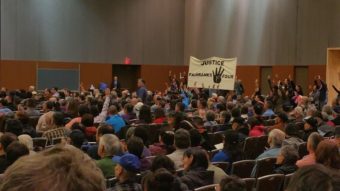
Supporters sporadically yelled out “No more four!” throughout Gov. Bill Walker’s address to the convention. Just before Walker began to mention issues he felt the state hadn’t made enough progress on, about a dozen people entered the main room at the Dena’ina Center with a large cloth banner that read “Justice Fairbanks Four.”

After Walker’s address, AFN co-chair Ana Hoffman took to the podium and invited the organization’s board of directors to the stage. She motioned to Walker — who’d stepped back — to move toward the front of the stage.

“Gov. Walker, we have, on behalf of the board of directors and all of the delegation, we have a very important message for you,” Hoffman began. “Free the Fairbanks Four.”

The Alaska Federation of Natives asks Gov. Bill Walker to free the Fairbanks Four at the organization's annual convention in Anchorage.
The Alaska Federation of Natives asks Gov. Bill Walker to free the Fairbanks Four at the organization’s annual convention in Anchorage.

Each member of the board of directors stretched their arm up into the air and displayed four fingers to represent the four men they believe are wrongly convicted. Most of the crowd followed the board’s lead. Chants of “No more four!” strengthened for a for a minute. Lt. Gov. Byron Mallott stepped forward to join Walker.

As Hoffman continued to speak, Walker acknowledged the audience by nodding his head as he scanned the room.

“As you know Gov. Walker, the Fairbanks Four — Eugene Vent, Marvin Roberts, Kevin Pease and George Frese — have spent the last 18 years in prison for a crime that they did not commit and they deserve to be exonerated,” she said. “With the utmost respect for you, governor, we ask you to make things right and just. We put our faith, hope and love in your wisdom.”

Hoffman invited co-chair Jerry Isaac, former president of the Tanana Chiefs Conference, to take the podium to share a traditional song he’d composed for the demonstration.

“In our Native way, when death suddenly happens we are shocked, we are saddened and we grieve. In this case, there’s no physical death but the forceful taking away of freedom from four young men,” Isaac said. He continued: “We are shocked and saddened and grieving because the facts prove them innocent. The long years of shock and sorrow and the want for freedom and equality fill us with a grief. A grief that is so crippling by its power our only way to express our frustration, our sadness, is to grieve, grieve by a song to express our grief, sadness and sorrow.”

Afterward, Rob Sanderson, Jr. — the village chair for Southeast and 2nd vice president of the Central Council of Tlingit and Haida Indians of Alaska — told the crowd donations were being collected for the men’s legal expenses. The Alaska Innocence Project has been working to secure the men’s freedom for several years.

Victor Joseph, president and chairman of Tanana Chiefs Conference, spoke last before the board left the stage.

“It’s time that these young men come home,” Joseph said. “It could have been any of our children. I want everybody to know I place my trust in the governor to do the right thing and I believe he will. Thank you and ana basee’.”

In an interview with KSKA’s Zachariah Hughes, Walker said he admired the passion of the Fairbanks Four supporters and that he follows the case daily. He said, however, that anything he could do at this point would undermine efforts to have the men exonerated in a court of law.

“Whatever I would do in the way of releasing them from jail, they would still carry with them the question of (whether they’re guilty or not),” Walker said. “What they’re doing now is they’re having an opportunity to have their name cleared, assuming the evidence supports that.”


Fairbanks Four investigators testify, point to languishing evidence

Blind Lady Justice with scales
(Creative Commons photo by Marc Treble)

Two Alaska State Troopers hired in September 2013 to reinvestigate the 1997 John Hartman murder case testified in state court in Fairbanks on Monday.Jim Gallen and Randy McPherron took the stand during day six of a month-long evidentiary hearing prompted by men known as “The Fairbanks Four” who claim they were wrongly convicted of Hartman’s beating death.

Among numerous issues addressed was a 2011 memo to Fairbanks police from a California prison guard, sharing information from inmate and former Fairbanks resident William Holmes, claiming he and a group of high school friends, not the Fairbanks Four, are responsible for Hartman’s death. The 2011 Holmes confession that’s become central to the Fairbanks Four post-conviction relief filings was not promptly acted on by Fairbanks police.

Trooper investigator Jim Gallen testified that the memo was not included in the department’s Hartman murder case evidence record, but he found it in January 2014 while going through a box of case interview tapes at the station.

“Inside of it was this memo that I had not seen before,” Gallen says.

Gallen said he was surprised to find such an important document stashed in a file.

“We had not seen it before, and it would’ve been nice to have it,” he said.

Gallen said he asked Fairbanks Police Lt. Jim Gier about it.

“Gier looked at it,” Gallen said. “About that time … Detective Thompson walks in, he says, ‘Detective Thompson is good at finding these things on the internet. I believe he found it on the internet.’ Thompson seemed confused, kind of nodded in agreement, and we didn’t pursue it anymore.”

Former FPD detective Chris Nolan testified last week that he let the Holmes confession memo languish on his desk for two years, but gave it to Lt. Gier in September 2013, when the Fairbanks Four filed their suit.

How long the state knew about the memo is also at issue. Gallen said the state prosecutor, Assistant Attorney General Adrienne Bachman, refused to release email communications about it.

“I recall the investigator asking about these emails, and Ms. Bachman told him we were not getting it,” Gallen said.

Gallen testified that the 15-month investigation of the Hartman case was incomplete when terminated in January of his year.

CHOICES program takes new approach to housing people with severe mental illness

About 30 percent of people who are chronically homeless in the United States suffer from severe mental illnesses. These individuals more frequently require emergency services and can cost the city of Anchorage up to $60,000 per year. A new program in the city is trying a new tactic to help them, by meeting them where they’re at. Literally.

In August, substance abuse specialist Delroy Duckworth and his colleagues received a call from someone who needed help.

“The first thing we did was went out to find him,” Duckworth recalls. “And we went to the mall to look for this person and we did not know who he was. So we called him on the phone. We heard a phone ring, we saw a man answering his cell phone, I said, ‘Mary that’s him!’”

Leo Tondreault recently moved into his own place at Safe Harbor after four years on the street. (Photo by Anne Hillman/KSKA)

The man with the phone was 60-year-old Leo Tondreault, tall and bulky with a graying beard, joints achy from rheumatoid arthritis. He’s distrustful in general but knows he needs help.

“I’ve been homeless off and on for four and a half years. And nobody cares about you out there. And people that say they understand? How can they have no idea where I’ve been. Everyday is survival. How I’m going to eat, where I’m going to be for the night. Most of the times I just walk all night, drink coffee.”

Part of the reason he never stayed still was to help cope with his anxiety and bipolar disorder – a severe mental illness.

“I just stayed away from people. Because not a lot of people understand what bipolar is. And the worst part for me is the mania. The hyper vigilance.”

Tondreault says he went to see a case worker at Providence Hospital in August and he learned about the CHOICES program. It’s short for Consumers Having Ownership in Creating Effective Services. Unlike other service providers, CHOICES does everything — mental and physical health care, housing, substance abuse treatment, job skills training.

“We are like a one-stop shop,” says Duckworth of the ten-person team that uses hyper individualized care tailored to each client.

They’re using a model called Assertive Community Treatment. It was developed in the 1970s, but this is the first time it’s being tried in Alaska. Research shows it’s more effective than standard case management models, where an individual meets with many different organizations. It costs more up front, but saves money in the long run because clients are less likely to use expensive services, like emergency rooms and hospitals.

The CHOICES program has a budget of $1.8 million for the next three years. It’s funded mostly through the state’s Department of Behavioral Health and specifically targets people who have severe mental illnesses and are homeless. The team is mobile and adaptable. They carry tablets and keyboards and meet people on their own terms.

“We don’t want to overwhelm them,” says housing specialist Mary Abraham. “If they become angry we say, it’s okay, we’ll meet later on. And usually it works out.” They’ll work with people who are still using substances, too.

Abraham’s goal is to get people into housing first. That’s what she did for Tondreault at Safe Harbor at Merrill Field.

He sits on the edge of his twin bed in a sparsely furnished former hotel room. He has a microwave and a mini-fridge, but shares the kitchen. He often runs into other tenants in the hall, who he says offer him alcohol, but he’s resisting. He’s been sober for nearly two months. Tondreault says he’s tried other programs and received some help, but he’s never felt supported the way he does with CHOICES.

“I’m pretty peaceful today. Delroy came over today and said, ‘Man, you look well rested.’ Well, yeah. You change my situation and give me the things I need to help me survive, I’m a different person.”

Tondreault hopes the CHOICES staff can help him accomplish his goals, like staying sober and going back to school in the spring. He knows he needs to put forth his own effort, but he says now he has support to get there.

Fairbanks gets first major snow, braces for reduced maintenance

snow frost crystals
Frost crystals on a window pane. (Creative Commons photo by Tim)

Fairbanks got its first major snowfall of the season Friday. As usual, drivers are counting on the state to plow and sand highways and some side roads, but budget cuts mean reduced maintenance. The downsized operation is expected to be tested this winter.

Department of Transportation Northern region spokeswoman Meadow Bailey says maintenance staff overtime has been eliminated, and that will felt when there’s a major winter weather event.

Bailey says back up plow and sanding vehicles will no longer be available. High volume state roads will continue to be the top maintenance priority, but she adds it will take longer for crews to get to less trafficked outlying state roads.

New ways to fund housing in Anchorage opens doors for low-income families

Two new affordable housing complexes are opening in Anchorage this fall. Tenants have already started moving into the 18-unit Susitna Square in East Anchorage. But building the developments required much more than construction crews and moving vans.

“Come on up here,” invites Mae Lee as she walks up the newly carpeted stairs. “I don’t have anything yet ’cause I just moved from Sacramento in maybe like November, and I’ve been living with my parents.”

A table leans against the wall and just a few boxes are scattered about. For nearly a year, Lee and her three children have been living with eight other people in her mother’s three-bedroom trailer.

Mae Lee in her new apartment at Susitna Square. (Photo by Anne Hillman/KSKA)

“It was three of us in one small room,” she said. “It was really small. And my son had to sleep on the couch, and sometimes he would sleep on the floor. I felt bad for him.”

Lee is a single mom who moved to Anchorage to be close to family when her relationship fell apart. She found work within a month, but it took time to get housing she could afford while raising three kids on her own. Vacancy rates in Anchorage are 3.9 percent. Nationwide, it’s closer to 7 percent.

Lee walks through the three-story, two-bedroom, one-car garage apartment fawning over closet space, the new refrigerator and the chance to have some privacy.

“It’s a workout though!” she laughs as heads up to the top floor. “I’ll probably lose some weight later on. Going up these stairs.”

Lee was one of 150 applicants for the 18 new units. Hundreds more applied for the 70-unit Ridgeline Terrace complex that’s under construction in Mountain View.

AHFC’s new affordable housing development in Russian Jack, Susitna Square. (Photo by Anne Hillman/KSKA)

“It’s always kind of amazing that we actually got from where we first talked about the affordable housing to actually moving in because it’s so complex to do what you have to do to get affordable housing built in the community,” he explains. Building costs and land costs are high in the city.

The two projects combined cost $29.5 million. Butcher explains some of the money came from the usual sources — grants, tax exempt bonds, and state and federal funding. But another chunk came from a private-public partnership made possible through the Alaska Corporation for Affordable Housing, a subsidiary of AHFC. The units qualify for tax credits because they are low-income housing and because they feature an array of solar panels that cut energy costs by 10 percent. Key Bank bought the tax credits and the money went towards construction. Butcher said that’s what made the new developments possible. And the process is repeatable.

“So it’s our hope that we’re able to be able to do this over and over again, not just in Anchorage but all over the state,” Butcher said.

Rent for the units is subsidized so that families pay only 28.5 percent of their income. But it’s only for a limited amount of time for families with working adults. AHFC works with clients and case managers to help families manage their finances, improve their skill sets, and transition toward paying higher rents.

Site notifications
Update notification options
Subscribe to notifications