Juneau

Finalists for new Juneau fire chief present their plans for the department

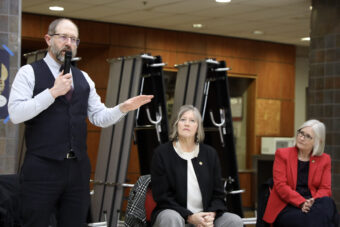
Capital City Fire/Rescue fire chief finalists Tom Hatley (left) and Sean Wisner (right) during presentations at City Hall in Juneau in December 2025. (Photos by Clarise Larson/KTOO)

Two finalists in the running for fire chief at Capital City Fire/Rescue got a chance to share their vision for the department during public presentations this week. Juneau’s city manager is expected to make a decision next week.

Finalist Sean Wisner, who presented on Monday, has been the fire chief for Alyeska Pipeline Fire & Rescue in Valdez since 2012. He’s spent more than 20 years serving in emergency services leadership roles. He founded a consulting firm that specializes in helping organizations be resilient and improve their performance.

“I’ve been in leadership positions in all sorts of complex, municipal, industrial, backcountry and critical infrastructure environments,” he said. “I think that gives me a unique perspective on a place like Juneau.”

Wisner said he’s had his eye on Juneau since he visited the capital city in 2022 to compete in the Ironman Alaska race.

The other finalist, Tom Hatley, presented on Tuesday. He served as the deputy chief for the Spokane Valley Fire Department in Washington until April of this year, when he left due to a family medical reason. He has more than 30 years of experience in fire service, holding positions like fire chief, assistant chief and fire marshal at multiple agencies in the Pacific Northwest. 

Hatley said he was drawn to the position because of the complexities of Juneau’s fire and emergency medical services. He pointed to the community’s lack of outside support, large service area and seasonal population surges. CCFR services 3,255 square miles.

“This unique operating environment is why CCFR must focus on prevention, system resilience, workforce sustainability and community-centered service delivery,” he said. 

Hatley said, as chief, he would focus on addressing staffing problems in the department, especially retaining the department’s current employees. The fire department has struggled with staffing shortages, which union officials say have led to burnout and driven people away from the department. 

The Juneau Career Firefighters Union is currently at an impasse in its negotiations over a new contract with the city.

Juneau’s Capital City Fire/Rescue Chief Rich Etheridge in downtown Juneau on Tuesday, Sept. 16, 2025. (Photo by Clarise Larson/KTOO)

“Retention must come before recruitment,” Hatley said. “Hiring new people is important, but keeping experienced, well-trained personnel is what maintains service quality and organizational stability.”

Wisner said his strategy for strengthening the department is focusing on staff mental health. He said he wants the department to be a place where employees feel empowered and supported when they need help. 

“Emotional intelligence and emotional literacy is one of the tools that we can use to get there, to create a better culture within the organization and to foster stronger mental health,” he said. 

Both finalists said they also want to increase transparency, leadership development and community engagement.

The new chief will replace outgoing Fire Chief Rich Etheridge, who announced his plans to retire in September. He has been at the helm of Capital City Fire/Rescue for more than 15 years.

The annual salary listed on the city’s website for the position is between $125,944 and $161,761.

Federal lawsuit could scrap Mendenhall Glacier Visitor Center improvement plan

The Mendenhall Glacier Visitor Center on Friday, Feb. 21, 2025. (Photo by Clarise Larson/KTOO)

Listen to this story:

A U.S. Forest Service plan to revamp the Mendenhall Glacier Visitor Center to accommodate more tourists could be upended by a lawsuit brought by a nearby homeowner. 

Katharine Miller has lived in the Dredge Lake area near the visitor center for about 22 years. 

“It’s my backyard,” she said. “I do spend quite a bit of time there.”

Last July, she sued the Forest Service, claiming the agency violated the National Environmental Policy Act, or NEPA, when it designed its visitor center improvement plan. The plan expands facilities and increases the cap on the number of visitors allowed to come through commercial tour operators. 

Miller’s lawsuit argued that the Forest Service planned the project to accommodate more tourism without considering other options, which it’s legally required to do. In September, a federal court agreed and ruled in her favor.

Now, she’s requesting that the U.S. District Court for Alaska throw out the improvement plan altogether. The Forest Service is asking the court to leave the plan in place, arguing there’s a serious possibility the agency would reach the same decision to deal with existing overcrowding, and that revisions can be made instead. 

But Miller said it matters how the federal government arrives at decisions.

“Federal agencies like the Forest Service manage resources on behalf of the U.S. public,” she said. “They’re public resources, and I think it’s important to hold agencies accountable to include us in that process in a realistic way.”

Miller said she had objected to the agency’s process before the plan was finalized, but felt ignored.

On top of increasing the number of visitors tour companies can bring to the area, the improvement plan includes building a new welcome center and five new cabins, improving the existing visitor center, paving more parking lots and expanding trails. According to the court decision, the improvements are based on an assumption that tourism will grow 2% per year and the agency’s position that it should strive to meet the demand. 

In its ruling, the U.S. District Court for Alaska found the agency’s options for improving the facilities were all narrowly focused on facilitating more tourism. None focused on restricting the number of visitors.

Miller said the Forest Service should have considered a wider range of options beyond supporting tourism growth. 

“Because this isn’t something that’s necessary, it’s something that you want to do,” she said in reference to the Forest Service. “So you need to explain, you know, why that’s better than figuring out a better carrying capacity.”

The annual visitor capacity for the Mendenhall Glacier Visitor Center is a little more than half a million. The improvement plan allows for nearly double that — bringing the cap to 999,000 — with 87% allowed to be allocated to commercial use.

The U.S. Department of Justice’s brief on behalf of the Forest Service argues the agency can delay raising the capacity and revise parts of the plan that mention the 2% projected tourism growth. 

Despite citing significant congestion, the Forest Service doesn’t have a system for consistently tracking exactly how many people go to the visitor center each year, according to Paul Robbins, a spokesperson for the Tongass National Forest. He said a safe estimate is probably around 700,000 per year. He wrote in an email to KTOO that an estimated million or so people visit the wider Mendenhall Glacier Recreation Area annually.

According to a court file the Forest Service submitted, the area’s busiest days over the summer of 2025 ranged from 3,849 to 6,257 visitors.

Robbins declined to comment on the status of the improvement plan due to the ongoing lawsuit. He said agency staff plan to address deferred maintenance at the visitor center in the fall of 2026, work that was supposed to happen this year. It includes things like lighting, HVAC, flooring and painting. He said this maintenance is not part of the improvement project.

It’s unclear when the court will decide whether to throw out the improvement plan as Miller wants, or choose a different way to address the Forest Service’s violation. 

Juneau Animal Rescue’s long-sought new shelter secures location from Assembly

Rick Driscoll, Juneau Animal Rescue’s executive director, holds a puppy at the shelter on Thursday, Jan. 18, 2024. (Photo by Clarise Larson/KTOO)

Juneau Animal Rescue has finally secured a location for its proposed new animal shelter.

On Monday night, the Juneau Assembly unanimously approved leasing a parcel of city property in the Mendenhall Valley to Juneau Animal Rescue to serve as the site of a larger facility for rescued animals. 

Rick Driscoll, the shelter’s executive director, said the approval is a major milestone for making the new shelter a reality.  

“This was kind of the big step,” he said. “We couldn’t really launch a capital campaign without having land that we can say we’re going to build it on. Everything has led up to this point.”

The nonprofit organization has been fundraising to construct a newer, updated facility for the last few years. The current shelter off Glacier Highway was built in 1984 and needs extensive repairs. The shelter also often finds itself at or near capacity for housing dogs and cats. 

Driscoll said the Assembly’s approval means the animal rescue can begin narrowing in on a design for the facility and figure out how much they need to fundraise to make it happen. 

The proposed new facility would have a better ventilation system to help prevent the spread of diseases, and more space for cats, dogs, and smaller animals like rodents and reptiles. The shelter is also interested in creating walking trails in the surrounding area for dogs.  

Driscoll said a long-term goal is to make the site a campus for all things animals by collaborating with other organizations in Juneau.

“Whether that’s working with the Capital City Kennel Club, or working with Parks and Recreation on a dog park, or working with Trail Mix to perhaps do some kind of cool trails out there — the sky’s the limit,” he said. 

Under the approved lease agreement, the shelter will pay $10 a year for the 35-year lease. The annual market value for the land is $3,000 a month. Driscoll said the organization will share more about the design and fundraising needs for the new shelter as soon as possible. 

Juneau school board contracts with national search firm to find new superintendent

From left, Juneau School Board member Jenny Thomas, Juneau School District Superintendent Frank Hauser and Administrative Assistant Jessica Richmond listen to public testimony during a school board meeting at Thunder Mountain Middle School on Nov. 18, 2025. (Photo by Jamie Diep/KTOO)

The Juneau School District Board of Education took another step toward finding a new superintendent. 

At a special board meeting Monday, the board approved a contract with a national search firm to find its next leader in a 5 to 1 vote, with board member Melissa Cullum absent.

The search comes after Superintendent Frank Hauser announced his resignation in September.

The board approved a $29,000 contract with search firm McPherson & Jacobson LLC. It previously worked with the Kenai Peninsula Borough School District and Valdez City School District to hire superintendents, according to the firm’s website.

Board member Amber Frommherz was the only no vote. She says she proposed having an interim superintendent in place following Hauser’s resignation, which the board decided not to do. 

“I’m struggling with this vote right now and still, in the moment, still struggling in terms of the vote,” she said. “It’s not the lack of trust in the committee, but in the general route.”

During its last search, the board contracted with Ray & Associates and hired Hauser in 2023. 

Hauser was hired with a yearly salary of $185,000. He currently makes $197,000.

The district will finalize the contract with the firm this week. Hauser’s last day as superintendent will be June 30. 

Editor’s note: Amber Frommherz serves on KTOO’s Board of Directors.

Lightning strikes milk run flying from Juneau to Sitka Monday morning

An Alaska Airlines plane prepares for take off at the Juneau International Airport on Wednesday, Dec. 11, 2024. (Photo by Clarise Larson/KTOO)

An Alaska Airlines flight headed from Juneau to Sitka on Monday morning was struck by lightning just before landing. 

Passenger Kathy Fitzgerald was on board the 27-minute flight. She said the plane was briefly engulfed in a bright orange and gold flash.

“It was like a giant flashbulb going off throughout the whole plane, coming from outside,” she said. “There was this huge, bright light — there was no loud sound, there was no shimmying or shuddering of the plane.” 

In her time flying through Alaska weather, she said she had never experienced anything like it. 

Fitzgerald was originally traveling from Anchorage, where flight 62 originated, back home to Ketchikan with her family. The leg between Juneau and Sitka was part of the milk run, and was supposed to continue to Ketchikan and Seattle.

According to a spokesperson for the airline, lightning strikes are not unusual.

“Our aircraft are designed to dissipate the electrical energy of the lightning bolt without damaging the aircraft systems,” the spokesperson said. 

The plane landed safely in Sitka, and the spokesperson said maintenance technicians were inspecting the aircraft as a precaution. 

The airline eventually cancelled the flight.

Eaglecrest Ski Area’s gondola cabins are headed to Colorado for refurbishment

Eaglecrest Ski Area’s gondola in its parking lot on Tuesday, Dec. 2, 2025. (Photo by Clarise Larson/KTOO)

Eaglecrest Ski Area’s gondola cabins are headed to Colorado next month for repairs and a paint job. Cost for the work and shipping is expected to be around $450,000. The cost to bring other gondola parts to Juneau is expected to be even higher with tariffs. 

It’s been more than three years since the city bought the used gondola system from Austria. The plan is to have it up and running by the summer of 2028, but the ski area continues to face timeline delays and financial hurdles.

Craig Dahl is a special projects manager for the city. He gave an update about the city-owned ski area’s ongoing gondola project during an Eaglecrest board of directors meeting last week.

He said the gondola cabins were inspected in 2022 when the ski area purchased them and were deemed to be in good condition. But, he said the refurbishment in Colorado will make the nearly 20-year-old cabins into like-new condition. 

“We’re talking powder coating all the moving parts, replacing any parts that need repair or replace, new glass, new paint, new floors, new seats,” he said. 

The cabins are slated to be shipped out of Juneau in mid-January and Dahl said they won’t return until early 2027. The cost of the contract to refurbish the cabins is $414,000. But that doesn’t include the cost to barge and truck the cabins to Colorado to get the work done, which is an additional $37,000 cost

And the recent Trump Administration’s tariffs on imports could raise costs even more. Parts of the gondola still remain in Austria, most of which are made of steel. At the meeting, Dahl said estimates to ship them to Juneau are still very much up in the air, but he anticipates they will tack on a significant amount to the project’s overall cost. 

“I don’t know the amount — we’re probably going to be spending somewhere between $600,000 to $700,000 if we’re not able to eliminate the tariff.”

The ski area’s financial future is heavily riding on the gondola. In the coming years, the ski area is slated to run into a multimillion-dollar deficit to repair some broken and aging infrastructure while boosting pay to employees and preparing to operate year-round. 

A local Alaska Native corporation, Goldbelt Incorporated, invested $10 million in the gondola in 2022 in exchange for a revenue-sharing agreement, but the project’s overall cost is expected to exceed that. In that contract, it stipulates that the gondola must be up and running by the summer of 2028 or Goldbelt could reclaim its investment. 

Eaglecrest opened at a limited capacity this past weekend after an influx of snow. This year marks its 50th season as a ski area. 

Site notifications
Update notification options
Subscribe to notifications