Juneau

Union contract negotiations spark student outrage in support of Juneau teachers

Zoe Lessard, dressed in a yellow t-shirt, sits at a wooden table in front of teachers crying during a school board meeting.
Zoe Lessard testifies in support of teachers during a Juneau School District Board of Education meeting on Oct. 28, 2025. (Photo by Jamie Diep/KTOO)

Listen here:

Juneau high school students are speaking out about how unresolved contract negotiations are affecting them in the classroom. 

It’s been nearly a year since contract negotiations officially began between the Juneau School District and its teachers’ union. During negotiations, they reached an impasse and the district declared it would enter arbitration with Juneau Education Association. But they haven’t yet reached a new agreement. The district also hasn’t reached an agreement with its support staff union.

Seventeen-year-old Zoe Lessard is a senior at Juneau-Douglas High School: Yadaa.at Kalé. She sits on the Juneau School District Board of Education as a student representative. At meetings, she typically gives updates on school dances and sports.

But during a meeting in October, she got up from where she normally sits for board meetings and sat at the testifier seat to speak as a student and not a representative.

“These people were and are my advocates, my friends, my support, and some of them, my family,” she said. “My teachers have pushed me to be better and go into my future with confidence. Please allow them to continue to do this.”

Lessard spoke after more than an hour of comments from teachers and community members sharing their experience about working without a new contract. Some spoke about taking multiple jobs to make ends meet. Others said they were overwhelmed with the workload. 

Outside of the board setting, Lessard is continuing to speak out. She wants to send an even stronger message. So she turned to the high school’s student government last week with a drafted message.

“I cannot say what I really want to say at school board meetings, and I thought it would be a powerful statement if it was approved by the whole student council,” she said.

The high school’s governing body of 42 students unanimously approved the statement. Lessard is part of the student government because of her school board role. 

The written statement speaks to the need to have contracts that adequately pay teachers. 

“We, as the Juneau-Douglas High School: Yadaa.at Kalé Student Government, are completely appalled at the Superintendent and School Boards (sic) lack of action about this matter,” part of the statement reads. “We do not support your decision to leave teachers and support staff with insufficient contracts.”

Lessard has some personal insight into teachers’ lives; her dad is a teacher. But, she said, students in general notice and see the impact not having a new contract has on teachers.

“If they are stressed, if their needs aren’t getting met, if they need to work one or two other jobs, we notice, and we notice because they aren’t able to focus on teaching as much as they would like to, which is by no means their fault,“ she said.

The statement also brings up teacher vacancies. Based on reports from early January, the Juneau School District has more than 40 open teaching and staff positions. Vacancies and employees not opting into the district’s health insurance plan amounts to $8.5 million dollars in unused funding, according to board documents.

Bella Reyes-Boyer is the student body president at the high school. Her mom is a veteran teacher and now the school’s librarian. Last year, Reyes-Boyer volunteered at an elementary school and said she saw the effect teacher vacancies have on students.

“I really got to see firsthand how important having those paraeducators and, like, teachers who are actually able to accommodate each student individually, and how important that really is.” She said. “It was really apparent that there is a lack of, like, specialized teachers for certain students.”

Two students smiled while sitting next to each other. One wears a blue and gray sweatshirt while the other is in a green winter jacket.
Juneau-Douglas High School: Yakaa.at Kalé seniors Bella Reyes-Boyer and Zoe Lessard pose for a portrait at the high school library on Jan. 24, 2026. (Photo by Jamie Diep/KTOO)

Lessard said many students don’t know much about the contract negotiations, so she’s trying to educate her peers. She wants them to speak to the board in support of teachers.

“I would hope people come and testify for their teachers and support staff at the next school board meeting, that they tell the school board how much the teachers and the staff in the schools matter to them and how that’s what they need to be investing in for everybody’s future,” she said.

Juneau Education Support Staff, the union representing employees like paraeducators and custodians, had its latest negotiation meeting on Jan. 26. JEA met with the district last month, according to JEA negotiation support team co-chair Kelley Harvey. JEA and the district have an arbitration hearing scheduled April 27 and 28. As of Tuesday, JESS does not have any additional meetings scheduled with the district.

The school board is holding several budget-specific meetings in the coming weeks, including a budget work session on Tuesday evening and a budget public forum on Feb. 5.

Clarification: This story has been updated to reflect new information from the district. 

Juneau Assembly stalls on whether to disempower Eaglecrest Ski Area’s board

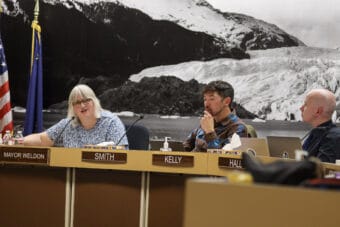
Juneau Assembly member and Eaglecrest Ski Area board liaison Neil Steininger speaks during a meeting at City Hall on Monday, Jan. 26, 2025. (Photo by Clarise Larson/KTOO)

The Juneau Assembly has stalled on deciding whether to disempower the Eaglecrest Ski Area’s board of directors until a joint meeting in March. 

Earlier this month, Mayor Beth Weldon proposed an ordinance to reduce the status of the city-owned ski area’s board from an empowered board to an advisory board. She cited the recent leadership turnover at the mountain and ongoing financial challenges.

At a committee of the whole meeting Monday night, Weldon further explained her reasoning for the proposed ordinance to the Juneau Assembly and the roughly 20 members of the public in the audience. 

“I’m literally trying to save Eaglecrest, and I think with the empowered board making the decisions, I don’t see the status quo changing,” she said.

Right now, as an empowered board, Eaglecrest has its own set of laws, rules and responsibilities. But, if it became an advisory board, members could only make recommendations to the Assembly. It would lose the authority to establish policies or make decisions without Assembly approval. 

At the meeting, Weldon argued the ski area needs more oversight, given the high amount of funding the city has funneled toward it in recent years, specifically on a new gondola project.

“If we are investing large amounts of money on things such as the chair lifts or maybe even the gondola, we want to have more of a say in how that money is spent, and currently, we don’t,” she said. 

In the coming years, the ski area is slated to run into a multimillion-dollar deficit. The deficit is a part of a plan to repair some broken and aging infrastructure while boosting pay to employees and preparing to operate year-round. 

Its expansion into summer operations relies heavily on the success of the gondola, which the ski area hopes to get up and running by the summer of 2028. However, many city leaders are worried the timeline — and cost — of the project will run far over what the board projected. 

The Assembly agreed to hold off on any decision-making until it holds a joint meeting with the Eaglecrest board on March 4. Assembly member and Eaglecrest Ski Area board liaison Neil Steininger said he thinks that’s the best option. 

“I think we owe it to everybody in the community to have a joint meeting with the Eaglecrest board to actually hash this out,” he said. 

The Assembly will then vote on whether to move the ordinance forward during a committee meeting on March 16.

Rolling dice after midnight: Late night leveling up at Juneau’s Platypus Con

Tim Mikulski (right) and friends play Flow of History at Platypus Con on Jan. 25, 2026. (Photo by Yvonne Krumrey/KTOO)

With almost 700 participants, Juneau’s annual board game convention sold out for a second time this year. Some people traveled from as far as Indiana and Massachusetts to play at Platypus Con. And the weekend-long event stayed open late — until the early morning hours. 

A lot of players were deep in their games late-night on Saturday. In Centennial Hall, a room full of people competed in a Euchre tournament. In the main ballroom, tables of friends and strangers tried new games while local businesses ran booths selling games they could take home with them.

At one table, Tim Mikulski and friends were diving deep into the annals of capitalism with a game called Flow of History. 

“It’s a card and also a coin economy game,” he said. “So we’re progressing from ancient societies forward. Right now, we’re discovering mercantilism, and yeah, it’s a good competition so far.” 

Mikulski spent most of the day at the convention; at midnight, he was about 10 hours in and counting.  

“We’re feeling ambitious for a late night, but I don’t know if I’m going to close it out,” he said. “Two a.m. feels real far away.”

Platypus Con Creator and President Josh Warren started the convention in 2015. About 130 people attended that first year and it’s since only gotten more popular. Some people come to qualify for state and national championships in games like Catan. 

“A lot of the other board game conventions are just named after the town they started in,” he said. “And I thought that was boring.” So Warren named the convention after his favorite animal instead. 

He was wearing platypus pajamas, fitting for the late hour, but he has other outfit options as well: “I have a platypus full suit with a blazer that I should be wearing because it’s warmer than this. And I do have a platypus mascot costume”

Warren said, after the convention, he’s actually traveling to Australia and New Zealand to see the elusive creatures in person.

Platypus Con President Josh Warren poses with a plush version of his favorite animal on Jan. 24, 2026. (Photo by Yvonne Krumrey/KTOO)

Back in the ballroom, Pat Race — who owns the games and comics store Alaska Robotics Gallery in downtown Juneau — ran a booth with his best friend and co-owner. The two of them played a game in between talking to attendees. 

“What a great event this is. The whole community comes out. It’s packed in here all day, and then you get these late night hours and this dwindling, sleepy crowd either hopped up on the chai from these guys over here or they’re cramming pizza,” Race said. “It’s just good, wholesome fun.” 

He said events like Platypus Con bring people together. 

“You get to spend time with people you maybe see in different contexts, and it takes away all that — I don’t know — we have these facades of professionalism, or the ‘getting through the Foodland line’ armor, and so it’s nice to have that all peeled away and just hang out,” Race said.

Barb Lake set down a very tall stack of games to return at the event’s game library, which housed all 2,540 games available to play at the convention.

Volunteer De Hennes restocks games at the Game Library at Platypus Con on Jan. 24, 2026. (Photo by Yvonne Krumrey/KTOO)

Her favorite was one called Hues and Cues. 

“It’s like a color matching game,” Lake said.” So somebody has to give you the color that’s on the board, and then everybody puts their chip as close to the color as they can get. It’s really hard, because your perception of what lavender is is very different than what your friends think it is.” 

For Lake, the convention has become an annual tradition. She and her husband have come for the last five years. 

“This is the event of the year for us,” she said.

She said it’s one of her favorite ways to spend time with her friends and meet new people. Learning how to play the games with other people, she said, can bring on a lot of different feelings.

“It is all of the emotions, so it’s frustrating, it’s confusing, it’s hard because you have to figure out how to play something totally new from the rule book, or you have to try and look up a video to learn how to play it,” she said. “So that part can be a challenge, and then when you get it and you like it, it’s like elation.”

Lake said they’ve ended up buying many of the games they’ve played at the convention, and now have their own game library at home to pass the time between conventions.

“We don’t drink, so we don’t go out to the bars. We’re not really, like, into a lot of the other events that go around in town,” Lake said. “But board gaming is what we do.” 

Barb Lake explores the game library, home to 2,540 games, at Platypus Con on Jan. 24, 2026. (Photo by Yvonne Krumrey/KTOO)

Juneau teens call on state lawmakers to halt Alaska LNG project

Members of the Alaska Youth for Environmental Action hold signs at the steps of the Alaska State Capitol in downtown Juneau on Saturday, Jan. 24, 2026. (Photo by Clarise Larson/KTOO)

Juneau teens and residents are calling on the Alaska Legislature and Gov. Mike Dunleavy to call off the state’s longtime push for a natural gas pipeline in Alaska. 

On Saturday, more than 40 people gathered at the steps of the Alaska State Capitol in downtown Juneau to protest the long-sought Alaska LNG project. The protest was led by Alaska Youth for Environmental Action, a youth-led environmental advocacy group with chapters across the state. 

Paige Kirsch is a senior at Juneau-Douglas High School: Yadaa.at Kalé and a member of the group’s Juneau chapter.

“I think it’s really important to be cognizant of the future of Alaska, especially because I do want to live here when I grow up, and I don’t want to live somewhere that’s purely for economic profit,” she said. “I just don’t think it’s really that fiscally responsible to keep investing in non-renewable resources.”

Alaska officials have been pushing for the proposed pipeline for decades and the state has already poured more than half a billion dollars into the project. If it’s built, the project would move natural gas from the North Slope to Southcentral for export overseas. A portion of the gas would be reserved for in-state use. The project has already been federally permitted. Last year, the Texas-based Glenfarne Group assumed majority ownership of the project from the state. 

Members of the Alaska Youth for Environmental Action write messages in chalk in front of the Alaska State Capitol in downtown Juneau on Saturday, Jan. 24, 2026. (Photo by Clarise Larson/KTOO)

Since then, it has announced a handful of nonbinding gas purchase and supply agreements. Last week, the company announced several more agreements it says moves the project’s first phase into an early development stage.

Proponents for the project say it would tap into an underdeveloped natural resource and provide energy security to a region facing shortfalls. But others remain skeptical about whether the project will actually be built, citing high costs and competing global energy projects.

At the protest on Saturday, multiple teens took to a microphone to share some of the negative impacts they believe the pipeline would bring, including bisecting land, disrupting habitat and emitting carbon dioxide. Atagan Hood, a junior at JDHS, says Alaska’s dollars would be better spent on renewable energy to mitigate human-caused climate change. 

“We are told that the 800-mile Alaska liquid natural gas pipeline is a bridge to a cleaner future, but you cannot build a bridge to a stable climate out of fossil fuel infrastructure,” he said. 

Last year, an Anchorage Superior Court Judge dismissed a youth-led lawsuit challenging the pipeline.  

There was one counter-protester at the event on Saturday. Kevin Nye, a retired engineer, stood on his own holding a sign that read “Build the Pipeline.” He said he wanted to represent those in Alaska who support the economic benefits the pipeline would bring to the state. 

Kevin Nye, a retired engineer, stands with a sign outside the Alaska State Capitol on Saturday, Jan. 24, 2025. (Photo by Clarise Larson/KTOO)

Glenfarne told reporters last week it expects to begin laying pipe later this year. But project skeptics say that the timeline is unrealistic. The company also initially said it planned to make a development decision by the end of 2025. That decision is now expected to come in February at the earliest.

Candlelit vigil lights downtown Juneau following Alex Pretti shooting in Minneapolis

Residents gather for a candlelit vigil at Overstreet Park on Monday, Jan. 26, 2026. (Photo by Clarise Larson/KTOO)

More than 200 Juneau residents gathered downtown at Overstreet Park Sunday evening for a candlelight vigil. They were there to honor a man who was fatally shot by a U.S. Border Patrol officer in Minneapolis, Minnesota, during protests against ongoing U.S. Immigration and Customs Enforcement operations. 

“There’s a lot of grief, there’s a lot of anger — and there’s also a lot of hope,” said Claire Richardson, a volunteer with ReSisters, a local group of women who work for social justice and equality. 

The crowd gathered just a few hours after the pop-up event was posted on social media by several advocacy groups in Juneau. 

Multiple local and state leaders spoke to the crowd as snow fell Sunday night, including Juneau Assembly member Maureen Hall. She says immigrants are the bedrock of the community. 

“Let us keep praying, let us keep speaking out, and let us keep standing in solidarity with those in the community that are too afraid to show up at something like this tonight,” she said. 

Juneau’s vigil on Sunday night joins a wave of vigils and protests in Minneapolis and across the U.S. that erupted over the weekend following the death of another person killed by federal officers during immigration enforcement protests. 

The man killed was identified as 37-year-old Alex Pretti, an intensive care nurse. His death marked the second person killed in Minneapolis during encounters with immigration officials amid a crackdown in the city. Just weeks prior, an ICE officer shot and killed 37-year-old Renee Good in her vehicle while the agency was conducting an operation in the city. 

The deaths have ignited fierce debates, with Minnesota and Congressional leaders pressing the Trump Administration over the facts and legality of actions by ICE officers as immigration enforcement ramps up across the country. 

In Anchorage and Fairbanks, residents gathered in similar protests this weekend, according to social media posts. U.S. Sen. Lisa Murkowski, along with other congressional Republicans, has called for an investigation into Pretti’s shooting. 

Juneau Rep. Andi Story prioritizes education and housing this legislative session

Rep. Andi Story, D-Juneau, speaks during a House Education Committee meeting on May 3, 2024. (Eric Stone/Alaska Public Media)

With the second regular session of the 34th Alaska Legislature under way, it’s a good time to check in with members of Juneau’s delegation.

Morning Host Mike Lane recently sat down with Representative Andi Story to learn what’s on her agenda for this session.

The following transcript has been lightly edited for clarity.

Mike Lane: The second regular session of the 34th Alaska legislature has just begun. What are your top priorities for this session?

Rep. Story: My top priorities for this session have to do with keeping our young people here, cost of living, housing is really important. And of course, education and ferries, ferries, ferries.

Mike Lane: Speaking of education, you pre-filed a bill on education funding, House Bill 261. Can you give us a brief explanation of what the bill would do if passed?

Rep. Story: Well, if you’ve been living in Juneau for a long time, you know that our education funding is backwards, that we do not get our numbers to our school districts till, like, June after the session is over. And so they are not being able to give contracts to their teaching staff, to staff at all. And so they’re living in limbo, and they leave us or we can’t maintain them. And so this bill has us do our funding a year early, where they get the number. It takes the average of the last three years student count or your last prior year student count, so whichever is greater, so we will give more stability to school districts. So that’s just critically important. And this came about because I’m on the task force for education funding. We’ve been reviewing. If you are an independent school district, you have your own taxing authority. They usually take the current year and the prior two years. But we cannot raise our own revenue. We are dependent upon what the state does and our municipalities. It allows us to focus on student achievement and not redoing budgets, and not put our community in chaos because we have to predict all this out. We don’t know our number, so I want to give confidence to our school funding budget process. 

Mike Lane: So what is your plan for getting this bill passed?

Rep. Story: I co-chair education. I’m starting to talk to people about it. I have an advantage that I’m on the task force, and so people have read that report, they’re, they’re aware of that, but just have a lot of talking to do. But people have been living this roller coaster of instability for funding for school districts, so it’s not going to be a surprise for them that we’re trying to stabilize this.

Mike Lane: What other bills have you sponsored or co-sponsored that you think could get traction or succeed this session?

Rep. Story: Well, I’m really hoping my bill, which is in house rules, on housing investments, where [Alaska Industrial Development Economic Association]will be allowed to do workforce housing, give developers loans for workforce housing of five dwelling units or more. This has been critical. We have to move on housing. There are a few things that [Alaska Housing Finance Corporation] does, but this is something AIDEA  could do that would really help developers. 

Mike Lane: How can Alaskans inside and outside of Juneau get a hold of you?

Rep. Story: 907-465-3744, of course. I’m on the website, but calling is really good. And I very frequently do Zoom meetings, you know, phone calls. And I do that with Alaska residents too. Juneau residents who do not want to drive and try and find parking downtown, they just call and we set up a meeting. So please call, please email. That is probably the number one thing we have to do is bring the community, the state in on our policies, and get their voices heard. And so I like to hear what people really want me to be working on

Mike Lane: To wrap up: As one of Juneau’s representatives, what do you see as your ultimate duties and responsibilities to the people of Juneau and all of Alaska?

Rep. Story: Really, to meet our constitutional obligations because it is so important — the people of the state. We have a lot of resources in the state. The biggest resource we have is each of us, is the people. So we want to try and bring that voice up to the the capitol that it’s important our human resources and how are we making sure we have quality of life here.

Site notifications
Update notification options
Subscribe to notifications