Juneau

Eaglecrest board pushes back against Juneau mayor’s plan to diminish its power

Snow covers the Eaglecrest Ski Area’s Fish Creek lodge on Dec. 10, 2023. (Photo by Clarise Larson/KTOO)

Eaglecrest Ski Area’s board of directors is pushing back against the mayor’s proposal to remove most of the board’s decision-making authority. This comes after recent leadership turnover at the mountain and ongoing financial challenges.

Last week, Mayor Beth Weldon told the Juneau Assembly she asked the city’s attorney to draft an ordinance to reduce the status of the board from an empowered board to an advisory board. The Juneau Assembly will discuss the draft ordinance at its committee of the whole meeting on Monday evening. 

As an empowered board, Eaglecrest has its own set of laws, rules and responsibilities and makes decisions without direct Assembly oversight. If it became an advisory board, members could only give advice or make recommendations to the Assembly. It would lose the authority to establish policies or make decisions without Assembly approval. 

“As we know, they’re having major financial issues, and I just think the city needs to have more oversight over what’s happening to Eaglecrest,” she said. “I think the government is standing in its way right now, and it needs to be changed.”

But, at a special meeting on Thursday evening, Eaglecrest’s board moved to draft a letter to the mayor and Assembly asking to remain an empowered board. The board intends to finish the letter this weekend, in time for the Assembly discussion during its committee of the whole meeting on Monday. 

Board member Jim Calvin said remaining an empowered board is in the community’s best interest. 

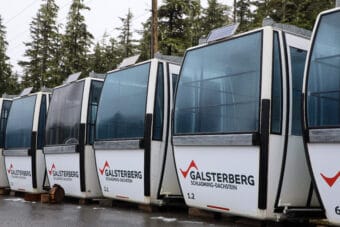
“The board is deeply engaged in gondola planning work, and we’re deeply engaged in recruiting a new GM (general manager),” he said. “We’re initiating some business planning work, and all of that is at risk of completely derailing if we’re not an empowered board.”

The tension between the Eaglecrest board and the mayor comes after the ski area’s general manager resigned and the board chair stepped down earlier this month. Eaglecrest has also had several issues with its facilities that sullied the beginning of its season, including a broken water line and issues keeping Ptarmigan lift open. 

Eaglecrest is expected to run into a multimillion-dollar deficit in the coming years to repair some broken and aging infrastructure, while boosting pay to employees and preparing to operate year-round. Its plan toward financial stability relies heavily on revenue from the gondola, which the ski area hopes to get up and running by the summer of 2028.

According to the board, the city plans to post the general manager position online next week, which will remain open until it’s filled. 

Mary Peltola to make stop in Juneau for U.S. Senate campaign launch

U.S. Rep. Mary Peltola smiles for a photo at a meet and greet in Juneau on Saturday, Jan. 27, 2024. (Clarise Larson/KTOO)

Former Alaska Congresswoman Mary Peltola will be in Juneau Friday evening at the Crystal Saloon bar downtown to celebrate her campaign launch for U.S. Senate. 

Last week, she announced she’s running for U.S. Senate against Republican incumbent Senator Dan Sullivan. 

Peltola, a Democrat, served both a partial and full term in the U.S. House until the 2024 election, when she narrowly lost her seat to Republican Nick Begich. She became the first Alaska Native person elected to Congress when she won the 2022 special election.

Peltola has historically seen strong support from Juneau. During the 2024 election, Peltola outpaced Begich in every Juneau precinct – even in the precincts from the Juneau International Airport to Mendenhall Valley that went for Trump, according to the Alaska Division of Elections.

Her bid for the congressional seat, if successful, would give Democrats a shot at winning a majority in the Senate.

Her meet and greet will be at the Crystal Saloon on Front Street, Friday evening from 5 p.m. to 7 p.m.

New city survey seeks public feedback as Juneau faces multimillion-dollar budget hole

People walk past City Hall in downtown Juneau on Thursday, Jan. 22, 2026. (Photo by Clarise Larson/KTOO)

The Juneau Assembly is bracing for a tough budget season in the coming months. 

That’s because during last fall’s municipal election, Juneau voters approved municipal tax cuts that created a multimillion-dollar recurring hole in the city’s budget.

The city’s next fiscal year begins on July 1 of this year. Starting then — and every fiscal year moving forward — the city will face an estimated $10 to $12 million in revenue loss in its general fund. That’s due to the tax exemption on food and utilities and a cap on the city’s property tax rate that voters passed. It’s now up to the Juneau Assembly to figure out how to mend that gap. 

Earlier this week, the city released a survey asking residents to help inform the Assembly as it decides in the coming months how to move forward with the budget. Christine Woll is on the Juneau Assembly and is its finance committee chair. During KTOO’s Juneau Afternoon show on Tuesday, she said the survey is meant to be tough. 

“We want people to be a little bit in our shoes in terms of having to make hard decisions about priorities,” she said. 

The survey asks residents to pick what city programs and services are most important to fund and to pick what services to reduce funding for. The list includes programs like libraries and museums, trails and parks, and homeless services. 

This is a graph of the City and Borough of Juneau’s general fund operating expenditures. (City and Borough of Juneau)

The survey also asks what values they want the Assembly to prioritize, like whether to keep taxes low, continue to support local business year-round, or fund affordable housing projects. 

The survey broadly lists programs, services and values. That’s by design, said Phil Huebschen, an engagement specialist with the city’s communications department. He said the survey is meant to simplify the complexities and nuances of the city’s $478 million budget so it is digestible for everyday residents. 

“We’re trying to reposition all of this really complex data and information as really simple values information that people can understand,” he said. 

The survey also includes some budgets that the Assembly doesn’t necessarily have direct control over, like the airport and hospital, which have their own boards and operate like businesses. But, Huebschen said, the information is meant to guide the Assembly as they make decisions during the budget cycle. 

“We’re hoping that they’ll have a compass, so to speak, of what kind of areas in terms of city services, the broad public of Juneau kind of values the most, and where they’re willing to make trade-offs,” he said. 

Assembly member Woll explained that budgetary cuts aren’t the only way to mend the deficit. There are other options too, like increasing revenue using bonds, increasing sales taxes or user fees. The survey asks respondents what option they’d be comfortable seeing implemented. 

“There are lots of different ways to address revenue reductions. You can figure out other ways to increase revenue,” Woll said. 

Along with the survey, the city plans to host three community workshops and two Assembly listening sessions on the budget. The first workshop is at the Filipino Community Hall on Feb. 18, the second at the Valley Library on Feb. 24, and the third at the Douglas Library on March 3. Each workshop starts at 5:30 p.m. The city hasn’t posted details on the listening sessions yet.

The survey is open until mid-February and respondents are eligible for several prizes, like an annual city bus pass or a two-night stay at Hilda Dam Cabin. 

The city manager will release the draft city budget in March. The Assembly must finalize its budget before July 1.

Juneau Rep. Sara Hannan talks about what a successful session looks like

Rep. Sara Hannan, D-Juneau, smiles for a photo at KTOO on Wednesday, Jan. 14, 2026. (Photo by Clarise Larson/KTOO)

With the second regular session of the 34th Alaska Legislature just kicking off, it’s a good time to check in with members of Juneau’s delegation to talk priorities and plans for the session. Rep. Sara Hannan (D-Juneau) spoke with KTOO’s Mike Lane last week just before the session started. 

The following transcript has been lightly edited for clarity.

Mike Lane: How you are feeling about going into the second regular session of the 34th Alaska legislature?

Rep. Hannan: Well, you know, I came out of a education background, so I always like to say the start of session feels like returning to school and, you know, seeing friends you haven’t seen for a while. It’s always a good pace, of course. As a junior representative, this is my year-round office. I’m in the Capitol Building 12 months a year. But it gets kind of quiet in the fall, you know. The summer, we have all those summer visitors, but the pace has picked up. The building’s alive with new people, bright eyes, all the college interns who are, you know, here to to change the world in 120 days. And that’s always really good energy.  

Mike Lane: Is there anything that you are particularly looking forward to for this session? And is there anything that you’re not looking forward to for this session?

Rep. Hannan: Well, we have got to address our big fiscal issues in this state and we have got to figure out a path to pay for the things we need. Things haven’t gotten cheaper and our disasters have continued to grow in cost and scope, and keeping the lights on will be a struggle, but we have got to keep the state functional and the roads plowed and the ferries running and schools operational and public safety people eligible to respond and get people working in Alaska, keep people working in Alaska. So there are a lot of tough political discussions to have, and it’s the second half of a two-year session, so it makes it a challenge to get complex policy addressed, and then it’s a big political election year. You know, as a member of the House, every two years is an election year, but this is one of those where it’s gubernatorial and, you know, a high profile U.S. Senate seat, as well as every member of the House of Representatives.

Mike Lane: When it comes to the budget, where do you believe cuts are necessary?

Rep. Hannan: I don’t see a lot of areas for cuts. We have squeezed and cut the budget for over a decade, and so when we start talking about cuts, we are talking about basic services not being able to be delivered that people have an expectation of. You know, we can’t put more equipment on the road to keep our roads plowed without paying workers to drive them. And we compete with private sector. You know, operators and engineers, they can go to the private sector and make more money, and in variety of places, we can’t keep up with the services we need, so I don’t see a lot of places to cut.

Mike Lane: And what does a successful session look like for you? 

Rep. Hannan: Well, when it comes to personal legislation, you always want to see improvements on that. If I could get House Bill 242 passed, that would be good. I see this as a bill with very little policy dispute because it’s very narrow in scope. We’re modernizing the sexual assault consent in this from knowing to unknowing being irrelevant. I think that in the 21st century, we understand the dynamics about how people respond in sexual assault cases and make it prosecutable, because it’s pretty horrific that medical providers could assault someone and not be prosecuted. I have a couple pieces of personal legislation that I think we can get passed. Tax on vape tobacco – that’s a bill I’ve been sponsoring since I first got in, but the Senate version of it is sponsored by Senate President Gary Stevens; that’s Senate Bill 24. It’s all the way over in House Finance. I believe that we are positioned to get that because, right now, vaped nicotine in Alaska is not taxed by the state. Our tax state statutes on tobacco specified type, so cigars, cigarettes, chew, snuff, et cetera, and the last time we amended that statute, vaping wasn’t a thing, so it’s not listed. Then there’s a little bill of just sort of local interest on charitable gaming, a snow classic, that we’ve gotten out of the house and is in the senate. We have charitable gaming in Alaska, classics being, you know, the Nenana Ice Classic is the one that people most know about. A fiscal plan would be helpful; that would be that would be a real success. But that’s pretty optimistic for 120 days.

City and Borough of Juneau announces new fire chief

Capital City Fire/Rescue’s new fire chief, Thomas Hatley, during a public presentation in Juneau on Tuesday, Dec. 16, 2025. (Photo by Clarise Larson/KTOO)

Alaska’s capital city will soon have a new fire chief. 

The City and Borough of Juneau named Thomas Hatley as Capital City Fire/Rescue’s new fire chief on Friday afternoon. His first day will be Feb. 9. 

He was one of the two finalists for the position to replace longtime fire chief Rich Etheridge, who retired at the end of December after more than 15 years leading the department. 

Hatley served as the deputy chief for the Spokane Valley Fire Department in Washington until April of this year, when he left due to a family medical reason. He has more than three decades of experience in fire service, holding positions like fire chief, assistant chief and fire marshal at multiple agencies in the Northwest. 

During a public candidate presentation in Juneau in December, Hatley said he was drawn to the position because of the complexities of Juneau’s fire and emergency medical services needs. He pointed to its lack of outside support, large service area and seasonal population surges. 

Hatley said he wanted to see the department focus on resolving its staffing issues, especially by retaining the department’s employees. The Juneau Career Firefighters Union is currently at an impasse in its negotiations over a new contract with the city. Union representatives say uncompetitive wages and staffing shortages are driving people away from the department.

The annual salary listed on the city’s website for the position is between $125,944 and $161,761.

Cindy Carte, the city’s human resources manager, is currently serving as acting chief.

Juneau School Board delays returning $1 million to the city due to questions about after-school child care

A green metal play structure with two slides on a blue rubber flooring.
The Harborview Elementary School playground on July 9, 2025. (Photo by Jamie Diep/KTOO)

The Juneau School Board held off on returning $1.05 million in funding earmarked for child care to the City and Borough of Juneau this week amid questions about the current privately-run program and the possibility of an additional operator in the future.

Board Vice President Elizabeth Siddon said at a meeting Tuesday she still has questions around how things are going with Auke Lake Preschool, like the status of its state licensing. Auke Lake Preschool started running an after-school program at the beginning of this school year after the district stopped operating its own.

“I just think we’re not ready, especially in a final reading, to make this decision,” Siddon said. “We don’t have all the information about the programs and what options we have for kids at all of our sites.”

Siddon said there is also a possibility for YMCA Alaska to expand its child care program to Juneau, and that the city funding might be able to be used for that.

Nate Root is the CEO of YMCA Alaska. The organization currently runs after-school child care in Anchorage, the Mat-Su Borough and Kodiak.

In an interview with KTOO, Root said YMCA is looking into how feasible it would be to expand its after-school program to Juneau. He toured three schools last year and said the organization is working on surveys to see how many families are interested in the program.

He said running a program depends on how financially sustainable it will be. And it will still take a while to get licensed by the state if they move forward with starting a program in Juneau.

“To be completely transparent, it would look like the soonest we would open a program would be the beginning of the 26-27 school year,” he said.

Derik Swanson is the co-owner of Auke Lake Preschool, which runs the current after-school child care program out of Harborview Elementary, Auke Bay Elementary and Sít’ Eetí Shaanáx̱ – Glacier Valley Elementary.

He said in an interview Friday that the program is still currently unlicensed. Swanson said staffing issues have delayed the process, but with those now resolved, he plans to keep working on getting licensed.

“It’s been pretty successful overall,” Swanson said. “It was kind of a rush to get the program started and up and running, but now it seems to be running fairly smoothly.”

Swanson was unaware of the potential for YMCA to expand to Juneau, but said child care providers in the city generally work together to meet the high demand.

The school board unanimously agreed to discuss the state of the after-school child care program and the remaining city funding at its facilities committee meeting on Feb. 3.

Site notifications
Update notification options
Subscribe to notifications