Juneau

Under Dunleavy proposal, Juneau residents might pay sales tax on food and utilities again

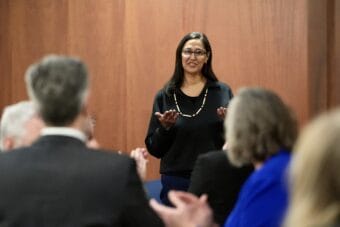
Gov. Mike Dunleavy speaks during an Alaska Chamber luncheon in Juneau on Wednesday, Jan. 28, 2025. (Photo by Clarise Larson/KTOO)

Juneau residents might have to pay sales tax again on food and utilities, despite approving a local exemption during last fall’s municipal election. 

That’s because Gov. Mike Dunleavy recently proposed a statewide sales tax as part of his fiscal plan meant to stabilize the state’s finances. 

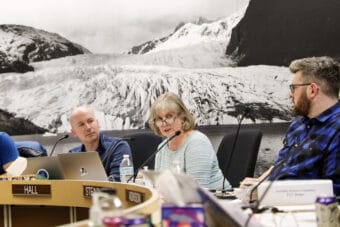
At a community town hall event Thursday evening, Juneau’s three state lawmakers weighed in on the governor’s plans and other topics at play this legislative session. Democratic Juneau Sen. Jesse Kiehl said the governor’s sales tax proposal, as written, would override Juneau’s local exemptions.

“The governor’s proposal would be to override that and to allow no variation,” he said. “I think that’s a bad choice, especially because it impacts people with a sales tax who struggle most to get by.”

Juneau residents attend a town hall event with Juneau’s legislative delegation at the Mendenhall Valley Library on Thursday, Jan. 29, 2026. (Photo by Jamie Diep/KTOO)

Dunleavy’s proposed sales tax – Senate Bill 227– would follow a seasonal structure, set at 4% from April through September and 2% for the remainder of the year. That would be on top of Juneau’s existing 5% sales tax on most items. If passed, the state sales tax would expire in 2034 and provide between $735 million and $815 million of revenue to the state each year.

The governor’s proposal might sound familiar, because this past municipal election, the Juneau Assembly proposed implementing a similar seasonal sales tax at the local level to take advantage of the 1.7 million cruise passengers that come to town each summer. While voters shot that down, they did approve an exemption for essential food and residential utilities from local sales tax. 

Kiehl said he thinks a moderate state income tax would be a fairer way to raise additional revenue for the state while not disproportionately affecting low-income residents. At the town hall meeting, Democratic Juneau Rep. Sara Hannan agreed. She said Alaska needs to stabilize its revenue with its expenditures. 

“A state sales tax on top of local sales tax makes things really burdensome,” she said. “But right now, this is the first time we’ve been able to get the governor to use the word tax and not choke, so that’s a step forward.”

Some Alaska Senate leaders have said they’re skeptical the governor’s plans will pass the Senate this year. Leaders in the state House similarly said they’re not optimistic Dunleavy’s plans will pass this year, which is his last as governor. The House Finance Committee plans to hear public testimony on the tax proposal at 5:30 p.m. Thursday, Feb. 5.

KTOO’s Jamie Diep contributed to this report. 

Juneau Assembly asks View Drive residents to help pay for their own buyout after years of outburst flooding

The Mendenhall River surrounds homes on View Drive in the Mendenhall Valley on Tuesday, July 22, 2026. (Photo by Clarise Larson/KTOO)

The City & Borough of Juneau tip-toed toward a federal buyout program for homeowners on View Drive this week, a street that’s been hit the hardest by annual glacial outburst flooding. The city’s asking those residents if they’ll help pay for it.

Eighteen homes line the forested cul-de-sac on View Drive, which extends into the Mendenhall River like a peninsula. They’re located beyond the temporary levee the city built last year, which protected hundreds of homes during the record flood in August. 

The buyout program, through the Natural Resources Conservation Service, or NRCS, would cost roughly $25 million if every household participates. The federal government has offered to cover three-quarters of the cost. The local portion could be around $6 million. 

City Manager Katie Koester spoke about it at a Juneau Assembly finance committee meeting on Jan. 7.

“The project would be a buyout of up to 18 homes on View Drive, and those homes would need to be demoed and turned into parkland in perpetuity,” she said. 

The city sent an informal ballot and letter to View Drive residents on Wednesday, asking if they’d be willing to give up hundreds of thousands of dollars from their home payout to shoulder that local portion. But it’s still unclear how this would work. In exchanges with KTOO, staff from the federal agency and the city explained it differently. 

Tracy Robillard, a spokesperson for NRCS Alaska, said in an email that state governments typically sponsor the 25% cost-share — including in New Jersey and Connecticut, and upcoming projects in New Mexico and South Carolina — where state environmental protection agencies have programs to purchase floodplains. In other cases, city governments have paid the local portion, Robillard said. 

Brett Nelson, Alaska’s watershed program manager at NRCS, said at the committee meeting there is another option.

“The more likely route would be some sort of third party coming up with the 25% local cost share,” he said. 

That third party could be a nonprofit. City staff spoke with the Southeast Alaska Land Trust back in July, but leaders there said they can’t commit millions of dollars in such a short time frame. 

NRCS hopes to offer the buyout before the next flood, expected this summer, Nelson said.

The U.S. Army Corps of Engineers is working on an engineered solution that would protect the whole Valley, but it’s still years away. In the meantime, homes on View Drive are expected to flood again and again. Some residents have said that leaving feels like their only option. 

“That’s an individual decision for those property owners, whether or not to, you know, take their chances and wait for an enduring solution,” Koester said at the meeting. 

If the buyout program moves forward, homes would be appraised at their 2024 value, prior to the flood that year. 

The city is asking residents to submit their informal ballots by Feb. 16, and plans to discuss the results at a Juneau Assembly committee meeting on Feb. 23. 

Juneau residents call to defund ICE at rally downtown following killings in Minnesota

Ariel Hasse-Zamudio urges protestors to call their representatives. (Photo by Alix Soliman/KTOO)

More than 200 people gathered in the capital city Thursday to speak out against U.S. Immigration and Customs Enforcement, or ICE, following recent killings of two citizens in Minneapolis. 

Juneau resident Denali Marin organized the noon rally outside the courthouse, where protestors brought salt and chanted, “Melt ICE.” 

Marin listed some of the people who have lost their lives at the hands of ICE officers, including U.S. citizens Alex Pretti and Renee Good. Dozens of others have died while in custody in recent months. 

“I want to be very clear about what we’re asking for today, not vague statements, not calls to lower the temperature and not investigations that lead to nowhere,” she said into a microphone on the plaza steps. “Today, I’m calling on our national leaders to act.”

She and other speakers at the event called for leaders to defund ICE and impeach Homeland Security Secretary Kristi Noem. 

On Thursday, seven U.S. Senate Republicans joined Senate Democrats to block a funding bill that would have included $10 billion for ICE. Senators Dan Sullivan and Lisa Murkowski were not among those Republicans; instead they voted in favor of the funding bill. But Murkowski said this week that Noem should resign.

Protestors hold a large banner urging senators to stop funding ICE. (Photo by Alix Soliman/KTOO)

Local advocate Ariel Hasse-Zamudio encouraged attendees to call Alaska’s congressional delegation. 

“Dan Sullivan, Lisa Murkowski, Nick Begich, we need to call them and hold them accountable,” she said. 

Emma Sulczynski, a student at the University of Alaska Fairbanks, took the microphone to urge people to get involved in other ways. 

“There is a nationwide strike — strike on going to school, going to work, and on spending,” she said, referring to the national anti-ICE strike planned for Friday. “You don’t have to do all of these things, but whatever is accessible for you, please stand in solidarity with the brave people in Minneapolis and in the rest of our country who are resisting day and night.”

She also urged people to boycott corporations that support ICE.

Representative Sara Hannan and others sing along to a song written by an organizer. (Photo by Alix Soliman/KTOO)

Budding Juneau muralists learn the ins and outs of public art through new workshop

A teenager wearing glasses and a gray sweatshirt paints a large orca.
Maddox Rasmussen paints a mural of an orca at the Juneau Arts and Culture Center on Jan. 25, 2026. (Photo by Jamie Diep/KTOO)

Listen here:

Murals will soon adorn the Marine View building parking garage near Juneau’s cruise ship docks. 

It’s part of a project years in the making that teaches local artists about the legal and creative sides of murals.

Maddox Rasmussen washed paintbrushes in between sections of a mural he was working on at the Juneau Arts and Culture Center on a recent Sunday afternoon. The Juneau-Douglas High School: Yadaa.at Kalé junior was painting a realistic orca swimming through the tendrils of an ethereal kelp forest. Rasmussen finished the orca’s fin and moved to a section of its body that’s white. 

“I like blending on the palette or on the piece itself,” he said. “So sometimes, if I have leftover blue in a section that I want to be more white, it’ll mess it up.”

Rasmussen is one of 13 artists participating in a workshop to create murals in downtown Juneau. It’s the first time he’s worked on a large project like this. But art is not his only interest: he also swims competitively and works as a lifeguard.

He said it’s been a bit difficult to make time for the project on the weekends while balancing his other interests. He had a swim meet earlier in the day.

“It’s definitely a little hard, because the swim meet lasts all day, so I have to sacrifice the finals to come here,” he said. “But it’s okay.”

Rasmussen’s project is sandwiched between two artists along the wall of the JACC. Every mural has a different style – one artist is experimenting with spray paint and another carved a massive block print. The designs vary from folk art to landscapes and wildlife.

Each mural is 8 feet wide and 4 feet tall. Altogether that’s more than 100 feet-worth of new art for downtown Juneau.

Rio Schmidt, dressed in a baseball cap, fills in a large block print mural with black paint.
Rio Schmidt fills in a large block print mural with black paint at the Juneau Arts and Culture Center on Jan. 25, 2026. (Photo by Jamie Diep/KTOO)

Dezarae Arrowsun is at the helm of the project, which is a collaboration between her business, the Downtown Business Association, the Juneau Arts and Humanities Council and Princess Cruises.

Arrowsun owns Picture This, a custom frame shop in downtown Juneau with a view of the concrete walls of the Marine View parking garage that will be the future home for the murals. She said the idea came from wanting to beautify space downtown outside of her store, and she turned it into an opportunity to teach local artists more about mural making.

“A lot of the things that are very intimidating to artists is the permit process, the legal side of it, contractual side of it, and then site preparation. What do you have to look for as warning signs, those kind of things,” Arrowsun said. “So that’s how we came about this.”

The artists don’t get paid. Instead, they get education and materials, including large sheets of plywood that are treated to withstand the elements. After a year the murals will come down and the artists can either keep or sell their work.

Arrowsun said she put a lot of thought into making sure the murals will last an entire year in the Southeast Alaska elements. She said she wants it to be art for the community as a whole, not just something for tourists.

“I want us in Juneau to appreciate it all winter long, especially when it’s dark and, you know, we need some brightness and some beauty,” she said.

Arrowsun has a three-year contract with the Marine View owners and plans to run the workshop again next year. She said they plan to take applications this September.

Lillian Egan is another artist in the workshop. They work at the Pottery Jungle as a ceramic studio assistant, and have had their art featured around Juneau in the past. They’re painting a landscape with a little bit of fantasy added to it.

“I was thinking of, you know, what it’d be like to be up at Gold Creek, and kind of being the salmon in the river and coming up,” Egan said. “But also being able to be aware of the city in the backdrop and seeing the channel in the distance and stuff, but kind of seeing it from a perspective of, ‘This is what Juneau is.’”

A person dressed in a blue sweatshirt sits cross-legged on the floor and paints a mural.
Lillian Egan sits and paints a mural at the Juneau Arts and Culture Center on Jan. 25, 2026. (Photo by Jamie Diep/KTOO)

They said it’s been fun to do more community art and they feel the city needs more of it.

“It’s been really cool to find out that it is kind of attainable for people, even in Juneau, to do community art and … have it like, actually support you financially,” they said.

In the future, they want to use their newfound skills to create more art in the community.

“How can I apply that into ways that can help our community more? I don’t know. I think about our recycling center right now, and how could I maybe make a mural like this, but with recycled materials in the future, would be pretty cool,” Egan said.

The murals are going to be installed in late April, with a celebration taking place May 1.

It could be weeks before Juneau residents can recycle again

Cardboard and other recyclable materials stack in a pile at Juneau’s recycling center in Lemon Creek. (Photo courtesy of Stuart Ashton)

Juneau’s recycling center is closed again in order to repair damaged critical equipment. 

It could be quite a while before the center opens back up again, according to Denise Koch, the city’s director of Engineering and Public Works.

“Recycling is a really important service, and we recognize that the people of Juneau really value this service,” she said. “What we are doing right now, we hope that we’re talking about a timeframe of weeks.”

The city contracts with Waste Management — the private company that runs the landfill — to operate its recycling program in Lemon Creek. The center has been closed on and off since late December, after Juneau was hit with back-to-back record-breaking snowstorms. That inundated the open-air warehouse with a backlog of materials to process. 

A sign sits in the snow outside Waste Management’s Capitol Disposal Landfill on Wednesday, Jan. 28, 2025. (Photo by Clarise Larson/KTOO)

The closures have left many residents and businesses without a place to recycle. That’s a problem, Koch said, because the alternative to holding onto the recyclables is to throw them in the landfill, which is estimated to run out of space in the next decade. She said having the city’s recycling program up and running again is crucial to extending the landfill’s life. 

The closure is due to multiple issues with the recycling baler, Koch says. The baler is the machine that compresses the recyclables into blocks, which are then shipped by barge to recycling facilities in Seattle that repurpose the materials. Koch said it’s the most critical piece of equipment for the center to operate. 

“We’ve identified three different problems with the baler. So we’re trying to solve three problems, and that’s part of why we are working as quickly as we can to try and solve those problems,” she said. “But, it’s challenging to identify a date certain when all three problems will be solved.”

In the meantime, Koch recommends people hold onto their recycling as long as they’re able before they opt to throw it in the garbage. She said the city will provide updates about the status of the center as it becomes available.

Juneau’s new avalanche advisor started right before recent evacuations

John Bressette, the city’s avalanche advisor, smiles for a photo under Mount Juneau on Wednesday, Jan. 28, 2026. (Photo by Clarise Larson/KTOO)

John Bressette is Juneau’s new avalanche advisor, tracking weather and avalanche risk in the capital’s urban paths. He joined the city just before record snowfall, followed by rain and flooding, pushed the community to declare a disaster and issue evacuation advisories downtown.

KTOO’s Mike Lake spoke with Bressette about navigating that moment and what first drew him to avalanche forecasting.

Listen:

The following transcript has been lightly edited for clarity.

Mike Lane: You’re not new to forecasting avalanches. How did you get your start in this field?

John Bressette: Well, I grew up here in Juneau, and I started going heli-skiing with my friends when I was about 18 years old, and decided I better start learning about avalanches to make sure I knew what I was doing. So I took my first avalanche class here through Bill Glude, who is a longtime avalanche specialist in Juneau and worked on some of this urban stuff a long time ago. Took some classes with him, helped him out with some research projects, and started working for him under Alaska Avalanche Specialists. And in the beginning, he had a contract with AEL&P to do forecasting for them. We also worked out at Kensington Mine and kind of helped develop the program they have going out there now and then I worked for AEL&P directly for a long time under Mike Janes as an avalanche tech assistant forecaster. 

Mike Lane: Where did you work before CBJ?

John Bressette: Well, I was doing backcountry forecasting for the Coastal Alaska Avalanche Center. And still am trying to balance both of those for now. It depends on the time of year; I’m a commercial fisherman in the summer, heli-ski guide in the spring and avalanche forecaster in the winter.

Mike Lane: So this isn’t a full-time position with CBJ. This is more of a seasonal?

John Bressette: Yeah, seasonal for now, and we’ll see how it plays out moving forward.

Mike Lane: Immediately, when you started working at CBJ, you were immediately right in the midst of of a disaster, so what was it like to experience that kind of timing?

John Bressette: Yeah, it was intense right off the get go there. So there wasn’t a whole lot of learning on the job. It was right into it. But I feel like everybody at CBJ was really good to work with, and we kind of seamlessly moved into a pretty good workflow, and were able to kind of make decisions on the fly and keep the public informed of what was going on, and I hope that went well from their perspective.

Mike Lane: What are some misconceptions people have about avalanche danger?

John Bressette: Oh, some of the big myths in the avalanche world are that loud noises can set off an avalanche, which is untrue. I think maybe one of the others is that we can predict how big or how far an avalanche will run. And that’s one of the real tricky points to avalanche forecasting, is not knowing how big or how far an avalanche will run during a given avalanche cycle. So it’s — the science behind it is coming a long ways, but it will always be an unprecise science as far as predicting the size of avalanches.

Mike Lane: Do you have any advice that you could give to those folks who are heading into avalanche terrain in the backcountry?

John Bressette: Yeah, so that’s, I want to make it clear that you know forecasting for the urban danger is much different than forecasting for the backcountry, which I do both. So I’m happy to speak on both, but it’s a completely different thing when you’re talking about people traveling into avalanche terrain, you’re looking more at human-triggered avalanches, whereas in the urban, especially in a place like Behrends, where we can’t do control work, you’re looking at more natural avalanches. So yeah, the advice for people, if they’re heading into avalanche terrain is to take an avalanche class, get some education, find the right mentors and group of people that also practice safe habits and just get yourself educated and find the right people to travel with. 

Mike Lane: And what about equipment? 

John Bressette: Yeah, with equipment. I mean, the bare minimum you want to have is a beacon, probe, shovel, partner — and know how to use those things, too. You know, it doesn’t do you any good if you don’t know how to use the equipment. So getting comfortable with those specific tools are kind of the bare minimum that you need to travel safely in the backcountry.

Mike Lane: Okay. And as far as avalanches go, what do you think we could improve on, CBJ specifically? Are there any lessons to be had that we should know about?

John Bressette: Yeah, I think that having more monitoring tools and using technology that’s come a long way for avalanche and weather monitoring is something we’re pushing really hard to get done. Right now, we’re working with AEL&P and DOT to put together a weather station on Mount Juneau, or, I should say, rebuild. There was one there previously, but we’re kind of revamping it and getting it live again, as well as, thanks to the state and the governor’s office, through this disaster declaration, we were able to buy what’s basically an avalanche radar. So it points at Mount Juneau, and we can now detect when avalanches happen at night or during foul weather. So that’s a really useful tool for us to kind of know when activity starts if we can’t visually see it or hear it. So I think those two things are going to have huge, huge benefits down the road when we enter this kind of avalanche cycle again.

Mike Lane: Are there any hot spots right now that you look at today? You step outside and you look up and you go, Hmm, that’s something we want to keep an eye on, more so than these other areas?

John Bressette: Yeah. I mean, I would say that the Behrends and the White Subdivision pass, the Bartlett pass. Those are our three big ones. Debris came a lot closer to people’s homes and the roads than than we previously thought. So you know, there was debris within 10 feet of a couple homes and on Thane it came down under the power lines and was within 100 feet of Thane road and stuff like that. So, yeah, I would say, when we get a big snow cycle like that, there’s, you know, places that we don’t typically think of the hazard being high that actually came pretty close. So those are the reasons we got people out of their homes. And yeah … I hope that comes through, that people’s safety was of the utmost importance.

Site notifications
Update notification options
Subscribe to notifications