Alaska

Dunleavy introduces sales tax, new dividend formula and other pieces of fiscal plan

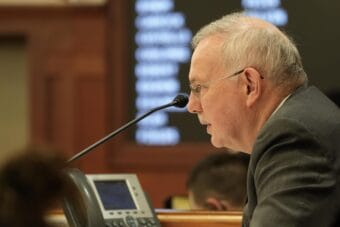
Man in grey suit standing behind microphones
Gov. Mike Dunleavy speaks to reporters during a news conference on May 19, 2025. (Eric Stone/Alaska Public Media)

Gov. Mike Dunleavy introduced a series of bills on Friday and Monday that he says would stabilize the state’s finances. The most prominent pieces of Dunleavy’s plan are a statewide sales tax and a new formula for Permanent Fund dividends.

“I want to stop our fights over the PFD and the Permanent Fund, and I want to minimize arguments over how much we’re going to spend each year and how we’re going to control the growth of government,” Dunleavy said in his State of the State speech on Thursday, before the bills were unveiled.

The governor did not take questions on the plan on Monday. His press office declined requests to interview members of his administration and did not respond to questions sent by email Monday afternoon.

Debates over the state budget have routinely dominated legislative sessions in Juneau in recent years. Alaska has not followed a formula in state law specifying the amount of the dividend since 2015, after a crash in oil prices sharply reduced the amount of money flowing into state coffers.

The new dividend formula would split the state’s annual Permanent Fund drawdown 50-50 between state services and dividends. If the 50-50 formula were in effect this year, next year’s PFD would cost the state roughly $2 billion and provide each eligible Alaskan with about $3,200.

The new formula would be amended into the state Constitution. The amendment would also combine the Permanent Fund’s two accounts, responding to calls from Permanent Fund managers who say the current structure creates unnecessary risk, and constitutionally cap the state’s annual draw from the fund at 5% of its value.

A constitutional amendment requires a two-thirds majority in both the House and Senate. If lawmakers approve, voters would be asked to ratify it.

Dunleavy also proposes a variety of tax changes, most of them temporary. As a whole, they’d raise more than $900 million in annual revenue from mid-2027 through mid-2032 as the measures begin to phase out.

“Alaska has prosperous years ahead,” the governor wrote in a letter sent alongside the tax bill. “Starting in (mid-2032), Alaska is projected to see higher revenue due to expected increases in pipeline throughput and the Alaska LNG Project.”

The sales tax, proposed Monday in Senate Bill 227, would be set at 4% from April through September and 2% for the remainder of the year. As written, the sales tax would expire in 2034. That would provide the majority of the revenue from the tax package, between $735 million and $815 million each year.

“All who benefit from Alaska’s public services — residents, workers and visitors — will share in supporting those services,” Dunleavy wrote.

The bill would also seek to extract additional revenue from the North Slope’s oil and gas industry by raising the minimum tax companies must pay on each barrel of oil for as many as five years. The tax would end sooner if North Slope oil production increases to 650,000 barrels a day, roughly 40% more than current volumes.

It also includes elements of a bill the governor vetoed last year that seek to bring in more revenue via corporate income taxes from out-of-state companies that sell to Alaskans. It would eliminate the state’s corporate income tax in 2031.

A separate piece of the plan, laid out in House Bill 274 and Senate Bill 222, would require legislators to periodically vote on whether to continue various government programs, known as a “sunset review.”

Another element of Dunleavy’s plan would set a stricter limit for the growth of government spending in state law, reducing the allowable increase in state spending from 5% to 1% . A sunset review and a spending limit have been priorities for some of Dunleavy’s Republican allies in the state House and Senate.

The tax bill would not take effect unless the constitutional amendment, spending limit and sunset review bill each pass.

Anchorage Democratic Sen. Bill Wielechowski expressed reservations about the plan on Monday. He said he’d rather the state lean more heavily on the oil industry and Outside tech billionaires to raise revenue.

But Wielechowski said Dunleavy’s proposal will get “serious consideration” in the Senate.

“I’m glad the governor put something out. I think it’s the basis for discussion,” he said. “It’s hard to pass any of these major bills without the governor actively engaged, and this shows that he’s actively engaged.”

The new statewide sales tax would mean big changes for local governments, many of which already collect a sales tax.

The head of the Alaska Municipal League, Nils Andreassen, said on a video call Monday that Alaska’s local governments broadly support a plan to stabilize the state’s budget. But a statewide sales tax could have a variety of “unintended consequences,” especially for communities that already have a local sales tax, he said.

“The addition of a state-level (tax) is definitely a burden that some communities will feel more than others,” he said. “There will be calls from those residents to lower not the state’s rate, but the local (rate), which will diminish revenues at the local level.”

Dunleavy’s plan would also do away with so-called “tax caps” that limit sales taxes in some communities and set a statewide list of sales tax exemptions, Andreassen said. For example, it would likely override a local ballot measure in Juneau exempting most groceries and utilities from sales taxes.

Medical care, rent, groceries purchased with federal SNAP or WIC benefits, jet fuel, insurance premiums and business purchases would be among items exempt from sales tax under Dunleavy’s proposal.

It’s too soon to say if the governor’s plans will pass the Senate this year, Wielechowski said. Leaders in the House said earlier this month they’re not optimistic Dunleavy’s plans will pass this year, his last as governor.

Editor’s note: This story has been updated with additional information about the revenue the tax package would raise.

Investigation continues over massive oil rig toppling on North Slope as Nuiqsut residents raise concerns

Doyon Rig 26 after it toppled over on Jan. 23, 2026.
Doyon Rig 26 after it toppled over on Jan. 23, 2026. (Photo from the Alaska Department of Environmental Conservation situation report.)

The oil rig that crashed into the frozen ground on the North Slope near Nuiqsut Friday remains too unstable for responders to access the scene, state officials said. While no serious injuries were reported, days after the incident, there were still many unknowns for the companies involved and the nearby community.

Doyon Rig 26 was commissioned in 2016 by ConocoPhillips and built, owned and operated by Doyon Drilling, a subsidiary of Doyon, a regional Native corporation based in Fairbanks. The 10-million-pound machine, also known by the nickname “The Beast,” was being moved on a gravel road on Friday afternoon, when it suddenly toppled over, 6 ½ miles from Nuiqsut, an Iñupiaq village of about 500.

ConocoPhillips said in a statement that no one was seriously hurt. Two workers, who were on the rig when it crashed, as well as six responders, were taken to nearby clinics, treated and released.

The company also said there was no damage to community infrastructure, with no impact to oil pipelines and fuel deliveries.

The Department of Environmental Conservation said in a situation report that the rig had a capacity of 8,400 gallons of diesel on board. But DEC said it has been unable to get close to the wreckage, due to worries that metal from Rig 26 might fall on response team members.

“Structural hazards continue to limit access,” the report said. “A safety team has been dispatched to evaluate concerns.”

The cause of the accident remains unknown, officials said. According to the DEC report, the wreck happened near a tributary to the Colville river.

ConocoPhillips said Doyon is in charge of a unified command that is managing the response. Neither company agreed to an interview about the incident.

Neither ConocoPhillips nor Doyon have said what can be salvaged from the wreckage – or whether it’s a total loss. It is believed to be one of the largest mobile land drilling rigs in North America.

Community concerns and a lawsuit

The North Slope Borough released a statement about the incident, and a local tribe, Inupiat Community of the Arctic Slope, sent out an alert about it to residents.

But Nuiqsut resident Colleen Sovalik said she did not receive any official communication about it for many hours, and when she did, it did not bring her reassurance.

“Unfortunately, that was not any information that allowed community members to feel at ease and only heightened concern because we didn’t know if there was more that was happening, and nobody told us about it, or what to expect,” she said. “Also, it didn’t give us any reassurance with any information provided that they were going to do any assessments, independent of what industry was reporting.”

Sovalik said she was also concerned about whether the conditions were too warm to move the rig. The temperatures in the area were around and above freezing on the day of the incident.

“The weather was real warm,” Sovalik said. “I don’t know where that rig was headed… If it was moving (on) the ice, it was not a good decision.”

Rosemary Ahtuangaruak, a former Nuiqsut city mayor and a long-time environmental activist, lives in the community. She said the event highlights the worries some have had about the development in the area.

“We’re very concerned about what this means to our community and whether or not we’re safe in our lands and waters where they’re developing,” she said.

Last month, an environmental law organization Earthjustice filed a lawsuit, challenging the winter-exploration program near Nuiqsut. The lawsuit centered around concerns over how the project will affect subsistence activities and ecological resources, especially near Teshekpuk Lake.

Ian Dooley, an attorney with Earthjustice, said the Doyon rig was being moved for the exploration program.

“One thing that this points to is a concern that we’ve raised from the very beginning about the agency rushing to permit this project without proper or adequate process, without considering the comments and the concerns that have been raised,” Dooley said.

The plaintiffs requested a preliminary injunction to halt the program and are awaiting a legal ruling.

Dooley also said there were also immediate concerns about contamination because the wrecked rig, with diesel on board, is so close to the Colville river tributary.

Record-setting oil rig

In 2022, ConocoPhillips and Doyon set a new long distance drilling record of almost seven miles with Rig 26. Tim Bradner, publisher of the Alaska Economic Report, said both companies were proud of the rig, which they designed and built especially for the Arctic drilling. Bradner said the module was a huge success story for both companies.

“It was significant because it was very specialized for the drilling of these long-distance extended reach wells,” Bradner said. “That enabled a lot of pockets of oil and reservoirs that were difficult to teach from the surface.”

Bradner said Drill 26 was an important milestone for Doyon, capping decades of hard work.

In a court filing over the pending environmental lawsuit, ConocoPhillips said the accident wouldn’t impact its winter drilling plans. It said it would use a substitute drilling rig from Doyon.

Editor’s note: The link to the DEC incident report has been updated with a more permanent webpage. 

Rolling dice after midnight: Late night leveling up at Juneau’s Platypus Con

Tim Mikulski (right) and friends play Flow of History at Platypus Con on Jan. 25, 2026. (Photo by Yvonne Krumrey/KTOO)

With almost 700 participants, Juneau’s annual board game convention sold out for a second time this year. Some people traveled from as far as Indiana and Massachusetts to play at Platypus Con. And the weekend-long event stayed open late — until the early morning hours. 

A lot of players were deep in their games late-night on Saturday. In Centennial Hall, a room full of people competed in a Euchre tournament. In the main ballroom, tables of friends and strangers tried new games while local businesses ran booths selling games they could take home with them.

At one table, Tim Mikulski and friends were diving deep into the annals of capitalism with a game called Flow of History. 

“It’s a card and also a coin economy game,” he said. “So we’re progressing from ancient societies forward. Right now, we’re discovering mercantilism, and yeah, it’s a good competition so far.” 

Mikulski spent most of the day at the convention; at midnight, he was about 10 hours in and counting.  

“We’re feeling ambitious for a late night, but I don’t know if I’m going to close it out,” he said. “Two a.m. feels real far away.”

Platypus Con Creator and President Josh Warren started the convention in 2015. About 130 people attended that first year and it’s since only gotten more popular. Some people come to qualify for state and national championships in games like Catan. 

“A lot of the other board game conventions are just named after the town they started in,” he said. “And I thought that was boring.” So Warren named the convention after his favorite animal instead. 

He was wearing platypus pajamas, fitting for the late hour, but he has other outfit options as well: “I have a platypus full suit with a blazer that I should be wearing because it’s warmer than this. And I do have a platypus mascot costume”

Warren said, after the convention, he’s actually traveling to Australia and New Zealand to see the elusive creatures in person.

Platypus Con President Josh Warren poses with a plush version of his favorite animal on Jan. 24, 2026. (Photo by Yvonne Krumrey/KTOO)

Back in the ballroom, Pat Race — who owns the games and comics store Alaska Robotics Gallery in downtown Juneau — ran a booth with his best friend and co-owner. The two of them played a game in between talking to attendees. 

“What a great event this is. The whole community comes out. It’s packed in here all day, and then you get these late night hours and this dwindling, sleepy crowd either hopped up on the chai from these guys over here or they’re cramming pizza,” Race said. “It’s just good, wholesome fun.” 

He said events like Platypus Con bring people together. 

“You get to spend time with people you maybe see in different contexts, and it takes away all that — I don’t know — we have these facades of professionalism, or the ‘getting through the Foodland line’ armor, and so it’s nice to have that all peeled away and just hang out,” Race said.

Barb Lake set down a very tall stack of games to return at the event’s game library, which housed all 2,540 games available to play at the convention.

Volunteer De Hennes restocks games at the Game Library at Platypus Con on Jan. 24, 2026. (Photo by Yvonne Krumrey/KTOO)

Her favorite was one called Hues and Cues. 

“It’s like a color matching game,” Lake said.” So somebody has to give you the color that’s on the board, and then everybody puts their chip as close to the color as they can get. It’s really hard, because your perception of what lavender is is very different than what your friends think it is.” 

For Lake, the convention has become an annual tradition. She and her husband have come for the last five years. 

“This is the event of the year for us,” she said.

She said it’s one of her favorite ways to spend time with her friends and meet new people. Learning how to play the games with other people, she said, can bring on a lot of different feelings.

“It is all of the emotions, so it’s frustrating, it’s confusing, it’s hard because you have to figure out how to play something totally new from the rule book, or you have to try and look up a video to learn how to play it,” she said. “So that part can be a challenge, and then when you get it and you like it, it’s like elation.”

Lake said they’ve ended up buying many of the games they’ve played at the convention, and now have their own game library at home to pass the time between conventions.

“We don’t drink, so we don’t go out to the bars. We’re not really, like, into a lot of the other events that go around in town,” Lake said. “But board gaming is what we do.” 

Barb Lake explores the game library, home to 2,540 games, at Platypus Con on Jan. 24, 2026. (Photo by Yvonne Krumrey/KTOO)

Juneau teens call on state lawmakers to halt Alaska LNG project

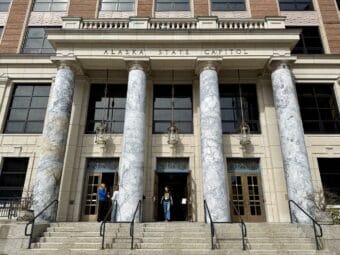
Members of the Alaska Youth for Environmental Action hold signs at the steps of the Alaska State Capitol in downtown Juneau on Saturday, Jan. 24, 2026. (Photo by Clarise Larson/KTOO)

Juneau teens and residents are calling on the Alaska Legislature and Gov. Mike Dunleavy to call off the state’s longtime push for a natural gas pipeline in Alaska. 

On Saturday, more than 40 people gathered at the steps of the Alaska State Capitol in downtown Juneau to protest the long-sought Alaska LNG project. The protest was led by Alaska Youth for Environmental Action, a youth-led environmental advocacy group with chapters across the state. 

Paige Kirsch is a senior at Juneau-Douglas High School: Yadaa.at Kalé and a member of the group’s Juneau chapter.

“I think it’s really important to be cognizant of the future of Alaska, especially because I do want to live here when I grow up, and I don’t want to live somewhere that’s purely for economic profit,” she said. “I just don’t think it’s really that fiscally responsible to keep investing in non-renewable resources.”

Alaska officials have been pushing for the proposed pipeline for decades and the state has already poured more than half a billion dollars into the project. If it’s built, the project would move natural gas from the North Slope to Southcentral for export overseas. A portion of the gas would be reserved for in-state use. The project has already been federally permitted. Last year, the Texas-based Glenfarne Group assumed majority ownership of the project from the state. 

Members of the Alaska Youth for Environmental Action write messages in chalk in front of the Alaska State Capitol in downtown Juneau on Saturday, Jan. 24, 2026. (Photo by Clarise Larson/KTOO)

Since then, it has announced a handful of nonbinding gas purchase and supply agreements. Last week, the company announced several more agreements it says moves the project’s first phase into an early development stage.

Proponents for the project say it would tap into an underdeveloped natural resource and provide energy security to a region facing shortfalls. But others remain skeptical about whether the project will actually be built, citing high costs and competing global energy projects.

At the protest on Saturday, multiple teens took to a microphone to share some of the negative impacts they believe the pipeline would bring, including bisecting land, disrupting habitat and emitting carbon dioxide. Atagan Hood, a junior at JDHS, says Alaska’s dollars would be better spent on renewable energy to mitigate human-caused climate change. 

“We are told that the 800-mile Alaska liquid natural gas pipeline is a bridge to a cleaner future, but you cannot build a bridge to a stable climate out of fossil fuel infrastructure,” he said. 

Last year, an Anchorage Superior Court Judge dismissed a youth-led lawsuit challenging the pipeline.  

There was one counter-protester at the event on Saturday. Kevin Nye, a retired engineer, stood on his own holding a sign that read “Build the Pipeline.” He said he wanted to represent those in Alaska who support the economic benefits the pipeline would bring to the state. 

Kevin Nye, a retired engineer, stands with a sign outside the Alaska State Capitol on Saturday, Jan. 24, 2025. (Photo by Clarise Larson/KTOO)

Glenfarne told reporters last week it expects to begin laying pipe later this year. But project skeptics say that the timeline is unrealistic. The company also initially said it planned to make a development decision by the end of 2025. That decision is now expected to come in February at the earliest.

Candlelit vigil lights downtown Juneau following Alex Pretti shooting in Minneapolis

Residents gather for a candlelit vigil at Overstreet Park on Monday, Jan. 26, 2026. (Photo by Clarise Larson/KTOO)

More than 200 Juneau residents gathered downtown at Overstreet Park Sunday evening for a candlelight vigil. They were there to honor a man who was fatally shot by a U.S. Border Patrol officer in Minneapolis, Minnesota, during protests against ongoing U.S. Immigration and Customs Enforcement operations. 

“There’s a lot of grief, there’s a lot of anger — and there’s also a lot of hope,” said Claire Richardson, a volunteer with ReSisters, a local group of women who work for social justice and equality. 

The crowd gathered just a few hours after the pop-up event was posted on social media by several advocacy groups in Juneau. 

Multiple local and state leaders spoke to the crowd as snow fell Sunday night, including Juneau Assembly member Maureen Hall. She says immigrants are the bedrock of the community. 

“Let us keep praying, let us keep speaking out, and let us keep standing in solidarity with those in the community that are too afraid to show up at something like this tonight,” she said. 

Juneau’s vigil on Sunday night joins a wave of vigils and protests in Minneapolis and across the U.S. that erupted over the weekend following the death of another person killed by federal officers during immigration enforcement protests. 

The man killed was identified as 37-year-old Alex Pretti, an intensive care nurse. His death marked the second person killed in Minneapolis during encounters with immigration officials amid a crackdown in the city. Just weeks prior, an ICE officer shot and killed 37-year-old Renee Good in her vehicle while the agency was conducting an operation in the city. 

The deaths have ignited fierce debates, with Minnesota and Congressional leaders pressing the Trump Administration over the facts and legality of actions by ICE officers as immigration enforcement ramps up across the country. 

In Anchorage and Fairbanks, residents gathered in similar protests this weekend, according to social media posts. U.S. Sen. Lisa Murkowski, along with other congressional Republicans, has called for an investigation into Pretti’s shooting. 

Wetlands are warming as fast as the atmosphere. That’s bad news for salmon.

Researchers used air and water temperature from sites around the Copper River Delta to gauge climate impacts on wetlands.
Researchers used air and water temperature from sites around the Copper River Delta to gauge climate impacts on wetlands. (Amaryllis Adey)

Before juvenile salmon make their way to the sea, they grow and feed in freshwater, including wetlands, for anywhere between a few months and several years.

But new research finds that as air temperatures rise with climate change, the water that flows through coastal Alaska’s ponds and marshes is warming rapidly, too. That could spell trouble for Pacific salmon, which can’t grow – or live – in waters above certain temperatures.

“I’ve never really hoped so much that I might be wrong,” said Amaryllis Adey, a researcher at Virginia Tech.

Adey is a co-author of the report, which was published in December in the journal Nature. The researchers compared nine years of water and air temperature data from 20 ponds near Yakutat and Cordova. They found that the water was keeping pace with increases in air temperatures.

That’s notable because it marks a departure from what’s happening with other freshwater ecosystems as temperatures rise, Adey said.

Past research shows that rivers and streams are warming more slowly than the air due to a range of factors, including that they move quickly and benefit from glacial runoff. Wetlands, meanwhile, are typically shallow, still, and more spread out across the landscape – leaving them more exposed to the air.

“It was really stark,” she said. If “one degree of air temperature results in one-degree increases in water temperature, that could be really concerning in the future.”

Report co-author Amaryllis Adey and a fellow researcher download temperature data in the field.
Report co-author Amaryllis Adey and a fellow researcher download temperature data in the field. (Elliot Deins)

The researchers’ next step was using the historical data to model what might happen in the decades to come.

The researchers looked at two possible scenarios. One was a future in which humans continue producing greenhouse gases at the current rate. Adey called that the “business as usual scenario” and said it resulted in a “drastic increase” in water temperatures.

“It was like up to 22 degrees Celsius by the end of the century,” Adey said.

That’s about 71 degrees Fahrenheit, which is really warm – and dangerous – for these wetland ecosystems. Coho salmon, for instance, stop growing at around 68 F. And death becomes likely once temperatures surpass about 73 F.

Adey says it’s certainly possible that salmon would adapt. But if they can’t shift the timing of their migrations or habitat use, she said, “they won’t be able to continue to grow and survive in these systems that are very economically and culturally dependent on them.”

The second scenario was less grim. If humans continue emitting at current rates for another decade and then begin reducing carbon emissions, water temperatures would still rise. But they would be less likely to reach dangerous levels.

The study looked specifically at two areas – the Yakutat Forelands and the Copper River Delta. But the results have far-reaching implications, including in Southeast Alaska.

“We’d expect that there’s going to be kind of similar responses across that coastal region,” she said.

Other organisms, including algae and bottom-dwelling invertebrates, are also temperature sensitive, the study said. That means warmer water could be felt by the entire food chain, ranging from different fish species to migratory birds.

Site notifications
Update notification options
Subscribe to notifications