Alaska

Gov. Dunleavy reviews his record and touts final-year agenda in State of the State speech

Gov. Mike Dunleavy delivers his final State of the State speech at the Alaska State Capitol in Juneau on Jan. 22, 2026.
Gov. Mike Dunleavy delivers his final State of the State speech at the Alaska State Capitol in Juneau on Jan. 22, 2026. (Eric Stone | Alaska Public Media)

Gov. Mike Dunleavy reviewed his seven years in office and outlined his agenda for his final year during his annual State of the State address on Thursday.

“I believe the people in this room can accomplish big things, whether it’s in public education, public safety or stabilizing our fiscal situation,” Dunleavy said. “We’ve got the time to do it. We’ve got the smarts to do it. We just have to have the desire to do it.”

Dunleavy spent much of his 79-minute speech presenting a long list of accomplishments from his first seven years in office.

He highlighted the state’s recovery from an economic downturn after emerging from a recession in early 2018. Dunleavy said his administration had enabled six consecutive years of job growth.

“I know there’s a feeling that things can be better, and of course, they can,” he said. “But our economy has been getting stronger and stronger every year under my administration, and diversifying as well.”

Dunleavy also called out a significant drop in crime across Alaska. The number of crimes reported to police dropped by more than 40% between 2018 and 2024, according to the state Department of Public Safety, and violent crime fell nearly 20% over that period.

He also previewed a new “quality of life” initiative that would seek to reduce crime in Anchorage. He said he was working with Anchorage Mayor Suzanne LaFrance on the effort.

Dunleavy said the first phase is already underway, focused on retail theft, illegal camping, disorderly behavior and drug use. He says later phases will focus on drug smuggling and violent crime.

The governor also used the speech to highlight progress on the Alaska LNG project, which would bring natural gas from the North Slope to Southcentral Alaska. He applauded an announcement from project developer Glenfarne saying it had secured nonbinding commitments from ExxonMobil and Hilcorp to provide gas for the pipeline, a nonbinding commitment to purchase gas by Southcentral utility Enstar and the planned Donlin Gold mine, and a variety of other deals with other companies to provide materials and support for the project.

Glenfarne CEO Brendan Duval said the series of announcements indicated the project was “progressing from planning to building,” though the company stopped short of saying it had made a final investment decision.

Dunleavy said the progress on the gas line was only one piece of good news from his tenure.

“Today, we are on the cusp of realizing a decades-old dream of delivering abundant, affordable energy that will benefit all Alaskans,” he said. “Today, unlike seven years ago, oil production is increasing, reading scores are improving, and the Permanent Fund has reached record highs thanks to steady and strong leadership.”

Dunleavy also said he would work to expand the supply of housing across the state in his final year in office.

Senate President Gary Stevens, a Kodiak Republican leading a bipartisan caucus that has often found itself at odds with Dunleavy, said many of the accomplishments the governor touted were in fact items lawmakers had worked on, too.

“I noted down a whole lot of them, all things that we were involved in, and we appreciate the governor’s leadership on those things, but (those are) things that we have worked hard on,” he said.

Dunleavy also pitched a forthcoming fiscal plan that he said would stabilize the state’s turbulent budget, though he stopped short of outlining what the plan would include. He outlined the goal of his plan — to reduce volatility in the state budget in order to make the state a more attractive place for investment — but stopped short of providing specifics.

On Friday, he introduced two measures in that vein: a cap on government spending and a constitutional amendment that would combine the Permanent Fund into a single account and set up a new formula for dividends. On Wednesday, he said his plan would also include a “temporary, seasonal sales tax concept.”

But lawmakers in the bipartisan, Democrat-heavy House and Senate majorities said they were not optimistic the governor’s plans would pass this year. Even if they did, Sitka Republican Sen. Bert Stedman said he did not expect them to provide immediate relief.

“Even if we move forward with a fiscal plan, it’s going to take a couple years to engage it and get the revenue collected,” he said. “So this year, I would tell the people around the state to expect something very similar to last year.”

Bristol Bay fisherman and retired educator Bill Hill enters U.S. House race

(Bill Hill for Alaska campaign)

Alaska U.S. House Rep. Nick Begich III has a new challenger.

Bill Hill, a Bristol Bay fisherman and retired teacher and school administrator, filed to run for the congressional seat as an independent candidate.

He cites the late Alaska Congressman Don Young as an inspiration.

“That’s kind of who I hope to, in some respect, mold myself after,” he said. “What’s good for Alaskans first and, you know, we need to start putting distance between politicians that are just cozying up to billionaires and special interests. And we need people that are going to work for Alaskans.”

A day after launching, Hill’s campaign announced he’d raised $200,000.

Hill has retained the campaign consulting firm Ship Creek Group, the same agency that brought early success for Mary Peltola when she launched her bid for U.S. House in the 2022 special primary election.

If elected, Hill isn’t committing to joining either the Republican or the Democratic House caucuses.

“I think that decision needs to be done thoughtfully, and that needs to be done at the appropriate time with whatever the structure of Congress looks like at that time,” he said.

Public records show he made small donations last year, through the ActBlue platform, to Rep. Alexandria Ocasio-Cortez, D-N.Y., and Sen. Bernie Sanders, I-Vt., and larger ones to Democrat Les Gara for his campaign in 2022 for Alaska governor.

Hill is Athabaskan, raised on Lake Iliamna and now lives in Naknek. He worked as a teacher in Naknek and Juneau, an administrator in the Lake and Peninsula School District and as superintendent of the Bristol Bay district. He’s also lived in Fairbanks and worked in construction jobs and ran a small business.

Begich, a freshman Republican, has raised more than $2 million for his re-election campaign. Democrat Matt Schultz, a Presbyterian minister from Anchorage, is also campaigning for the seat. He hasn’t had to file a fundraising report yet.

Mary Peltola to make stop in Juneau for U.S. Senate campaign launch

U.S. Rep. Mary Peltola smiles for a photo at a meet and greet in Juneau on Saturday, Jan. 27, 2024. (Clarise Larson/KTOO)

Former Alaska Congresswoman Mary Peltola will be in Juneau Friday evening at the Crystal Saloon bar downtown to celebrate her campaign launch for U.S. Senate. 

Last week, she announced she’s running for U.S. Senate against Republican incumbent Senator Dan Sullivan. 

Peltola, a Democrat, served both a partial and full term in the U.S. House until the 2024 election, when she narrowly lost her seat to Republican Nick Begich. She became the first Alaska Native person elected to Congress when she won the 2022 special election.

Peltola has historically seen strong support from Juneau. During the 2024 election, Peltola outpaced Begich in every Juneau precinct – even in the precincts from the Juneau International Airport to Mendenhall Valley that went for Trump, according to the Alaska Division of Elections.

Her bid for the congressional seat, if successful, would give Democrats a shot at winning a majority in the Senate.

Her meet and greet will be at the Crystal Saloon on Front Street, Friday evening from 5 p.m. to 7 p.m.

Alaska lawmakers fail to override Dunleavy’s veto of corporate income tax bill

Legislators watch during an vote seeking to override Gov. Mike Dunleavy's veto of a bill that would have expanded Alaska's corporate income taxes to capture more revenue from Outside businesses.
Legislators watch during an vote seeking to override Gov. Mike Dunleavy’s veto of a bill that would have expanded Alaska’s corporate income taxes to capture more revenue from Outside businesses. (Eric Stone | Alaska Public Media)

Alaska lawmakers failed Thursday to override Gov. Mike Dunleavy’s veto of a bill that backers said would have modernized Alaska’s corporate income tax system.

The override failed 35-25. It would have required a 45-vote majority to become law.

Senate Bill 113 would have expanded the state’s corporate income tax to capture revenue from so-called “highly digitized businesses” that sell to Alaskans over the internet but may not have a physical presence in the state. Some of the money raised by the tax change would have gone toward reading programs in public schools.

After the vote, House Speaker Bryce Edgmon, a Dillingham independent, said the debate over the bill illustrated how difficult it would be for lawmakers to agree on ways to raise new revenue as the state deals with a fiscal crunch.

“I’d also say it’s a preview of the debate that we’re going to undergo on a fiscal plan,” he said.

Some Republicans who voted against the override said they were concerned that the bill could increase costs for Alaskans, including Big Lake Republican Rep. Kevin McCabe.

“It’s disingenuous to think that we are not going to pay for this tax one way or the other,” he said.

Supporters of the bill rejected McCabe’s characterization, saying that the bill would simply give Alaska a share of similar taxes companies already pay in other states.

Sen. Bill Wielechowski, an Anchorage Democrat who championed the bill last year, said the idea that the bill would raise consumer costs was “wildly inaccurate.”

“In fact, there’s been research on this,” he said. “The National Bureau of Economic Research did a working paper titled Corporate Taxes and Retail Prices, and found null — zero — effects on prices for firms subject to a single sales factor.”

Gov. Mike Dunleavy said Wednesday that he planned to introduce a temporary sales tax as part of a larger fiscal plan. Wielechowski said the corporate income tax change was a better option.

“How dare we go to Alaskans and say, ‘We want to tax you. We want to take your dividend,’ before we’re going to tax collect revenue from tech billionaires,” he said. “Really? Is that where we’re going with this?”

Some lawmakers who voted against overriding the bill said they supported the law in concept, including Fairbanks Republican Rep. Will Stapp, who voted for the bill when it passed in May.

But he said the complexity of the tax change— and the fact that the bill would take effect immediately if the veto was overridden — gave him pause.

“(If) you vote to override this bill, Mr. Speaker, you’re going to create a new type of corporate tax structure for people that there’s no regulatory guidance on how to pay,” Stapp said. “I would argue we probably shouldn’t do that.”

Wielechowski said he was confident the state would have been able to put out regulations before taxes would be due in 2027.

Even so, Stapp said he planned to introduce a new version of the bill this session addressing that and several more technical objections he raised on the floor.

“There are a lot of questions with the bill that we should probably know the answer to,” he said.

WATCH: Gov. Dunleavy delivers 2026 State of the State address

Gov. Mike Dunleavy is set to deliver the annual State of the State address to the Alaska Legislature in Juneau Thursday at 7 p.m.

Starting at 6:30 p.m., KTOO Managing Editor Lisa Phu will host a discussion with Alaska Legislative Digest Publisher Tim Bradner, KNBA News Producer Rhonda McBride, and Alaska Public Media State Government Reporter Eric Stone to provide some context for the speech.

Watch live Gavel Alaska coverage of the discussion and Dunleavy’s speech on KTOO 360TV or listen to your local public radio station.

New city survey seeks public feedback as Juneau faces multimillion-dollar budget hole

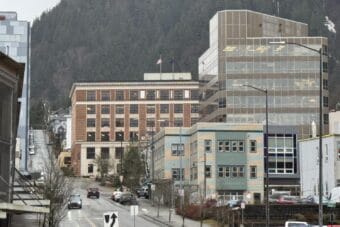
People walk past City Hall in downtown Juneau on Thursday, Jan. 22, 2026. (Photo by Clarise Larson/KTOO)

The Juneau Assembly is bracing for a tough budget season in the coming months. 

That’s because during last fall’s municipal election, Juneau voters approved municipal tax cuts that created a multimillion-dollar recurring hole in the city’s budget.

The city’s next fiscal year begins on July 1 of this year. Starting then — and every fiscal year moving forward — the city will face an estimated $10 to $12 million in revenue loss in its general fund. That’s due to the tax exemption on food and utilities and a cap on the city’s property tax rate that voters passed. It’s now up to the Juneau Assembly to figure out how to mend that gap. 

Earlier this week, the city released a survey asking residents to help inform the Assembly as it decides in the coming months how to move forward with the budget. Christine Woll is on the Juneau Assembly and is its finance committee chair. During KTOO’s Juneau Afternoon show on Tuesday, she said the survey is meant to be tough. 

“We want people to be a little bit in our shoes in terms of having to make hard decisions about priorities,” she said. 

The survey asks residents to pick what city programs and services are most important to fund and to pick what services to reduce funding for. The list includes programs like libraries and museums, trails and parks, and homeless services. 

This is a graph of the City and Borough of Juneau’s general fund operating expenditures. (City and Borough of Juneau)

The survey also asks what values they want the Assembly to prioritize, like whether to keep taxes low, continue to support local business year-round, or fund affordable housing projects. 

The survey broadly lists programs, services and values. That’s by design, said Phil Huebschen, an engagement specialist with the city’s communications department. He said the survey is meant to simplify the complexities and nuances of the city’s $478 million budget so it is digestible for everyday residents. 

“We’re trying to reposition all of this really complex data and information as really simple values information that people can understand,” he said. 

The survey also includes some budgets that the Assembly doesn’t necessarily have direct control over, like the airport and hospital, which have their own boards and operate like businesses. But, Huebschen said, the information is meant to guide the Assembly as they make decisions during the budget cycle. 

“We’re hoping that they’ll have a compass, so to speak, of what kind of areas in terms of city services, the broad public of Juneau kind of values the most, and where they’re willing to make trade-offs,” he said. 

Assembly member Woll explained that budgetary cuts aren’t the only way to mend the deficit. There are other options too, like increasing revenue using bonds, increasing sales taxes or user fees. The survey asks respondents what option they’d be comfortable seeing implemented. 

“There are lots of different ways to address revenue reductions. You can figure out other ways to increase revenue,” Woll said. 

Along with the survey, the city plans to host three community workshops and two Assembly listening sessions on the budget. The first workshop is at the Filipino Community Hall on Feb. 18, the second at the Valley Library on Feb. 24, and the third at the Douglas Library on March 3. Each workshop starts at 5:30 p.m. The city hasn’t posted details on the listening sessions yet.

The survey is open until mid-February and respondents are eligible for several prizes, like an annual city bus pass or a two-night stay at Hilda Dam Cabin. 

The city manager will release the draft city budget in March. The Assembly must finalize its budget before July 1.

Site notifications
Update notification options
Subscribe to notifications