Alaska

Tlingit clan conference set for this spring in Sitka


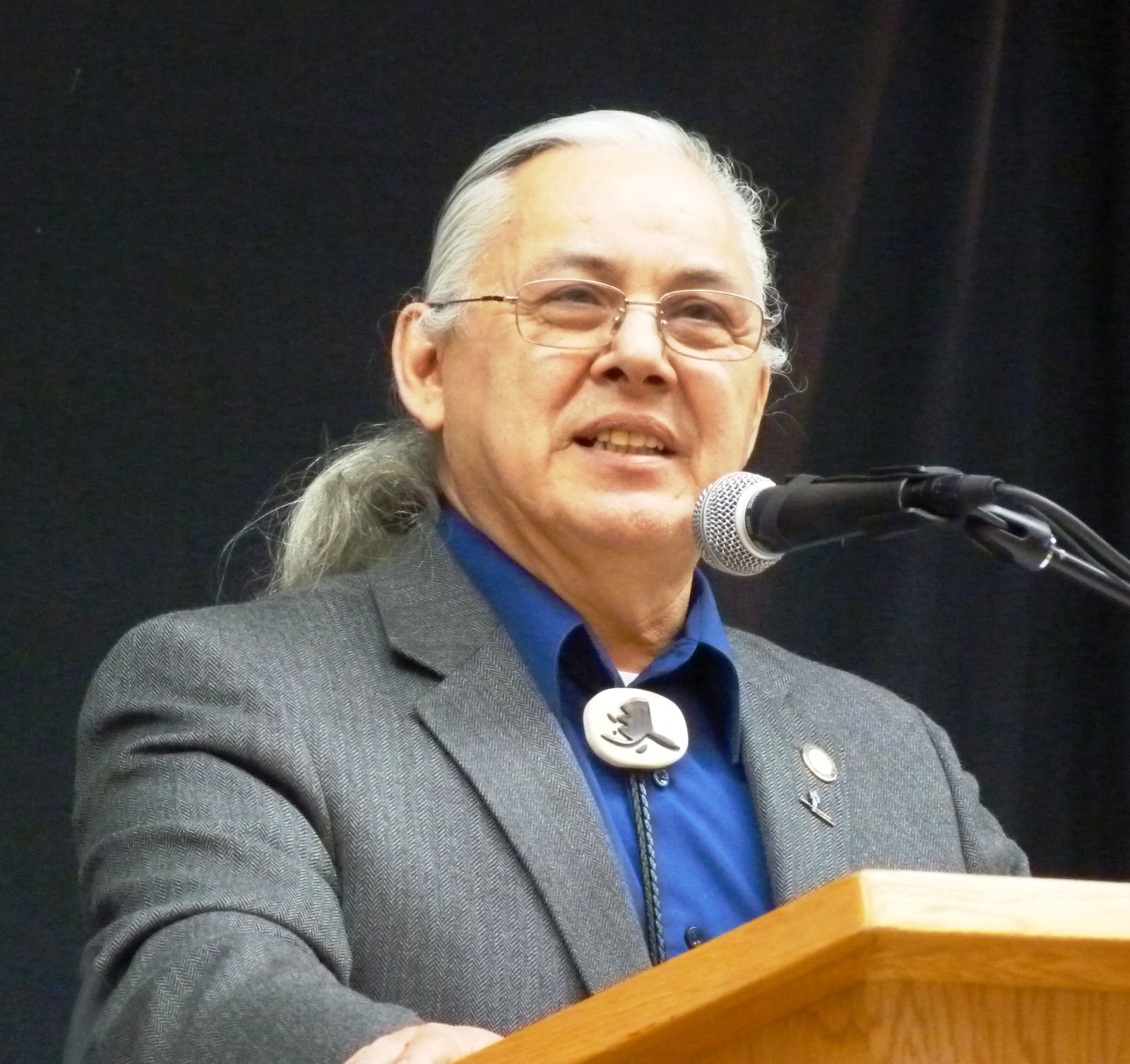
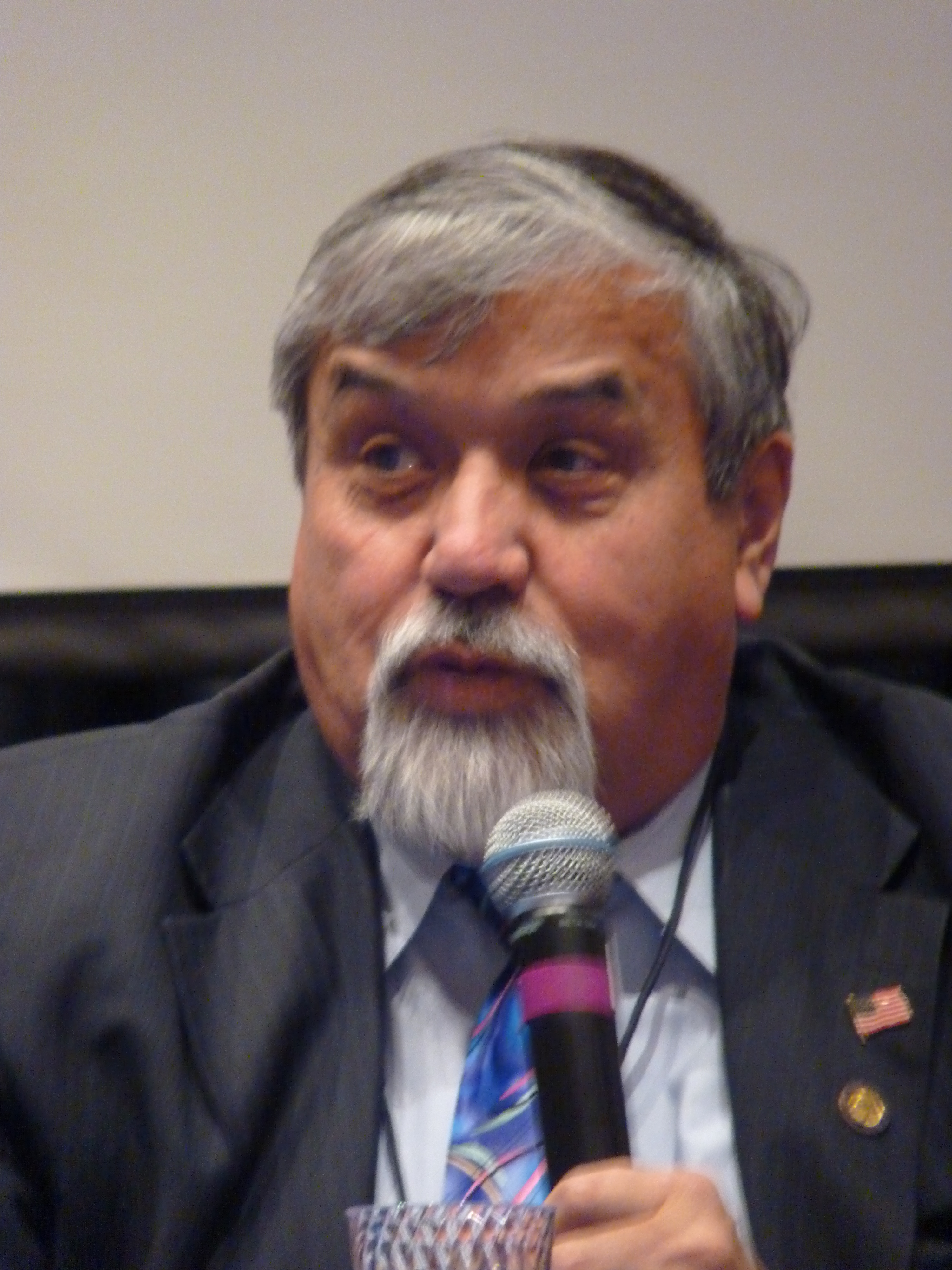
The late Andy Hope, conference organizer, during the 2006 event. Photo by Peter Metcalfe.


Anthropologists, linguists and elders will gather in Sitka this spring for a conference of Tlingit tribes and clans. It coincides with the 100-year anniversary of Alaska Native Brotherhood, the state’s oldest indigenous-rights association.

Organizers are meeting in person and by phone to assemble this year’s clan conference.

“The idea is that it’s sort of a combination of a down-home get-together and an academic conference,” says Richard Dauenhauer, a Juneau-based author, researcher and linguist, as well as one of the event organizers.

“So we encourage both academic participation, but also just folks in the community. Everybody has a chance to get together and we get different perspectives on things,” he says.

The event, called “Sharing Our Knowledge,” takes place March 29th through April 1st at Sitka’s Harrigan Centennial Hall.

Presenters include tradition-bearing elders, historians and anthropologists from Southeast, the Pacific Northwest, and as far away as Germany. (Read about the previous Clan Conference.)

“What’s unique about this is that for academics they get an opportunity to speak and kind of mix it up with people who are actually living the culture,” says Peter Metcalfe, an author, researcher, and one of the conference organizers.

Nora and Richard Dauenhauer, Kathy Kolkhorst Ruddy, Peter Metcalfe and Ishmael Hope.

“The part I like about it is that it’s very accessible. There’s a lot of very intimidating concepts, linguistics and cultural anthropology and so on. But people aren’t really talking down, they’re speaking English – or Tlingit, as the case may be. There’s very little jargon and people are very respectful each other,” Metcalfe says.

He says the public is welcome, whatever their background or interest.

The Sitka clan conference will include sessions on the Alaska Native Brotherhood, which is celebrating a century of work, as well as the Alaska Native Sisterhood.

That’s a topic of interest to Kathy Kolkhorst Ruddy, another person helping with the event. She, Metcalfe and Dauenhauer researched and authored a study of the ANB’s role in protecting Native rights.

“And I learned a lot about the history of the success of the Alaska Native Brotherhood in preventing extinguishment of aboriginal title. It was very close. People don’t know the drama of that story. So I’m eager that that success of the Brotherhood and Sisterhood be highlighted,” Ruddy says.

Other sessions will focus on museums, access to digital collections, archeology training, traditional art and food, and other topics.
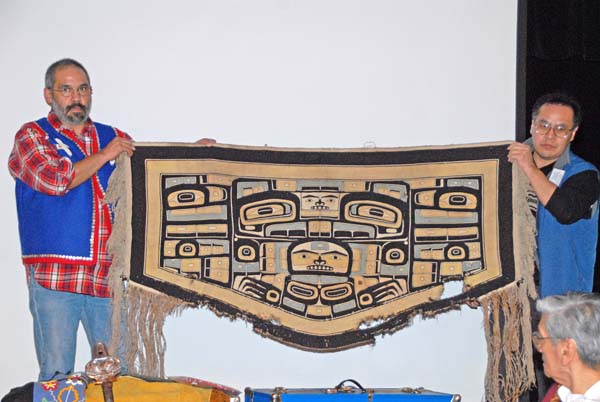
A Chilkat blanket is displayed at the 2007 Clan Conference. Photo by Peter Metcalfe.

Language expert and author Nora Marks Dauenhauer will present at the conference, as well as work behind the scenes. She’s been recording elders and transcribing their oratory since the late sixties.

“That’s part of the reason I’m glad that the conference is happening. I think there’s a lot of people who would like to have their stories told,” she says.

Clan conference sessions will be videotaped and made available to those who can’t attend.
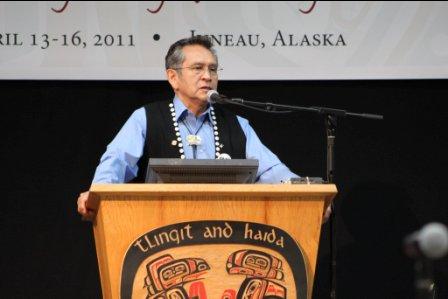
See photos from the 2009 conference.

Southeast Native leader opposes oil tax cuts

Tlingit-Haida Central Council President Ed Thomas.

A key Southeast Native leader is asking the Legislature to not lower oil taxes.

Tlingit-Haida Central Council President Ed Thomas says Alaska needs the revenue. He also says oil companies are already making huge profits.

“If there’s no incentive for them to get more oil under those conditions, I really don’t think a few dollars of taxes taken away from our education programs or rural energy programs is going to make a difference,” he says.

The Central Council is a regional tribal organization representing more than 28,000 Tlingit and Haida Indians in and outside Alaska. It runs health, job-training, business, public safety and other programs.

Governor Sean Parnell says lowering taxes would promote new development needed to keep oil revenues coming. The House has passed such a measure, but the Senate wants a different plan.

Thomas says even talking about tax cuts is a bad idea.

“If the oil companies are going to keep getting promised that they are going to get cutbacks in taxes, they’re not going to drill. You know that and I know that. Because they’re waiting for the better deal. They can afford to wait because they have barrels of money already,” he says.

Thomas spoke at Wednesday’s Native Issues Forum in Juneau. His comments followed statements from House Speaker Mike Chenault and Representative Reggie Joule.

Rural lawmaker pushes place-based education

Rep. Reggie Joule addresses the Native Issues Forum. Photo by Ed Schoenfeld.

A Western Alaska lawmaker says place-based education is working.

Representative Reggie Joule, a Kotzebue Democrat, told Juneau’s Native Issues Forum today that the approach makes sense.

Theme- or place-based education teaches traditional subjects using students’ frames of reference.

Joule cited a math class he and other lawmakers visited last year at Barrow’s high school.

“The issue they were working around was height, distance and time. The problem that they were solving was in throwing a harpoon in which you hunt the whales with. What’s the time it takes to reach a certain point? What’s the time it takes to come down? What’s the distance? Those kids were into it big time,” he says.

Middle-schoolers compared the density of whale meat and blubber. And elementary students worked on kuspuk, or parka, designs.

Joule says those students were also very engaged in their classes.

“We put some money out there for a pilot project that’s taking place in the Iditarod Area School District. Because their board’s vision was to be, and to deliver to students, relevant education without losing the expectations and standards of what the education community needed to have,” he says.

Other Alaska schools use the technique. A legislative task force last year recommended more schools try place- or theme-based education.

Link to the final recommendations from the Alaska Legislative Task Force on Theme-Based Education.

Native groups oppose expanded otter pelt sales

Several Alaska Native organizations oppose a legislative effort to increase sea otter harvests. But they support efforts to get Alaskans more involved in federal management of the once-rare marine mammals.

The voracious marine mammals are expanding in number and range in Southeast and some other coastal areas. Crabbers and divers say otters are decimating populations of crab and other shellfish they gather for commercial or subsistence use.

Alaska Natives are allowed to hunt otters, but face strict federal limits on how they are used. Full pelts can be sold to other Natives. Traditional products, such as clothing or regalia, can be sold to anyone.

Sea otters near Sitka. Photo by Nathan W/Creative Commons

Representative Peggy Wilson, a Wrangell Republican, authored the legislative resolution asking federal authorities to work with state and Native leaders to allow more hunts.

“We’re hoping that the Natives can do what they traditionally have done for years. And they can be able to harvest (otters), use their skins to make other things so that they can make money. If we just keep it to them, we’re not going to overharvest by any means of the imagination,” Wilson says.

Wilson’s resolution would allow whole pelts to be sold to non-Natives, which is now illegal. She recently told the House Resources Committee that would boost harvests and lessen impacts on fisheries.

Tlingit-Haida Central Council President Ed Thomas says that could create problems.

“The biggest threat is that if we were allowed to sell those pelts unaltered, you could pretty much guess, if you look down here on South Franklin (Juneau’s tourist district), that they would come back as ‘authentic’ Native crafts made in Taiwan,” Thomas says.

Thomas supports other parts of the resolution calling for a new federal management plan that increases otter harvests.

So does Rosita Worl, who spoke on behalf of the Alaska Federation of Natives, Sealaska Corporation and the Sealaska Heritage Institute.

Sealaska and tribal governments in Sitka and Petersburg are among those trying to expand pelt processing. Worl says they’re providing training and equipment needed to support a growing cottage industry.

“We see sea otters as just one answer to trying to promote sustainable economies in our communities,” Worl says.

She says the current law is interpreted too narrowly. She wants Native craftspeople to be able to make and sell a wider variety of otter products, such as teddy bears.

“We’ve had a number of our people that have been cited. We’ve complained vigorously about the enforcement practices. We’ve advanced the ideas of co-management. But our idea was to really change the marine mammal law that would allow for the sale of contemporary items,” she says.

House Joint Resolution 26, Wilson’s measure, was introduced last year. Its first hearing was February 3rd in the House Resources Committee. It remains before that panel.

If passed, it will be sent to Alaska’s Congressional delegation and the Secretary of the federal Department of the Interior.

Veterans’ job measure passes House, Senate

Alaska’s House and Senate have passed bills aimed at easing veterans’ chances of getting jobs.

The measures direct the state to consider military training and experience when granting professional licenses. Alaska licenses about 40 professions, from barbers to contractors to nurses.

House sponsor Bill Thomas, a Haines Republican, says about 1,200 Alaska-based service-members leave the military every year. And the unemployment rate among young veterans is about 22 percent.

Haines Rep. Bill Thomas.

“Many have already received quality training through the military. I use an example of mechanics who have the ability to perform the duties and then have to go through the process of being certified at the local level. The other one is a plumber who’s been in the Navy for 20 years,” Thomas says.

“There’s no reason for them to come back and start over again. It’s a way to help them come out, get a job and go forward,” he says.

The bills also tell officials to grant temporary, six-month, professional licenses to qualified veterans. They also direct the University of Alaska to consider military training and experience as credit toward degrees.

House Bill 282 passed without opposition February 1st.

A similar measure, Senate Bill 150, passed the Senate 19-1 the same day.

Anchorage Sen. Bill Wielechowski.

Senate sponsor Bill Wielechowski, an Anchorage Democrat, says the measure recognizes veterans’ knowledge.

“There’s no special treatment here. What this bill does is it eliminates the need for duplicative education, classes and training. These service-members have already received this training,” Wielechowski says. “They’ve already received this education. This will help them more quickly integrate and it’s very likely to lower the unemployment rate for veterans.”

The two bills are very similar. But they have some differences, such as timing and cost. That means the House will have to approve the Senate’s version, or the other way around.

Thomas’ House bill has been assigned to one Senate committee, indicating it may be the most likely to pass both chambers first. Most senators have signed on as co-sponsors.

Will the Costa wreck hurt Alaska’s cruise industry?

The Costa Concordia partially submerged after hitting a reef. Photo by Roberto Vongher/Wikimedia Commons.

You’ve probably heard that cruise-ship bookings took a dive after the Costa Concordia hit a reef and partially sunk. But are travelers avoiding cruising or just delaying ticket purchases? And what does it mean for Alaska tourism?

The Carnival Corporation is the Costa Concordia’s owner. Carnival and its subsidiary lines will sail about 11 ships through Alaska waters this summer.

The corporation this month reported an almost 15-percent drop in worldwide bookings after the vessel struck a reef off Italy. The January 13th incident killed at least 30 people and badly damaged the ship.

But how will this tragedy halfway around the world affect cruise ship traffic here?

“I think Alaska is going to have a very good year,” says Stuart Chiron, a Miami-based industry analyst and cruise broker. He operates a website called “The Cruise Guy” that follows industry developments around the world.

Chiron says the sales dip won’t last – and may not hurt Alaska at all.

“There’s a lot of people who are on a wait-and-see type of scenario. But bookings as of now are looking very strong for Alaska. And there could be definitely some pickup if there are any hiccups on the international front, in the Middle East as well as in the Mediterranean,” he says.

(Read about the Prinsendam, which burned and sunk in the Gulf of Alaska. )

(Read about more recent cruise ship groundings and sinkings.)

Past crises, such as the 9/11 attacks, inspired American and Canadian cruisers to traveler closer to home.

Alaska Cruise Association President John Binkley says that might be the case this time too.

The Sapphire Princess docks in Ketchikan. Photo by Ed Schoenfeld.

“There could be a feeling by the consumer that cruises in the U.S. that are under the jurisdiction of the United States Coast Guard are inherently more safe than those abroad. I don’t know that but there’s that possibility,” Binkley says.

Alaska’s cruise-ship capacity will grow to about 950,000 passengers in the upcoming season. And even if bookings drop, he says the lines know how to bring them back up again.

“If they have to, then they will just discount the pricing until they fill those berths. So it shouldn’t have an effect on the overall number of people coming up to Alaska on cruise ships. It could have an effect, though, on the amount of earnings that the companies get from those different berths coming up to Alaska,” he says.

When berths are cheap, the lines still make money by selling drinks, spa time and shore-based excursions.

Industry analyst Chiron says his information shows the bookings drop is largely over. In the meantime, lines such as Carnival and Princess are offering attractive deals highlighting other destinations.

“I can tell you that bookings did pick up very nicely. And we’ve also seen cruise lines begin to push Europe, Alaska and Caribbean summer sailings,” he says.

But the shipwreck’s timing could not have been worse. Binkley says many people book Alaska cruises in January or February.

Watch a video of the partially sunken Costa Concordia from RT media.

Site notifications
Update notification options
Subscribe to notifications