Alaska

Thomas targets spending growth, village projects

Representative Bill Thomas wants to slow the growing cost of state government. And he has the influence to try to do it.

He co-chairs the House Finance Committee, where he oversees drafting the Legislature’s operating budget.

The Haines Republican says it’s increasing about 7 percent a year, more than the state can afford. It can’t stay level because of program guarantees and commitments already made.

He says he’ll work with the governor and other lawmakers to reduce that growth.

“Everybody has a need and a want. And we’re sitting here (wondering) at what point do they finally realize that we can’t continue to allow the budget to grow at this rate,” she says.
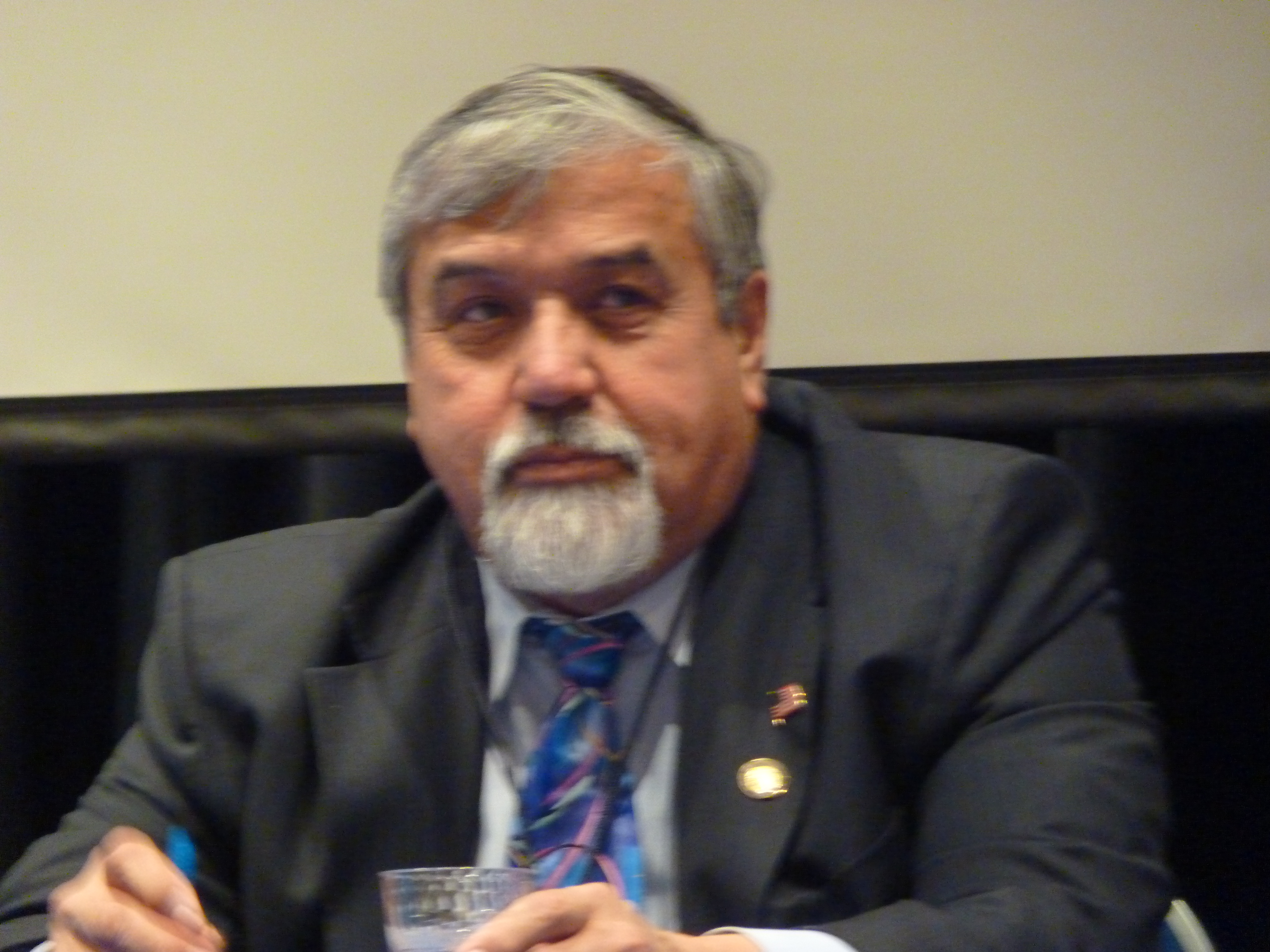
Haines Rep. Bill Thomas speaks at a 2011 Southeast Conference forum. Image by Ed Schoenfeld.

Thomas says he supports the governor’s plan to reduce spending by eliminating 284 funded, but unfilled, state jobs.

The Haines Republican doesn’t write the capital budget, which funds public-works projects around the state. But he has influence as a finance committee member.

Thomas plans to push for a powerline that could lower the price of electricity in one Southeast village.

“It’s been a project that we’ve been pushing for years. And for two years now it’s been vetoed. It’s for the intertie service for Kake. I think we’re going to try one more time and see. Maybe we’ll have to go for less money and build it over a two-year period, or something,” he says.

Other preferred projects include Angoon erosion repairs, statewide harbor improvements and village energy projects.

Thomas would consider additional funding for the first Alaska Class Ferry, if what’s budgeted now is not enough. But he questions the need for a whole new design.

“We’ve got now some of the finest boats running around and they’re 50 years old. Seems to me if it’s not broke, why fix it. These are working fine. I just don’t get it, I guess,” he says.

Thomas has authored or backed several veterans’ assistance bills. He’s also sponsoring a bill to help veterans to apply military experience to some occupational licensing requirements.

“Let’s say that you’re a captain in the Coast Guard and you come out and want to be a marine pilot or maybe a marine highway captain, this will allow you to use some of your sea hours, if you have six years or so of duty, you come in and we can help you waive some of that,” he says.

This is Thomas’ final session representing more than two dozen small communities from Metlakatla to Skagway to Cordova. Reapportionment will drop some of those towns, while adding Sitka to the district.

He says that will mean an extra push for his current constituents’ projects.

“The way we look at it now we’re going to be losing one representative and one senator. So we have to work together and anything anybody puts in hopefully we’ll be able to protect and work with each other. And we’re going to have to work with each other harder than we ever have before,” he says.

In addition to finance, Thomas serves on the Legislative Budget & Audit Committee.

Hear Angoon Sen. Albert Kookesh discuss his legislative plans.

Hear Wrangell Rep. Peggy Wilson talk about her legislative priorities.

Hear Sitka Sen. Bert Stedman describe his legislative plans.
Sealaska offers scholarship bonus

Descendents of Sealaska shareholders have until March to apply for corporate scholarships. But those submitting applications this month will receive an extra $50.

About 400 college, university and vocational school students receive the scholarships every year.

The money comes from Sealaska, the regional Native corporation for Southeast. It’s distributed by the Sealaska Heritage Institute, the businesses’ cultural arm.

Institute President Rosita Worl says the merit-based scholarships run from about $1,000 to $4,000 a year. The amount is based on each student’s year in school, as well as his or her grades.

“They have to be in good standing in their school. And we require a minimum of a 2.0 (grade-point average). If they fall below a 2.0, they go on probation for a semester and they have a semester to bring their grades up,” she says.

Applications must be filed online, through the institute’s website.

Forms, transcripts and letters of recommendation must be submitted by March 1st. Those completing paperwork by February 1st get the extra $50.

Students must attend an accredited institution full-time.

“One of the objectives is to train our future managers and employees of not only Sealaska, but our Native organizations. So in addition to the scholarship, we also have an intern program,” Worl says.

Students do not have to be Sealaska shareholders to receive scholarships. But they must prove they are a lineal descendent. The corporation has more than 20,000 shareholders, about half living in Alaska.

Power plan questions Southeast-wide electrical grid

Southeast leaders should stop trying to build a regionwide power grid. Instead, they need to focus on saving energy and developing wood-powered heating plants. Those are among recommendations from an in-depth study of the region’s energy issues released this week.

The draft Southeast Alaska Integrated Resource Plan was unveiled during an advisory group meeting at Juneau’s Baranof Hotel. (Link to the plan’s website.)

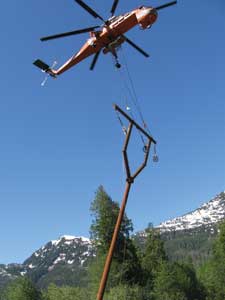
A helicopter lowers a tower during construction of the Swan-Tyee Intertie. Photo by Dave Carlson/SEAPA.

The Alaska Energy Authority plan recommends completing two power lines that already have some momentum. One would link Kake to Petersburg and the other would connect Metlakatla to Ketchikan.

But consultant Kevin Harper says a region-wide grid is just too expensive.

“Largely a combination of the high cost of building transmission (lines) and the very low loads in the region make the cost of transmission uneconomic,” Harper says.

The plan also says a line across the border to Canada is not worth building.

It says reduced power use, through efficiency efforts and lowered peak-time demands, is a better way to cut electrical costs.

The energy authority’s Jim Strandberg says that includes reversing the growing trend of using electricity instead of fuel oil to heat homes and businesses.

“That has really, in a rather unexpected fashion, caused their loads to go high. And they’ve consumed what they thought in many cases was adequate hydro capacity,” Strandberg says.

The energy plan recommends continued work on building or expanding five hydroprojects. They are Angoon’s Thayer Lake, Hydaburg’s Reynolds Creek, Ketchikan’s Whitman Lake, Hoonah’s Gartina Falls and Sitka’s Blue Lake. (Read the draft plan.)

It also calls for a more detailed study and comparison of several other projects before they move ahead.

Wood pellets are loaded into a silo at Sealaska Plaza. Casey Kelly photo.

Advisory board chairman Rick Harris says research shows wood-powered biomass energy should also be a big part of the solution.

“New technologies in some areas, tidal or wave action may be a viable alternative in the future. But we just see that’s one (where) the technology’s well developed. And so we think it has an important role in the region,” Harris says.

Harris is executive vice president of Sealaska. The regional Native corporation recently switched to a pellet boiler to heat its Juneau headquarters. It’s also trying to develop a regional wood-heat industry.

Plan authors heard from critics during the meeting. Sitka’s Larry Edwards, of Greenpeace, opposes the biomass focus. Speaking by phone, he says wood burners add too much carbon to the atmosphere, which contributes to climate change.

He also says the plan’s authors ignored good information on heat pumps.

“What would make all this stuff work is underground thermal energy storage, which is a well-proven, well-demonstrated, used in many places technology. You can collect these kinds of surplus or waste energy when it’s available and use it months later when you need it,” Edwards says.

Others criticized the plan’s dismissal of a region-wide grid, which they see as boosting business growth.

Juneau’s Brad Fluetsch spoke as an Alaska Native Brotherhood official.

“One of the things about the transmission grid we also need to think about: It’s not just power going over that line. That is going to bring broadband to every one of our communities. The internet, and wireless communications, is as important to our economic development as electricity,” Fluetsch says.

Consultants also recommend changes for SEAPA, the Southeast Alaska Power Agency. It runs two large hydropower projects and the lines linking them to Ketchikan, Petersburg and Wrangell.

Energy consultant Kevin Harper

Energy authority consultant Kevin Harper says its operational agreements discourage new hydropower development.

“The issue is right now there’s no provision on the SEAPA system for someone outside the SEAPA utilities to move power over their system. That is an issue that if addressed would make it easier for other parties to come in and propose projects and use that system,” Harper says.

SEAPA CEO Dave Carlson says the system works. He says the agency requires member communities to buy its power before going to another source. But that should not stop new projects that fill power gaps.

“Essentially, you can’t displace power from an existing hydroproject. That makes no sense at all. That will just cost the ratepayers more money,” Carlson says.

Parts of the plan, which is open to public comment, would require substantial state investment. And authors admit other parts could be hard to put into place. But they project it could save the region about $350 million over the next two years, and more than $2 billion in 50 years.

Southeast 2011 roundup: Redistricting, roadless, ferries

One of Southeast Alaska’s biggest stories of 2011 was reapportionment, or election district realignment.

Population shifts will cost the region two of its eight legislative seats in the 2012 elections. And some felt the way the districts were reconfigured divided close communities.

“You do your best to group areas that are integrated with each other,” said Redistricting Board Executive Director Taylor Bickford. He said the region, like some other parts of Alaska, was a challenge.

“You do your best to give the number of seats or percentage of a seat that they’re entitled to. But you are inevitably left with some pieces that don’t fit,” he said.

Those pieces included Skagway and Petersburg, which were added to Juneau-based House and Senate seats in a plan released in May. Among other changes, Wrangell was packaged with Ketchikan’s House District.

That set up a 2012 primary race between two incumbent Republican representatives.

Reps. Kyle Johansen, Peggy Wilson

“I feel bad that Kyle and I are going to be up against each other,” said Wrangell’s Peggy Wilson.

“I know we’ll have a healthy and issues-oriented campaign,” said Ketchikan’s Kyle Johansen.

Two Senate incumbents, Sitka Republican Bert Stedman and Angoon Democrat Albert Kookesh, will also face off in a district made up of communities from each lawmaker’s constituencies.

In February, the marine highway system got a new top official. Former Coast Guard

Capt. Mike Neussl

Captain Mike Neussl took over ongoing work toward building a new vessel for northern Southeast. The Legislature brought funding for the first Alaska Class Ferry up to $120 million in May. But it might not be enough.

“The price of steel, the cost of labor and the design of the ship. There’s a lot of factors that play into that, and whether it’s higher or lower, I couldn’t really tell you,” Neussl said.

Two large Prince of Wales Island mines moved closer to development in 2011. New ore finds were announced by the Niblack multi-metal prospect. And the Bokan Mountain project gained nationwide attention due to worldwide shortages of the rare-earth elements it hopes to mine and process.

In March, a federal judge decided the nationwide “roadless rule” should apply to the Tongass. That limits timber harvests and other development in key national forest areas.

“The future industrial-style of logging, it really would have impacted some more on our customary and traditional gathering,” said Mike Jackson, natural resource officer for the Organized Village of Kake, which brought the suit.

Opponents of the rule worried new mines and hydropower projects would be blocked. Exemptions were allowed, but the final impacts wait to be seen.

In May, many in the timber industry changed their focus by leaving the Tongass Futures Roundtable, a large group with strong environmental membership.

“In Southeast Alaska we have some high unemployment in a lot of the rural communities. And the timber industry could solve some of that if there was a supply again,” said Coffman Cove’s Elaine Price.

She was among those shifting their energy to the governor’s new Timber Task Force. Some also joined a “cluster initiative” focusing on industry growth.

In September, Governor Sean Parnell signed legislation doubling the size of the Southeast State Forest, which could increase long-term timber sales. But it’s not enough to replace what the Forest Service no longer provides.

Other top regional issues of 2011 include further cutbacks in commercial halibut harvests and changes in charter fishing limits. Also, the expanding sea otter population, up to 12 percent a year in some areas, continued to hit divers and crabbers who harvest species the protected marine mammals eat.

Northern Southeast sea otter numbers up 4 percent

Will Ware goes subsistence fishing in Sumner Strait, south of Petersburg. But the administrator of the town’s tribal government says he finds fewer shellfish there these days.

“When you get onto the reefs you’re seeing that it’s just shell-laden all over the rocks and beaches. There’s gumboot shells everywhere, shrimp shells. It’s almost like a devastating sight to see on some of these islands and rocks,” he says.

The shells are leftovers from sea otters’ meals. A few decades ago, the federally protected marine mammals were hard to find. But that’s no longer the case.

The U.S. Fish and Wildlife Service and other agencies have been surveying Southeast

A sea otter floats on its back. U.S. Fish and Wildlife Service photo.

waters to determine the extent of otter growth.

Wildlife Biologist Verena Gill just released a new population estimate: 20,000.

“The reason it is increasing, both in distribution and in number, is because these sea otters are just recolonizing where they were extirpated from,” she says.

Otter fur is thick and warm, making it a valuable commodity. Russian, and later American, hunters killed so many that they disappeared from Southeast and most other coastal areas about a century ago.

Then, the state decided they should be brought back.

“In the late ‘60s, the Department of Fish and Game actually translocated otters from some remnant colonies that were left in Prince William Sound and the Aleutians and took them over to Southeast Alaska. And they’ve been increasing and expanding back into their original range since then,” she says.

Four hundred otters were brought to the outer coast of Southeast. Gill’s new population estimate means their numbers have risen 50-fold in the past 45 or so years.

But growth has not been even across the region. The south is seeing a 12 percent growth rate, while in the north, it’s only 4 percent.

“There isn’t the habitat otters really they like in northern Southeast that there is in southern Southeast. They tend to like water about 100 feet deep and there is a lot more shallow habitat available in southern Southeast Alaska with more of the kind of foods they like to forage on,” he says.

The reintroduced otters have expanded from the outer coast to inside waters. But it will take a while for large numbers to reach the mainland.

“But if they do move into the inner waters of Southeast I think it would be many, many years. There’s a lot of available habitat on the outer coast yet for them to recolonize,” she says.

But Gill says there’s no doubt the population will continue to increase and spread out.

A recent report from the Southeast Alaska Regional Dive Fisheries Association says otter expansion is reducing the region’s crab, sea urchin, sea cucumber and geoduck populations. That’s hurt commercial crabbers and divers who make their livelihood from the same species. (Read a story on that report.)

Gill says the worst impacts may come with the marine mammal’s arrival.

“Otters, when they move into a new area, they will go for the higher fat, high calorie, easy pickings. And then gradually their diet will revert to clams. Otters don’t eat themselves out of house and home, they just switch prey,” Gill says.

Diet studies show 90 percent of what sea otters eat is clams. The rest overlaps with what people harvest.

But Gill says the otters could boost the herring population. They eat sea urchins that consume kelp, where herring lay their eggs.

One factor expected to limit population growth is climate change. Gill says the warming ocean contains more neurotoxins and biotoxins. And it’s becoming more acidic, which will damage otter food.

“The shells of clams may become softer. It may impact invertebrate populations, so sea otters won’t have the forage they need. That will also impact people too,” she says.

Groups involved in the issue will get together prior to the next state Board of Fisheries meeting, January 15th in Petersburg.

Read a report from the U.S. Fish and wildlife service.

Hear a report on sea otter harvest legislation.

Marine highway plans to replace fast ferry engines

The fast ferry Chenega pulling into Whittier in August. Photo by Ed Schoenfeld.

Alaska’s Marine Highway System is asking the Legislature to budget $22 million for new fast ferry engines. But it may not use the money if a lawsuit against the shipbuilder succeeds.

Engines on the Fairweather and Chenega have shown signs of excessive wear that could stop them from sailing within a few years. State officials tried to negotiate a solution, and then filed suit.

They also asked the court for a preliminary injunction forcing the builders to provide replacements soon. That’s because the engines could wear out before the issue goes before a jury.

Ferry chief Mike Neussl says experts check the engines on a regular basis.

“The Fairweather just underwent an inspection and was granted authority for another year. So we are good through the summer of 2012 operating season on Fairweather’s engines,” Neussl says.

The Chenega will be inspected in January and its engine cylinders could be bored out to remove damage. But little more can be done for the Fairweather’s power system.

The $22 million would replace one ship’s engines. It is part of the Governor Sean Parnell’s capital budget request for the fiscal year starting in July.

Neussl says it would not be a direct appropriation of state money.

“Those are federal receipts. That’s really seeking authority from the Legislature to be able to use federal funds to replace fast ferry engines, should that become necessary,” he says.

He says replacement engines would likely come from the company that built the current set. That’s because few choices are available.

“They have safely powered the ship, moved a lot of people and moved a lot of vehicles. It’s just a longevity issue and the ability for them to last as long as the ships last. That’s really the heart of the issue here,” he says.

It’s not known when the judge will rule on the preliminary injunction against shipbuilder, Derecktor Shipyards, and the subcontractors that built the engines

The fast ferries each carry up to 250 passengers and 36 vehicles. The Fairweather was built in 2004 and the Chenega in 2005.

Site notifications
Update notification options
Subscribe to notifications