The U.S. Senate has rejected an amendment today (Thursday) by Alaska Senator Lisa Murkowski to require a comprehensive study before genetically engineered salmon can be sold to consumers.
Murkowski says she’s disappointed with the 50-to-46 vote, but notes it’s closer than previous votes on the subject.
Her amendment to the Food and Drug Administration Reauthorization Bill would have required the National Oceanic and Atmospheric Administration do the same scientific and economic analysis for genetically modified salmon as it does for other federal fisheries.
Murkowski told her Senate colleagues that people have a right to know what their fish is made of and where it comes from.
Despite the vote, Senator Mark Begich, who co-sponsored the legislation, says there is progress in the fight against “Frankenfish.”
“Today’s vote shows more and more Americans are realizing that genetically engineered seafood is risky and unnecessary,” Begich says.
Begich has sponsored three bills that attempted to ban, label or prohibit the interstate commerce of the genetically modified fish.
Aqua Bounty has developed an Atlantic salmon that would grow year-round and make it to market-size quicker. The company claims it would rear only sterile female salmon in a land-locked area to prevent escape into the wild. Alaskans see it as a direct threat to one of the state’s largest industries.
If Aqua Bounty’s fish is certified, it would be the first genetically engineered meat product approved for human consumption.
Sea otter numbers are growing exponentially in Southeast. Council President Ed Thomas says that’s damaging stocks of some key species.
“They seem to be raising havoc around many of our communities. And not just subsistence, but also the divers who go after sea cucumbers and sea urchins,” he says.
Alaska Natives are allowed to hunt otters and give or sell them to other Natives. Proposed legislation would allow whole pelts to be sold to non-Natives.
Thomas says the council wants to do more to slow population growth. But its concerned expanded sales could compete with otter products in the handicraft market.
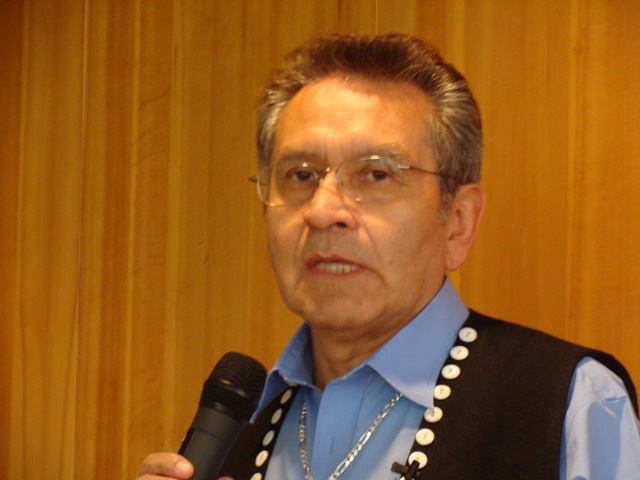
Tlingit-Haida Central Council President Ed Thomas.
“We don’t want to export anything that will undermine the local utilization. But where there is a potential for surplus we would like to still get some of those exported in the raw and to set up a system whereby they would be able to bring those back, competing with local artisans,” Thomas says.
He says the council is already trying to work with federal officials on otter management issues.
Council delegates also elected officers at the assembly.
Thomas outpolled former Sealaska CEO Bob Loescher to retain the president’s seat, which he’s held for most of the past 30 years. Loescher was named Citizen of the Year.
Six incumbent vice presidents were also re-elected. Thomas says it’s the first time the full Executive Council has gone unchanged.
Funding prospects are always a major topic at the tribal assembly. Thomas says they’re not looking good.
“It’s really very difficult to get into a growth scenario when we have cutbacks. I think there might be some opportunity in energy programs. But, boy, everything else is under fire,” he says.
Thomas expects federal-funding reductions that could lead to staff and program cuts. He says that would start with administrative spending, but likely move into other areas.
Other news from the tribal assembly:
Delegates also approved a resolution strongly opposing the exclusion of Alaska Native tribes from the Violence Against Women Act. The federal act is currently going through a re-authorization. The council says the current version of the VAWA (H.R.4154, H.R.4271 and S.1925) discriminates by singling out all Alaska Native tribes with the exception of the Metlakatla Indian Community, and removes the pre-existing authority of Alaska Native tribes to issue civil protective orders.
Delegates re-elected 1st Vice President William Micklin of San Francisco, 2nd Vice President Robert Sanderson Jr. of Ketchikan, 3rd Vice President Yodean Armour of Klawock, 4th Vice President Richard Peterson of Kasaan, 5th Vice President Harold Houston of Juneau, and 6th Vice President Lowell Halverson of Seattle.
Ed Thomas presented Mary Elizabeth Jones with the President’s Lifetime Achievement Award for her many contributions towards improving healthcare services for Tlingit and Haida people and strengthening Alaska Native women’s political positions within their communities.
The Doloresa Cadiente-Hardin Tribal Justice Award was presented to its first two recipients: Tribal Child Support Unit Attorney Jessie Archibald and Alaska Legal Services Corporation Attorney Holly Handler.
The Alaska Board of Fisheries addresses Southeast finfish issues starting on Friday (Feb. 24).
Members will consider 145 proposals from advisory boards, gear groups and individuals.
They range from Sitka’s sac roe herring harvest to Juneau’s Taku River king sport fishery to changes in seine boat size limits.
The meeting lasts 10 days.
Fish and Game boards director Monica Wellard says much of the first few days will be taken up by public testimony.
“They’ll be allowed that particular time frame to talk about the proposals they’re for or against. And then there’s also the written comments they can provide, put it all in writing and submit that during the meeting so their comments can be heard,” she says.
Other proposals involve sport fishing for fresh water kings, rules for reporting catches, and listing Haines’ Luta Inlet as a subsistence management area.
The board of fisheries is meeting at Ketchikan’s Ted Ferry Civic Center.
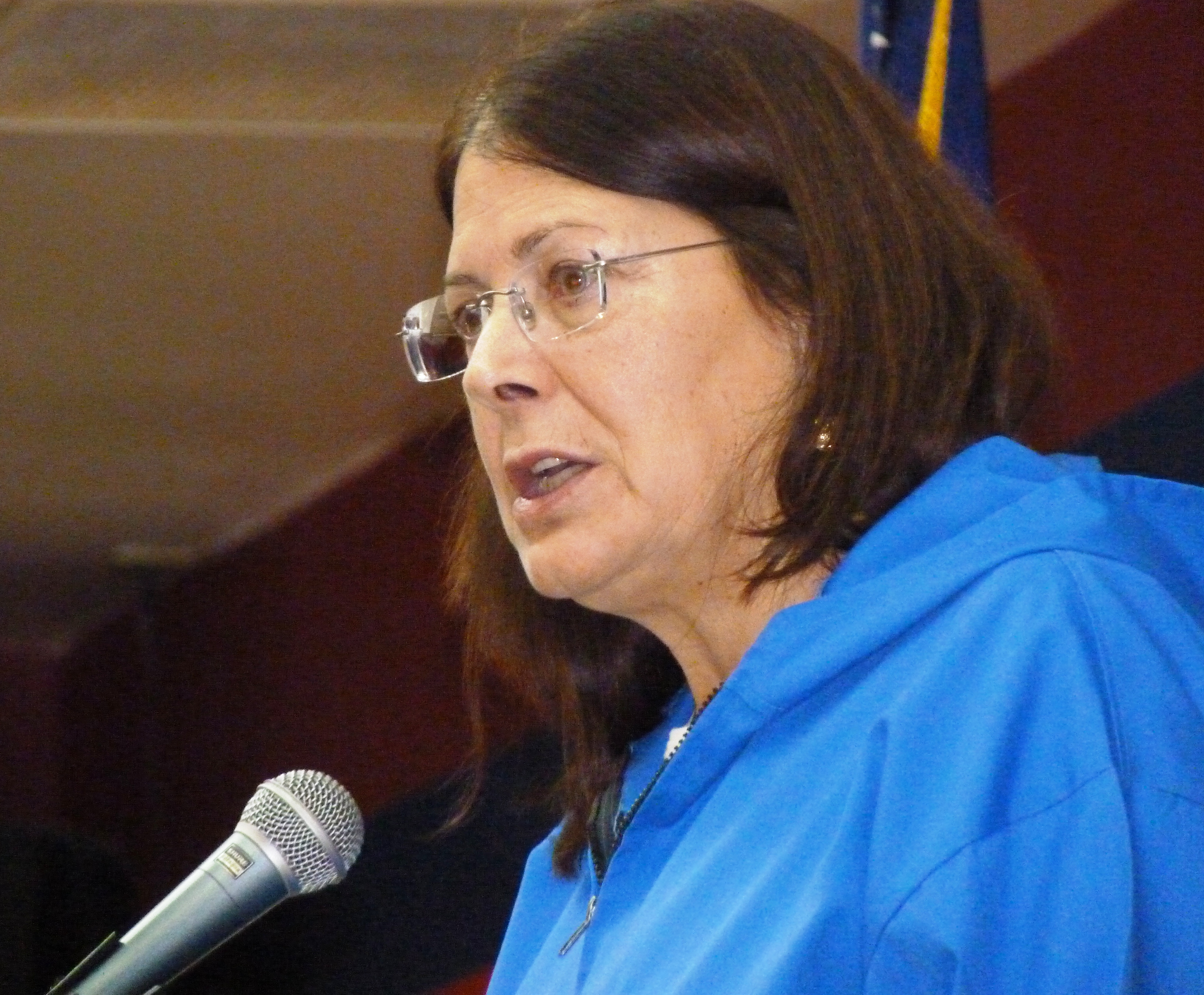
AFN President Julie Kitka addresses the Feb. 22 Native Issues Forum in Juneau. Photo by Ed Schoenfeld.
Alaska Federation of Natives President Julie Kitka warns that the continuing federal budget battle could impact essential services.
But she says it’s hard to tell where the ax will fall.
“We could see programs that we have spent decades building up and working and just will disappear in the budget acts as they deal with those federal deficits,” she said.
She told those attending Juneau’s Native Issues Forum on Wednesday, Feb. 22, to be ready for a last-minute call-to-action if major programs face significant cuts.
At the same time, Kitka expressed optimism about Native Americans’ chances in the coming year.
She pointed to an upcoming conference in Washington, D.C., cosponsored by the Center for American Progress. The think-tank is closely tied to the Obama administration.
“It’s one of those opportunities (where) you make of it what you can. It may turn out to economic development issues that could pop out of this and get done. It could be renewable energy. It could be regulatory changes or a whole array of things,” she said.
Kitka said the conference is a major focus for AFN during the last year of the Obama administration’s first term.
Sen. Albert Kookesh addresses the Feb. 22 Native Issues Forum. Photo by Ed Schoenfeld.
The senator representing Alaska’s largest legislative district is suggesting major changes to the state’s Permanent Fund and the governor’s scholarship program.
Albert Kookesh, an Angoon Democrat, spoke during the Native Issues Forum in Juneau today (Feb. 22). Kookesh, who could be serving his final term, speculated on what he would do if he was king for a day.
He said the $41 billion Permanent Fund should be divided into three accounts.
One, starting with $20 billion, would fund annual dividends. The second, with half of what’s left, would become an education endowment. The third would use what remains to form an energy and transportation endowment.
“I’m not the king for the day. But that’s something I wish we could do and I wish people would think about it. And I’d take that whole thing to a vote of the people. Tell me what you think. We could take 20 billion dollars and give you a permanent fund check for the rest of your life and guarantee it,” he said.
He said it helps very few rural students, who attend schools with few, if any, specialized staff. He said he told Parnell he would instead put the money into the Head Start preschool program.
“And I said ‘Governor, we don’t need the money on this end of the spectrum for scholars. We need it on the other end of the spectrum for students who are just starting out so they have good beginnings’,” he said.
Kookesh represents more than 125 villages and small cities in Southeast, Prince William Sound and the Interior.
He’s in his 16th year in the Legislature.
He faces an uphill re-election battle, because reapportionment left him in a Southeast-only district with about a quarter of his current constituents. That puts him up against Sitka Republican Bert Stedman, who will retain about three quarters of his current Senate district.
Kookesh also co-chairs the Alaska Federation of Natives and chairs the Sealaska Corp. board of directors.