Alaska

Government-tribal collaboration session set for Southeast

Tribal leaders attend May 4th’s Ketchikan tribal cooperation meeting. From left: Tim Gillen, Wrangell Cooperative Association; Delores Churchill, Ketchikan Indian Community; Frank Demmert Jr., Klawock Cooperative Association and Rob Sanderson, Ketchikan Indian Community. Photo courtesy U.S. Agriculture Department Rural Development.

Officials from 10 federal agencies will meet Thursday, Aug. 9, with tribal leaders from northern Southeast Alaska.

They will discuss federal housing, nutrition, economic development, utility and other programs available to tribal governments and non-profit groups.

Department of Agriculture Rural Development spokesman Larry Yerich says it’s one in a series of regional tribal collaboration gatherings.

“We want to just say ‘Here’s the main stuff that we have available, but we’re certainly open to hearing what your questions are.’ And that’s the difference between this kind of meeting and rule-making, which is much more rigid,” Yerich says.

Thursday’s meeting runs from 8:30 a.m. to 5 p.m. at Juneau’s Tlingit and Haida Vocational Training and Resource Center. It’s part of an Obama administration directive for agencies to work with Native organizations.

The meeting is in person and will not include participants via teleconference.

Yerich says much of the discussion will be about funding.

“Any of the federal partners who are participating in the project, we all have a variety of loan and grant programs. And we all have services that could be of interest to the people who are attending,” Yerich says.

Thursday’s meeting is for Southeast tribal officials from Sitka or to the north. Southern Southeast had its own meeting in early May in Ketchikan. Bethel, Nome and Tazlina, near Glennallen, have had similar events. Yerich says more are planned.

Federal agencies to be represented at the meeting are Rural Development, Farm Service Agency, Natural Resource Conservation Service, Forest Service, Food and Nutrition Service, Department of Housing and Urban Development, Small Business Administration, Economic Development Administration, Department of Energy and the Denali Commission.

Programs of greatest interest:

• Food production, availability and nutrition

• Rural housing

• Land management programs of Natural Resources Conservation Service and Forest Service

• Rural utilities (electric, telecom, solid waste, sewer and water)

• Rural economic and community development
Term-limits lose, Sealaska board members re-elected

Sealaska Corporation shareholders have voted down a term-limits measure.

It called for limiting board of directors members to four, three-year terms, for a total of 12 years. It only attracted a little more than a quarter of the voting shares required to win.

Sealaska Corporate Secretary Nicole Hallingstad says shareholders also returned five incumbents.

“The Sealaska board slate was re-elected. Directors Albert Kookesh, Barbara Cadiente-Nelson, Bill Thomas, Joe Nelson and Tate London,” she says.

Three independent board candidates lost: William Micklin, Raymond Austin and Edward Sarabia Jr.

Sealaska is the regional Native corporation for Southeast Alaska. It has more than 21,000 shareholders, with fewer than half living in the region.

Nicole Hallingstad, Sealaska corporate secretary and vice president.

Election results were announced at Saturday’s annual meeting, which was held in Juneau.

“Approximately 350 of our shareholders joined us at Thunder Mountain High School for our annual meeting. And 417 of our shareholder households viewed the webcast of our annual meeting,” she says.

Last year’s meeting, in Haines, attracted about a third as many people, but twice this year’s webcast count.

Those attending Saturday’s meeting heard from Hawaiian Native leader Nainoa Thompson, of the Polynesian Voyaging Society.

Hallingstad says he spoke about Alaska Natives as cultural leaders. He also talked about a major expedition he’s planning to several Polynesian Islands.

“It designed for those paddlers to navigate the way the old Hawaiians did merely by geography and the stars along the paths that their ancestors used to paddle. And he indicated it would be wonderful if some Alaska Natives could join those Hawaiians on the voyage,” she says.

The board also voted to retain Sealaska’s management team.

2012 Annual Meeting Election Results
Numbers indicate shares voted. Most shareholders have 100 shares.

CANDIDATE VOTES
Albert Kookesh – 1,004,184
Barbara Cadiente-Nelson – 901,138
Bill Thomas – 845,123
Joe Nelson – 802,338
Tate London – 778,126
William Micklin – 337,159
Raymond Austin – 294,618
Edward Sarabia, Jr. – 213,754

Term Limits resolution
Shall Sealaska Corporation amend Bylaw Section 3.1 to establish term limits for directors of four complete three-year terms, with permanent ineligibility thereafter?
Threshold to pass: 983,621 shares (50 percent of shares that could be voted, plus one.)
Shares voted in favor of the resolution: 499,147 or 25.37 percent of all possible shares.
\

Sealaska shareholders meet Saturday in Juneau

The regional Native corporation for Southeast Alaska holds its annual shareholders’ meeting Saturday, June 23.

Sealaska Corporation has about 21,000 shareholders, many living outside the state.

Saturday’s meeting is at Juneau’s Thunder Mountain High School. It begins at 10 a.m. with a shareholder’s fair and comments from board of directors’ candidates and both sides of a term-limits resolution.

The meeting also includes a business report and election results. It ends at about 5 p.m. with a question-and-answer session for shareholders.

Critics say the hour planned for that session is too short, and is an attempt to muzzle opponents. Corporate officials say it was just an estimate and will run longer if needed.

Sealaska’s annual meeting will be webcast live through the corporation’s website. Only shareholders can attend the meeting in person or on the internet.

Click on this link for the full meeting schedule.

See a slideshow of the 2011 annual meeting in Haines.

House passes bill granting thousands of acres of National Forest to Sealaska

The U.S. House passed a bill on June 19, ceding tens of thousands of acres of the Tongass National Forest to the Sealaska Native Corporation. However, the vote is just one step the bill needs to clear Congress.

This is the furthest along the legislative process the Sealaska bill has made it. It passed the Republican controlled House with 232 votes including 16 Democrats.

The bill would transfer control of tens of thousands of acres of the Tongass from the U.S. Forest Service to the Sealaska Corporation, the final Regional Native Corporation to settle its land claims. The land is outside the plots originally agreed to in the Alaska Native Claims Settlement Act 40 years ago.

Some of the land will be used for logging, with some future sites left open to other possible ventures. Those future sites have Andi Burgess worried. She’s with the Alaska Wilderness League.

“There’s no prohibition on what can be done at these sites,” Burgess said.

Those sections of land could be parceled off as heritage sites or be designated for money-making projects, like ecotourism. While Burgess’s fears may be stoked by the bill’s passage in the House, it still has some way to go before it becomes law.

The bill needs to clear the Senate, and if its current pace there is any indication, that probably won’t come quickly. Senator Lisa Murkowski introduced her version into committee last year, but has yet to receive a markup – let alone a vote.

Aides to Murkowski say it’s possible the House vote will speed along the process, at least out of committee, but the full Senate is another story.

Murkowski’s plan is more scaled back than the House version.

“To have limited impact into those old-growth areas, to have limited impact in those watershed areas. That’s why we’ve gone through the negotiated process,” Murkowski said.

She’s says that process has taken years –years of negotiations with Sealaska, the U.S. Forest Service and Southeast residents. And those negotiations could make for a more pleasing bill for both parties in the Senate.

And While Young’s bill did earn some Democratic votes – it lost more Republicans, a sign it could be hard to move his version down the line.

Senator Murkowski says the chairman of the Senate Energy and Natural Resources Committee, Jeff Bingaman, hasn’t committed to another hearing on the bill, but she’s trying.

“We keep sitting down,” Murkowski said. “And I suppose the fact that we’re still talking about it is good.”


High-profile trials lined up for this fall

A jury trial is now set for September 24th in the case of last summer’s fatal accident out the road. Ryan West is being charged in connection with the death of Gabriel Carte. West and Carte were both in a truck that went into a ditch and rolled several times at Mile 35 Glacier Highway in June 2011. West sustained minor injuries. Carte died when he was ejected from the vehicle. Police believe alcohol and speed were factors in the crash.

Scheduling the West trial was complicated by other high profile cases also headed for trial this fall.

One includes a Juneau man accused of four counts of sexual abuse of a child. All four charges stem from Joshua David Burger as a parent or guardian allegedly abusing a child in his care. A September 4th trial date was set in the case.

Also tentatively planned for sometime this fall is the case of John Marvin who accused of shooting Hoonah police officers Tony Wallace and Matt Tokuoka in August 2010. Marvin was declared not competent to stand trial in January. Another competency hearing is planned for next week.

Former Juneau Police Lieutenant Troy Wilson is also scheduled to stand trial for an alleged shooting and standoff at his home in April. He’s being charged for allegedly firing on his former colleagues. The trial is expected to start December 3rd and last two weeks.

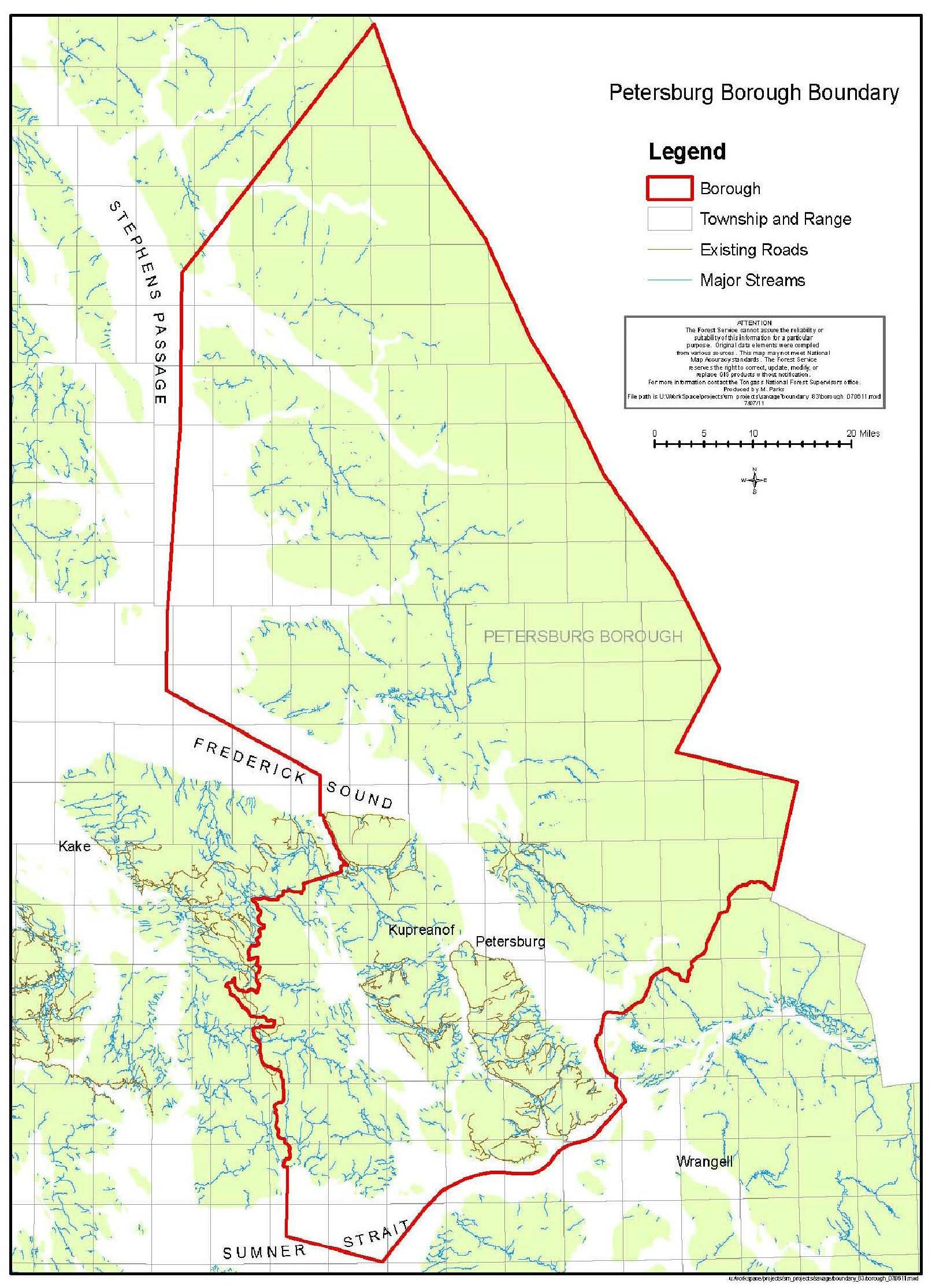
LBC wraps up Petersburg borough hearing

The Alaska Local Boundary Commission is wrapping up three days of hearings in Petersburg on its petition to incorporate into a borough, bringing along with it an area north to the Juneau borough, south to the Wrangell borough, west to include roughly half of Kupreanof Island and east to the Canadian border.

Juneau’s competing petition calls for annexing some of the territory. Mayor Bruce Botelho this morning (Friday) urged the LBC to at least adjust the boundaries, particularly for resource development. In the past, for example, mining in the area has been staged out of Juneau, and future mines will be too, he says.

“These will be staged out of Juneau by virtue of both the mining support industry and the mining labor-force residents of Juneau, because of Greens Creek and Kensington (mines), he said.

Botelho reminded commissioners that their own regulations require them to look at model borough boundaries within the proposed area.

The LBC several years ago recommended that Juneau annex some of the area Petersburg now wants. Botelho says it did not in deference to the Native corporation, Goldbelt, which owns 30,000 acres in Hobart Bay. Goldbelt says it does not want to be part of any borough.

Botelho told commissioners that Juneau and Petersburg are intertwined and their decision will not change that.

“We’re tied economically, socially and by family,” he said. “And whatever decision you make will not alter that relationship over time.”

The LBC is expected to make a decision later today.

Petersburg Proposed Borough Map
A map of the proposed Petersburg Borough. Map by the Department of Commerce Local Boundary Commission.
Site notifications
Update notification options
Subscribe to notifications