Western

Nome public schools considers new program to fight principal turnover

Nome-Beltz Jr/Sr High has had six principals in the last seven years. (Photo by Laura Kraegel/KNOM)

With high local turnover and a statewide shortage of administrators, Nome Public Schools is looking take a new tack when it comes to attracting — and retaining — qualified principals and other school leaders. Superintendent Shawn Arnold broached the subject at a school board work session Tuesday night.

“Our turnover with our building leadership is something that we’ve dealt with for some time,” he said.

Nome-Beltz Jr/Sr High, for instance, has seen six principals in the last seven years. The school’s most recent principal — Edwin “Chip” Sharpe — resigned in December after just six months on the job.

That’s why Arnold wants to establish a cohort of aspiring leaders around the district. He said the program would facilitate and fund professional development for promising staff members who are already a part of Nome Public Schools, with the aim of “growing our own administrators.”

Not every member of the cohort would go on to become a principal or superintendent, but Arnold said the district would have a larger pool of local applicants when administrative positions do open up.

“Having administrators that have come up the ranks in the district they’ve worked and taught in — and if they’re from that community — they may stay for a longer time,” he said. “They’ll have some of that institutional knowledge that others from some Lower 48 state might come up without.”

The Lower Kuskokwim School District has done something similar in partnership with the University of Alaska Anchorage over the past five years. Arnold said most of their administrators now come from within their district, which has also seen less turnover.

If the cohort initiative moves forward in Nome, Arnold said members would have to commit to the district for a certain period of time — and they’d face financial penalties if they took their talents elsewhere too soon.

The school board isn’t attaching any funding to the program right now, but Arnold said backing could eventually come from the district’s title and professional development funds.

In that vein, board members also took their first look at the draft budget for the fiscal year that begins July 1. overall, the draft budget spends about $15.4 million — a little less than this year’s budget.

District CFO Lucy Ann Smith said most revenues and expenses are expected to stay about even, apart from natural increases in salary and benefits.

Still, Smith emphasized that the budget is very much a work in progress. Joining the work session by phone from Anchorage, she said the draft will change over the next six months, depending on upcoming salary negotiations and contributions from the City of Nome.

“And then, of course, everyone knows the uncertainty of education funding from the Alaska legislature really is a cause for concern,” she said.

The district is required to submit its balanced budget to Alaska Department of Education by July 15. The school board’s next meeting is Feb. 9.

New arrivals in Kotzebue Sound preying on belugas

Orcas. (Creative Commons photo by Chis Michel)

Kotzebue Sound is changing and beluga hunters are facing new competition. Researcher Manuel Castellote at the Alaska Fisheries Center placed underwater microphones in the Sound. Instead of belugas, he found the source of the problem — killer whales.

“It turns out when we look at our data what we found was mainly killer whales. So that’s why the project quickly became a killer whale project.”

Things have gotten so bad in Kotzebue Sound that belugas there don’t sing out as much as they do elsewhere. Researchers suspect the belugas are afraid killer whales will find them and eat them.

“… because they know that if they are happy they will hear them and they might be predated. So they try to be silent.”

As in so many areas in the Arctic, changes are happening more quickly than further south. In Kotzebue Sound, the seabirds that used to eat fish have declined while those eating plankton have increased.

3 teens charged in death of Kotzebue man

Three teenagers have been arrested and charged with second-degree murder in Kotzebue following the shooting death of Joshua Sours III.

Sours was found with a gunshot wound Friday after Kotzebue Police and paramedics responded to a report that someone had been shot on Second Avenue at 1:18 a.m.

The 27-year-old victim was taken to the hospital and pronounced dead, according to a news release from the Kotzebue Police Department.

Charged with the fatal shooting are Brandon M. Nelson, Tony Jackson, and Frank J. Jackson Jr. — all three were arraigned Monday at the Kotzebue Trial Court. In addition to second-degree murder, the three teenagers face charges of first-degree robbery and tampering with physical evidence.

Nelson is just 17 years old, but Kotzebue Police said he was “automatically waived to adult status,” given the seriousness of his alleged crimes. Tony Jackson is 18, and Frank J. Jackson Jr. is 19. Their bail is set at $1 million.

Sours’ next of kin was notified after his death on Friday, and the State Medical Examiner’s Office is scheduled is perform an autopsy.

Former Akiachak teacher reports sexual assault, harassment in lawsuit

A lawsuit has been filed against the Yupiit School District, four Akiachak school supervisors and an Alaska State Trooper official for allegedly showing “deliberate indifference” when a former school teacher was sexually assaulted and continuously harassed during her nearly three years teaching there.

The lawsuit, which was filed late last month, claims the entities exercised gross negligence, caused emotional distress, retaliation, and violated Title IX among other charges.

According to court documents, the teacher taught at the Akiachak school from late 2011 to early 2014. During this time she faced repeated harassment at her home. The school district provided the housing.

“On almost a nightly basis strange men would pound on her door and outside walls of her house, demanding to be let in and loudly demanding sex,” the documents say. During her third year, she requested safer housing and the school district allegedly said they would find her a new home, but after Christmas break there was none.

The plaintiff decided to sleep at the school until she was given better housing. However, the teacher suffers from epilepsy, and one night she experienced a seizure and lost consciousness. When she awoke there were signs of a sexual assault and her chest was mutilated.

The lawsuit alleges that the teacher attempted, but was unsuccessful in reaching the village public safety officers. Alaska State Troopers flew her to Bethel where she underwent a rape kit exam.

She was able to get shelter and seek medical attention in Bethel. She tested positive for an incurable form of herpes and suffers from a severe post-traumatic stress disorder.

The teacher is seeking compensatory and punitive damages and an order for the school to take more preventive measures against sexual assault and harassment.

The attorney representing the client is Anchorage-based civil rights lawyer Caitlin Shortell. Shortell declined to comment on this story.

Tuluksak school wins national contest, learns computer coding

Katherine Garrison holding the check from Code.org inside her Tuluksak classroom. (Photo by Anna Rose MacArthur/KYUK)

Last week in President Barack Obama’s final State of the Union address, he envisioned a future where all students in the U.S. learned computer science. That future is beginning in Tuluksak where 21 iPads are being shipped to the Kuskokwim school to teach coding.

In December Tuluksak seventh- and eighth-grade teacher Katherine Garrison saw a Facebook post asking teachers worldwide to include an hour of code in the school day.

“And I did, because my kids love to be on the computers. I thought that would be kind of cool,” Garrison said.

Hour of Code is a one-hour introductory computer science tutorial offered by the free website Code.org, a non-profit devoted to increasing computer science education by making it available in schools. The event occurred during national Computer Science Education Week in mid-December. One school from each state, and from Washington D.C., received $10,000 worth of computers. In Alaska, Tuluksak took the prize.

“So we’ll be able to use them for the coding,” Garrison said. “We’ll also be able to use them for everything else that you can use a computer for. We’ll have computers in the room, so we can do research projects and learn about current events and probably play a few games if we’re going to be honest.”

Garrison says her class will code for an hour every Friday using Code.org and use the iPads for research during the rest of the week.

“Now they’re confined to what they can find in the library because we can’t get a lot of computer time,” Garrison said. “But this will open it up so they can get more current and relevant information.”

Garrison says the school currently holds 19 computers for its 140 students. She said the school spent the prize money on iPads because tablets use less broadband than laptops.

“We have very limited and very narrow abilities to get onto the Internet. So, if you have too many computers, then the whole system crashes down. And the whole village gets in on our Internet,” Garrison said.

Garrison says the iPad influx will change how she’s able to teach and the coding will create new job opportunities for her students.

“What’s really cool about this is Tuluksak along with a lot of the other remote village area schools, the kids don’t necessarily want to leave home, but they do want to make a lot of money. Computer science—  designing these applications— they can do anywhere. They just have to have a computer,” Garrison said.

The iPads should arrive this week.

After corruption allegations, tribes call on AVCP to meet

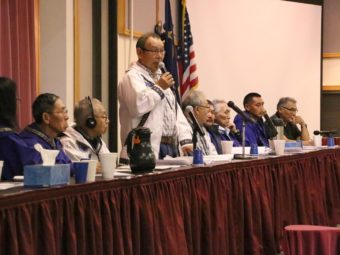
Association of Village Council Presidents’ 51st Annual Conference. (Photo by Dean Swope/KYUK)

Four tribes in Western Alaska are calling on the Association of Village Council Presidents to broaden the focus of a special meeting originally intended to address regional governance, and to set a date for the gathering.

On Jan. 8, KYUK in Bethel reported it had obtained documents showing AVCP used grants for intended to help needy families to keep a vocational flight school going. In December, AVCP laid off 30 employees, 7 percent of its workforce, citing budget troubles. AVCP also announced a 5 percent pay cut for general staff and a 10 percent salary reduction for senior management.

Mike Williams, Sr., with the Akiak tribal council, says the sudden layoffs may leave people unable to pay for stove fuel or electricity.

“Yeah, the majority live in Bethel and a lot of those are in the villages. So they’re left out in the cold, and we’re very concerned about that.”

He says the tribes of Akiak, Akiachak, Kwethluk and Tuluksak — along with several others along the Yukon River — want to find out more than they’ve been told.

“I think in that meeting, we can close the door and find out what’s really going on.”

Last year, the regional for-profit corporation Calista created a group to study problems with legislation affecting Alaska Native people and organizations. The group came up with three proposals: 1) To strengthen AVCP, 2) To create a borough, or 3) To create a new regional tribal government. Williams says the goal is to give Natives a stronger voice…

“… and if there is development, for instance, the Donlin Gold project, then how are we going to have the ability to regulate and also the issue of tax payment as well.”

In an October meeting, tribal representatives voted to hold a special meeting on governance in February. AVCP Administrators have not yet approved or announced a meeting date. AVCP is the regional nonprofit for the 56 villages in the Yukon-Kuskokwim Delta.

Site notifications
Update notification options
Subscribe to notifications