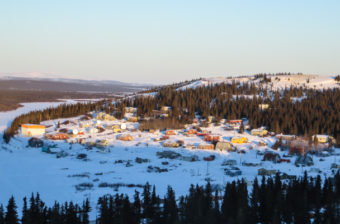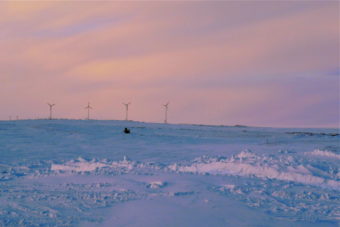
Shishmaref Sea Ice. (Photo by Maddie Winchester/KNOM)
One man in Shishmaref is using a drone to keep track of sea ice conditions this winter. He’s using social media to share the footage he collects in an effort to raise awareness about the effects of climate change on Alaska’s Northwest coast.
Last fall, Dennis Davis bought a drone.
“One of the reasons why I got it was in the springtime, once everybody starts getting ready to go out ugruk hunting, you can’t really see what the ice is going to be like out there,” he said.
He said sea ice conditions have become less reliable and weather more unpredictable for his fellow seal and walrus hunters in recent years, so footage he collects with the drone “is like insurance.”
“I can shoot either a video or I can shoot still pictures and blow them up and look at the ice that way I can find a better trail for everybody to go on,” he said.
Davis can legally fly his drone as high as 400 feet. He can also capture images from more than a mile away. He shares it all through accounts on Twitter, Instagram and Facebook. He said the first photo he posted in November reached more than 14,000 people, but since then the attention has dwindled.
“At least, it’s getting out there and people are recognizing and seeing what we are going through,” he said.
Davis said he’ll continue to post his footage. He wants to stoke a bigger conversation about winter storms and coastal erosion in Western Alaska.
“I feel it’s a personal mission of mine,” he said.
This summer, he plans to travel more than 100 miles of coastline with his drone.
“From Cape Espenberg all the way down past (Shishmaref), just to see what the coastal erosion is up to – how bad it is,” he said.
Davis has considered using his photos and video to start a fundraising effort for the residents of Shishmaref and other villages seriously threatened by climate change, but he hasn’t quite figured out how.
The House Finance Committee sent its budget proposal to the full House of Representatives on Wednesday. The budget, with some late changes, would cut spending by $280 million. It also spends $225 million in funds left from the current budget.
There were some intense exchanges between committee members before the final vote.
Rep. Lynn Gattis, R-Wasilla, during discussions about the state operating budget shortly before it was passed out of the House Finance Committee, March 9, 2016. (Photo by Skip Gray/360 North)
Wasilla Republican Rep. Lynn Gattis questioned why the leftover funds from the current budget only emerged recently.
“Folks in my district are saying, ‘Why in the heck would I trust you to go and tax me or take my Permanent Fund dividend, when you guys are playing these shell games?’” she said.
But Eagle River Republican Rep. Dan Saddler said spending the savings was a legitimate budget strategy.
On Tuesday, the committee added $30 million for an addiction treatment program, and restored $2.7 million for public broadcasting and $1.7 million dollars for the Nome Youth Facility.
Anchorage Democratic Rep. Les Gara said the budget shortchanged vulnerable Alaskans. He noted the spending plan cuts all state funding for pre-kindergarten.
Rep. Les Gara, D-Anchorage, during discussions about the state operating budget shortly before the House Finance Committee passed it on Wednesday. (Photo by Skip Gray/360 North)
“I understand we have to cut waste. But we don’t have to cut the things that make a difference in people’s lives,” he said. “That’s where I draw the line. And we crossed that line over and over and over yesterday. I don’t believe we have to cut things that senior citizens rely on. Three hundred and fifty thousand dollars got cut from senior citizen help for people who need emergency housing.”
But Committee Co-Chairman Mark Neuman said that as the state considers cutting Permanent Fund dividends and raising taxes, it must cut spending.
“I’ve had to tell every group, every person that’s walked into my office that has approached me on the street – wherever they talk to me – no. I can tell you, look you straight into the eye that everybody that has walked into my office was told no, we don’t have the money.”
The House is scheduled to discuss the budget — and potentially vote on it — on Thursday. The Senate may vote on its version of the budget on Saturday. Then the two houses will work to resolve the differences.
Sen. Donny Olson, D-Nome, at a Senate minority press availability, March 4, 2015. (Photo by Skip Gray/360 North)
Sen. Donny Olson joined Republicans in the Senate Majority last month, and with that move came funds for one more staffer. Olson, a Democrat from Golovin, brought on a former employee who has a long history in the Alaska Legislature.
“I hired my former chief of staff, David Gray, who has been working in the legislature for more than 30 years,” Olson explained.
Gray’s resume includes work with former senator and Alaska Native rights advocate Willie Hensley, former Kotzebue lawmaker and Alaska Native leader Frank Ferguson, and current Sen. Lyman Hoffman of Bethel.
Gray was in retirement when Olson got the funds for one more staffer. Gray is now working part-time on specialized projects and makes $49 per hour.
Olson said he made sure his fellow Democrats weren’t affected by his move.
“I made sure the minority caucus, the friends and colleagues I have there, the other Democrats, did not lose any staff, did not lose their press person, did not lose their webmaster, and they were still able to continue on,” Olson said.
Minority leader Sen. Berta Gardner confirmed her caucus did not lose any resources with Olson’s move to the majority. She said they remain on good terms with Olson.
“We have had no falling out with him,” Gardener said. “It’s nothing to do with our caucus. It’s about how he can best advocate for the needs of his district, and that is what every legislator is called to do.”
Gardner said Olson’s move is understandable since certain projects are more pressing in rural Alaska.
“In Alaska, what matters to rural legislators is capital projects,” Gardner said. “Capital is the difference between clean water and not having clean water, or sewage or new schools.”
One capital project Olson is focusing on is the Power Cost Equalization, or PCE, project, which helps people afford the high cost of energy in rural Alaska. Olson’s newest staffer, David Gray, is working to preserve funding for the PCE amid state budget cuts.
The House Finance Committee is considering taking more than $24 million from the PCE fund to help refinance the University of Alaska budget.
Neil Laughton (left) and James Bingham were recently rescued by U.S. Coast Guard off the Bering Strait. (Photo by Emily Russell/KNOM)
Two British explorers were rescued from the icy waters of Bering Strait Thursday afternoon. Neil Laughton and James Bingham left the village of Wales on the western edge of the Seward Peninsula Wednesday. The men were attempting to cross the strait when they began to drift north into the open ocean.
Laughton and Bingham started their journey on foot from the village of Wales Wednesday morning. They planned to walk over ice and paddle in open water in the hopes of reaching the island of Little Diomede. Bingham says they fell victim to changing ice conditions in the Bering Strait.
“The issue we face now with global warming is that the ice just isn’t forming,” said Bingham. “It makes what was already a challenging expedition close to impossible.”
They knew they needed to be prepared for open water since Bingham made a similar attempt just last year. He was deterred by the inconsistent ice conditions. This and last year’s attempts are practice. The two are training to cross the entire Bering Strait in 2017.
Neil Laughton says things started to go wrong by the end of their first day.
“We’d been paddling quite hard for nine or 10 hours. We’d got approximately halfway across the Strait,” Laughton explained.
That’s when he said they noticed ice forming around their kayaks.
“We (had) to punch through with the paddles to break the ice to make progress,” Laughton said. It was very hard, very slow and quite debilitating.”
Near nightfall, they couldn’t continue paddling because of thin ice. And they couldn’t pitch a tent due to the lack of thick ice. Instead, they pulled their kayaks up onto the slushy ice and hunkered down.
“We spent the night in the open in our clothing, kind of involuntarily shivering for the next twelve hours until daybreak,” described Laughton.
By the time the two woke up, the ice had frozen around. Bingham said it started to carry them even farther north into the open ocean.
“So there really was no way out of it,” Bingham explained. “We were caught in this ice drifting north, further and further away from our objective.”
It was at that point that Bingham and Laughton decided to call for help. They both say they would have kept going if the ice were thicker. Laughton said that it still wasn’t solid enough to walk across.
“As soon as you stepped off onto this ice there were parts where it would hold you for a bit, and then suddenly your feet would go through and you’d fall in,” Laughton said.
“So it was just a pretty dire situation. You couldn’t paddle, you couldn’t walk. Check. Check Mate,” Laughton admitted
“We were in Kodiak getting ready for a training flight and the SAR alarm went off,” said U.S. Coast Guard Lieutenant Andrew Jarolimek. Air Station Kodiak was contacted for the search and rescue mission Thursday morning. They sent a C-130 aircraft and two Jayhawk helicopters.
Laughton and Bingham were spotted from the C-130 drifting on a section of sea ice about 25 nautical miles northwest of Wales. Jarolimek, who was piloting one of the Jayhawks, lowered a rescue swimmer down onto the ice.
“He was able to give him a general assessment and they were cold, but in good spirits, and happy to be rescued,” Jarolimek explained.
Jarolimek said they were actually well prepared for the expedition, but the drifting sea ice worked against the two explorers. Laughton and Bingham were flown back to Nome yesterday afternoon. Laughton says they escaped mostly unscathed.
“James has a little frostbite on his fingers. Me, being a bit older and uglier and harder skinned, I’m fine, thanks,” Laughton joked.
Both Laughton and Bingham seem to be aware of the risks associated with their Bering Strait expedition.
“We kind of estimate there are three outcomes on this project: there’s success, there’s rescue and there’s death,” Laughton explained. “When success starts to fade away, you’re left with two, and that’s the reason why we pulled the pin early.”
Laughton, who has summited Mount Everest five times and skied to both the North and South Poles, says the Bering Strait crossing is at the top of his list. But ice conditions in the strait are now so unpredictable that a crossing of this kind may be impossible in the years to come.
The Nome Youth Facility. (Photo by Laura Kraegel/KNOM)
A subcommittee of the Alaska House of Representatives has recommended closing the Nome Youth Facility. The closure would save more than a million dollars outright, but some say it would come at the expense of children who live in Western Alaska.
The Nome Youth Facility serves 28 communities surrounding Nome and Kotzebue. Last week, the Department of Health and Social Services House Finance Subcommittee recommended the state shut it down.
“We reduced funding to the Nome Youth Facility in the amount of $1,693,900, which deletes 15 full-time positions and three temporary positions and would close the facility,” said Representative Dan Saddler (R-Eagle River), the subcommittee chair.
Saddler said the recommendation comes as an adjustment to Governor Bill Walker’s budget proposal, aimed at shrinking the state’s deficit.
Juvenile Justice Director Rob Wood said generally low and fluctuating numbers at the Nome Youth Facility in the last few years probably played a role in the recommendation.
“Realistically, if you look at detention numbers, they just go up and down quite a bit. And we don’t control those numbers,” he said. “Those are based on law enforcement investigations and arrests.”
He said the Nome Youth Facility’s rural location makes lower numbers — and higher operating costs — stand out.
But Wood said the facility’s location is also one of its strengths. He said having a facility in Nome allows young offenders around the Bering Strait Region to rehabilitate near home, rather than leave for Fairbanks or Anchorage. They can even participate in local activities like fishing and hiking on the tundra.
“One of the reasons we have the Nome Youth Facility is because we thought it was important where it is. We think they do a really good job for the area, not just the community,” he said. “So this is hard for us, but we’re still talking. A lot of this is negotiable.”
The full House Finance Committee will consider the recommendation as part of the proposed FY17 budget for the Department of Health and Social Services. Wood said it’s hard to tell whether it will pass, but he knows difficult cuts have to be made.
In the meantime, Nome Public Schools is one of the local entities waiting for a final decision. Superintendent Shawn Arnold said the closure would affect the district’s student enrollment and state funding.
“We actually run a school out of the Youth Facility, and this cut will be pretty significant for us,” said Arnold. “So it’s not just going to impact the Youth Facility. It’s going to impact our district as well.”
The Nome Youth Facility can house 14 juvenile offenders at a time, and it’s one of eight youth facilities in Alaska. Three others also face state funding cuts.
The Alaska state capitol building in Juneau. (Public Domain photo)
With Alaska’s budget deficit nearing $4 billion, Rep. Neal Foster (D-Nome) says cuts are coming and they’ll have major repercussions for the Bering Strait Region.
“It’s going to shape what rural Alaska looks like over the next 10 or 20 years,” said Foster.
Foster said he’s fighting proposed cuts to low-income heating assistance, preschool education funding and broadband internet support — all services important to those off the road system.
“It concerns me and it frustrates me that I’m seeing a number of cuts targeted toward rural Alaska,” he said. “I think things are shaping up to be a real showdown here. It’s not going to get any prettier from here on out.”
Beyond those cuts, Governor Bill Walker’s budget proposal would introduce a state income tax. According to Foster, the tax wouldn’t be too costly for most rural Alaskans.
“I think it’s a fairly small amount to ask for,” he said. “If you’re a single person and you make $50,000 a year and you don’t have any kids that amounts to $341. If you’re married with two kids, your income tax would be $15.”
But Walker’s plan would also reduce dividend payouts from the Permanent Fund, which Foster doesn’t support.
“If you take $1,000 from somebody’s Permanent Fund [dividend] and that person makes $10,000 a year, that’s 10 percent of their income,” he said.
If the state does cut back on PFD checks, Foster said he’ll propose reducing dividends in proportion to income to minimize the impact on rural Alaskans.
As state lawmakers debate how to handle the deficit, Foster said he wants to hear more on the issues that matter to his constituents.
“I do want to very much encourage everybody in our district — from Shishmaref down to Hooper Bay and from Gambell and Savoonga all the way to Ruby — that if there’s any time that we want to hear from them, it’s now. This really is a history-making moment,” he said.
Foster said constituents can contact him by mail, email, and phone as well as through their city and tribal councils.
Close
Update notification options
Subscribe to notifications
Subscribe
Get notifications about news related to the topics you care about. You can unsubscribe anytime.