Western

Stranded ugruk rescued from Nome parking lot

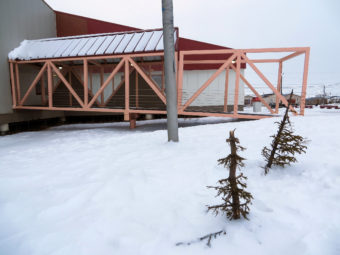
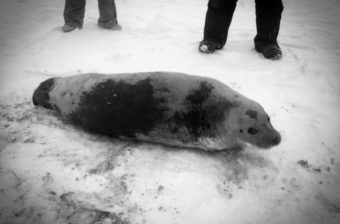
The bearded seal made its way of out the iced-in port up into a parking lot. (Photo by Emily Russell/KNOM)

A bearded seal came ashore Thursday night and made its way into a parking lot on Nome’s west side of town. Gay Sheffield was one of the first on the scene.

“We’re east of the harbor on Lomen right in front of the Crowley office building,” Sheffield explained, “and we have a young bearded seal that’s crawled out of the iced-over harbor and is in the parking lot.”

Sheffield works for the Alaska Sea Grant program at the University of Alaska Fairbanks and is the local stranding responder. NOAA Fisheries created the National Marine Mammal Stranding Network to response to incidents like this one. Local stranding responders like Sheffield are trained in stranding response, animal health and disease.

Sheffield explained that this isn’t the first time a seal has made its way toward downtown Nome.

“Last year we had a spotted seal that also got iced out of the harbor and was headed into town.”

But, often the stranded seals are on the smaller size. Kevin Keith explained that that wasn’t exactly the case with this one.

“It’s an ugruk, which are the bearded seals, which are quite large,” Keith said.

Keith is a fisheries biologist for Norton Sound Economic Development Corporation. Adult bearded seals average around 600 pounds, but this one was only a pup, so Keith estimates it was 150 to 200 pounds.

While Sheffield is authorized to transport stranded marine mammals, due to this one’s size she called for reinforcements.

Keith picked up a fish tote from the seafood plant.

The seal was held overnight at Nome’s Public Safety Building. (Photo by Mitch Borden/KNOM)

“The fish tote is probably 5 feet by 5 feet, so we tipped the fish tote on its side and Gay basically wrestled the seal into the fish tote,” Keith explained.

It took four people to lift the tote with the seal in it onto the bed of a truck. The seal was then transported to Nome’s Public Safety Building where it was kept overnight.

While much is still unknown about the health of the animal and the reason for its behavior, Sheffield said that the seal’s coat may hint at why it came ashore.

“What’s unusual is that he has symptoms of the seal sickness, where the seals have lost the ability to grow their coat,” Sheffield explained. “So this is why he’s looking so patchy.”

According to Sheffield, there are three different options for what to do next with the animal. The seal could be used for subsistence, released back into the wild, or sent down to the Alaska SeaLife Center in Seward, which handles marine mammal rehabilitation.

As of Friday evening, calls for an update on the seal were not returned.

Documentary on climate change in Kivalina and Newtok premieres this weekend


A new documentary focusing on the effects of climate change in Kivalina and Newtok will premiere this weekend on Al Jazeera America. The 30-minute TV program is titled “When the Water Took the Land.”

Libby Casey is a correspondent for Al Jazeera America, which produced the show for its documentary series, “Fault Lines.” Between President Obama’s fall visit to Alaska and the recent climate talks in Paris, she said there’s a large-scale spotlight on finding ways to fight climate change.

For this documentary, though, Casey said the goal is to highlight people who deal with coastal erosion and rising temperatures in their daily lives.

“When you go to villages like Kivalina and Shishmaref and Newtok, you experience it firsthand,” she said. “So we wanted to go and talk to the people for whom this isn’t theoretical. It’s not a debate in Congress. It’s their real lives.”

The filmmakers landed in Kivalina in early October and filmed there for a few weeks, interviewing everyone from elders and whaling captains to tribal leaders and city officials. Even early on, Casey said it was clear the community had spoken on the subject before.

“A lot of journalists come up and parachute in,” she said. “The community is really patient, and they tell their story over and over again to people like me — to reporters. They tell it to state officials. They tell it to federal officials. One woman we talked to — Lucy Adams, a well-known elder — said, ‘Sometimes I just feel like I should stop talking. We talk and we talk, but what good does it do? Nothing’s changing.’”

Casey said she heard similar frustrations in Newtok, even though the community is a step ahead of Kivalina, having already decided on a site for relocation. Both villages will need major funding — and more federal help — before they can move.

In the meantime, Casey said their lands are being swallowed up by the sea — something she hopes the documentary can convey, with urgency, to viewers around the world. She said Al Jazeera will broadcast the show in the U.S. and internationally, giving residents in Kivalina and Newtok a chance to communicate with a wider audience.

“We were privileged to have people sharing their stories in their own words,” she said. “We really wanted the Yupik community and the Iñupiaq community to be able to share their stories in an honest and raw way.”

The documentary will premiere Dec. 20 at 9 p.m. and then air again Dec. 22 at 6 p.m. Viewers in Alaska can watch on Al Jazeera America, available on DISH and DirecTV.

Nome judge admits to misconduct, will undergo sensitivity training

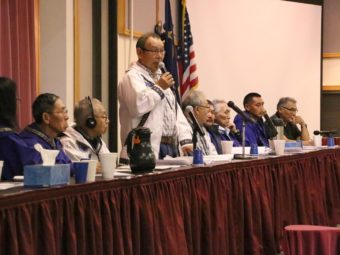
The Nome Courthouse broadcasted an audio feed of the disciplinary hearing for Superior Court Judge Timothy Dooley last week. The hearing was held in Anchorage. (Photo Laura Kraegel/KNOM)

At a disciplinary hearing last week, Nome Superior Court Judge Timothy Dooley admitted to violating the state code of judicial conduct by making inappropriate statements to victims and witnesses. The Alaska Committee of Judicial Conduct has recommended that he be publicly censured, assigned a mentor judge and encouraged to undergo sensitivity training.

During the Thursday hearing in Anchorage, Dooley reversed his earlier stance on the six charges brought against him in May. He had previously denied all wrongdoing. But before the commission, Dooley acknowledged the insensitivity of his comments and apologized.

Picture and brief résumé of Nome Superior Court Judge Timothy Dooley. (Image courtesy of Alaska Department of Law)

“Those are my statements. I don’t dispute them,” Dooley said. “I probably caused grief for some victim, perhaps. I’m also regretful that I caused trouble for the staff at the Nome court. They don’t deserve to have a judge who goes off the high dive and lands on the rocks.”

The statements in question spanned from May of 2013 — when Dooley first took the bench — to September of last year. The first violation occurred at a hearing when Dooley asked a defendant accused of resisting arrest:

“You don’t have to answer this question, but has anything good ever come out of drinking except for sex with a pretty girl?”

Addressing that comment, Dooley told the commission his statement came out differently than he intended.

“In the last couple weeks, I’ve learned that people thought I meant to get the girl drunk, so you can have sex with a girl who’s drunk — which is, of course, a crime,” he said. “I didn’t mean that. Basically, (I meant to) get yourself drunk so you have the false courage to ask a girl to dance or whatever.”

Dooley also said he was speaking as if he were still a private practitioner, looking to build rapport with a client. As a judge, though, he said he has since learned to “screen” his statements and “quit going off the script.”

Dooley’s attorney — William Satterberg, Jr. — emphasized that was a learning process the judge had to go through largely on his own. Dooley is the only superior court judge in Nome. And when he was appointed in May of 2013 by then-Gov. Sean Parnell, Nome’s magistrate judge was out on leave.

Satterberg argued that left Dooley overwhelmed and without help as he assumed his new position.

“Let’s keep in mind here that Judge Dooley literally was tossed into the system cold, completely cold … without any guidance, without any pre-training, with just rapid cases on the desk,” Satterberg said.

Satterberg told the commission that Dooley’s violations came from a place of “ignorance.” He also asked the panel to recommend training rather than harsher sanctions like public censure, suspension, or permanent removal from office — all of which were on the table.

While the commission accepted that Dooley did not mean to be insensitive, Mera Matthews — who served as special counsel to the commission — said his statements were still harmful, especially to victims of domestic abuse and sexual assault.

“We’re doing everything we can to combat and stem the tide of the pervasive problem of domestic violence and sexual abuse in our state. Nobody would argue that it’s anything other than a scourge,” Matthews said. “And we accept as true that Judge Dooley didn’t intend his comments as anything other than condemning that, but the statements do make light of sexual assault. They do make light of domestic violence.”

Matthews cited Dooley’s first statement — “Has anything good ever come out of drinking except for sex with a pretty girl?” — as well as two later violations.

One occurred at sentencing when Dooley told a man convicted of sexually abusing a 14-year-old girl:

“From what I’ve read, this was not someone who was — I hate to use the phrase ‘asking for it.’ There are girls out there who seem to be temptresses, and this does not appear to be anything like that.”

The other happened during a domestic violence case when a juror couldn’t hear a witness on the stand and Dooley said: “I’m sorry, folks, but I can’t slap her around to make her talk louder.”

After over an hour of deliberation, the commission recommended Dooley be publicly censured, which was the least severe outcome possible and amounts to a public statement of his wrongdoing.

The panel also recommended that Dooley be assigned a mentor judge for one year and that he undergo training on gender sensitivity, cultural awareness, and domestic violence.

The commission’s recommendations will now go before the Alaska Supreme Court, which is ultimately responsible for deciding and enforcing any sanctions against Dooley.

Village police officer accused of raping teen previously celebrated at AFN convention

The community of Selawik, near the mouth of the Selawik River, is home to over 800 people. The site of the village, spread between riverbanks and an island, is also called Akuligaq, meaning "a river fork." (Photo by Steve Hillebrand/USFWS)
The community of Selawik, near the mouth of the Selawik River, is home to over 800 people. (Photo by Steve Hillebrand/USFWS)

A substitute village police officer from the dry village of Selawik is in jail in Nome awaiting trial. Brent Norton is charged with supplying alcohol to a minor and raping her while she was unconscious. The 16-year-old girl was found dead hours later.

One month earlier Norton received an award at AFN for his dedication to public safety. His case brings up important questions about how VPOs are vetted in villages throughout the state.

Norton was presented with a President’s Award at the Alaska Federation of Natives convention in Anchorage this October.

The Glen Godfrey Law Enforcement Award is given each year at the annual AFN convention to an Alaska Native law enforcement officer who has shown “outstanding dedication to the safety of the public in Alaska.”

Norton was recognized for his response to a shooting in Selawik this summer. He had less than six months of experience at the time but was first on the scene. While a victim died from gunshot wounds, Norton risked being shot at to retrieve the body.

One month later, 29-year-old Norton allegedly supplied a 16-year-old girl, Lois Cleveland, with alcohol and later raped her while she was unconscious.

According to an article published by the Arctic Sounder, the Selawik Clinic received a call from Norton just before 1 a.m. on Nov. 18. Norton described Cleveland as cold and not breathing. Emergency responders spent 20 minutes trying to resuscitate her before she was declared dead.

But Norton’s record was far from clean prior to this year.

In 2006, he was arrested and pleaded guilty for transporting alcohol to a dry village. He was arrested for the same charge again in 2012. Then in June of this year, he was arrested and pleaded guilty for giving alcohol to a 13-year-old girl.

So how did a man with a record for importing and supplying alcohol to minors get hired as a substitute VPO in the dry village of Selawik?

“According to Alaska statutes, only a village can hire a village police officer. They’re the only ones who can hire a VPO,” explains Chris Hatch, program coordinator for Village Public Safety Officers in the Northwest Arctic Borough.

To be clear, a VPSO is different in many ways from a VPO. A VPSO goes through extensive training and vetting compared to a VP, but there are some safeguards in place.

According to the statutes Hatch mentioned, a person with misdemeanor convictions in the last 10 years will be “judged on his or her moral character, at the council’s discretion.” A person convicted of a felony in the last 10 years is ineligible. The incident in February of this year, in which Norton supplied alcohol to a minor was a Class C Felony. But he was a substitute VPO and under less scrutiny.

“What happens in a lot of communities is they hire a VPO and then they’ll hire someone to fill in,” Hatch explains. “You have a guy who works 20-30 hours a week, but when he leaves for some reason they have someone to fill in for him. In this case, they’re calling him a substitute VPO.”

While VPOs must pass a background check, the hiring of substitutes is at the discretion of the village. The city of Selawik had no comment for this story. Neither did AFN regarding Norton’s award.

According to his introduction at this year’s AFN conference, Norton’s reputation outshone his record.

“Residents describe him as dedicated to helping and he is known for his courteousness and kindness. He is an example of responsibility, courage, and respect.”

Norton’s involvement in the death of Selawik teen Lois Cleveland will add another felony to his record if he’s convicted. He’s being held at the Anvil Mountain Correctional Center in Nome, with bail set at $50,000.

Correction: A previous version of this story said Norton was arrested in February; he was actually arrested in June. We regret the error.

School District Considers Adopting Unconventional Schedule at Nome-Beltz

Colonel Bob Blake presents on JROTC’s life skills curriculum at a school board meeting last week. (Photo by Laura Kraegel/KNOM)

Nome public schools may follow a new schedule next year that gives students regular opportunities to immerse themselves in two-week exploration sessions.

Superintendent Shawn Arnold recently announced the district may adopt the innovative calendar at the junior and senior high, starting next school year.

“School doesn’t have to look the same way as it did 10, 20 or 30 years ago — you know, 7 a.m. to 2 p.m., you rotate through classes,” Arnold said.

Instead, the district is considering a schedule based on seven-week quarters — where students focus on core classes — followed by the exploration sessions; students would choose from a range of rotating electives.

The goal is to give students some variety and to take advantage of local knowledge and talent.

Arnold said the school would invite community members to teach electives on everything from art and music to shop and subsistence skills — topics that draw on community expertise and engage students in a different way than subjects such as English and math.

Arnold said the Copper River School District has adopted a similarly unconventional schedule this year, with great success so far. But before changes are made, he said the district will discuss the idea with staff members as well as seek input from students and families.

At Tuesday’s work session, the talk about schedules came on the heels of a larger conversation about student wellness and social and emotional learning.

“Our students are a whole person,” Arnold said. “Our young men and women are much more than just the academics.”

Arnold and the board heard presentations about programs used across Nome Public Schools to help students develop good values and well-being.

Colonel Bob Blake explained the life skills curriculum covered in JROTC while social worker Julie Falle spoke about Character Counts, a program new to Nome Elementary that’s been aligned with Iñupiaq values. Beth Sandefur, assistant principal at Nome-Beltz Junior/Senior High School, also shared information about “The Fourth R,” a course that teaches students about relationship building.

“I feel really passionate about social and emotional learning,” Sandefur said. “I believe that when we do this, it’s taking some time away from academics, but the academic gains the kids will have — when they feel safe and they feel cared about in school — outweigh that minimal time that we’re giving up for those activities.”

And the district is looking to do more. Sandefur said The Fourth R — now only taught  in seventh grade — could expand throughout the high school next year. Falle said Nome Elementary is considering a dedicated curriculum on social and emotional learning. And Blake suggested the JROTC life skills class be taught to all ninth graders, not just those training as cadets.

These ideas are all part of a growing district effort to educate students on conflict resolution, communication and healthy relationships.

“Students need to know life is about relationships, and when you learn how to build positive ones, it makes a big difference,” said school board president Barb Amarok.

But to make that difference, the district will need funding, and some is already on the way.

Arnold said the district recently won a grant to support culturally relevant programming on social and emotional learning. The $3 million grant will be split between Nome Public Schools, the Bering Strait School District, and four other Alaska school districts.


Grounded Russian oil tanker leaks into North Pacific

Workers cleaning Sakhalin’s oiled coastline. (Photo courtesy of Sakhalin Watch and Club Boomerang.)

A Russian tanker carrying 200,000 gallons of oil ran aground off an island in the North Pacific over the weekend. As it continues to leak, it resurrects a debate on how safety can be improved in a region where a major wildlife corridor overlaps with a busy shipping through-point.

The tanker struck a reef off the island of Sakhalin during a storm, according to The Siberian Times.

The vessel has been stuck on that reef since Saturday, leaking oil into the surrounding area. The region’s governor has called it an “ecological disaster.”

Pictures of an oiled shoreline quickly surfaced online, leading many to worry about the far-reaching effects of the spill.

Melanie Smith with Audubon Alaska says along with contaminating the local wildlife, some Alaska species may be affected as well.

Oiled birds on Sakhalin’s coast in the Russian Far East. (Photo courtesy of Sakhalin Watch and Club Boomerang)

“There’s a very large sea lion rookery there and several globally significant bird areas are in the region and a number of Alaskan species use those IBAs — important bird areas. So we’re not sure whether individual birds that travel between Sakhalin and Alaska are being affected, but we do know that a number of Alaskan species are present in that area, which is part of our concern.”

Audubon Alaska has been working with the Coast Guard to prevent accidents like this one from happening in American waters. Along with designating a specific shipping route for the Bering Strait, Smith says Audubon’s top priority has been to designate areas to be avoided.

An oiled bird struggled after the spill off the coast of Sakhalin. (Photo courtesy of Sakhalin Watch and Club Boomerang)

“And that’s a technical term that designates a place off-limits to ships other than those that are accessing local communities. So aside from local traffic, large vessels would avoid those areas whenever they need to deviate from the route that the coast guard identified.”

The Bering Strait not only serves as a choke-point for vessel traffic but also as one of the world’s most active migratory corridors, which in turn helps feed the region’s Native communities.

“So you have hundreds of thousands of mammals, about 12 million birds nesting in the region, and really important cultural subsistence areas around all of those communities. So those areas to be avoided that we’ve identified, there are four of them, and they would protect those ecological and cultural values.”

Sakhalin’s oiled coastline. (Photo courtesy of Sakhalin Watch and Club Boomerang)

Despite those efforts, a spill in the Bering Strait would still be hard to respond to.

The Russian tanker that ran aground in the North Pacific was less than 500 feet from a port that has access to cleanup equipment. But, those efforts were stalled due to harsh weather.

Elena Agarkova is the senior shipping officer at the Worldwide Wildlife Fund’s Arctic Program, says this incident should encourage more infrastructure development.

“In the Bering Strait, you know the northern Bering region, we don’t have that kind of response infrastructure, so even if the weather cooperates, it will take a much longer time for any response vessel to reach the potential oil spill location. It’ll be even more difficult for U.S. or Russian forces to respond to an incident like that in the Bering Strait.”

And that brings up the final hurdle to ensuring safe shipping through the strait: cooperation between the U.S. and Russia. Agarkova says the WWF has been advocating for more bilateral cooperation.

“We’ve been urging the Coast Guard to resume their cooperation with Russia on oil spill preparedness and response including holding actual exercises in the Bering Strait. They were supposed to do those a couple of years ago and they were postponed. And because the current political situation it’s been a challenge to get that process going again.”

While cooperation may be a long way off, many on both sides of the strait are hoping the North Pacific storm will soon pass. Meanwhile, oil continues to leak into surrounding waters.

Site notifications
Update notification options
Subscribe to notifications