Western

Amidst Alaska’s economic woes, Nome focuses on port’s future

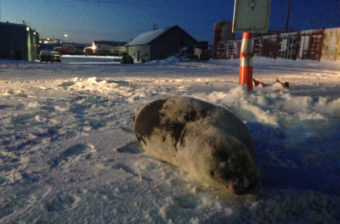
Winter sea ice locking in Nome for the winter. (Photo by Laura Collins/KNOM)

Alaska’s harsh environment is often used to explain its resilient population. But more recently it’s been the economy that’s tested the toughness of its people. Royal Dutch Shell pulled out of its multi-year and multi-billion dollar plan to drill in the Chukchi, taking with it business from the Norwegian oil company Statoil, and the U.S. Army Corp of Engineers put its plan for a deep draft Arctic port on hold.

Alaska’s economic woes are affecting all corners of the state, especially communities that were banking on an Arctic boom. But, in Nome, go to any one of the city’s meetings and it’s all eyes on the future.

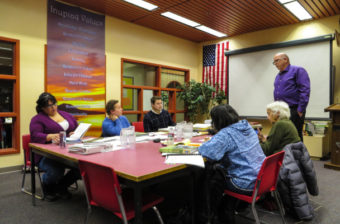
Nome’s Port Commission has been working with the McDowell Group, a research and consulting firm based in Anchorage. They’ve partnered together to update the port’s strategic plan. While the winter weather prevented two of the firm’s consultants from attending the meeting in person, the commissioners wasted no time before diving into the details.

Commissioner Charlie Lean, while seemingly un-phased by the Army Corps’ postponement of its Arctic port study, emphasized that Nome must be viewed as a national port rather than a regional port.

“This is for the extended Bering Sea, Chukchi Sea region,” Lean explained, “and whenever we say ‘regional’ everybody thinks Norton Sound, but we need to have a different word and think about a broader scheme.”

He wasn’t the only one at the table who still thought Nome can play a role in the future of Arctic shipping.

Commissioner Megan Alvanna-Stimpfle, who just recently moved back to Nome after working for Sen. Lisa Murkowski, was adamant about involving Alaska’s delegation in their efforts.

“Our state and our leaders need to get behind this port and the opportunity to support the port of Nome is now, or else it may not happen.”

And, according to City Manager Tom Moran, that might be easier than it sounds. Moran just returned from a trip to Juneau, where he attended the Alaska Municipal League conference alongside Nome’s newly appointed Mayor Richard Beneville. At this month’s city council meeting, which coincided with another burst of bad weather, Moran recapped Governor Walker’s speech at the conference.

“It was a half hour speech and he mentioned three places: Anchorage, Juneau and Nome, and he mentioned Nome four times.” So, Moran pointed out, “it’s worth noting that we do have a friend in the Governor’s office and that is the governor himself,” adding that, “he does certainly have a place in his heart for Nome.”

With the governor’s budget to be released soon, Moran urged the City Council to “keep your fingers crossed, we might see some love from the Governor.”

While schools and businesses were shut down due to the weather, Nome’s City Council plotted a way forward. It was Beneville’s second council meeting since being sworn in as Mayor, and he, too, was keeping an eye on the port’s future.

“One of the things that I would really like to see us continue to do as we move forward with the port, however it turns out to be,” Beneville said, ” is to make Nome as marine-friendly as we can.”

With the sea ice packing into the port and surrounding the city, the docks may no longer be bustling with activity, but Nome’s commissioners and councilmembers are sure to remain hard at work through the winter months.

Nome officially recognizes Indigenous Peoples’ Day

Nome’s November City Council meeting agenda. (Photo by Emily Russell/KNOM)

Amidst the season’s second blizzard that left schools and businesses closed, Nome’s city council hunkered down for their monthly meeting on Monday. It’s a good thing they didn’t yield to the weather and cancel because on the agenda was a resolution to formally change Columbus Day to Indigenous Peoples’ Day.

School Board President Barb Amarok was quick to take the podium during the first round of citizens comments to voice her support for the resolution.

“I think it would promote the learning of inclusive history and authentic history by students,” Amarok explained.

Amarok played a key role in the schools’ effort to become the second district, behind Fairbanks, to recognize the holiday. In front of the city council, she described that what she was taught when she was in school in the ’50s and ’60s didn’t quite portray the nation’s history accurately.

“We learned that we were supposed to honor Christopher Columbus, who 500 years discovered North America but … some indigenous people have been on this continent for 11,000 and 500 years,” she said.

Before voting on the issue, council member Jerald Brown, who works for Bering Straits Native Corporation, offered his comments. Bering Straits does not recognize Columbus Day, and he’s often asked “why not?”

“The standard response that I give is why would a Native corp recognize honor the invasion of the North American continent by Europeans? That’s really how I’ve come to see it,” Brown said before adding, “it just goes against my grain.”

And it seemed to go against the grain of the rest of the council. The resolution passed with no objection.

The City of Nome will now join the state and other cities including Anchorage, Portland, Oregon, and Albuquerque, New Mexico, in setting aside the second Monday of October to honor the true founders and settlers of our nation.

Search suspended for missing Unalakleet elder

The search for a missing Unalakleet elder has been suspended. Alaska State Troopers had been searching for 74-year-old Vivian Foote since last Wednesday.

Foote was last seen walking near her home in the early afternoon. The community — led by the Unalakleet Search and Rescue team — conducted a preliminary search for the missing woman before notifying Troopers of her disappearance around 6 p.m. Wednesday.

Alaska State Troopers. (KNOM file photo)

Troopers arrived in Unalakleet two days later to investigate and assist with the search. As of Monday afternoon, all search efforts — including sweeps by four rescue dog teams and more than 120 community volunteers — have found no sign of Foote.

Rescue efforts escalated from door to door searches on the day Foote went missing, to shoulder-to-shoulder sweeps across city limits the day after. Rescue dog teams were flown in from Anchorage and Fairbanks after a crowdfunding campaign raised money for their charter. They were also unable to find any sign of Foote.

The dog teams left Unalakleet Sunday night to avoid the incoming winter storm, and Troopers called off their search Monday afternoon.

Middy Johnson is a coordinator with the Unalakleet Search and Rescue team. On Sunday, he said the community would continue its search with closer looks at the outskirts of town and along the water.

“It does get tiring a little bit, but right now we’re hanging in there,” Johnson said. “We’ve had plenty of calls from other communities that are on standby — just waiting for us if we want to expand it more and need more personnel. So we appreciate that, and we’ll just keep going until we’ve exhausted all our efforts or until we find her.”

Troopers say Foote may suffer from medical ailments. Anyone with information on the whereabouts of Vivian Foote should contact the Alaska State Troopers and the Unalakleet Search and Rescue Team.

Nome Native corporation sells mining equipment, reclaims land

Muskox grazing on the reclaimed land of Rock Creek Mine. (Photo courtesy of Bering Straits Native Corporation)

It’s been a long and unproductive road for the Rock Creek Mine. But now that it’s being liquidated, money will finally flow into the pockets of its current owner, Bering Straits Native Corporation.

The mine was originally owned by Canadian mining company NovaGold and operated by its subsidiary, Alaska Gold. It opened briefly in 2008 before shutting its doors just months later. In the two years of preproduction and the two months of actual production, the mine went more than $20 million over budget, lost two of its workers in a construction-related accident, and violated the Clean Water Act, resulting in over $800,000 in federal fines.

There was a glimmer of hope that the mine’s doors would reopen when Bering Straits bought it from NovaGold in 2012. CEO Gail Schubert told KNOM in an interview at the time of the purchase that they planned to bring the mine back into production, albeit on a much smaller scale.

“Economic development opportunities are few and far between in rural Alaska and given the fact that this mine site has already been developed that NovaGold put several hundred million dollars into developing this site we just really felt that it was a good opportunity and kind of our responsibility to look closely at it to see whether it couldn’t be made operational,” Schubert said.

At the time, Schubert hoped the mine could be an economic engine for the region.

“You know we want to be able to provide some jobs and other opportunities to our shareholders and descendants and other folks that live in the region,” she said.

But what they hoped would be a source of revenue for locals, turned out instead to be a continuation of cleanup and reclamation. Now, it seems that along with ridding the land of toxins, Bering Straits will also be clearing out the facility’s interior. A news release published by another Canadian mining company, Almaden Minerals, revealed that it was entering into an agreement with Bering Strait to purchase much of the mine’s equipment.

Almaden will pay Bering Straits $6.5 million for the equipment over the next 30 months. Jerald Brown, Bering Straits’ vice president of Nome operations, has been working on the sale for a little over a year and says the initial investment in the failed mine turned out to be quite profitable.

“We’ve actually recovered 100 percent of the purchase price to date without including the proceeds from selling this equipment so it actually was a very good investment decision that Gail Schubert worked on a negotiated,” Brown said.

Along with the profitability of the purchase, Brown is optimistic that the land will eventually give back to Nome though this time in a different way.

“The land will be reclaimed, in fact, it already has been, and it will go back to being an area where people can go berry-picking and look at the muskox and everything they were doing before the mine was there,” Brown said.

The mine’s used equipment will be shipped south, where it will be put to work at a gold mine in Mexico.

Norton Sound looking for ‘something different’ to deal with mental health, substance abuse

Darlene Trigg (standing) with the First Alaskans Institute listens in on a roundtable discussion with Alaska Dept. of Corrections Commissioner Ron Taylor and Kari van Delden with University of Alaska-Fairbanks’ Cooperative Extension Service. (Photo by Matthew F. Smith/KNOM)

The Alaska Mental Health Trust Authority visited Nome, Gambell, Stebbins and Unalakleet recently. They held discussions with providers and experts from around the region and across the state about what is and isn’t working when it comes to mental health, substance abuse, and intellectual disabilities.

The focus of the talks across the Norton Sound are broad, but discussions at Nome’s Pioneer Hall brought local providers face to face with the heads of major state agencies, forcing many to confront uncomfortable truths.

“Department of Corrections is the biggest mental health facility in our system. Something’s wrong with that picture,” said Ron Taylor, the commissioner for the Alaska Department of Corrections.

Amid discussions of strong families and youth, housing shortages, employment, and education, some participants called for fundamental and systemic changes to how Alaska approaches its jails and prisons, specifically, the disproportionate and disruptive impacts the systems have on rural Alaska Native communities.

Taylor said he was in Nome with an open mind and ready to talk about change.

“It’s obvious that we’ve done in the past hasn’t worked,” he said. “Coming to a rural community in Nome, and learning of the challenges that are here in Nome, a lack of housing, a lack of real community re-integration for our persons that are transitioning out, it makes us realize that, are we on the right track? Or do we need to be shift to something different?”

Just what the state, the Department of Corrections, and others looking for reform should shift to remained an open question.

“If we’re going to shift to something different, we have got to come to consensus on what the different looks like,” Taylor said.

Darlene Trigg, the social justice manager with the First Alaskans Institute, helped lead the conversation on what “something different” should look like. The ideas being offered ranged from broad goals down to specific changes. Trigg said the common ground was making cultural resources part of the solution.

“Integration of culture is something that I’ve heard throughout these conversations,” she said. “The challenging question of how we do that, and how we create space for that, is where the conversations are going … it’s amazing to hear the kind of dynamic solutions people are coming up with.”

Those conversations are continuing in a big way Wednesday night, with a public Community Conversation starting at 5:30 p.m. at Nome’s Pioneer Hall on Front Street.

Trigg stressed the importance of local voices being heard.

“The community conversation is a real opportunity for people to share their lived experience, and in sharing your lived experience it gives you an opportunity to reflect on the impact that it has on your life,” Trigg said. “It offers an opportunity for our communities to start acknowledging some of the traumatic events that happened even in our own community, and it really informs how systems will function inside our community.”

She added that “without the voice of the community, and without the voice of the community members, we may come back with a design that doesn’t work, and we’re back to square one. And that is not what we need right now.”

KNOM Exchange will also be hosting a similar conversation Thursday morning, with guests from the Alaska Mental Health Trust Authority and the Alaska Criminal Justice Commission, who will be listening to share thoughts—and experiences—on the issues of mental health and criminal justice from across the Norton Sound and Bering Strait.

Nome reindeer ranch fundraises for mobile slaughter units, looking to sell local meat

A reindeer at the Midnite Sun Reindeer Ranch in Nome. (Photo by Mitch Borden/KNOM)

After five years of rebuilding their herd and corral, the Midnite Sun Reindeer Ranch is ready to take the next step — fundraising for two mobile slaughter units that would let them process and sell the meat from their business just outside of Nome.

“We need a USDA-certified processing and slaughter facility, and we’ve been seeing all these crowdfunding campaigns,” said Bonnie Davis. “We thought, ‘Well, we should give it a try. Why not?’”

Davis is part of the family reindeer herding business founded in 2010 by her parents, Bruce and Ann. The Davis Family has started their own fundraiser on Indiegogo, a crowdfunding website where anyone can contribute toward their goal of $200,000 — a sum that would pay for two slaughter units outfitted with extra winter insulation.

Without the equipment, Davis said the ranch is limited right now. U.S. Department of Agriculture (USDA) regulations restrict butchering to frozen ground only, which keeps them from processing for part of the year. And even then, USDA rules only allow sales to other processors and local people, meaning most commercial business is out of the question.

But with slaughter units certified by the USDA, Midnite Sun could process their meat more efficiently — without having to wait for the right weather or shipping meat to bigger facilities across the state. Lena Danner works for the Kawerak Reindeer Herders Association, and she said USDA approval would also open up their business to more buyers.

“If they had the mobile slaughter units, they’d be able to get the USDA stamp, and that broadens their market,” said Danner. “They’re able to sell to more people. More people would be accepting of it. So having the mobile slaughter unit and the USDA approval that opens so many more doors for them.”

And Davis says the demand is there. The ranch has heard from local schools and the XYZ Senior Center — both looking to add reindeer meat to their lunch menus — as well as chefs from Anchorage and restaurants around the state.

“We get a lot of inquiries once people find out that we have reindeer,” Davis said. “They’re like, ‘Oh, do you have any meat to sell?’ or ‘Oh, do you have any skins or fur or antlers for projects and traditional and cultural applications?’”

Considering there aren’t any herders in the region processing at a USDA-approved facility, Danner said Midnite Sun meat could be in especially high demand if they do find funding.

“Everyone in the region loves reindeer meat. And it’s not just in the region,” Danner said. “If they could get that USDA stamp, not only does it open them to being able to sell here in Alaska — it opens doors for them to be able to sell in the Lower 48, where people are always wanting to eat organic or free-grazing meat.”

And while Midnite Sun is looking forward to boosting their own business, Davis said they’re also excited about what mobile slaughter units could mean for the region, where the majority of groceries are shipped in from afar.

“We would be able to offer really fresh meat — super local — without having to wait for it to come up on the plane or the barge,” she said.

The ranch has only received two donations so far, but there are two weeks left in the online fundraiser. Davis said her family is also looking into grants if they don’t raise enough.

For more information on the Midnite Sun Reindeer Ranch, visit their fundraising campaign page.


Site notifications
Update notification options
Subscribe to notifications