Western

Nome’s urban musk oxen have residents worried about their safety

A group of musk oxen near Nome’s Dredge 7 Inn in 2021. (Courtesy Kim Knudsen)

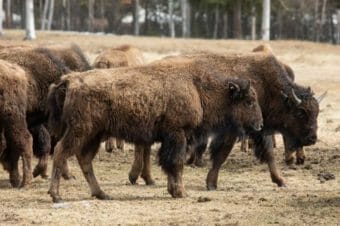
Nome residents are worried about their safety as musk oxen hang around within city limits.

Musk oxen have been spotted in various places around town, including the elementary school and neighborhoods. Musk oxen have reportedly killed or antagonized animals, and they’re keeping people from visiting the cemetery.

And in December of 2022, a musk ox killed a state court services officer as he was trying to haze it off his property’s dog lot near Nome.

Musk oxen disappeared from Alaska by the beginning of the 1900s but were bred in the Bering Strait Region in the 1970s and transplanted to the mainland.

According to the Alaska Department of Fish and Game, the population has grown from 750 musk oxen in the 1970s to more than 4,000 today.

This year, the state is offering 30 musk ox hunting permits for the inner and outer Nome areas. Sarah Germain, a wildlife biologist with Fish and Game, said this should help control the musk ox population in town.

“Hopefully, now that there’s a cow season, folks may be encouraged to harvest a musk ox in the fall,” Germain said. “And we’ll have to assess and see if that does help the nuisance musk ox situation.”

Germain said musk oxen have been coming into town since 2007.

“Since that time, we’ve periodically gotten calls about dog and human conflicts with musk ox,” she said. “I don’t really know that I’d say that it’s increased over time.”

She said residents have used tactics to help deter the animals off personal property, and some are more effective than others.

“Fish and Game staff have learned a lot about getting musk ox enout of an area through time, but it seems like you could yell, you could try to use sirens, there’s water guns,” she said. “Folks have tried various things, but all those things are temporary compared to a fence.”

Sarah Swartz, a Nome resident since 2006, remembers driving down Beam Road to view musk oxen when she first moved to town. But a personal encounter six years later changed her perspective.

“Back in 2012, my dog, in that short time of folding my laundry, he did get gored,” Swartz said. “And that was very, very traumatizing because this big animal who had just attacked my dog was angry and he wouldn’t move. And I couldn’t find my dogs.”

The increasing presence of musk oxen in town prompted Swartz to adapt her daily routines around musk oxen, specifically around her home. She said she goes outside every morning to make sure there are no musk oxen hiding, so she can safely leave her house.

Fish and Game advises residents living in musk ox country to clear brush around their homes to improve visibility and reduce potential encounters with musk oxen. But Swartz said not all Nome residents have the financial means or tools to clear brush or build a fence.

“That takes a tremendous amount of time and money because of resources and stuff that I have to use,” she said. “I really don’t feel like we should be paying for it.”

Swartz said she can’t find a management plan for musk oxen in the Seward Peninsula, but has found plans for other Arctic regions, including Greenland. She said there’s enough land in the region for the musk oxen to be moved and recommends a musk ox farm.

“It’d be great for tourism, and it would be safer for the community and everybody else,” Swartz said. “We could actually get to a point where we could have a higher population and end up having some of those animals harvested for food and it can go to communities in need.”

Nome police didn’t immediately answer a request for comment Friday.

Germain said that Fish and Game will be performing a musk ox survey around the Seward Peninsula next spring that will assess the results of the new bag and cow limits. Limits will be reevaluated for the next hunting season based on those results.

As frustration grows, Quintillion extends timeline for restoring Western Alaska internet service

The Port of Nome at the mouth of the Snake River, June 2018. (Photo by Gabe Colombo/KNOM)

Repairs to a damaged fiber optic cable affecting internet and cellular services to much of Western Alaska will now take longer than initially anticipated, according to Alaska-based communications company Quintillion.

The original timeline of 6-8 weeks for restoring services is now 9-11 weeks. Quintillion says repairs to the cable can’t happen until sea ice opens up enough for a repair vessel to get through.

The company plans to begin repair operations Aug. 9-22, if the area is 90% free of ice. In a statement published July 14, Quintillion said a repair vessel would be in the North Slope community of Wainwright by the middle of August on standby for when the ice opened up.

Michael McHale is the President of Quintillion.

“The ice is really on the critical path. It looks like right now that the ice is cooperating with us, and moving as expected, in some cases, even faster than expected. As soon as we can access the area, we’ll go in and start to affect the repair,” he said.

McHale says ice forecasts are moving out quicker than expected and the vessel will be mobilized over the weekend and will then go north. He says ice will likely open the first and second weeks of August, with repairs expected to take up to a week.

In early June [June 13th] the company announced the sub-sea outage was a result of an ice scouring event, located just over 34 miles north of Oliktok Point. Quintillion initially estimated the break could result in a six to eight-week outage. It’s now been six weeks and repairs are still stalled by sea ice, leaving some customers questioning whether repairs will be made before freeze-up.

McHale says that the cable break in early June was the first outage since the subsea cable went live in December of 2017, and that the company is working to improve how the cable is buried.

“We’ll take some risk mitigation steps to make it even more durable than it was. We buried it below the seabed floor, we will do that, again, we may use concrete to cover the trails,” he said.

McHale says Quintillion is looking at securing a bypass route that would create a ring between Fairbanks and Homer to prevent another outage from happening in the future. In June, the company received a nearly $90M grant from the National Telecommunications and Information Administration toward expanding the subsea broadband project. McHale says they started communication right after the break to contact their customers directly. The company has been posting updates on several of their social media outlets, although many affected by the break are having trouble viewing the online updates.

“I don’t want to put a date out there that disappoints at this point, because again, the ice cover is really the gating item. If we had visibility at this point, we’d be in the area making the repair right now, but you know, it’s important to get the services back up and running,” he said.

Nome Mayor John Handeland says Quintillion has kept him informed, when there are updates.

“I’m not expecting a regular report from them. As to their process, I know things won’t happen till August. Should they have something new and exciting I know they’ll call me, or I can pick up the phone and call them,” he said.

Frustration is growing as businesses and individuals are approaching seven weeks without reliable internet services. Some residents have opted to order Starlink internet, a satellite internet provider, while others have adjusted to the changes.

Businesses in Nome have been reluctant to speak to KNOM about their experience with Quintillion, as many have turned to Starlink. Communication remains minimally affected for those with landlines.

Bush pilot Jim Tweto’s plane struck tree before deadly crash near Shaktoolik, NTSB says

Jim Tweto, known for his appearances on the Discovery TV series “Flying Wild Alaska,” and passenger Shane Reynolds were killed in a Friday, June 16, 2023 plane crash near Shaktoolik. (Courtesy Discovery)

Shifting winds and a tree strike were both factors in the small-plane crash near Shaktoolik last month that killed an Alaska aviation legend and an Idaho hunting guide, according to federal investigators.

The National Transportation Safety Board released its preliminary report Tuesday on the June 16 wreck. Jim Tweto, 68, of Unalakleet and Shane Reynolds, 45, of Orofino, Idaho, died in the crash.

Tweto, who had flown in rural Alaska for decades, was known nationwide for his appearances on the Discovery TV show “Flying Wild Alaska” which followed the operations of family airline Era Alaska.

Clint Johnson, the NTSB’s Alaska chief, said Tuesday that investigators reached the site of the crash, roughly 35 miles northeast of Shaktoolik, a few days after it happened.

“What they found was the airplane appears to have struck a large snag – a tree, a dead tree – during takeoff,” Johnson said. “And the airplane crashed shortly after that.”

According to the report, Tweto was flying from a roughly 750-foot-long remote mountain airstrip near Shaktoolik on the day of the crash, in a Cessna 180H operated by Golden Eagle Outfitters. The airstrip was near the hunters’ camp. Tweto had already flown two bear hunters to Unalakleet from the airstrip that day. The NTSB report said the airstrip was along a sloped ridgeline, so Tweto landed uphill then took off downhill.

“During previous departures, after takeoff, the airplane would dip below the airstrip off the departure end, out of sight, then climb back into view and out of the valley,” NTSB investigator Millicent Hill wrote in the report.

Tweto planned to fly two more trips that day from the airstrip, each carrying a hunting guide plus some gear. Reynolds was the first guide to be flown out, with the second – who told the NTSB he’d seen Tweto fly from the strip on numerous occasions – awaiting the second trip.

“(The second guide) watched the initial portion of the downhill takeoff roll, and nothing appeared abnormal, so he turned away and did not watch the remainder of the takeoff,” said the NTSB report. “When he did not hear the engine noise during climb out or see the airplane climbing, he ran to the ridgeline’s edge and saw the airplane had impacted the tundra 300 (feet) below the airstrip.”

The second guide used his GPS tracker to send an emergency signal, then hiked to the plane to look for survivors.

A helicopter pilot who responded about 45 minutes later said winds in the area were “unusual” that day, cycling between 10- to 12-knot gusts from the north, calm periods and 5-knot gusts from the south.

The tree struck by the Cessna 180H’s left horizontal stabilizer in the fatal crash. (From NTSB)

At the crash site, investigators found a small cluster of trees. One 12-foot-tall, 4-inch-thick tree was broken about 4 feet above its base, on the runway’s left side. The broken trunk “displayed fragments of red paint that matched the accident airplane’s paint color,” said the report.

Tree sap and “embedded tree fibers” were found on the Cessna’s tail, in its left horizontal stabilizer.

NTSB meteorologists are collecting weather data from the area at the time of the crash, Johnson said. Other elements not mentioned in the preliminary report – such as weight and balance of gear aboard the Cessna, as well as any potential medical issues – are also being examined.

The airplane’s wreckage has been recovered from the crash site, according to Johnson, and is currently in Nome en route to investigators.

“We’re expecting that wreckage to be in town here very shortly,” Johnson said. “What we do now is do a wreckage layout – again, that’s standard procedure for us. We’re going to be looking very closely at that airframe and also the power plant, the engine.”

Johnson said Tweto, with whom he’d spoken about Alaska NTSB cases depicted in the Smithsonian Channel series “Alaska Aircrash Investigations,” was one of “our notable folks” in aviation statewide.

“It is pretty amazing how the aviation community has come together and just supported the family,” Johnson said. “It’s pretty heartwarming, I gotta be honest with you.”

Johnson said the preliminary report was delayed by the shortened July 4 work week, as well as NTSB policy barring the release of reports on fatal crashes before major holidays. A factual report containing more information on the crash is expected later in 2023, with a final report in the next 12 months.

Aniak residents shocked by quadrupled power bills

Aniak Airport (Amazon River Adventure photo via Creative Commons)

In April, Aniak resident Amanda Hoeldt’s electricity bill was $381.95. In May, it was more than $1,100.

“We were very shocked at the price of the power bill because we have a propane stove, we have a wood fireplace,” Hoeldt said. “And, like, it’s April, June. So it’s not like we’re in the middle of January where we have lights on all the time or, like, running the furnace or the water heater or that sort of stuff.”

At Aniak’s school, the electricity bill went from around $7,700 to almost $24,000.

“Just honestly, like, I’m standing in my district office right now and all the lights are off. We’re all working in the dark,” said Madeline Aguillard, superintendent of the Kuspuk School District.

Residents and organizations across Aniak were shocked when their electricity bills quadrupled in May — and that they weren’t officially notified beforehand. The sole warning was posted on the village’s main Facebook page from the personal account of the Aniak Light & Power Company’s president, Darlene Holmberg. She wrote that because of fuel prices, bills were going to be increased by four times or more. Then the post was deleted.

Holmberg did not return multiple calls from KYUK or an email requesting comment.

“I didn’t really pay that much attention to it,” Hoeldt said. “Because, like, it was just a post on Facebook, and kind of just went on with my life. And then we got the power bill.”

As people in the community wrapped their heads around their bills, some started using lanterns; some didn’t pay. People unplugged devices and limited screen time. Some are considering moving.

Dave Diehl owns the Hound House, a local restaurant in a log cabin that he opened in 1994. They run three refrigerators, a big stove, small stove, dough mixer, and an air fryer. He mentioned the region’s compounding cost of energy.

“Gasoline is almost nine bucks a gallon up here. Diesel fuel is almost nine bucks a gallon up here,” Diehl said.

He’s hopeful because the community is resilient. He said that he won’t change prices until he has to, but he also said that this is the biggest hurdle in their 30 years. Right now, they’re not making money. If their power bill continues at this rate, they only have one option.

“Close down, I guess,” Diehl said. “I don’t know. It’s not, we can’t just be working and making a couple of bucks a week.”

More than 10 people reached out to the Regulatory Commission of Alaska, the organization that regulates public utilities in the state. Aniak Light & Power, as a private firm and the sole power provider for the village of about 500 people, had to submit filings to the commission before it could raise its rates.

Diehl and other residents tried to dig in and call the commission, but they ran into regulatory code and calculations.

“The thing is, you got to be real educated. You got to be real computer skookum to get your messages across,” Diehl said.

The regulatory commission suggested three key reasons that the cost increased by so much this May.

The first and primary explanation was due to the increase in the fuel costs, which went up by 50%. Residents questioned why their bills then went up by 400%, and why neighboring communities hadn’t seen similar changes.

Steven Jones, a spokesman for the commission, said utility rates can rise to retroactively account for major expenses.

“So sometimes it’s a little bit difficult for people to understand that that is not immediate,” he said. “They say, ‘hey, this is a good break. Now, we should be charged a good price.’ It’s because their utility’s recovering the cost of something that occurred in the past, in some cases, so this better price is not necessarily there yet.”

The second reason is that the utility expects sales to go down in the next few months. The third is that Aniak Light & Power’s finances show a big difference between what it’s spending versus what it is making and it’s hard to pin down exactly why.

The company’s financial deficit started in September, based on records Aniak Light & Power provided to the commission after repeated requests in April.

The records also showed that in 2023, the company’s line loss, or the power lost during transmission and distribution, which customers pay for, frequently surpassed the 12% maximum recommended by the state.

In mid-April, Holmberg wrote a letter to the commission saying the company had again found a discrepancy between how much fuel inventory it was supposed to have and how much it actually had.

The details are little help to the people struggling with the price increases. Big customers include Aniak stores, restaurants, the airport, the post office and the school.

Aguillard, the superintendent, said that the new rate is unaffordable for the draft budget for next year. Though it’s the Kuspuk School District’s hub, Aniak is just one of its nine schools spread across seven villages.

“But we had projected that we were going to budget $380,000 for utilities,” Aguillard said. “However, at a rate of $25,000 a pop, Aniak alone will consume that.”

With this new cost, she’s afraid that they’re going to have to make cuts.

“It’s personnel. It’s personnel that would take the hit,” Aguillard said. “And that’s what we’re afraid of. And we’ve worked really, really hard to keep these positions. To keep the minimal positions that we have.”

The district doesn’t have electives or music or art, but teaches a core curriculum and has a tele-social worker. Staff have already seen an enrollment decline, and now more families are talking about moving.

The higher rates are also affecting the district’s summer school classes. Officials sent a district-wide memo urging employees to turn lights off, as well as unplug microwaves and other devices after use.

“Like, a little bit micromanaging,” Aguillard said. “But it all adds up and it all, I mean, at this rate it’s not, you know, cents on the dollar. Is it dollars that, you know, turning off the light is gonna affect?”

The power company doesn’t foresee a change in the prices over the next months. The commission has requested that the company file updates more frequently and advises residents to keep monitoring the commission’s website.

Some residents still don’t think that will lead to much. Marcus Tanner says the latest complaint he’s filed with the commission is his fourth.

“We have a history. Back in 2018, I had to leave here because they pretty much ran me out of my house,” Tanner said. “And every winter since I’ve been here, like 13 years now, people have these insane high bills. And it’s, like, random people.”

This month, Tanner’s bill went up from around $400 to $4,000.

“Went up 10 times,” Tanner said. “And the first thing [an Aniak Light & Power representative] said is, ‘Well, it’s going to be more expensive next month.’”

Tanner is hoping something will change before he has to leave Aniak.

NTSB responds to crash that killed Alaska aviation legend Jim Tweto and his passenger

Jim Tweto, known for his appearances on the Discovery TV series “Flying Wild Alaska,” and passenger Shane Reynolds were killed in a Friday, June 16, 2023 plane crash near Shaktoolik. (Courtesy Discovery)

Federal crash investigators were traveling Tuesday to the site of a Friday plane crash near Shaktoolik, which left Alaska aviation legend Jim Tweto and a passenger dead.

Alaska State Troopers said in an online dispatch that Tweto, 68, and 45-year-old Shane Reynolds of Orofino, Idaho were aboard the Cessna 180 which crashed about 35 miles northeast of Shaktoolik. Tweto was nationally known as the face of the Discovery TV series “Flying Wild Alaska,” which chronicles flights by family airline Era Alaska.

“The Cessna 180 aircraft was witnessed taking off but not climbing and then crashing,” troopers said.

Troopers were initially informed of the crash just before noon Friday by the activation of an InReach satellite device’s SOS signal. Nome troopers responded to recover the victims’ bodies.

Clint Johnson, the National Transportation Safety Board’s Alaska chief, said Tuesday that the crash took place as Tweto was helping a hunting party break camp. A guide in the party saw the Cessna go down.

“My understanding is that they were operating from a ridgeline,” Johnson said.

Johnson said NTSB investigator Millicent Hill was part of a team headed to the scene from Nome Tuesday, after poor weather over the weekend kept flights from reaching the crash site.

Investigators are also gathering information on Friday’s weather conditions in the area, Johnson said, and plan to fully examine the Cessna for any possible mechanical issues.

“Hopefully, by the end of the day, we will have completed the on-scene portion,” Johnson said. “And then we’re going to go into wreckage recovery, and that is probably going to take a little bit of time.”

The NTSB typically issues preliminary reports on fatal Alaska crashes within weeks, with formal determinations of their causes often taking about a year.

Johnson said he had spoken with Tweto on several occasions during the production of “Alaska Aircrash Investigations,” a Smithsonian Channel series detailing several prominent NTSB cases across the state.

“Jim was an icon here in the state, a very successful businessman, very successful pilot, and it’s gonna leave a huge gap in the aviation community here,” Johnson said. “We’re sorry to see this happen.”

A GoFundMe account has been formed for Reynolds, a fishing and hunting guide who left behind a wife and daughter in Idaho.

Chevak Native Village joins others in federal lawsuit over Donlin Gold permits

A foggy treeless hill
The Donlin Gold mine site is located about 70 miles up the Kuskokwim River from Aniak. (Photo by Katie Basile/KYUK)

The number of Kuskokwim River tribes challenging the federal permits for the Donlin Gold project in court has doubled from three to six. They say that the process was flawed and that tribal consultation was inadequate. They want the court to order the federal government to take a closer look.

On June 7, the Chevak Native Village joined other Yukon-Kuskokwim tribes in their federal lawsuit challenging the proposed Donlin Gold mine.

“You know, it’s just something that we’ve been involved with all along is this opposition of one of the world’s greatest, biggest, most open pit mines that’s proposed upstream or upriver from the Kuskokwim River,” said Second Chief and Councilmember of Chevak Native Council Richard Slats.

The Chevak Native Village, along with other tribes, is requesting more scrutiny of the Donlin project to ensure protection of the Yukon-Kuskokwim Delta ecosystem and the natural resources they depend on for their existence and traditional ways of life. Slats does not think that there was sufficient Tribal consultation.

“And the majority of this has mostly been through the environmental impact statement that was approved, and then mostly that without adequate consultation to the tribes after the final, and it’s moving forward,” Slats said.

There are 56 tribal communities in the Yukon-Kuskokwim Delta, including 13 downriver that could be directly affected if something went wrong at the massive project.

Tribal leaders say that what happens at the Donlin mine has the potential to affect the entire Yukon-Kuskokwim Delta, including coastal communities like Chevak, and the fish and wildlife resources people in the region depend on for their existence. Slats said that dwindling salmon stocks within the region highlight the need to protect the entire ecosystem, including salmon and smelt habitat.

The lawsuit targets flaws in environmental and subsistence studies. It alleges that permits for the mine are deficient in many areas. Slats said that when the final environmental impact statement for Donlin came out in 2012, only selected villages were afforded the opportunity to consult.

“Not all of the villages were consulted. Final EIS came out in 2018 with 10,668 pages with 30 days of comment period,” Slats said.

Donlin disagrees. The company responded with a press release which pointed out that it has held hundreds of public meetings to encourage open engagement and create opportunities for residents of the region to share their concerns and questions.

“We have a longstanding history of investing in the region’s communities to share our values of safety, environmental stewardship, community wellness, cultural preservation, and education,” the company wrote in the release.

The court challenge, if successful, would invalidate key permitting documents and authorizations for the mine and would require federal agencies to identify and require measures to prevent predicted harm to rainbow smelt from Donlin’s barges.

If built, the proposed mine would include a vast and deep open pit, a 316-mile buried natural gas pipeline, a processing plant, waste rock and tailing storage facilities, water treatment and power plants, dams and reservoirs, and transportation infrastructure including airstrips, access roads, a port expansion in Bethel, and a barge corridor along the Kuskokwim River.

There are now six tribes suing in federal court to halt Donlin, represented by Earthjustice. The three original plaintiffs were Orutsararmiut Native Council, Tuluksak Native Community, and the Organized Village of Kwethluk. Three tribes joined as plaintiffs in the amended complaint filed this week: Native Village of Eek, Native Village of Kwigillingok, and Chevak Native Village.

Site notifications
Update notification options
Subscribe to notifications