Western

Evacuations wind down as focus in Western Alaska shifts to recovery and relief

An Alaska Air National Guard C-17 carried 61 people from Bethel to Anchorage on Friday, Oct. 17, 2025 as evacuations from Western Alaska villages wound down.
An Alaska Air National Guard C-17 carried 61 people from Bethel to Anchorage on Friday, Oct. 17, 2025 as evacuations from Western Alaska villages wound down. (Evan Erickson/KYUK)

Large-scale evacuation efforts are winding down in the Yukon-Kuskokwim Delta after the remnants of Typhoon Halong washed away homes and infrastructure.

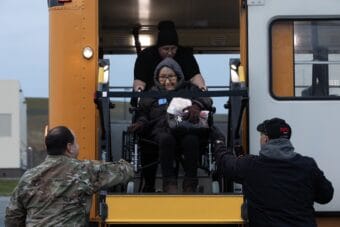
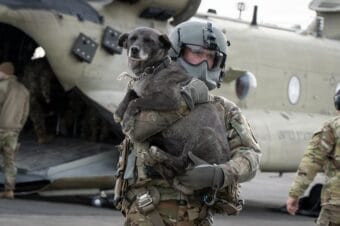
In the days since Halong brought record floods and high winds to the coast, more than 600 people have boarded military helicopters and planes bringing them to Bethel and on to Anchorage. The Alaska National Guard called it the largest airlift operation in the state’s history.

Now, the focus is shifting.

“We’re in the relief process,” Gov. Mike Dunleavy said at an Alaska Army National Guard hangar in Bethel on Friday after visiting Kipnuk and Kwigillingok, two villages hit hardest by the storm.

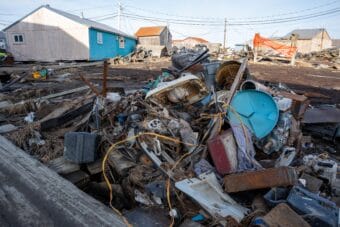
Teams are continuing to assess damage in villages throughout the region and restore basic services, like power, water and communications. Some 90% of the structures in Kipnuk were destroyed by the storm, along with 35% of buildings in Kwigillingok, according to the state Department of Transportation and Public Facilities. A quarter of households in Napakiak have been displaced by flooding.

Further east, in Quinhagak, the storm eroded 60 feet of shoreline separating the community’s sewage lagoon from Kuskokwim Bay, and left raw wastewater perilously close to entering a vital salmon stream. Artifacts dating back to the 16th century at the Nunalleq archeological site, key to understanding pre-contact Yup’ik history, were left scattered on the sand.

Loading…

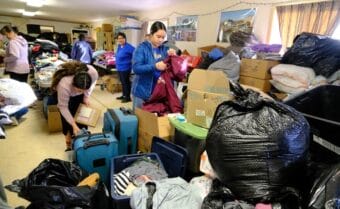
Meanwhile, hundreds of people are in shelters at the Alaska Airlines Center at the University of Alaska Anchorage and the Egan Civic and Convention Center.

State officials say the next step for evacuees is moving them into temporary, so-called “non-congregate” housing, like apartments or hotel rooms. The Municipality of Anchorage reported Saturday it had identified 1,000 hotel rooms and 100 apartments that could be used by evacuees.

But the long-term future for evacuees — whether they’ll be able to return to their home communities, and when — remains uncertain with winter fast approaching.

“Hopefully over the next few weeks, we’ll have a much better understanding about how many people can go back to the villages, and then long term discussions as to, what is this going to look like over the long term?” Dunleavy said.

Kipnuk, he said, was in “bad shape.” But Dunleavy said he was optimistic about Kwigillingok’s future.

“We believe we can get that place up and running, probably on a much larger scale, where we think a lot of folks can actually come back,” he said.

Though military flights are tapering off, State Division of Homeland Security and Emergency Management spokesperson Jeremy Zidek said evacuations would continue with smaller aircraft. He said the Yukon Kuskokwim Health Corporation, the regional tribal health consortium, is working with state officials to coordinate ongoing flights.

“If people still want to evacuate, now is really the time to let YKHC health care providers in the communities know, so we can start that process to get them out of the community,” he said.

Dunleavy sent a request to President Trump on Thursday asking him to declare a major disaster, which would unlock additional federal resources. He asked the federal government to cover 100% of the costs for the first 90 days. Local officials and the state’s congressional delegation are pressing Trump to approve the declaration.

On Saturday, a spokesperson with the Federal Emergency Management Agency said the disaster declaration was “under review.” An earlier email from FEMA warned of delayed responses to questions because of the ongoing federal government shutdown.

State officials are encouraging anyone who suffered damage in the storm to apply for the state’s individual assistance program, which helps people find housing, make repairs and more. It also helps tell state officials where help is needed and marshal resources from charitable groups, Zidek said.

Survivors can apply for assistance online at ready.alaska.gov/ia or by calling (844) 445-7131.

Gov. Dunleavy requests Trump declare federal disaster for Western Alaska storm

Evacuees from arrive in Bethel on Friday, Oct. 17, 2025.
Evacuees from Tuntutuliak arrive in Bethel on Friday, Oct. 17, 2025. (Eric Stone/Alaska Public Media)

Gov. Mike Dunleavy requested Thursday that President Donald Trump declare a federal disaster after remnants of Typhoon Halong brought high winds and record-breaking floods to coastal villages in Western Alaska.

“This incident is of such magnitude and severity that an effective response exceeds state and local capabilities, necessitating supplementary federal assistance to save lives, to protect property, public health, and safety, and mitigate the threat of further disaster,” Dunleavy wrote in a letter to the Federal Emergency Management Agency.

Dunleavy and members of his cabinet were scheduled to visit Kipnuk and Kwigillingok on Friday.

The disaster declaration would unlock federal resources to respond to the Lower Kuskokwim and Lower Yukon regions in Western Alaska, in addition to the Northwest Arctic Borough. The Association of Village Council Presidents, a consortium of tribal governments in the Yukon-Kuskokwim Delta, urged a federal disaster declaration in a letter to the White House on Tuesday.

Loading…

Previously, officials coordinating the state’s response in the immediate aftermath of the storm said federal resources were not necessary. But with damage widespread, leaving evacuees unsure when they’ll be able to return home, Dunleavy said the state’s resources may not suffice.

“Due to the time, space, distance, geography, and weather in the affected areas, it is likely that many survivors will be unable to return to their communities this winter,” Dunleavy wrote. “Agencies are prioritizing rapid repairs to all lifelines where possible, but it is likely that some damaged communities will not be viable to support winter occupancy, in America’s harshest climate in the U.S. Arctic.”

Alaska’s congressional delegation urged Trump to sign the disaster declaration.

“The people of Western Alaska are once again facing the onset of winter and the immense challenge of rebuilding in the aftermath of another coastal storm,” they wrote. “Quick federal action will help ensure that families remain safe, critical services are restored, and communities are stabilized before winter arrives.”

Trump was expected to sign the declaration Friday afternoon.

This is a developing story. Check back for updates. 

Alaska Public Media’s Liz Ruskin contributed reporting.

Anchorage prepares for up to 2,000 evacuees from Western Alaska

Cots line the floor at the Alaska Airlines Center on the campus of the University of Alaska Anchorage.
Cots line the floor at the Alaska Airlines Center on the campus of the University of Alaska Anchorage. (Jeremy Zidek/Alaska Division of Homeland Security and Emergency Management)

The city of Anchorage is preparing to welcome up to 2,000 people displaced by the catastrophic storm that hit Western Alaska on Sunday. Mayor Suzanne LaFrance said she expects many will stay through the winter.

“We’ll do everything we can to help folks and to do our best to provide a safe and welcome environment where they can heal and have stability as they work to rebuild,” she said in an interview Thursday.

About 260 evacuees arrived Wednesday. Hundreds more arrived Thursday, with additional groups expected in the coming days.

LaFrance said some will likely stay with friends or family. But many will need housing. The city is standing up shelters at the Alaska Airlines Center, the Egan Center and the Fairview and Spenard recreation centers. Together, they can house up to about 1,200 people. The mayor’s team is also working to find hotel rooms. Going forward, she said, her team will look at options for more permanent housing.

“It’s unknown how many people right now will be able to go back to those communities, or when or how they will be rebuilt,” she said. “We are working very closely with partners and looking at ways that we can help to quickly scale up different kinds of housing to meet this need.”

Alaska Air National Guard C-17 Globemaster III aircrew, assigned to the 176th Wing, evacuate approximately 300 displaced Western Alaska residents from Bethel following Typhoon Halong, Oct. 15, 2025. (Staff Sgt. Joseph Moon/Alaska National Guard)

LaFrance said the municipality is taking a supporting role as the state of Alaska and the Red Cross manage the emergency response. Her team is focusing on emergency shelter and transitional and temporary housing. She said the Red Cross is working to feed evacuees and provide other basic amenities.

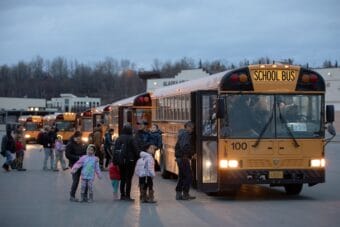
Anchorage School District Superintendent Jharrett Bryantt said in an email that schools are ready to enroll students and provide support including emergency supplies, bus transportation, mental health services and translation assistance.

“This transition carries both emotional and cultural weight,” he wrote. “Our schools will be places of belonging, healing, and hope, where every child feels safe, valued, and connected.”

Bryantt and LaFrance both underscored the devastation of the storm, noting Alaskans impacted have had to uproot their lives.

LaFrance said when she visited with evacuees Wednesday, one man told her about his house floating away.

“He went in twice to save family members,” she said. “He lost his house, he lost his boat, he lost his snowmachines. He said he never wanted to go through that again.”

LaFrance said she’s asking all Anchorage residents to greet those who have been displaced with generosity and kindness, because they are going through something traumatic and have lost so much.

She said anyone wishing to donate can do so through the Alaska Community Foundation.

‘Everything is lost now’: Hundreds evacuate from Western Alaska villages

Evacuees from the village of Kipnuk walk towards a waiting C-17 military transport plane in Bethel, Alaska on Oct. 16, 2025.
Evacuees from the village of Kipnuk walk towards a waiting C-17 military transport plane in Bethel, Alaska on Oct. 16, 2025. (Eric Stone/Alaska Public Media)

A massive airlift is underway in Western Alaska as Alaska National Guard planes and helicopters take people from villages devastated by the remnants of Typhoon Halong.

On Wednesday and Thursday, hundreds of people from Kipnuk and Kwigillingok boarded military transport planes headed for Anchorage, leaving their homes, belongings and communities behind.

Now, they’re not sure when or if they’ll be able to return.

Sitting on a green military cot at an Alaska Army National Guard hangar in Bethel, Luke Amik Jr. mourned his village.

“Kipnuk is our hometown, and we’ve been living there all our life. Everything is lost now,” he said. “All the memories … all the houses are gone.”

Amik was waiting for his turn to board a massive C-17 military transport plane ferrying survivors to shelters in Anchorage.

Water came within an inch of Amik’s home before it started to recede, he said. He watched other homes float by as wind-driven waters rose higher than they ever had in recorded history. One crashed into his house.

For Amik, it all just seems surreal.

“I couldn’t believe what I was seeing,” he said. “I still can’t believe what’s happening right now.”

Not everyone from Kipnuk and another hard-hit village, Kwigillingok, is going to Anchorage. Some are staying with family and friends in Bethel or surrounding villages.

Still others are staying behind.

“There’s about, maybe, 50 to 100 people in Kipnuk, and probably about 200 to 300 in (Kwigillingok) that are staying in the village,” said Lt. Col. Brendon Holbrook, commander of the Alaska Army National Guard.

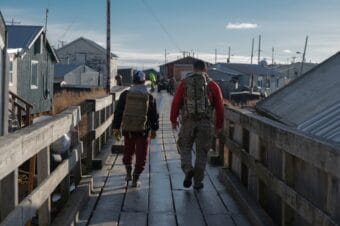
It’s not just people in Kipnuk and Kwigillingok who need help, he said. The National Guard planned to send helicopters to Nightmute and Tuntutuliak for an environmental assessment on Thursday.

“While we’re on the ground there, we’ll let them know that we do have the ability to evacuate as necessary,” Holbrook said. “From what I understand, there are people out in those villages that are looking to come in to go to Anchorage as well.”

Evacuees from Kipnuk, Alaska board an Alaska Air National Guard military transport plane in Bethel on their way to shelters in Anchorage on Oct. 16, 2025. (Eric Stone/Alaska Public Media)

From there, their future is unclear.

Jeremy Zidek, a spokesperson for the state’s emergency response, said officials were first moving people out of harm’s way to large shelters, like those at the Alaska Airlines Center and Egan Center in Anchorage.

After that, Zidek said they’ll look for accommodations with some more privacy — hotel rooms, temporary apartments, that kind of thing.

“No one wants to stay in a big, giant room with cots,” Zidek said in an interview at KYUK in Bethel. “We understand that people can’t do that for very long, and we want to really find other solutions for them as fast as possible.”

The state is not ordering people to leave, he said. For those sticking around, responders are working to restore essential services like power, water and communications. After that, Zidek said National Guard members could start mucking out and repairing damaged homes, hopefully before winter.

Zidek encouraged everyone who suffered losses in the storm to register for the state’s individual assistance program. That’ll help emergency managers connect survivors with funding for housing, repairs, medical expenses and more, he said, and also help state officials coordinate assistance from volunteer groups like Samaritan’s Purse.

“If they register for that individual assistance, then we know what those needs are, and if our programs don’t cover it, we can reach out to all of these other partners that we have, and maybe we can address those needs,” Zidek said.

But recovery will take time.

Standing in line with her boyfriend and two daughters waiting to board the military transport plane, Kipnuk evacuee Reanna Jimmy recounted the terrifying night.

Around 3 a.m. Sunday, she got a call from her father. His house was floating free from its foundation.

Jimmy rushed outside to grab her four-wheeler. But floodwaters had already swept it away.

“I remember seeing the water and feeling very, very helpless,” she said. “For the sake of my girls, I tried to stay calm when we started floating and the water started coming in. I didn’t know where we were going.”

When the sun rose, she found her home had come to rest at the Kipnuk airport.

Jimmy said she’s grateful to be alive. Everyone from Kipnuk is, she said.

Like Amik, she can’t quite wrap her mind around what’s happened to her home.

“It feels like a really bad dream,” she said.

Jimmy said she’s not sure if she and her family will ever be able to return.

“If we do, I hope Kipnuk is located somewhere else,” she said.

‘No one is giving up’: Local search continues for 2 missing in Western Alaska

Debris sits in piles in Kwigillingok after the remnants of Typhoon Halong brought widespread devastation to the region.
Debris sits in piles in Kwigillingok after the remnants of Typhoon Halong brought widespread devastation to the region. (Brea Paul)

Local officials are continuing to search for two people missing from a Western Alaska village after remnants of Typhoon Halong left one dead and much of the region devastated by high winds and flooding.

However, large-scale search and rescue efforts are largely on hold pending new information.

The U.S. Coast Guard, Alaska State Troopers and Alaska National Guard said they were unable to locate a floating house and its occupants before they suspended their active search Monday evening.

The search covered dozens of square miles around the village of Kwigillingok using helicopters, planes, drones and more, according to Coast Guard Capt. Christopher Culpepper.

“Suspending an active search is always a tough decision to make, and it is especially difficult in this situation where the Kwigillingok community is already suffering so much,” he said.

Alaska State Troopers identified the missing people as 71-year-old Vernon Pavil and 41-year-old Chester Kashatok and said they had located the body of 67-year-old Ella Mae Kashatok. All three were residents of the hard-hit village of Kwigillingok and members of the same family.

Brea Paul, a court administrator in Kwigillingok, said in an interview that she knew the family well. She saw their house floating off its foundation as floodwaters rose on Sunday.

“They were the most kindest people I’ve ever met. They didn’t have much, but they always, always had a positive mindset and they always greeted anyone — they welcomed everyone to their home,” Paul said. “They deserve to be searched (for). Their names deserve to be heard.”

Village public safety officers with the Association of Village Council Presidents and volunteers are continuing to look for the two men, the organization said in a post on social media.

“Teams continue operations with drag bars, sonar equipment, and coordinated volunteer efforts,” the group said. “Our commitment to this mission is unwavering: no one is giving up.”

All are accounted for in Kipnuk, another community that saw widespread devastation, troopers said.

Hundreds of people remain sheltered in village schools scattered throughout the Yukon-Kuskokwim Delta. State officials say they’re rushing aid to the region and working to evacuate residents of Kipnuk and Kwigillingok.

KYUK’s Evan Erickson contributed reporting.

Hundreds evacuating from hardest hit Western Alaska villages following storm

people in a large plane
Alaska Air National Guard C-17 Globemaster III aircrew, assigned to the 176th Wing, evacuate approximately 300 displaced Western Alaska residents following Typhoon Halong, Oct. 15, 2025. (Staff Sgt. Joseph Moon/Alaska National Guard)

A mass evacuation is underway for Kipnuk and Kwigillingok, where a thousand people were sheltering in schools after Sunday’s huge storm.

Reached by phone Wednesday afternoon, Kipnuk tribal administrator Buggy Carl said he was focused on one thing.

“Right now, just trying to convince everybody to go before the next storm hits,” he said.

Shelter conditions in the two communities were rough. The toilets weren’t working at the Kwigillingok school. Power and telecommunications were spotty in Kipnuk, and fuel to heat the school was running low. Nearly all the homes in both towns were damaged. It’s unsafe to stay, Carl said. Still, some people are reluctant to leave.

“I know their mindset, that their heart is here,” he said. “They don’t know anywhere else to go.”

It’s more than just familiar. Carl said it’s where they know how to make a living as subsistence hunters and harvesters. Carl said he heard some say they were afraid to go somewhere else.

“And then there is a possible thought that we will be able to come back, for those who want to come back, and still continue to help clean up,” he said.

Alaska Army National Guard personnel unload belongings from a Black Hawk helicopter at the Bethel Alaska Army National Guard Armory on Wednesday, Oct. 15, 2025. (Eric Stone/Alaska Public Media)

Carl said houses that were pushed off their foundations are scattered across Kipnuk. He was in a house with 14 family members during the storm, six of them children, when the four-bedroom house started drifting around 2 a.m. At one point he yelled at his family to brace when it looked like they were going to strike another house. He estimates his home traveled half a mile before it came to rest.

“We only floated down a few minutes. It felt like hours, because the time was really slow,” he said. “My adrenaline was like out of the roof.”

Kwigillingok tribal court administrator Brea Paul said a substantial portion of her town has already been flown to Bethel.

“We’re going to be one of the last families to leave so we can let the ones with no homes go first. But as of right now, we don’t know where we’re gonna go. We don’t know what to do,” she said.

The first evacuees were taken to the Bethel Armory, but that shelter quickly filled.

On Wednesday afternoon, evacuees were seen boarding a C-17 transport plane at the Alaska Army National Guard hangar in Bethel.

A Guard spokesperson said that 300 people from both Kipnuk and Kwigillingok were being evacuated to Anchorage.

The Alaska National Guard said the evacuees were being flown to Joint Base Elmendorf-Richardson, where agencies will be available to direct them to shelter, food and medical care.

Site notifications
Update notification options
Subscribe to notifications