Western

State begins distributing disaster aid to residents of Western Alaska, federal aid also approved

People in uniform help a woman in a wheelchair down from a bus ramp
Alaska Air National Guard C-17 Globemaster III aircrew, assigned to the 176th Wing, arrive at Joint Base Elmendorf-Richardson, Alaska, with 62 evacuated residents from western Alaska, Oct. 17, 2025. (Alaska National Guard photo by Alejandro Peña)

The State of Alaska has begun distributing disaster relief payments, totaling over $217,000 as of Friday, to residents of western Alaska impacted by storm damage from ex-Typhoon Halong.

The state has received more than 940 applications for state individual assistance, according to a statement from the Alaska Division of Homeland Security and Emergency Management. Applications are open on the state’s website, through Dec. 9.

As many storm evacuees left or lost identification or essential documents, the Alaska Department of Motor Vehicles and the Department of Health have booths at emergency evacuation shelters in Anchorage to assist with replacements. The Association of Village Council Presidents is offering tribal IDs in the shelters. State caseworkers and a Yup’ik speaking public notary are helping with documentation, the state update said.

Residents must prove they are from the designated disaster area, and provide proof of identification and a mailing address where checks can be mailed.

As of Thursday night, there were 302 evacuees staying in emergency shelters in Anchorage, with 178 at the Egan Center and 124 at the Alaska Airlines Center.

The state’s assistance program provides financial assistance for storm damage to homes, vehicles, essential personal property and medical, dental or funeral needs directly related to the disaster. Applicants will be eligible for $21,250 in home repairs and another $21,250 for “other needs.”

The state’s individual assistance program also includes a housing assistance program that provides renters with up to three months and homeowners with 18 months of financial assistance, according to the state’s website.

Gov. Mike Dunleavy announced Friday that he amended the state’s disaster declaration to waive state fees associated with replacing documents, including licenses and registrations. It also waives late fees for state-administered loan and payment programs.”

Federal disaster assistance approved

On Wednesday, the Trump administration authorized a federal disaster declaration for the Western Alaska storm. The president said that he has authorized an immediate $25 million in federal aid for the state to cover costs as the recovery effort is underway.

Trump also approved the state’s request for federal assistance, including federal individual assistance, public assistance and the hazard mitigation grant program.

Residents can apply on the Federal Emergency Management Agency’s website at DisasterAssistance.gov or on the FEMA app. Applicants must file a claim and are required to go through a FEMA inspection to qualify.

Federal disaster assistance provides up to  $42,500 for home repairs and up to $42,500 for other items.

The U.S. Small Business Administration is also offering low interest loans to small businesses, non-profits and individuals impacted by the storm, to help pay for losses not covered by insurance. Applications can be submitted on their federal website.

Financial donations pour in for Western Alaska communities

Individual and business donations have come pouring in for the families and communities devastated by ex-Typhoon Halong, including food, supplies, and financial assistance.

The state has a list of resources and links to assistance on its website.

The Western Alaska Disaster Relief Fund has raised $2.5 million to date, said Ashley Ellingson, director of communications with the Alaska Community Foundation, with mostly corporate donors pledging an additional $1.5 million more. She said an advisory committee of regional and state leaders meets at least weekly to consider requests and how to best allocate funding.

The Alaska Community Foundation has already distributed roughly $575,000 to five organizations: the Association of Village Council Presidents, the Maniilaq Association, the tribal councils of Kipnuk and Kwigillingok — the communities hardest-hit by the storm — and the Alaska Native Heritage Center. Ellingson said that is to ensure funding goes to immediate needs.

“Local organizations can distribute to individuals and families affected the most,” she said.

Correction: The application for state disaster assistance is open until Dec. 9, 2025. 

Dog evacuations continue from Western Alaska villages hit hard by remnants of Typhoon Halong

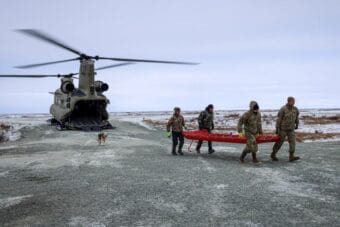
Army National Guard aviator carrying dog
Alaska Army National Guard Sgt. Hunter Lorenz, a CH-47 Chinook helicopter crew chief, carries a dog during recovery operations at Bethel, Alaska, Oct. 16, 2025. (Staff Sgt. Joseph Moon/Alaska National Guard)

As evacuees from villages like Kipnuk, Kwigillingok, Nightmute and Tuntutuliak boarded military helicopters bound for safety, many had no choice but to leave their dogs behind.

The mass evacuations from Western Alaska villages in the wake of ex-Typhoon Halong are mostly over. More than 600 people were airlifted to Anchorage aboard military helicopters and transport planes.

But a parallel effort to shuttle dogs and other pets out of storm-damaged villages aboard everything from Cessnas to cargo planes is continuing — and many of them are coming to Anchorage.

“People know how they would feel if this happened to them, so they want to help,” said Julie St. Louis, the cofounder and director of The August Foundation for Alaska’s Racing Dogs. She started the nonprofit to find long-term homes for retired sled dogs, she said, and today, the group takes rescue dogs of all ages and connects them with families.

Now, she said, planeloads of dogs are arriving on cargo flights just about every day. Twenty-nine arrived in Anchorage Wednesday night.

But reuniting those dogs with their families is a complicated task. So Anchorage Animal Care and Control on Tuesday started taking in dogs at an emergency shelter set up in a long, sandy-brown heated tent outside its main facility. The idea is for it to serve as a hub, said the agency’s community outreach manager, Joel Jorgensen.

“We specifically are being told to get involved because no one knows how to go about finding their dogs without calling 10 different rescues,” he said. “So, at this point, Anchorage would like to funnel the animals that are coming to the Anchorage city into Anchorage Animal Care and Control, and then disperse them out from there.”

Anchorage Animal Care and Control Assistant Shelter Manager Logan Robinson, left, and Community Outreach Manager Joel Jorgensen stand outside a temporary emergency shelter set up for dogs arriving from Western Alaska on Oct. 23, 2025. (Eric Stone/Alaska Public Media)

The emergency shelter keeps dogs isolated from one another and from the shelter’s other dogs before they can be checked for diseases like Parvo. Once they get to the shelter, a veterinarian gives them a quick health exam and checks their vaccine records before connecting them with rescues and foster homes, Jorgensen said.

“The animals wouldn’t stay here for hopefully more than 24 hours, is the goal,” he said.

As of Thursday, the agency appeared to be meeting that goal. They wouldn’t let the public inside for health reasons but Jorgensen said the emergency shelter was empty.

Jorgensen said some volunteers have stepped up to provide long-term fostering for people who won’t be able to return to their homes for months, or longer.

“You would hate to lose out on a family pet just because of a natural disaster like this,” he said. “But we have folks lined up that are willing to hold on to animals for six months, and then when that six months is over, they get their animal back and they have the happy ending they all deserve. ”

As local animal shelters and rescues coordinate evacuations and reunifications, other groups are taking on support roles. Alaska Rural Veterinary Outreach, a nonprofit that provides vet service to rural communities, is shipping out dog food and airline crates to places like Kotzebue, Nome, Bethel and Aniak. Board member Christine Witzmann said it’s all part of an important mission.

“I think people just want to make sure that the animals are treated humanely, and that they get rescued too, and that they are valued — they are valued as a living being,” she said.

St. Louis, with the August Fund, said there have been some hiccups along the way as everyone involved figures out the best way to handle the complex task — the kinds of hiccups you might expect in a disaster. She said she’s grateful for everyone who’s stepped up to help.

“Stand by, I guess, and be patient, is the best thing I can can tell people,” she said. “We’re all working really hard and are going to get the dogs out.”

How you can help

Anchorage Animal Care and Control is taking supply donations at its facility at 4711 Elmore Road, including:

  • Unopened bags of kibble and cans of wet food
  • Gallon jugs of water
  • Toys
  • Leashes
  • Collars
  • Blankets
  • Airline-approved kennels

Alaska Rural Veterinary Outreach has a dog food collection site at South Side Animal Hospital in Anchorage.

Best Friends Animal Rescue, a Wasilla-based group helping with the effort, also has an extensive list on its Facebook page.

Trump administration approves disaster declaration for Western Alaska storm

Alaska Army National Guard Staff Sgt. Steven Gildersleeve, right, an HH-60M Black Hawk critical care flight paramedic, assigned to the 207th Aviation Troop Command, surveys Nightmute, Alaska, with local resident Harvey Dock during Operation Halong Response, Oct. 17, 2025. (Alaska National Guard photo by Staff Sgt. Joseph Moon)

President Donald Trump granted the State of Alaska’s request for a federal disaster declaration on Wednesday, unlocking federal disaster aid to support the ongoing relief and recovery effort in the aftermath of ex-Typhoon Halong throughout Western Alaska.

Gov. Mike Dunleavy formally submitted the request on Oct. 16, and applauded the announcement on social media on Wednesday.

“This declaration will be instrumental for ongoing response and recovery efforts. I want to thank President Trump and his administration for the continued support of Alaska and providing help for Alaska during this time of need,” Dunleavy said on Facebook. “Thank you President Trump!”

The declaration authorizes a 100 percent cost share for relief assistance for the next 90 days, through January, according to a statement from the governor’s office. The Federal Emergency Management Agency (FEMA) will coordinate with the Alaska Division of Homeland Security and Emergency Management on all recovery operations and programs. Representatives with the governor’s office and Alaska Division of Homeland Security and Emergency Management said they did not yet have a copy of the declaration on Wednesday.

Trump said he also authorized an immediate $25 million in relief funding, to cover costs as the state continues to conduct damage assessments.

“I am approving $25 Million Dollars to help Alaska recover from the major typhoon they experienced earlier this month,” Trump wrote on the social media site Truth Social. “It is my Honor to deliver for the Great State of Alaska, which I won BIG in 2016, 2020, and 2024 — ALASKA, I WILL NEVER LET YOU DOWN!”

The Alaska congressional delegation also thanked the president in a joint statement, noting their letter urging the president to respond and grant the disaster declaration.

“I raised Alaska’s disaster declaration directly with President Trump yesterday at the White House and thank him for quickly approving it to ensure impacted western communities have federal support in the wake of Typhoon Halong,” wrote US Sen. Lisa Senator Murkowski, R-Alaska. “I also appreciate FEMA’s expedited review of this request, which is one of the quickest federal responses in recent years.”

“To all Alaskans impacted,” Murkowski added. “Please know that your congressional delegation, state, and nation stand united and will continue to coordinate recovery efforts as you move forward.”

Sen. Dan Sullivan, R-Alaska, praised Trump’s move and said he would be visiting storm-impacted villages on Saturday.

“I plan on being in Western Alaska this weekend with top FEMA and DHS officials, and my team and I will continue working closely with the Trump administration and our state, local, and tribal partners to make sure these incredible Alaskans get the help they need to recover and return to their communities,” Sullivan said.

Begich has not announced plans to visit the region. He also praised Trump and the announcement. “Our focus as a delegation remains on ensuring every Alaskan family impacted by this storm receives the resources and support needed throughout the long process of rebuilding their lives,” he said.

The disaster declaration request covered the Northwest Arctic Borough, Lower Yukon Regional Education Attendance Area and the Lower Kukokwim Regional Attendance Area, places hit by the remnants of Typhoon Halong.

More than 1,500 residents were displaced by the storm that killed one woman and left two missing in Kwigillingok.

The storm recovery effort is in full swing. Local residents are working on clean up, while regional tribal partners and dozens of state agencies, non-profit and relief organizations provide support to the region, particularly the hardest hit area of the Yukon-Kuskokwim Delta. State and tribal agencies are flying aid into those residents who remain in the coastal villages, like immediate food, water and fuel, while crews continue to work on debris removal, fuel spills, infrastructure assessment and repair to water, power, and sewer systems, roads and boardwalks. Crews are working throughout communities to repair homes where possible, so that local residents can return before winter sets in.

There is no cost estimate for the storm damage at this time, according to Jeremy Zidek, a spokesperson for the state Division of Homeland Security and Emergency Management, because agencies are working to restore services simultaneously.

The state is offering emergency assistance, available through an application on the state’s website, open through November 9.

The program provides financial assistance for storm damage to homes, vehicles, essential personal property, medical, dental or funeral needs directly related to the disaster. Applicants will be eligible for $21,250 in home repairs and another $21,250 for “other needs.”

The president has not yet authorized federal individual assistance — $42,500 for home repairs and $42,500 for other items — but state officials say there will likely be more information from the Trump administration in the coming days.

‘We got hope’: The few who remain in storm-ravaged Kipnuk race to rebuild

Debris sits in a pile in storm-ravaged Kipnuk, Alaska on Oct. 19, 2025, a week after the remnants of Typhoon Halong brought catastrophic flooding and hurricane-force winds to the village.
Debris sits in a pile in Kipnuk, Alaska on Oct. 19, 2025, a week after the remnants of Typhoon Halong brought catastrophic flooding and hurricane-force winds to the village. (Eric Stone/Alaska Public Media)

It’s Sunday in Kipnuk.

And like a lot of folks on Sundays, Tony Paul is headed to the hardware store.

“We’re making progress every day, seems like,” he said.

Unlike a lot of folks, he needs a boat to get there.

“It floated away,” he said, gesturing upriver. “There’s a couple stores down past that way, a bunch of houses.”

A week earlier, on Sunday, Oct. 12, Kipnuk endured the worst storm anyone can remember. It’s one of dozens of communities in Western Alaska working to restore essential infrastructure and repair damaged homes after the remnants of Typhoon Halong devastated coastal communities.

According to preliminary damage assessments, Kipnuk fared the worst.

The few residents who remain are determined to rebuild — but the task ahead is immense, and the future is unclear.

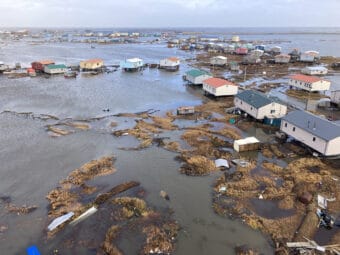
Homes and other buildings that floated off their foundations in Kipnuk, Alaska rest on tundra miles upriver on Oct. 19, 2025, a week after the remnants of Typhoon Halong brought record flooding and high winds to the Western Alaska village. (Eric Stone/Alaska Public Media)

In this village, four miles from the Bering Sea on the east bank of the Kugkaktlik River, Halong’s high winds and storm surge left a catastrophe. Halong’s hurricane-force winds pushed seawater more than six and a half feet above the normal high tide line.

Water poured into houses. It lifted homes off their foundations and deposited some of them miles away. It toppled four-wheelers and snowmachines, and left freezers full of food for the winter without power.

The state Department of Transportation estimates that 90% of the structures in the community were destroyed. Most of Kipnuk’s residents evacuated on military helicopters in the days after the storm.

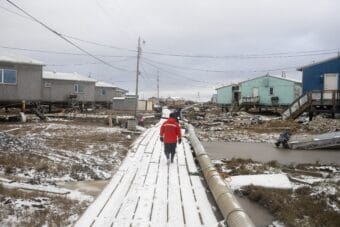
Now, Kipnuk is in ruins. Piles of debris are everywhere.

Houses and other buildings sit jumbled and surrounded by debris in Kipnuk on Sunday, Oct. 19, a week after the remnants of Typhoon Halong brought record flooding and high winds. (Eric Stone/Alaska Public Media)
A building sits on a boardwalk among other debris on Oct. 19, 2025 in Kipnuk, Alaska, a week after the worst storm on record. (Eric Stone/Alaska Public Media)
An all-terrain vehicle sits overturned on a boardwalk in Kipnuk on Sunday, Oct. 19, a week after the remnants of Typhoon Halong washed ashore. (Eric Stone/Alaska Public Media)

Anna Kashatok was with her boyfriend, his family and her two kids when the storm hit.

“We floated away pretty far,” she said. “A mile or two.”

They escaped from a window and trudged to the community’s school. She recalled seeing the destruction for the first time.

“So heartbreaking, devastating,” she said. “Kipnuk’s not Kipnuk anymore.”

Kashatok was only back in town for a couple days, retrieving some belongings and important documents from her parents’ house. It also floated away with them inside. She evacuated to the hub community of Bethel with her boyfriend, parents, and two children.

Only a handful of people remain in this village that just a week ago was home to 700.

In spite of the widespread destruction, the school remains a place of refuge. It escaped major flood damage. It’s elevated on pilings with a dedicated backup generator.

All-terrain vehicles and a dog sit outside the Chief Paul Memorial School in Kipnuk, Alaska on Oct. 19, 2025. (Eric Stone/Alaska Public Media)


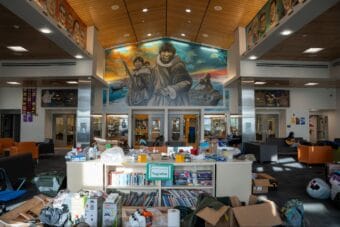
Supplies sit in the lobby of the Chief Paul Memorial School in Kipnuk, Alaska on Oct. 19, 2025, a week after the remnants of Typhoon Halong devastated the community. (Eric Stone/Alaska Public Media)

James Paul III sat at a table in the cafeteria, speaking with a local Yup’ik teacher.

“It happened so fast. Everything changed, like in a day,” he said. “The rest of their lives are changed in one day.”

The school remains, but the kids are gone. Many evacuated to Anchorage. Others are with friends and family in Bethel, surrounding villages or other communities around the state.

So for now, the Chief Paul Memorial School is a hub for the recovery effort. Packaged food lines the walls. Cafeteria workers prepare hot meals — chili was on the menu for dinner.

The state Department of Transportation told Paul some heavy equipment was on the way, he said, things like small excavators, skid-steers and all-terrain vehicles. That would help crews working to connect the school and a water treatment plant to power, he said.

“That’s our main objective right now,” he said.

James Paul III poses for a photo in the cafeteria of Kipnuk’s Chief Paul Memorial School on Oct. 19, 2025. Paul is one of a handful of residents racing to rebuild Kipnuk after the remnants of Typhoon Halong struck a week earlier. (Eric Stone/Alaska Public Media)

But time is running short. Winter is well on its way. Bits of frost lined ponds on the tundra. That, and an oily sheen.

State emergency officials say they believe the fresh water supply is contaminated. A stiff breeze brought some relief Sunday from what residents said had been a lingering stench of fuel and sewage.

A big question looms ahead: Can evacuees return before winter — or at all?

“The way that their houses are right now, I don’t think they want to come back, especially people whose houses were pulled off their foundation,” Paul said.

There are a few dozen homes built on pilings that survived the storm and are still livable. They number 40 or 50, Paul estimated.

Paul wants to stay in Kipnuk if he can, he said. He’s spent most of his life here.

“Kipnuk means family, (it) means values, traditions. It’s my culture. I grew up here, and my dad taught me to hunt and live off the land here,” he said. “I do know some about city life, but I’d rather be here.”

From left to right, Tony Paul, Anna Kashatok, Benjamin Kugtsun, Logan Paul and Joshua Dock stand outside the Chief Paul Memorial School in Kipnuk, Alaska on Oct. 19, 2025. (Eric Stone/Alaska Public Media)

Outside the school, standing with a group of young men working to restore basic services to the community, Benjamin Kugtsun was unequivocal.

“We’re going to stay here in the winter,” he said. “We can survive. How did our ancestors survive? Without nothing. But they did.”

But when — or whether — large numbers can return is unclear. Gov. Mike Dunleavy, in a request to the federal government, said some evacuees from villages across the vast, low-lying Yukon-Kuskokwim Delta might not be able to return for 18 months.

For now, Kugtsun and his crew are taking it one day at a time. One task at a time. One boat ride to the hardware store at a time.

But he’d like to see more residents return to help out.

“With teamwork, it can happen,” he said. “We got hope.”

What’s in a disaster declaration? One big detail matters for storm survivors.

Volunteers and evacuees from villages impacted by the ex-typhoon Halong sort through donations at the Bethel Search and Rescue building on Oct. 14, 2025.
Volunteers and evacuees from villages impacted by the ex-typhoon Halong sort through donations at the Bethel Search and Rescue building on Oct. 14, 2025. (Corinne Smith)

The damage from ex-Typhoon Halong is already a declared state disaster but there’s no word yet on whether President Trump will sign a federal disaster declaration. Tens of millions of dollars, for the state and communities, hang on that decision.

For people displaced by the storm or whose homes were damaged, there’s another big question: If the president signs a disaster declaration, will it say survivors are eligible for Individual Assistance? That would make as much as $85,000 available per household.

Very few Alaska disasters have included the federal Individual Assistance component, said Jeremy Zidek, a spokesman for the state Division of Homeland Security and Emergency Management.

“We think that we’ve got a good chance at it,” he said, “but it comes down to the federal government to make that determination.”

Federal declarations sometimes come within days of a disaster, as was the case when the remnants of Typhoon Merbok struck in 2022. Or, as occurred with three Alaska disasters last year, the federal declaration can come months later.

In the meantime, the state has its own Individual Assistance program. It’s asking every family who incurred property damage from the storm or has been displaced to register for state Individual Assistance. Claimants may be eligible for $21,250 in home repairs and another $21,250 for “other needs.”

Zidek said that could be “money for transportation, medical-dental expenses, subsistence equipment, repairing or cleaning and sanitation of property — some of those items are under our state’s IA program.”

There’s a different program to pay for temporary housing that would not count toward the cap.

If the president signs a federal disaster declaration that includes Individual Assistance, the caps are double, Zidek says — $42,500 for home repairs and $42,500 for other items.

In some cases, a family may be eligible for both state and federal Individual Assistance, because, while the programs are similar, they differ somewhat in the type of property a person can claim for.

“We make sure that there isn’t a duplication of benefits. We can’t pay for things twice,” Zidek said. But if the federal Individual Assistance program is unlocked “there is more money available to people that have lost their homes or lost their possessions.”

Applying for state Individual Assistance lets the state know what your needs are, so it can direct services to you and your community, he said. The information is shared with other agencies, so it also serves as a headstart on a federal application for assistance.

For those who can’t or don’t want to apply online, at ready.alaska.gov, the state is making face-to-face help available in Bethel and Anchorage, Zidek said.

After village evacuations, Bethel nonprofit steps in to save dogs

Pilot Nate DeHaan of Bethel-based DeHaan Aviation preparing to transport displaced dogs back to Bethel in Kipnuk, Alaska on Oct. 15, 2025.
Pilot Nate DeHaan of Bethel-based DeHaan Aviation preparing to transport displaced dogs back to Bethel in Kipnuk, Alaska on Oct. 15, 2025. (Bethel Friends of Canines/Bethel Friends of Canines)

As residents boarded air transports out of Kipnuk on Wednesday, Oct. 15, they were leaving what remained of their houses, belongings, and ancestral homeland behind. For many, that list also included their pet dogs.

The remnant of Typhoon Halong ravaged Yukon-Kuskokwim Delta communities on Oct. 12, leaving the coastal village of Kipnuk among the hardest hit. Flood waters swept whole homes miles from their foundations and state officials say nearly every building has suffered flood damage.

Community members sheltered in Kipnuk’s school building until many voluntarily evacuated to Bethel or Anchorage. But animals were not permitted on the National Guard and Army helicopters out of the community.

Bethel-based dog rescue Bethel Friends of Canines (BFK9) sprang into action, looking for a way to evacuate the animals left behind.

Jesslyn Elliot is the director of the Bethel-based nonprofit dog rescue. She said that as of Friday, Oct. 17, the organization was caring for about 70 displaced dogs, most of them rescued in bush planes.

“We’re slowly but steadily getting the numbers down in Kipnuk,” said Elliot.

BFK9 coordinated with school teachers that had stayed behind in the village, who rounded up the dogs to help them evacuate.

Elliot said pilots from the United States Fish and Wildlife Service, Ryan Air, and DeHaan Aviation quickly responded to BFK9’s call for aviation support.

Air kennels with dogs packed into a bush plane. (Bethel Friends of Canines/Bethel Friends of Canines)

Elliot said that about 10 dogs from the village of Kwigillingok evacuated with residents in National Guard helicopters and are also now under BFK9’s care. She said there are more pets there. She said late in the week, BFK9 had still been working to establish a point person who could assist in plane evacuations out of Kwigillingok. As of Saturday, Oct. 18, BFK9 announced that it was beginning to charter flights to Kwigillingok.

Elliot said that most of the rescued dogs’ families have been identified, though some were surrendered after the storm or are strays. Some have been reunited with their families in Bethel or are being fostered by extended family. Other dogs have been sent to foster homes in Anchorage to help expand Bethel’s capacity for future dog evacuations.

Right now, it’s a matter of managing BFK9’s sheltering capacity before another round of evacuations can begin.

“We’re pretty full, but people have stepped up,” Elliot said. “Quite a few people stopped in and were like, ‘Let me take a dog,’ you know. And that has worked out the best. Just stopping by and saying, ‘What can I do?'”

Volunteers at Bethel Friends of Canines care for dogs evacuated from storm-impacted villages in Bethel, Alaska. (Bethel Friends of Canines/Bethel Friends of Canines)

Other individual efforts to evacuate dogs from flood-impacted communities are underway. Independent pilot Jeanine Faulker has flown to hard-hit communities and evacuated planefuls of dogs, some she’s sheltering in her home.

Pilot Nate DeHaan co-operates DeHaan Aviation and flew with BFK9 to Kipnuk on the evening of Wednesday, Oct. 15. DeHaan said that they arrived just hours after the community had been evacuated.

“You [could] start to see that debris field from a long ways away,” DeHaan described. “And then you get closer, and you realize that the debris field is partially made up of buildings and people’s houses, and they’re a long way from the village.”

DeHaan said that it was clear that people had recently fled. He described left-behind four-wheelers parked across from the airport.

“The airport ramp was just scattered with people’s boots, with their rubber boots that they had left behind, you know, right before they got on the transport taking them out of there,” DeHaan said.

DeHaan loaded air kennels filled with dogs of all sizes onto the plane.

“My prior experience flying a large number of dogs was flying sled dogs after the [Kuskokwim 300 Sled Dog Race],” DeHaan said. “So this was a little different, because these dogs weren’t necessarily tired and had a little more energy.”

Once in Bethel, dogs have been housed at the BFK9 kennel or in foster homes. In some cases, evacuees in Bethel were able to reunite with their pets.

“What it would mean for all these displaced families to get reconnected with a little piece of their home that they’ve had to leave behind, I can’t even imagine,” DeHaan said.

Elliot said that teachers in Kipnuk are still feeding and looking out for the few dogs that remain until future evacuations can take place.

Elliot said that Bethel Friends of Canines is calling for volunteers in Bethel to help the shelter manage dogs and supplies. It’s also in need of dog bowls and flight kennels, and is accepting dog food donations to send to other storm-impacted communities. Elliot said that anyone can bring supplies by the shelter or leave them on the porch.

Bethel Friends of Canines is also accepting monetary donations through its website that will support its ongoing evacuation efforts.

In Anchorage, at the Alaska Federation of Natives conference on Saturday, Oct. 18, Sen. Lisa Murkowski spoke of her visit to the Yukon-Kuskokwim Delta in the aftermath of ex-typhoon Halong. After visiting the emergency shelter in Bethel’s National Guard Armory, she took a Chinook helicopter to survey Kipnuk’s damage.

Murkowski said that she brought two loose dogs from the village back with her to foster, who she’s temporarily named “Kipnuk” and “Chinook.” She plans to reunite the dogs with their owners.

This is a developing story. Check back for updates.

This story was produced with contribution from Nat Herz at KYUK.

Site notifications
Update notification options
Subscribe to notifications