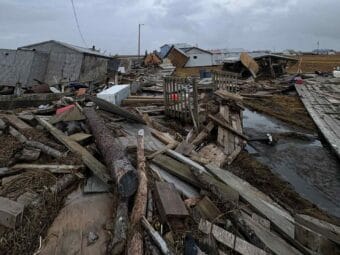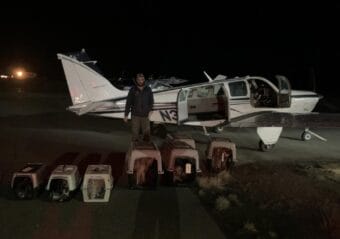
Residents and their dogs in Kipnuk navigate high waters on Oct. 12, 2025, as the remnants of Typhoon Halong collide with the community. (Jacqui Lang)
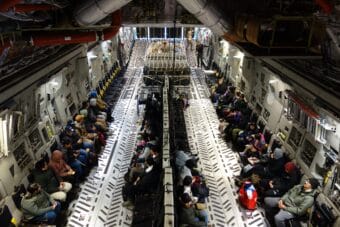
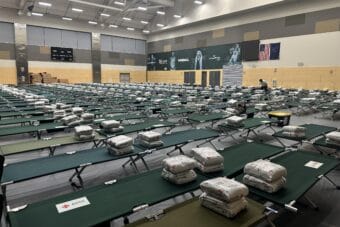
More than a thousand people in Western Alaska are sleeping in their local school after a massive storm Sunday made their homes unlivable.
But some of the schools aren’t livable either.
In Kwigillingok, some 400 people were sheltering at the school, without functioning toilets, the Alaska Department of Homeland Security and Emergency Management reported Monday.
Nearly 600 were staying at the school in Kipnuk, where the water plant wasn’t working and electricity was limited.
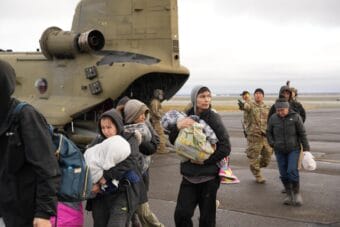
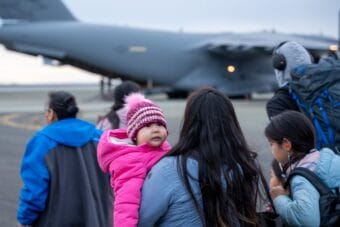
Mark Roberts, the state incident commander, said Tuesday they’ve begun evacuating the medically vulnerable to Bethel.
“We’re moving as fast as we can,” he said. “We know that folks are miserable.”
The storm struck two communities very hard, Kipnuk and Kwigillingok, with record-breaking storm surge and damage to nearly every home. But many more communities along the Yukon-Kuskokwim Delta and farther north suffered flooding. Complicating rescue efforts, some airports are closed to fixed-wing planes, some power plants and phone systems are down and none of the communities are on a road system. Also, another storm is expected to bring high winds this week.
About 60 people have been evacuated to a shelter established at the Bethel National Guard Armory, Roberts said. For everyone else still stuck in their village school, State Troopers and National Guard are flying in supplies like water, food and satellite communications equipment while the state figures out what to do.
“We need to have places for people to go safely, where they can be warm and fed and taken care of. We’re moving quickly to have that established, but it’s taking some time,” Roberts said. “So some folks are in some really uncomfortable places. We’re doing everything we can to push in support to them, where they are.”
Bethel, he said, doesn’t have the capacity to shelter everyone who needs it, so the state is considering other places, including Anchorage and Fairbanks.
The longer-term outlook is more uncertain. Roberts says the state needs to evaluate each house in the flooded communities, in conjunction with the Association of Village Council Presidents, the Yukon-Kuskokwim Health Corp. and tribes.
“If folks’ homes are viable and the water goes down, and we can get the power back on and get them proper sanitation and reestablish some of their subsistence foods, then they can stay in their homes,” he said.
Where possible, he said, crews from the National Guard and Alaska’s Organized Militia will do rapid repairs to get homes ready for winter. Other residents, he said, can register to receive state assistance and seek temporary housing outside the community.
The storm has killed one person, left two missing, displaced hundreds and destroyed or damaged dozens of homes, especially in the hardest-hit communities of Kipnuk and Kwigillingok.
Here’s how you can help.
Financial support: The Western Alaska Disaster Relief Fund
The Alaska Community Foundation, an Anchorage-based nonprofit, has partnered with organizations serving people throughout the Yukon-Kuskokwim Delta region, Norton Sound and the Northwest Arctic to funnel financial donations to people affected by the storm.
“The thing that’s unique about this fund is that we have partnered with local and regional organizations to make sure that the money goes to the areas that it’s needed most,” the Alaska Community Foundation’s Ashley Ellingson said in an interview. “Since we are not on the ground, we rely on those partnerships to make sure that the gifts and donations are the most impactful.”
The Alaska Community Foundation is partnering with the Alaska Federation of Natives, the Association of Village Council Presidents, the Alaska Native Tribal Health Consortium, Yukon Kuskokwim Health Corp., Kawerak, Inc. Maniilaq Association and a number of other local, regional and statewide groups.
The foundation embarked on a similar effort in the wake of 2022’s Typhoon Merbok. As of 1 p.m. Tuesday, the fund had raised more than $300,000 from 3,550 donors, Ellingson said.
Cash donations are a better option than goods, since storing and transporting items can present challenges of their own, said Jenni Ragland, chair of Alaska Voluntary Organizations Active in Disaster.
“While it may seem impersonal, cash really is the best opportunity to help meet those immediate needs that are coming our way,” she said at a news conference Tuesday. “It provides flexibility for us to purchase exactly what’s needed, to procure those items quickly and to get them into the hands of disaster survivors.”
Other donations
A variety of organizations, though, are taking goods to distribute to survivors or contributing in other ways. Organizers request that donations include new and unused items only, and that the donations be limited to water, diapers, wipes, formula, non-perishable food, bedding, toilet paper, hand sanitizer, portable phone chargers and flashlights.
The Alaska Federation of Natives says it’s gathering supplies Friday, Oct. 17, from 1 p.m. to 5 p.m. at the Dena’ina Center’s Room 6, on the second floor. Donations will also be accepted Saturday, Oct. 18, from 8 a.m. to 2 p.m.
The Alaska Native Heritage Center is holding a benefit concert at Williwaw Social, 609 F St. in Anchorage, on Saturday, Oct. 18 from 6 to 10 p.m. Tickets are on sale online, and the group says it’s donating 25% of proceeds to relief efforts.
Alaska Children’s Urgent Care, at 751 East 36th Ave. in Anchorage, says it is taking children’s items, such as diapers, wipes, pediatric care supplies, socks, shoes and warm clothing for children of all sizes. Donations will be accepted 11 a.m. to 5 p.m. through Friday, Oct. 17.
Susitna Energy Solutions says it is collecting supplies at its office at 1432 Ingra St. in Anchorage from 9 a.m. to 6 p.m. Monday through Friday.
Alaska Discount Outfitters is offering a 10% discount to customers that bring donations to its location at 3401 Commercial Drive in Anchorage. Donations will be accepted Wednesday through Friday from noon to 7 p.m. and Saturday and Sunday from 10 a.m. to 7 p.m.
GCI says it is accepting donations at its C Street, Dimond Center, Muldoon and Abbott retail locations in Anchorage, as well as in Wasilla and Fairbanks.
The Fairbanks nonprofit Straw for Dogs is fundraising to provide doghouses and straw for families in the region.
The Association of Village Council Presidents is requesting that donations be dropped off at the Bethel Search and Rescue building at 499 State Highway in Bethel.
The Yute Commuter Service dispatch office in Soldotna is accepting donations through Saturday night at 627 Funny River Road at the local airport.
Editor’s note:This story has been updated to reflect that Lynden Air Cargo is no longer asking that donations not be brought to Anchorage airport cargo terminals, instead directing donations to GCI retail stores and the AFN convention.
If you are organizing a resource that we missed, please email news@alaskapublic.org
Gov. Mike Dunleavy and numerous state and federal officials held a news conference on Monday, Oct. 13, 2025, in Anchorage to discuss the devastating impacts of the weekend storm. (Matt Faubion/Alaska Public Media)
The U.S. Coast Guard commander for Western Alaska compared the devastation in Southwest Alaska villages over the weekend to the aftermath of Hurricane Katrina.
“Several of these villages have been completely devastated, absolutely flooded, several feet deep,” Coast Guard Capt. Christopher Culpepper said at a news conference Monday. “This took homes off of foundations. This took people into peril, where folks were swimming, floating, trying to find debris to hold onto in the cover of darkness.”
The remnants of Typhoon Halong barreled into remote, coastal communities in the Yukon-Kuskokwim Delta on Sunday, bringing hurricane-force winds and record flood waters. Coast Guard and National Guard crews have rescued at least 51 people so far from two of the hardest-hit communities: Kipnuk and Kwigillingok. Three people remain missing from Kwigillingok. Hundreds of survivors are in community shelters.
“It’s been very scary — very, very scary — for folks,” said State Emergency Operations Center head Mark Roberts.
Roberts and other officials at Monday’s news conference said they’re still taking stock of the damage, but said the storm destroyed dozens of homes. Some of them floated off their foundations with families still inside. Several people called the state’s emergency operations center for help.
“The folks that were in houses that were floating and didn’t know where they were was one of the most tragic things our folks in the state EOC have ever faced,” Roberts said.
Kipnuk on Sunday morning, Oct. 12, 2025. (Courtesy of Alaq Hinz)
The storm also cracked Kipnuk’s runway so planes cannot land and snapped a lot of utility poles in half, leading to continued power outages, Bethel state Sen. Lyman Hoffman said.
Massive search and rescue effort continues
Locating every missing person is the state’s top priority, Roberts said.
Alaska National Guard Adjutant General Maj. Gen. Torrance Saxe said he has activated every member of the state’s National Guard and Alaska State Defense Force living in Western Alaska, totaling 60 to 80 people. State officials are also calling up more personnel largely from Fairbanks and Anchorage, he said.
“This may end up being the largest off-the-road-system response for the National Guard in about 45 years,” Saxe said.
Dozens of nonprofit organizations, businesses and faith-based groups, including the Salvation Army, Red Cross, Samaritan’s Purse and World Central Kitchen, are also coordinating recovery efforts with the state, Roberts said.
“We’re coming,” Roberts said. “We’re going to have folks there to help you.”
Mark Roberts, head of the State Emergency Operations Center. (Matt Faubion/Alaska Public Media)
Gov. Mike Dunleavy has declared a disaster for the region, easing access to additional resources.
“We know you need help. We’re going to continue to get the help to you,” he said. “We’re going to do everything we can to get everything up and running as quickly as possible, and we will continue to help — not just today, tomorrow, but weeks and months on and until we get things back to what used to be at least considered semi-normal.”
Record flooding
The storm surge broke records in the hardest hit communities, said meteorologist David Kramer of the National Weather Service. At Kipnuk, the water reached 6.6 feet above the normal highest tide mark, he said.
“The previous record was 4.7 feet, and that was back in 2000. So almost two feet higher than what we have seen before,” Kramer said.
The surge at Kwigillingok was also several feet higher than the last record high water, Kramer said.
Despite its fierceness, this storm was more focused than Merbok, the big disaster that hit Western Alaska in 2022.
“Merbok was, I’ll say, more extended on the coast,” said Gen. Saxe. “This really did hit certain areas very hard, and we want to get our help there, as I said, very quickly.”
Coast Guard assess environmental impacts
In addition to its search and rescue mission, the Coast Guard is also focused on the potential for a marine disaster. By midday, the only pollution reported was a light sheen in the flood waters, but the area of storm damage includes dozens of bulk fuel tanks and other fuel storage facilities, Culpepper said.
“These facilities are those that which the communities rely upon for home heating oil, subsistence through winter, for travel, for fuel, for vehicles, boats, aircraft, and they’re critical assets,” he said.
Coast Guard teams will conduct assessments and decide where the greatest danger is, he said.
Dunleavy said spilled oil is a low priority for the state right now.
“We’ve got to take care of people quickly. We have to take care of their needs quickly,” he said. “We have to take care of water, food, sanitation, electricity.”
Gov. Mike Dunleavy. (Matt Faubion/Alaska Public Media)
Oil and gasoline spills can be addressed later, he said.
‘More and more warming that is disrupting lives’
Dunleavy said he didn’t know how much climate change may have contributed to the intensity of the storm. Alaska has seen big storms in past decades, too, he said.
“We certainly had a couple stacked on top of each other last couple of years,” he said. “At least two under under my watch.”
Hoffman, who represents the region and grew up in Bethel, said its climate has changed, forcing the village of Newtok to relocate.
“There has been more and more warming that is disrupting lives in the Y-K Delta from the last 25 years that I can tell,” he said.
Floodwaters in Chefornak. Oct. 12, 2025. (Courtesy of Clara Mathew)
At least three people were still missing Monday, and 51 had been rescued from two Southwest Alaska communities hit hardest by the remnants of Typhoon Halong, according to the Alaska National Guard.
The massive storm flooded communities and destroyed homes Sunday when it slammed into the coast of the Yukon-Kuskokwim Delta, bringing with it destructive winds and high waters. Officials have said that the hardest hit communities appear to be Kipnuk, Kwigillingok and Napakiak.
In an update Monday, the Guard said rescue teams from multiple agencies searched storm-impacted communities throughout the night. The storm blew and floated at least a dozen houses off of their foundations, some with families still inside.
An overturned home in Kotlik. The National Weather Service reported a maximum wind gust of 78 mph in Kotlik Sunday morning. (Courtesy of Adaline Pete)
As of Monday morning, U.S. Coast Guard and Alaska Air and Army National Guard aircraft had rescued 51 people and two dogs from Kipnuk and Kwigillingok. Three people were medically evacuated from Kipnuk to Bethel for medical care.
The three people unaccounted for are from Kwigillingok, the Guard said. Additional details were not immediately available Monday. Search efforts continued.
According to the National Weather Service, the wind had mellowed by Monday morning, as the storm moved north into the Beaufort Sea.
Carson Jones, lead forecaster with the Weather Service’s Anchorage office, said weather in the areas hit hardest over the weekend had returned to normal for fall on Alaska’s west coast.
“Kind of isolated rain showers, some snow showers, up farther north into the northwest area there, but throughout the Kuskokwim Delta, we’re mid-40s, light winds and isolated rain showers,” Jones said. “So the weather has calmed down significantly for those communities.”
Monday morning, Jones said, the storm was hitting the North Slope, where Prudhoe Bay and Deadhorse were seeing wind gusting up to about 40 miles per hour.
The Guard asked anyone in need of immediate rescue to contact the Alaska Rescue Coordination Center at 907-551-7230. Gov. Mike Dunleavy has scheduled a news conference for 1 p.m. Monday with numerous state and federal officials. It will be live-streamed on the governor’s Facebook page.
This is a developing story. Check back for updates.
The state Division of Homeland Security and Emergency Management said in a press release that flooding and storm surge damaged homes and infrastructure during Wednesday’s storm. Kotzebue was under a mandatory evacuation, which has since been lifted. According to officials, there are no reports of injuries at this time.
Carter MacKay is a meteorologist with the National Weather Service. He said initial forecasts overestimated tide levels by one to two feet, which was good for low-lying communities like Kotzebue and Shishmaref.
“As an overall trend, there was an abundance of high water and erosion across the west coast with some areas of damage, but it wasn’t widespread impacts,” MacKay said.
The declaration activates public and individual assistance programs across the Bering Strait, Lower Yukon, and Kashunamiut school regions, as well as the Northwest Arctic and North Slope boroughs. Those programs help repair public infrastructure and provide aid to families whose homes were damaged.
State emergency officials are deploying response teams and have requested help from the Alaska National Guard and State Defense Force.
Incident Commander Mark Roberts said in the release that preparations made before the storm helped keep people safe, but warned that more bad weather is on the way. Flood warnings are in effect across western Alaska through Monday as another storm, the remnants of Typhoon Halong, approaches the Bering Sea.
MacKay said the weather service is already shifting its focus to the upcoming storm.
“It’s looking a little bit worse in terms of really strong winds gusted about 70 to 80 miles an hour,” MacKay said. “So wind gusts could be even stronger with this next one moving in, which could lead to potentially more significant coastal impacts.”
Residents are urged to stay alert, follow local instructions and keep emergency plans ready.
Nome Harbormaster Lucas Stotts looks at a wind forecast for the Bering Strait region. Harbor staff advised boat owners to secure their vessels in anticipation of the Sunday storm. (Ben Townsend/KNOM)
Fish and Game says survey results show increases in all sex and size groups of snow crab compared to last year. Large males remain at historic lows, but the population is showing signs of stabilization and recovery after the recent collapse. (Laura Kraegel/KUCB)
Bering Sea crabbers will see a boost in catch limits this season, after years of cancellations and small harvests due to low snow and king crab stocks.
The Alaska Department of Fish and Game announced Monday that it’s nearly doubling the harvest for the upcoming Bering Sea snow crab commercial fishing season from last year’s totals.
Fish and Game set the cap at 9.3 million pounds. That’s a low number compared to historic levels. In 1991, crabbers harvested more than 320 million pounds of snow crab.
The catch limit was set at 45 million pounds back in 2020, the year before the snow crab stock crashed. And the next year, the fishery closed for two seasons after more than 10 billion snow crabs disappeared from the region.
Fish and Game now says survey results show increases in all sex and size groups compared to last year. Large males remain at historic lows, but the population is showing signs of stabilization and recovery after the recent collapse.
Officials said a return to colder ocean conditions and increased numbers, especially in juvenile crab, are reasons to be optimistic.
And for the first time, a portion of the harvest will be reserved for a hybrid snow-tanner crab. Those are crabs that share some characteristics of both snow and tanner crabs, like eye color and tooth shape.
Regulators said recent surveys show an “unprecedented” amount of the hybrid crab. To incentivize harvest of them, Fish and Game designated about 11% of the total snow crab catch to the snow-tanner mix. According to officials, the fleet will be encouraged to harvest about a million pounds of the hybrids from the “hybrid grounds.”
Meanwhile, Fish and Game also boosted the Bristol Bay red king crab catch limit by about 16% from last year, with a total harvest of about 2.7 million pounds. Tanner crab harvests more than doubled for the western district of the Bering Sea but dropped by almost 40% for the eastern area.
All of those fisheries open Oct. 15. The lucrative Bristol Bay red king crab has the highest priority harvest, as that fishery closes shortly after the new year. Snow and tanner crab both close in the spring.
Close
Update notification options
Subscribe to notifications
Subscribe
Get notifications about news related to the topics you care about. You can unsubscribe anytime.