Western

Satellite internet shakes up rural Alaska schools amid rising costs

A Starlink unit is seen mounted alongside other networking equipment on top of the Alakanuk School in the Lower Yukon School District in summer 2024. (From Lower Yukon School District)

With the rise of satellite internet and the unspooling of fiber optic cables, rural Alaska is in the midst of huge changes in broadband connectivity. For school districts increasingly reliant on the internet to deliver education, these changes couldn’t come sooner.

But finding the most affordable option, and turning away from established providers in favor of services like Starlink, is easier said than done for many rural school districts. It means navigating the complex and ever-growing systems of state and federal subsidies these districts have long relied on, and that critics say should be given more scrutiny.

It remains unclear how far into the future a school internet system propped up by hundreds of millions of dollars in subsidies can last. Which internet service providers are able to come out on top securing these lucrative contracts, and whether satellite internet like Starlink proves to be a pie in the sky approach, is still up in the air.

Switching to Starlink

With kids back in school across the state, one district in Western Alaska is in the first year of a major change. It’s switching from GCI to Starlink satellite internet to serve its approximately 2,000 students living hundreds of miles off the road system. The switch is only one of the difficult moves that the Lower Yukon School District has made in response to years of virtually flat per-student funding from the state.

“We were staring down the barrel of a big deficit,” said Joshua Walton, the district’s technology director. “And we were saying, ‘How do we mitigate some of the fallout of this?’ One of the biggest things that we looked at was internet. After a lot of calls and a lot of research, we made the plunge.”

Walton said that the decision to switch to Starlink wasn’t an easy one. But he said that the highest internet speeds the district could afford from long-time provider GCI were falling short of the mark.

“You run into a lot of issues with testing. Any kind of online curriculum, classes struggled to use it just because the bandwidth isn’t there,” Walton said.

In 2023, download speeds for all but one of the district’s 11 schools were limited to 25 megabits per second. That’s what the Federal Communications Commission considered, until recently, to be adequate for the internet needs of a small household. At its Emmonak school, the district was relying on that connection to serve more than 250 students and faculty.

With Starlink, Walton said that the district should be able to tap into download speeds as much as 10 times faster, and at a price many times cheaper. He said that upfront costs for the switch were around $100,000, but that the decrease in annual costs after federal subsidies is considerable.

“Out of pocket, we’re looking at, like, somewhere around ($40,000), which is just substantial savings when you look at where we were before,” Walton said. “From close to a million dollars out of pocket with GCI, (it) was an easy decision to make.”

Walton stressed that the district’s first year on Starlink is really a test run, and that there is no true backup if the low-Earth orbit satellite internet service fails.

Next year, after a one-year contract with an Anchorage-based Starlink reseller Microcom expires, the Lower Yukon School District will be free to choose whichever provider it believes can meet its needs through a competitive bidding process. Walton said that he hopes that the complete network overhaul that he helped to complete in time for the school year is more than a flash in the pan.

“I am on the edge of my seat, kind of just making sure that everything is going to work out because we’re betting big on Starlink right now,” Walton said.

The Lower Yukon School District is the largest district in the state to take the plunge with satellite internet, but it’s not the first. A handful of smaller districts spread across the state are headed into their second year using satellite internet.

“At the forefront”

More than 1,100 miles away from the lower Yukon, the tiny Southeast Island School District has fewer than 150 students spread across seven remote schools on Prince of Wales and Baranof Islands in Southeast Alaska.

Until recently, it was paying GCI around $1.2 million a year for 25-megabit internet at all but one of its schools. After state and federal subsidies, the district was still on the hook for nearly $50,000 in annual out-of-pocket costs.

That’s according to Everett Cook, the district’s technology director. As tech assistant in 2022, he said that he saw an opportunity to break away from the norm when the district’s remote Port Alexander school was facing chronic internet outages.

“It was right when Starlink was coming out, and I said, ‘We could be at the forefront of this and it would completely benefit all the schools,’” Cook said.

Within a short time, the district’s first Starlink unit was installed at Port Alexander, which Cook said kept roughly a dozen students connected that year. Over the coming months, additional schools in the Southeast Island district got Starlink, something Cook said that the district was fortunate to be able to phase in while still receiving services from GCI.

A Starlink unit is seen mounted on the Berry Craig Stewart Kasaan School on Prince of Wales Island, one of seven schools in the Southeast Island School District. (From Southeast Island School District)

“It was really on a testing (basis) like, ‘Let’s see how this is going to work,’” Cook said.

When its contract with GCI ended in 2023, Cook said that all seven schools were poised to make the switch. And in contrast to the Lower Yukon School District, there would be backups in place for all but two of the schools: 50 megabits per second connections through Alaska Power and Telephone or AP&T, another regional internet provider in Southeast.

Cook said that total internet costs for the district have been chipped down to just over $18,000 a year through the changeover to Starlink and AP&T, and that download speeds have increased multiple times over. He said that’s in part because the state program meant to help the Southeast Island School District afford internet connectivity also limited the speeds it could tap into.

So when the district turned away from its million-dollar contract with GCI last year, the stakes were high. By implementing faster internet, they were also turning away from more than $200,000 from a state broadband assistance program called the Alaska School Broadband Assistance Grant or BAG, which placed a cap on internet speeds eligible for support.

“You’re using this government money to purchase an internet connection, and then you’re using more government money to slow it down in order to help pay for it. Like, what the heck?” Cook said.

As for federal subsidies, Cook said that the district has decided to forego them altogether. He said that it was costing around $10,000 a year to hire someone just to handle the necessary paperwork. For now, the Southeast Island School District has achieved major savings and a level of broadband independence that is rare in Alaska school districts.

But the much larger Lower Yukon School District doesn’t have that luxury. This year, the district is asking for more than $600,000 in federal subsidies to pay for its Starlink-based network, according to federal records.

In Southeast, Cook said that so far he sees the switchover as a success. Nevertheless, there are risks and unknowns with the new setup, including a lack of guaranteed bandwidth or dedicated support staff in case something goes wrong, both services that GCI is able to offer. But Cook said that he’s up for the challenge.

“It seems to me that a lot of the schools prefer to have the management services and they don’t have the headache of it. They’d rather just deal with the other things that they have to deal with,” Cook said. “Whereas I had fun doing it.”

“The big money”: E-rate

While the switch in internet providers is an experiment for the Lower Yukon School District, it’s still relying on the same massive federal subsidies to cover its internet costs.

That money is distributed through the Schools and Libraries Universal Service Support Program, known as the E-Rate program, aimed at achieving equal access to telecommunications across the country. In 2023 it provided roughly $115 million in broadband subsidies to Alaska school districts. The number is expected to double in 2024, according to federal E-Rate records.

“That’s where all the big money is,” said Valerie Oliver.

Until last year, Oliver served as the state’s E-Rate consultant under the Alaska State Library, a position she held for two decades. As she explained, federal broadband subsidies are tied to poverty levels.

The number of kiddos you’ve got that are eligible for free or reduced lunch, that determines the discount that you’re going to get in the E-Rate program,” Oliver said.

In rural Alaska, that discount is generally 80% to 90%. The remainder of what districts owe each year to cover their internet cost is where the state comes in, through the BAG program.

BAG

BAG was first launched in 2014 to assist schools in Alaska with reaching internet download speeds of 10 megabits per second, considered laughably slow today.

Oliver helped write the first and second versions of the regulations that guide how BAG is administered. She said that she and the director of the BAG program at the time didn’t have the benefit of a team of experts to guide the process.

“It was two librarians working with an attorney who didn’t know anything about BAG, or E-Rate, or anything,” Oliver said.

For years, BAG capped eligible internet download speeds at 10 megabits per second, and then at 25 megabits per second. In the last legislative session, it quadrupled the cap to 100 megabits per second, enabled by fast-track passage of House Bill 193.

Rep. Bryce Edgmon (I-Dillingham), who sponsored the bill, which was originally introduced as Senate Bill 140 by Bethel Democrat Lyman Hoffman, urged quick passage of HB 193.

In a House Finance hearing in February 2024, Edgmon highlighted the looming deadline to apply for E-Rate subsidies at the 100 megabits per second benchmark, enabling eligible school districts to then secure the remainder of the necessary funding through the BAG program.

In the hearing, Edgmon said that he was hopeful that federal broadband funding, including more than $1 billion allocated for Alaska through the Broadband Equity and Development Program or BEAD, would eventually remove the need for the BAG program altogether.

“There is a sort of an imperfect nature of this as it was when it got introduced in 2014, amended in 2020, and here we are in 2024 upping it, hoping that these billions of dollars of federal money that are coming through primarily the BEAD program can help offset or make this bill not applicable,” Edgmon said.

Rep. Bryce Edgmon (I-Dillingham) urges quick passage of House Bill 193 in a House Finance hearing at the Alaska State Legislature building in Juneau on Feb. 14, 2024. (From Gavel Alaska)

Estimating the annual budget for the state’s BAG program is tricky. This is because Alaska’s commitment is determined by the level of E-Rate subsidies awarded to school districts. These begin flowing in after the state’s number is already set.

For the new law passed this year, the Legislature requested around $25 million, a rough estimate of the costs if every eligible district receives state funding to achieve the 100 megabits per second increase. And while the recently announced BAG award totals came in under budget, the new total is a three-fold increase from last year’s funding. It’s an expense that critics say the state should be leery of.

Fairbanks Republican Rep. Will Stapp was one of just a handful of lawmakers to vote no on HB 193. He said that he was shocked to see how much districts were paying out of pocket, despite receiving the maximum amount of federal and state subsidies.

“At the end of the day, these are considerable price increases, and you just have to ask yourself the question, ‘Hey, is this the actual cost of providing the service in the location?’ Some of these billings are pretty astronomical,” Stapp said.

An apparent windfall

When the Lower Yukon School District made the switch to Starlink, internet provider GCI lost its second-largest drawer of federal subsidies among the more than 30 districts it serves in Alaska.

But things have played out differently for GCI in the district it serves that draws the greatest subsidies: the much larger Lower Kuskokwim School District. In April, the district’s school board approved a contract with GCI for more than $101 million a year. The price tag for a high-speed connection at the district office in Bethel alone is currently $1.4 million per month.

After BAG and E-rate subsidies, the district is on the hook for around $3 million of this contract annually, according to a school board memo.

For GCI, the 100 megabits per second change to state BAG regulations has resulted in an apparent windfall, far beyond what the next largest Alaska providers have achieved in terms of overall subsidies. With the state support to increase speeds, districts GCI serves have roughly doubled their E-Rate subsidies to more than $200 million since the change, according to federal records. The Lower Kuskokwim district alone has applied for more than half of these federal subsidies. As for BAG subsidies, roughly $7.2 million is being awarded this year to bring its schools to 100 megabits per second.

In an emailed response, GCI declined to discuss details of its contract with the Lower Kuskokwim School District, but said that the price of internet services in rural Alaska were generally high due to the high costs of building, upgrading, operating, and maintaining networks.

The email went on to say that the company is very excited about bringing fiber internet to Bethel and other rural communities over the coming years through its AIRRAQ project – a collaboration between GCI and Bethel Native Corporation funded by over $100 million of tribal broadband connectivity grants. However, it did not say whether this project had any bearing on the current pricing for the Lower Kuskokwim School District.

The district’s new superintendent, Andrew “Hannibal” Anderson, said that it was satisfied with the current arrangement with GCI, but also declined to discuss details.

The future of BAG

This year, the state of Alaska can afford to fill in the gap between the millions of federal subsidy dollars and the internet needs of rural school districts. But that may not always be the case. Oliver, the state’s former E-Rate consultant, said that people should pay attention to the implications of steadily increasing costs for the BAG program.

“If we’re not careful and let the service providers jack up the cost of things too high, then we’ll never be able to pay our non-discounted share, our 10%, because they will knock things out of the ballpark, which is exactly what they’ve done with (the Lower Kuskokwim district),” Oliver said.

Oliver said that there’s a real risk that districts could have to make do with reduced subsidies.

“If we’re not already there, we will soon be at proration, and that is going to impact all districts that apply, including those that were good fiscal stewards of selecting a cost effective connection in the first place,” Oliver said.

Oliver said that she still believes in the importance of the program for helping address disparities in internet access across the state, and that there is still a chance to protect the future of the program.

“Can we improve upon something that started out as good? We absolutely can. And we should, because we are spending millions of dollars when we as a state don’t have a lot to spare,” Oliver said.

The Alaska Department of Education and Early Development declined to comment on the long-term sustainability of the BAG program.

The state Online Public Notices website was accepting written comments until Tuesday. It has details for providing oral comments via telephone on Oct. 9.

4 people killed in St. Mary’s plane crash

St. Mary’s, Alaska (courtesy of Walton Smith)

Four people are dead after a plane they were traveling in from Bethel crashed short of the runway in St. Mary’s late Sunday night, according to transportation officials.

The Cessna 207 was operated by Bethel-based Yute Commuter Service. The pilot and three passengers departed Bethel for the roughly 100-mile journey to the lower Yukon River community at around 9 p.m. Sunday, according to National Transportation Safety Board Alaska Chief Clint Johnson.

Johnson said the flight was not operating as one of Yute’s regularly scheduled or chartered flights.

“This is an in-house flight,” he said. “At least two of the folks on board are employees, and we’re still trying to sort out who the other folks are there, but at least two of them are company employees.”

According to National Weather Service data, conditions in St. Mary’s at the time of the crash were overcast, with light rain, fog and mist, and visibility limited to roughly 2 miles.

Johnson said the plane crashed within a half-mile of the runway at St. Mary’s following a request for what is known as special visual flight rules, or special VFR, clearance.

“Basically, what that allows is the airplane to get in under less than basic VFR conditions, into the airport area and onto the airport surface landing there,” he said. “Unfortunately, when they didn’t arrive, a search started shortly after that, and just after midnight is when Alaska State Troopers and good Samaritans found the airplane.”

Johnson said it is too early to say what may have caused the fatal crash.

According to the Anchorage Daily News, the crash is the third fatal airplane accident in Alaska in the past four days. Johnson said an additional investigator is being flown in from out of state to assist.

“We had to bring an investigator from the Lower 48. He arrives here tonight,” Johnson said. “And we also have a representative from the airplane manufacturer in this case, which is Cessna. So they plan on launching out there tomorrow, weather permitting, directly to St. Mary’s.”

Yute Commuter Service has had a string of accidents in recent years. The company’s last fatal crash was in February 2020, when a pilot and all four passengers died near Tuntutuliak. According to the NTSB, the probable cause was the pilot’s decision to fly in what may have been whiteout conditions.

According to Alaska State Troopers, the names of the four men will be released once they have been positively identified and next of kin have been notified. Johnson expects a preliminary report on the accident sometime next week.

This is a developing story and may be updated with additional information.

Yukon-Kuskokwim Delta residents brace for fall storms after early floods and erosion

On average, Napakiak residents see about 30 feet of the Kuskokwim River’s bank erode every year. (Gabby Salgado/KYUK)

A series of very strong storms caught many people in Western Alaska off guard last week, including in Napakiak, where the banks of the Kuskokwim River are eroding at a startling rate.

The community was inundated with floodwaters from the Kuskokwim for two days. Signs of the flooding are evident everywhere: snow machines and four-wheelers were still parked on high ground days later. And a crew had to repair the plumbing under the city office after high water damaged pipes.

“Everything was displaced,” said Walter Nelson, as he pointed to where floodwaters from the Kuskokwim, which is also influenced by tides on the Bering Sea coast, rose to about his midsection. He said he’s used to these kinds of events.

“Even if we don’t have a plan for it, there’s ways around it, and that we can tackle it and that’s what we’ve been doing and hope to continue doing,” he said.

In 2020, Nelson, who works for the city, helped devise Napakiak’s 50-year plan. It outlines how the community will retreat from severe erosion along the Kuskokwim River’s edge, which is about a quarter mile from the city office.

Nelson pointed to chunks of broken riverbank, where the sand, mud and gravel disappeared into the silty, grayish-brown water during this most recent series of storms. “It just cracks underneath at high tide, waves just bang this way,” he explained.

This is all happening about 10 feet from the back end of Napakiak’s public school.

“Every year we hold community gatherings for the whole community, meeting place, basketball games, what not, potlucks, potlatches, a lot of good memories are going to be gone …” Nelson said.

Roughly half the school building was demolished last year. A crew is racing to take down the rest of the building this fall before it collapses into the river.

According to climatologist Rick Thoman, these kinds of storms aren’t unprecedented, but they don’t usually arrive on the Yukon Kuskokwim Delta until later in the fall.

“It was a deep low pressure center by late August standards but not at record level,” Thoman wrote in an email.

He said that Bristol Bay saw severe coastal flooding in August in 2005. Back in 1990, Nome also experienced severe weather and saw significant coastal erosion.

On average, Napakiak sees up to 30 feet of riverbank disappear every year. Major storm systems can accelerate that pace, and Nelson, who is 64 and grew up in Napakiak, said he just hasn’t seen this kind of weather in August.

“September is actually where most of the southern and western storms come in. Everything is gonna accelerate, I just know it is,” he said. “But we cannot fight Mother Nature, just be prepared for her.”

Nelsons said the impacts from the remnants of Typhoon Merbok back in September 2022 are still the worst he’s ever seen, but the damage from this most recent storm system is a close comparison – perhaps a little too close for comfort.

Orcas challenge the Bering Sea’s black cod industry

Orcas spotted in the Bering Sea in August 2023. (Courtesy Dustin Unignax̂ Newman)

Black cod fishermen in the Bering Sea have reported an increase in orcas taking their catch off their fishing lines in recent years. Orca depredation isn’t just a costly headache for fishermen — it can be dangerous for orcas, too.

Jeb Morrow has been long-lining for black cod around Alaska for most of his life. The process includes baiting hundreds or even thousands of hooks to catch oily fish on the ocean floor. When he started fishing in the 1990s, he heard stories from elders about orcas regularly stealing their catch, but he said it was only within the last few years that it became a reality for him.

“I can tell you without question these orcas are geniuses,” Morrow said. “They just adapt and conquer at a level that is like nothing we’ve ever seen.”

The problem is so bad that Morrow has decided to skip fishing for black cod this year. He said it’s not worth the hassle. Morrow and his crew have to be careful to protect their catch. For instance, they have someone whose only job is to look out for killer whales with binoculars in the wheelhouse. Once an orca is spotted, the crew immediately cuts and anchors the line, leaving the area as quickly as possible.

“Because you don’t want to be known as a boat that feeds the whales,” Morrow said. “If they establish you as a boat that will feed them, you’re (expletive) for life.”

Morrow said orcas are so intelligent that they’ll follow the boat for the rest of the season. And once the opportunity strikes, the orcas will continuously approach the vessel and take caught fish.

Asia Beder, a biologist with the Alaska Department of Fish and Game in Dutch Harbor, has seen the behavior herself and said stories of orca depredation in the Bering Sea have increased in the last few years.

“Seeing it in person, I was shocked at how quickly they found us, how smart and fast they were at pulling the fish off,” Beder said.

As a management biologist, Beder finds this behavior puzzling. She said that when orcas are around a fishing boat, it doesn’t always mean they are trying to steal the harvest — they also like to play with gear. However, when fishermen aren’t catching fish, it could mean there are orcas around quietly taking caught fish.

Beder said it’s challenging to manage the amount of black cod in the fishery when fishermen can’t accurately count how many they’ve caught, knowing that the orcas are also a factor. So, in the state survey, she said fishermen have a box to check if they saw orcas around while fishing.

“I feel both sides of the equation,” said Beder. “I feel for the orcas, and I also feel for the fishermen.”

Federal agencies also manage the black cod fishery in the Bering Sea.

According to the National Oceanic and Atmospheric Administration, orcas aren’t just going after catches from small boats. They’re also going after large commercial vessels, which has resulted in a recent spike in orca deaths from gear entanglement in Alaska.

Suzie Teerlink, a marine mammal specialist with NOAA, said orcas are starting to show new feeding behaviors around large trawler nets. They’re trying to steal fish caught in nets that are typically being hauled back. Scientists aren’t sure why orcas are doing this, but it’s dangerous for them because it increases their chances of getting caught in the net and dying.

Depredation can also be pod-specific. Killer whales are cultural learners — the elders teach the young survival skills particular to their hunting area. They’re also opportunistic.

“They’re looking for calories that aren’t difficult to get,” Teerlink said, “using as little energy as possible to get as much energy, calorie gain as possible.”

Teerlink said orcas have been following fishing boats for food for ages. Orca depredation isn’t just a Bering Sea problem; it also affects fishermen in other parts of the world. She emphasized that fishermen try to avoid orcas. For instance, many black cod fishermen are transitioning to pot gear to prevent the fish from being stolen off the hooks.

“When it comes to killer whale depredation, they’ve [fishermen] been innovating ways to reduce this since the onset and have already come about with lots of different tools and ideas,” Teerlink said.

Morrow believes it’s only a matter of time before the orcas can outsmart the latest fishing gear. For example, a few years ago, fishermen created a new kind of pot called the slinky pot, which worked for only a couple of seasons.

“It was like the answer to all our problems fishing black cod in the Bering Sea,” Morrow said. “And then the orcas figured it out, like in two years, they had it figured out, and they were shredding our pots, and it was done.”

Even if the orcas can’t get the fish out of the pots, Morrow said they’ll smash onto it, so the fish aren’t good anymore. So fishermen are trying heavier, more durable pots — but only time will tell if they’ll work.

As for Morrow’s black cod fishing future, he’s not optimistic.

“If it’s just me versus the whales, they’re gonna win every time out there,” Morrow said.

So, Morrow said he might invest more time and money in other fisheries.

NOAA study links massive Bering Sea snow crab loss to climate change

A vessel working with NOAA Fisheries travels through the Eastern Bering Sea while some ice is still intact. (From NOAA Fisheries)

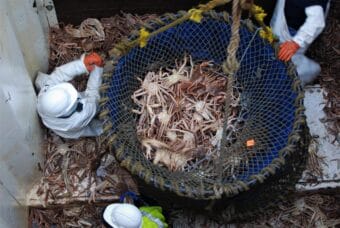
Scientists had previously linked the crash of the Bering Sea snow crab population in recent years to warming ocean waters. But a new study released Wednesday by the National Oceanic and Atmospheric Administration deepens the connection between human-caused climate change and the die-off.

Snow crabs are well suited for Arctic conditions. But Mike Litzow — the lead author of the report, which was published in the journal “Nature Climate Change” — said the southeastern Bering Sea is changing to more sub-Arctic conditions through a process called borealization. St. Matthew Island to the south, nothing north of 60 degrees’ latitude is included in the southeastern Bering Sea. It’s a process that’s also happening in terrestrial ecosystems in Alaska.

“Like an Arctic terrestrial ecosystem around Kotzebue is traditionally tundra, you don’t have shrubs. But as you borealize, you get more shrubs, even trees,” said Litzow, who is also the director of NOAA’s Alaska Fisheries Science Center in Kodiak. “So you can imagine what a huge transition it is to go from tundra to forest. And it’s the same type of thing going from ice-associated to no ice all year.”

This borealization, brought on by human-caused climate change, means warmer conditions and more negative effects for snow crab in the southeastern Bering Sea. That includes a greater abundance of predator species like Pacific cod, shifts in food availability for crabs and increased bitter crab disease which can be fatal. These were all evident in 2018-2019 when the thermal barrier — a cold pool of water in the Bering Sea — vanished, bringing on extreme ecosystem shifts that allowed different species of groundfish to migrate further north.

Litzow and his team had previously confirmed that a combination of these factors caused the crash of snow crab populations between the years 2018 and 2019, when the stocks declined greater than 90%. The population still hasn’t recovered. And after the last two back to back years without a commercial fishery, which is estimated to be worth roughly $227 million of ex-vessel value annually, fishermen have also not fully recovered. And the snow crab most likely never will.

The new report indicates the fishery may be entirely displaced in the coming decades. Litzow said the recent changes are not part of a one-off event and ecosystem-wide changes are expected to continue to affect snow crab populations into the future.

“So it’s not like we are going to lose snow crab anytime soon, but we should expect the southern limit of their range to be retracting north, fairly rapidly,” Litzow said.

There is still hope for a short-term recovery of snow crab over the next five years however, based on favorable abundance seen during a 2022 bottom trawl survey. The Alaska Fisheries Science Center conducts an annual bottom trawl survey in the eastern Bering Sea, but won’t do a survey this year in the Northern Bering Sea.

Otherwise, Litzow and his team said the southeastern Bering Sea may only see Arctic conditions 8% of the time in the years to come.

As for this year’s snow crab commercial fishing season, the North Pacific Fishery Management Council, and the Alaska Department of Fish & Game, are expected to make a decision on opening or closing the fishery in October.

Editor’s Note: Mike Litzow is on KMXT’s board of directors, which has no input on this article or any of its other news coverage.

Justice to monitor Alaska primary election for compliance with language requirements

The Yukon-Kuskokwim hub of Bethel is seen from the air on July 13, 2015. The Bethel Census Area, where many residents speak Yup’ik, is one of the rural regions where U.S. Justice Department representatives will be monitoring for compliance with Voting Rights Act language requirements. (Photo by Rachel Loehman/USGS Alaska Science Center)

The U.S. Justice Department plans to monitor operations at polling places in parts of rural Alaska on Tuesday, the state’s primary election day, for compliance with the federal Voting Rights Act.

Monitors have been assigned to majority-Native districts to check for compliance with the requirements for language translations and assistance, including provisions concerning different Yup’ik dialects, the department said on Monday.

The sites selected are the Bethel Census Area, Dillingham Census Area, Kusilvak Census Area, Nome Census Area and North Slope Borough.

Tuesday’s monitoring is similar to efforts in previous elections.

In the past, Yup’ik speakers did not get adequate assistance when they voted in Alaska elections, a federal court found. A 2013 federal lawsuit filed by Yup’ik speakers resulted in a 2014 ruling in favor of the plaintiffs. A 2015 settlement agreement followed, and that agreement was extended last year, with terms to remain in place through 2026, according to the Native American Rights Fund.

Other violations in past Alaska elections concern access for disabled voters, according to the Justice Department. A department investigation found that some polling sites and online resources failed to adequately serve disabled Alaskans trying to vote in 2022 and 2024. The Justice Department called for the Division of Elections to improve conditions at cited polling stations and update its online information.

Site notifications
Update notification options
Subscribe to notifications