A News

Alaska House passes bill tightening residency requirements for hunting and fishing licenses

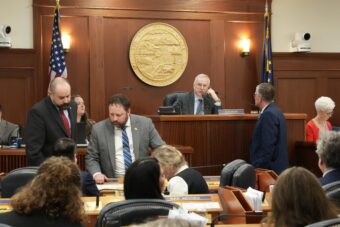
Sitka independent Rep. Rebecca Himschoot speaks in support of House Bill 93 on the House floor on Jan. 30, 2026.
Sitka independent Rep. Rebecca Himschoot speaks in support of House Bill 93 on the House floor on Jan. 30, 2026. (Eric Stone/Alaska Public Media)

The Alaska House of Representatives passed a bill Friday that would tighten residency requirements for Alaskans buying hunting or fishing licenses.

House Bill 93 aims to ensure that only people who spend enough time each year in Alaska to qualify for a Permanent Fund dividend can buy resident hunting and fishing licenses, which tend to cost less and offer higher bag limits than nonresident licenses.

State law currently limits resident licenses to people who are physically present in Alaska with no plans to leave, do not claim residency in another state and have maintained a home in the state for 12 consecutive months. But it does not require that resident hunters and fishermen actually live in the state for a full year.

Rep. Rebecca Himschoot, a Sitka independent who sponsored the bill, said that definition leaves a big loophole.

“The last point means that we allow someone who rents a room in a home from friends, or someone who has a liveaboard boat that’s on a trailer but actually is in the state for less than a month — less than two months, potentially less than a week — to hunt and fish and enjoy the higher bag limits that are reserved for residents who are here year-round, shoveling snow, volunteering in their communities and putting their kids in our schools,” Himschoot said.

Himschoot’s bill seeks to close that loophole. If the bill becomes law, Alaskans would have to be physically present in the state for at least 180 days each year to get resident licenses, though there would still be numerous exemptions, including for military servicemembers, students and others allowed to be outside the state while remaining eligible for Permanent Fund dividends.

In some cases, people ineligible for dividends would still be eligible for resident hunting and fishing licenses. For example, new Alaskans moving to the state would be eligible for resident licenses 12 months after they arrive. Permanent Fund dividend eligibility rules generally require new residents to live for an entire calendar year in the state, from Jan. 1 to Dec. 31, before applying for a dividend.

People who do not qualify for a resident license would have the option to buy a nonresident license instead.

The deputy director of the Alaska Wildlife Troopers, who enforce fish and game laws, told a House committee in 2024 that the current definition makes it difficult to prosecute people who violate the residency requirements. By contrast, state prosecutors often bring charges against people who fraudulently apply for Permanent Fund dividends.

“The problem is that our enforcement officers don’t have the right tools,” said Rep. Donna Mears, an Anchorage Democrat.

A wide range of local governments, tribes and fish and game advisory committees spread across the state backed the bill.

Twelve House Republicans opposed the bill, including Big Lake Rep. Kevin McCabe, who said he was concerned the bill would exclude some Alaskans from the benefits of a resident license.

“What about those pilots that have vacation homes elsewhere, that would like to go spend two months in Hawaii, say, and then they have to fly out of state for 15 days a month?” McCabe said.

The bill, however, had broad support and passed with a bipartisan two-thirds majority in favor.

A board shows the final vote on House Bill 93 on Jan. 30, 2026.
A board shows the final vote on House Bill 93 on Jan. 30, 2026. (Eric Stone | Alaska Public Media)

“Is there a problem? I think that we all acknowledge there is,” said Rep. Dan Saddler, an Eagle River Republican. “Is this a solution? I think it is. Is it the perfect solution? No, it’s not. But we don’t deal in perfect and ideal. We do what’s best and what we can do.”

The bill now heads to the Senate, which passed a similar bill in 2024.

“An Alaskan is and always will be an Alaskan,” Himschoot said. “But if you live outside Alaska, and you enjoy those lower prices at the grocery store and other costs of living that are much reduced compared to what we experience here in Alaska — if that is you, we ask you to please hunt, fish and trap as a nonresident.”

Juneau School Board seeks feedback for superintendent search

Juneau School District Superintendent Frank Hauser talks during an Assembly committee of the whole meeting on Monday, Jan. 29, 2024. (Clarise Larson/KTOO)

The Juneau School Board is quickly moving through the search process for a new superintendent. And it’s working with a search firm to collect feedback from the community before it makes a hiring decision.

Board Member David Noon said at a super site council meeting last week that the board plans to hire a superintendent in March.

“It’s an aggressive horizon,” he said. “But we’re pretty sure we can do it.”

Current Superintendent Frank Hauser announced his resignation in October.

The board in December approved a $29,000 contract with national search firm McPherson & Jacobson LLC to recruit candidates for the position. The job post lists characteristics the board is looking for in a new superintendent, which Noon said includes being able to work with local stakeholders and look at “new educational pathways.”

“We want someone who can, you know, create and sustain a positive educational environment, someone who has a record of advocacy for families, for students,” Noon said.

The application for the position closes on Feb. 5.

Noon said consultants with the firm are also meeting with staff, administrators, students, families and businesses to get information on what they are looking for in a superintendent.

In addition to meetings and interviews, community members can fill out a survey by Feb. 13. According to the district’s website, the board plans to make an offer to a new superintendent in March, with a July 1 start date.

Some small businesses in Juneau speak out against ICE amid nationwide strike

Alaska Robotics Gallery closed Jan. 30, 2026 as part of the nationwide general strike. (Photo by Alix Soliman/KTOO)

Some storefront owners in Juneau spoke out against U.S. Immigration and Customs Enforcement or shuttered their doors Friday as part of the nationwide general strike following recent killings in Minneapolis. 

Downtown, small businesses including Drip Drop Wonder Shop, Liaise Studio and Alaska Robotics Gallery closed, joining businesses across the country protesting ICE. 

Aaron Suring is co-owner of Alaska Robotics Gallery, a game and book shop. He said he participated in the strike because he wants to see ICE defunded. 

“There’s limited things that we can do so far away from what’s happening in Minneapolis, and we wanted to show our support in what way we could,” he said. 

He said he thinks joining the nationwide response can raise awareness and lead to action. Across the country, people are refraining from attending school, going to work or spending money in solidarity with those impacted by ICE. 

Some Juneau stores that remained open took a stance against ICE in other ways. 

Kindred Post, a gift shop and post office downtown, posted on social media that 25% of its revenue between Friday and Sunday will be donated to the International Rescue Committee in support of immigrants and refugees. 

Travis Smith, co-owner of The Rookery Cafe and In Bocca al Lupo, said he decided to keep the restaurants open because he can’t afford to close. But he encouraged patrons to pay in cash. 

“We’re going to basically take what would have been the credit card processing fees that we’re not paying, since people are paying in cash, and then we’re going to match that amount as a donation,” he said. 

He said that will amount to 6% of their sales from the day, which they plan to donate to funds on Stand With Minnesota, a directory aimed at supporting people impacted by ICE in the state. 

“The reality is that our businesses both rely upon immigrants, our communities are built on them,” he said. 

Travis Smith owns The Rookery Cafe and decided to donate a portion of sales on Jan. 30, 2026 to support the community response to ICE in Minnesota. (Photo by Alix Soliman/KTOO)

Smith called the ICE raids “atrocious” and said the U.S. should not allow masked officers to kill people. 

Across the street, a chalkboard sign stands in front of Bustin’ Out Boutique.

“It says, ‘fight fascism, not your bra.’ We’re just a full-service bra-fitting store,” said Hollis Kitchin, owner of the boutique. She said she’s been using the sign to speak out against the current administration since President Donald Trump’s inauguration last year. 

A sign outside of Bustin’ Out Boutique on Jan. 30, 2026. (Photo by Alix Soliman/KTOO)

She said she couldn’t afford to close for the day, but set up a snack and tea station in her shop to create a welcoming space for protestors. 

Kitchin said she’s a descendant of people who immigrated to the U.S. to escape fascism before World War II and the issue is close to her heart. 

“I have friends in Minnesota that are afraid to leave their houses because they’re not white, they’re carrying their passports and stuff with them,” she said. “It’s just disturbing and horrifying.”

The response from local business owners comes after organizers hosted an anti-ICE rally Thursday and a recent vigil remembering Alex Pretti and Renee Good Sunday. Another anti-ICE is planned for Friday evening starting at 5 p.m. at the whale statue. 

Correction: This story has been updated to correct when Hollis Kitchin’s family migrated. 

Newscast – Friday, Jan. 30, 2026

In this newscast:

  • Sitka will receive $10 million dollars for a new wastewater disinfection system.
  • Juneau residents might have to pay sales tax again on food and utilities despite voters approving a local exemption for them during last fall’s municipal election.
  • The Juneau School Board is quickly moving through the search process for a new superintendent.
  • Some storefront owners in Juneau are speaking out against U.S Immigration and Customs Enforcement or participating in the nationwide strike today, following recent killings in Minneapolis.
  • The state House’s ethics committee has launched an investigation into whether Homer Republican Rep. Sarah Vance illegally used state resources when she successfully pushed the local newspaper to remove and revise a story.

Alaska population rises slightly, but more people continue to move out than move in

Cars are driven on Fourth Avenue in downtown Anchorage on Oct. 7, 2024.
(Yereth Rosen/Alaska Beacon)

Alaska’s population rose slightly between 2024 and 2025 and is now at its highest level since 2017, the Alaska Department of Labor and Workforce Development announced Wednesday.

Alaska had an estimated 738,737 people as of July 1, 2025, the department said in its annual state population estimate. That’s up 1,649 people from the department’s July 2024 population estimate of 737,088.

The rise comes despite a revision that erased thousands of international immigrants that the U.S. Census mistakenly believed had moved to Alaska.

Last year, relying on Census figures showing that thousands of people had migrated to Alaska from other countries, the department in July 2024 estimated Alaska’s population at more than 741,000 people.

Since then, and after prodding from Alaska state demographer David Howell, the Census Bureau retroactively lowered the number of international migrants that came to Alaska, and this year’s population estimate is significantly lower than last year’s but higher than the state’s revised 2024 figure.

“We think (that) is more accurate given that people crossing the southern border aren’t very often making their way to Alaska,” Howell said.

With the extra residents removed and a new baseline in place, the state’s population grew on a year-over-year basis because the number of births in the state exceeded the number of Alaskans who died.

That natural increase — births minus deaths — of 3,389 people was greater than the number of people who moved out of the state.

Between 2024 and 2025, 1,740 more people moved out of Alaska than moved here. It was the 13th consecutive year of negative net migration in Alaska, extending the longest streak of negative net migration since 1945.

Overall, the state’s population grew by 0.22%. That was less than the nation as a whole (0.5%). Compared with the other 49 states and the District of Columbia, Alaska’s population growth ranked 40th.

South Carolina (1.5%), Idaho (1.4%) and North Carolina (1.3%) had the highest growth rates among states. Vermont (-0.29%), Hawaii (-0.15%) and West Virginia (-0.07%) had the lowest and were among five states that posted population declines.

The U.S. Census Bureau has slightly different figures than the state — it estimated a 0.1% population gain between 2024 and 2025 — but the Alaska Department of Labor conducts surveys of military bases and group homes that the Census Bureau does not, Howell said. For that reason, he believes the state’s estimate is more accurate than the Census Bureau’s.

Overall, Howell said, Alaska seemed to simply extend existing population trends between 2024 and 2025.

“We’re continuing to see losses in the working-age population. … We’re really starting to see declines in the school-age population. It was growing slightly at the beginning of this decade, but at this point, there’s about 1,000 more 17-year-olds than there are 4-year olds. And so we’re just going through aging,” he said.

Alaska’s median age is 37.1, one and a half years older than it was at the start of the decade. Haines, the state’s oldest community, has a median age above 50.

As the state ages, the number of new births is dropping and the number of deaths is rising.

Howell and the Department of Labor and Workforce Development are predicting that the state’s population will start dropping steadily by the year 2050.

The number of births in the latest population estimate is the lowest since the trans-Alaska oil pipeline was built. The number of deaths dropped slightly last year, but Howell said there may be a morbid reason for that: The COVID-19 pandemic peaked in Alaska in 2021-2022 and may have killed elderly Alaskans who would have died later.

This year’s state population estimate retroactively updated the population change between 2021-2022, turning it from a small gain into a decline.

On a borough and city level, existing trends continued in the latest forecast. The Matanuska-Susitna Borough continues to be the fastest-growing large area of the state, the population of Anchorage is relatively flat, the Interior’s population is growing slightly and Southeast Alaska’s population is falling.

Under Dunleavy proposal, Juneau residents might pay sales tax on food and utilities again

Gov. Mike Dunleavy speaks during an Alaska Chamber luncheon in Juneau on Wednesday, Jan. 28, 2025. (Photo by Clarise Larson/KTOO)

Juneau residents might have to pay sales tax again on food and utilities, despite approving a local exemption during last fall’s municipal election. 

That’s because Gov. Mike Dunleavy recently proposed a statewide sales tax as part of his fiscal plan meant to stabilize the state’s finances. 

At a community town hall event Thursday evening, Juneau’s three state lawmakers weighed in on the governor’s plans and other topics at play this legislative session. Democratic Juneau Sen. Jesse Kiehl said the governor’s sales tax proposal, as written, would override Juneau’s local exemptions.

“The governor’s proposal would be to override that and to allow no variation,” he said. “I think that’s a bad choice, especially because it impacts people with a sales tax who struggle most to get by.”

Juneau residents attend a town hall event with Juneau’s legislative delegation at the Mendenhall Valley Library on Thursday, Jan. 29, 2026. (Photo by Jamie Diep/KTOO)

Dunleavy’s proposed sales tax – Senate Bill 227– would follow a seasonal structure, set at 4% from April through September and 2% for the remainder of the year. That would be on top of Juneau’s existing 5% sales tax on most items. If passed, the state sales tax would expire in 2034 and provide between $735 million and $815 million of revenue to the state each year.

The governor’s proposal might sound familiar, because this past municipal election, the Juneau Assembly proposed implementing a similar seasonal sales tax at the local level to take advantage of the 1.7 million cruise passengers that come to town each summer. While voters shot that down, they did approve an exemption for essential food and residential utilities from local sales tax. 

Kiehl said he thinks a moderate state income tax would be a fairer way to raise additional revenue for the state while not disproportionately affecting low-income residents. At the town hall meeting, Democratic Juneau Rep. Sara Hannan agreed. She said Alaska needs to stabilize its revenue with its expenditures. 

“A state sales tax on top of local sales tax makes things really burdensome,” she said. “But right now, this is the first time we’ve been able to get the governor to use the word tax and not choke, so that’s a step forward.”

Some Alaska Senate leaders have said they’re skeptical the governor’s plans will pass the Senate this year. Leaders in the state House similarly said they’re not optimistic Dunleavy’s plans will pass this year, which is his last as governor. The House Finance Committee plans to hear public testimony on the tax proposal at 5:30 p.m. Thursday, Feb. 5.

KTOO’s Jamie Diep contributed to this report. 

Site notifications
Update notification options
Subscribe to notifications