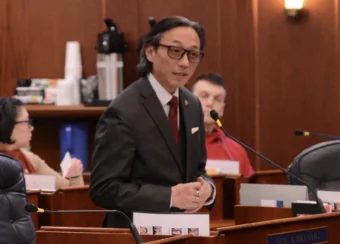
A new play, “These Birds: A play inspired by death, flowers, and Farkle,” opened in Juneau Jan. 29. The show was born from interviews and conversations with local residents about death and dying.
The Theater Alaska play is written by Juneau playwright Merry Ellefson. But the seed for the project started with hospice chaplain Claire Richardson.
Richardson wanted to find a way to inspire people to talk about death. She said creating a play from community-based interviews was a vehicle to ground stories of death and dying in Juneau.
“I kept thinking, there has to be a way to have people to be able to have conversations about death. It’s so challenging, even with all the books and web resources and everything that we can offer. It’s that personal connection,” she said during a recent Juneau Afternoon interview on KTOO.
Richardson contacted Ellefson, who has previously written plays based on interviews with Juneau residents and Alaskans across the state.
The women conducted about 25 interviews and Ellefson said it was a profound journey. Though death can be a somber topic, Ellefson said there’s so much life in connecting through stories.
She said she’s grateful for everyone they interviewed, as well as for the eight performers and other artists who transformed the script into a theatrical experience, honoring all the conversations and interviews.
“These stories live in our community. They are part of us. They are of us. We hear ourselves here, whether that’s a whale breaching or someone talking about a tragedy,” Ellefson said.
“These Birds: A play inspired by death, flowers, and Farkle” runs through Feb. 15, with two performances this Friday and Saturday at Ḵunéix̱ Hídi Northern Light United Church, and four shows next week at various locations.
Theater Alaska offers ticketed and free performances. Find details and the full schedule of performances and post-show conversations at theateralaska.org.
Editor’s note: KTOO is a media sponsor for “These Birds: A play inspired by death, flowers, and Farkle.”
A new play “These Birds: A play inspired by death, flowers, and Farkle” opened in Juneau last week,
The Ketchikan Indian Community purchased a former resort north of town with the goal of converting it into an addiction healing center, but a handful of residents in the neighborhood expressed opposition for the project at a recent borough planning commission meeting,
Marlene Johnson, a Lingit civil rights leader, died last week at the age of 90
A moment from a Moth performance in New York City. (Peter Cooper)
A national storytelling nonprofit is launching its winter and spring season in Anchorage this week, with Alaska voices helping to kick off a series centered on the idea of the American Dream.
The Moth is an organization that promotes the art of storytelling through education, performance and other efforts. The Moth’s Mainstage show comes to the Atwood Concert Hall in Anchorage on February fourth. The Anchorage performance is presented by the Anchorage Concert Association. The event will feature and features Alaska storytellers Na Mee and Polly Napiq Andrews.
Na Mee is a writer and teaching artist from Juneau. She said being invited to share the stage in her home state feels especially meaningful.
“I just feel honored to be one of the Alaskan storytellers for this particular show,” Na Mee said. “I love that The Moth reaches out to local storytellers, so people from the community are represented on stage, sharing their experiences from their viewpoint as Alaskans.”
While the story Na Mee will tell takes place out of state, she says it is deeply shaped by the Alaska experience.
“The story doesn’t take place in Alaska, but it’s grounded in the fact that we are from Alaska,” she said. “I think it especially speaks to fellow Alaskans and parents who may have taken their kids outside of Alaska, and what that might feel like.”
For Na Mee, storytelling itself is a cultural practice, not just a performance.
“Our family doesn’t really sit around talking about how we feel. At dinner, we tell stories. That’s how we transfer what we know about the world and how we feel about it,” she said.
The show’s director, Michelle Jalowski, says her focus is less on forcing a theme and more on curating voices that naturally resonate.
“When I’m curating a show, I try to put together the most compelling stories that represent a diverse group of voices. Finding local storytellers is always my favorite part, and Alaska has been good to us,” she said.
Anchorage storyteller Polly Napiq Andrews brings a background in trauma healing and cultural storytelling. She says story is central to identity in Indigenous communities.
“Story is one of the centerpiece values of who we are as Indigenous people,” she said. “We share stories to teach the younger generation who we are, where we come from, and how we live in community.”
Andrews said the idea of the American Dream, for her, is rooted in healing.
“The American Dream means healing and living a good life. It’s about breaking cycles of trauma and passing on healthier ways of living to our children, so they can have a better life than we did,” she said.
In Anchorage, those stories will open the season for a national tour, offering audiences a chance to sit together and listen to what dreaming looks like now.
The Moth Mainstage comes to the Atwood Concert Hall for one show, at 7:30 p.m. on Feb. 4, presented by the Anchorage Concert Association.
Cars drive aboard the Alaska Marine Highway System ferry Hubbard on June 25, 2023, in Haines. (James Brooks/Alaska Beacon)
Alaska’s state ferry system is at risk of a partial or total shutdown this summer due to the failure of the federal government to issue a key annual grant.
“Currently right now, we have a shortfall in our budget,” said Dom Pannone, director of program administration and management for the Alaska Department of Transportation and Public Facilities, to members of the Senate Finance Committee during a Monday morning hearing.
Money from the Federal Transit Administration’s rural ferry program pays for almost half of the Alaska Marine Highway System’s operating expenses, but the administration failed to open its annual grant process in fiscal year 2025, which ended Sept. 30.
The ferry system’s budget runs according to the calendar year. Last spring, the Alaska Legislature and Gov. Mike Dunleavy budgeted $171 million for the 2026 ferry budget. Of that, almost $78 million was supposed to come from the rural ferry program.
Without that money, the system could be forced to tie up its ships in midsummer, at the peak of the state’s annual tourist season.
“Right now, we have a federal chaos problem,” said Sen. Jesse Kiehl, D-Juneau and a member of the Senate Finance Committee.
Ryan Anderson, commissioner of the state DOT, said his agency is “looking at several options” to prevent a shutdown of the ferry system.
If a federal grant isn’t delivered, DOT would make significant changes to the summer ferry schedule, which is slated to begin in May.
Anderson said the state could “dispose of the Matanuska,” the state’s oldest active ferry, which has been tied up dockside as a “hotel ship” because of maintenance costs.
The ferry Kennicott, coming out of drydock, or the Columbia, another old mainline ferry, could be tied up as a hotel ship instead of the Matanuska, he said.
On Monday, neither DOT officials nor state legislators could say why the Federal Transit Administration has failed to make grants available.
“What is going on in Washington, D.C.? That’s always a tough thing to work with,” Anderson said.
U.S. Sen. Lisa Murkowski, R-Alaska, secured almost $1 billion in the 2021 Infrastructure Investment and Jobs Act bill for the rural ferry program, which was written in a way to steer much of the money to Alaska.
By text after Monday’s hearing, Murkowski spokesman Joe Plesha said the Federal Transit Administration told her office it will release the FY26 ferry grants this spring but did not give a timeline.
“We are directly engaged with the FTA and working to advance the release of this grant funding as soon as possible,” Plesha said.
When Murkowski got the ferry language signed into law, it was the first time the federal government had significantly funded operational expenses for Alaska’s ferry system.
“In this particular case, it can actually pay for the operations of those (ferry) vessels,” Anderson said, noting that includes operating costs like crew and fuel. That billion dollars was to be spread across five years, and the program disbursed more than $252 million nationwide in FY22, $170 million in FY23 and $194 million in FY24.
Alaska received more than five-sixths of the total distribution in that time, something that allowed Gov. Mike Dunleavy to divert state dollars to other parts of Alaska’s annual budget.
Alaska DOT estimates that about $410 million remains available for the federal government to disburse.
In each of the three prior grant years, it took between 152 and 199 days from the time the grant application period opened to the time the grant was awarded.
That timeline means that even if federal transit officials were to open the grant process tomorrow, a decision might not be made before the start of the summer ferry schedule in May.
Dunleavy and the Legislature could extend the timeline by changing the ferry system’s budget calendar so that it starts July 1 along with all other state agencies, but if there’s still no federal money, that would just extend operations until January 2027, and then the system would face a $150 million cliff instead of a $78 million one.
Sen. Bert Stedman, R-Sitka, said that finding “backfill” money will be difficult in either case.
“Our budgets are getting tighter and taking away the flexibility the (finance) committee has to backfill some of these holes, and this particular hole could be significant, pushing $80 million,” he said.
The ferry funding issue could persist even if the federal transit authority resumes paying grants, because its ferry operations program is set to expire this year.
“What happens when that grant money is gone?” asked Sen. Mike Cronk, R-Tok.
“This year, the surface transportation reauthorization is up for renewal,” Anderson said. “This, we understand, is part of that discussion: Will the rural ferry program continue over the next subsequent four years?”
Anderson said that even if Congress renews the program, the current Alaska-favorable rules might be rewritten.
“Other states are very interested in this program as well because they have a lot of similar challenges,” he said. “Nationwide, there’s support for a program such as this. The questions that are out: How will the rules be rewritten, and how competitive will the program be? That will be the challenge.”
Moonrise over the U.S. Capitol in 2021. (Brett Davis)
WASHINGTON — We’re only one month into election year 2026 and it’s already clear that the incumbents in Alaska’s federal races have a lot of money to defend their seats.
U.S. Sen. Dan Sullivan raised nearly $7.5 million last year, according to his latest campaign finance report.
“We’re feeling incredibly strong about where our campaign is,” campaign spokesperson Nate Adams said. “Our fundraising is on track, and our support continues to grow.”
The campaign of Democratic challenger Mary Peltola is also touting its fundraising success. Peltola has only been in the race a few weeks and hasn’t had to disclose her contributions yet. But a Peltola campaign press release says she raked in $1.5 million on the first day after she announced. The campaign declined an interview request.
Campaign strategist Jim Lottsfeldt, who led a 2020 group that tried to unseat Sullivan, said the senator’s $7.5 million actually doesn’t give him much of a head start.
“Mary Peltola is in the middle of a money bomb, and she will raise every bit of that and more, and I think ultimately outspend Dan Sullivan,” Lottsfeldt said.
The U.S. Senate race is, so far anyway, a referendum on how people feel about President Trump, he said, and money doesn’t tell the whole story.
“The problem with money in this race is there’s going to be so much of it that most people will shoot their TVs and their computers,” he said. “And I’m not sure how it’s going to all get spent in a way that actually is effective.”
In the U.S. House race, Congressman Nick Begich’s campaign raised $3.2 million last year. Paul Smith, a consultant to the Begich campaign, said that’s an Alaska record for a U.S. House race in a non-election year.
“We feel really good about it and are proud of the start that he has to this election cycle, on the fundraising side,” Smith said.
Democratic challenger Matt Schultz, an Anchorage pastor, filed to run against Begich in October. He reported contributions of $300,000 by year’s end.
Schultz campaign manager Mai Linh McNicholas, said it’s a good foundation, with contributions from more than 2,000 people. She said Schultz set a fundraising record, too.
“It’s the most that any first-time candidate has raised, in an off-year, for this seat in Alaska,” she said.
An Independent candidate is also running for U.S. House — fisherman and retired educator Bill Hill. He hasn’t had to file a campaign finance report yet but his team says he’s raised, like Schultz, more than $300,000, and he did so in his first week.
The reports show Sullivan and Begich, like most incumbents, get significant money from Political Action Committees affiliated with corporations, trade associations and political groups. About half of their 2025 contribution totals are from individuals. The rest largely came from PACs, or “other authorized committees.”
The North Douglas boat launch will soon reopen to the public after being closed for more than two weeks due to damage to its parking lot.
As the city’s Emergency Programs Manager, Ryan O’Shaughnessy leads emergency planning, response and recovery for the City and Borough of Juneau. KTOO’s Mike Lane recently caught up with O’Shaughnessy to talk about lessons learned from the major storm events in December and January and how the department operates.
The U.S. Forest Service is moving forward with a plan to harvest over five thousand acres of trees in the Tongass National Forest, just east of Ketchikan. A majority of that is going to be old-growth trees, which some people worry will be devastating to the forest.
Close
Update notification options
Subscribe to notifications
Subscribe
Get notifications about news related to the topics you care about. You can unsubscribe anytime.