A News

Southeast ferry riders call proposed Cascade Point terminal a ‘boondoggle’ in public comments

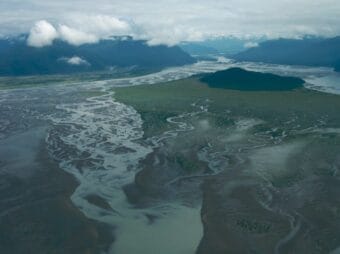
An aerial view of Berners Bay, where the state is proposing to build the Cascade Point Ferry Terminal. (Photo by Alix Soliman/KTOO)

More than 90% of the comments submitted to the state reject the Cascade Point ferry terminal proposed in Juneau. Many of the comments opposing the project suggest the purported benefits to ferry passengers are disingenuous, and the project looks instead like a fast-tracked subsidy for mining companies.

Dozens of commenters said that the public process to approve this project is lacking, with the comment period and a highly criticized economic analysis coming after the state already signed a $28 million contract for the first phase of construction, set to begin this summer.

The plan includes developing an access road from the end of Glacier Highway north to the site — roughly 30 miles north of the existing Auke Bay Ferry Terminal — and a staging area for future construction.

Leaders in Skagway and Haines oppose the project. Members of the Alaska Marine Highway Operations Board have also questioned the motives behind it and said it doesn’t fit into their long-range plan for the Alaska Marine Highway System.

Public funds for private industry

The Juneau Assembly hasn’t taken an official stance on the state’s plan, but Assembly Member Maureen Hall wrote a comment objecting to it. 

“I oppose the use of public funds to construct a remote State of Alaska ferry terminal when the facility’s apparent primary purpose is to function as an ore dock for private industry,” Hall wrote. “This represents a blatant misuse of public resources and raises serious concerns about the appropriateness and legality of such expenditures.”

Of the more than 500 comments opposing the project, a majority said the project would mainly benefit mining companies with holdings nearby and Goldbelt Native Corporation, which owns the land where the terminal would be built. Thirty-three commenters called the project a “boondoggle” outright, including Juneau resident Bjorn Wolter. 

“There is just no reason at all to build a new terminal,” Wolter wrote. “This project has all the potential to be another South Mitkof or Coffman Cove boondoggle.” 

Those ferry terminals on Mitkof Island and Prince of Wales Island cost millions of dollars. They were built far from the population centers they were meant to serve and close to logging sites 20 years ago. Two years after they were built, the Inter-Island Ferry Authority stopped running routes to them, and both have since sat unused

The Cascade Point ferry terminal stands to benefit the New Amalga gold mine proposed near the face of Herbert Glacier by Grande Portage Resources Ltd., a Canadian company. In December, Grande Portage announced that it is working with Goldbelt to design an ore barge dock alongside Cascade Point.

Ian Klassen, president and CEO of the company, was one of the 49 people who commented in favor of Cascade Point. He wrote that the plan will “create possibilities that currently do not exist north of Juneau for the reliable movement of cargo and commerce.”

Steve Ball, general manager of Coeur Alaska’s Kensington Mine, located across Berners Bay from the proposed site, also wrote in favor. 

“The twice-daily boat trips to the Kensington Mine would depart from the new Cascade Point Ferry Terminal, resulting in reduced risk for our workforce, contractors, and visitors by shortening the distance of the boat run and exposure to the Upper Lynn Canal,” Ball wrote. 

Coeur Alaska contracts with Goldbelt to transport miners to Kensington, mainly from Yankee Cove and from Echo Cove during inclement weather. 

Ferry users weigh-in

The state has been pushing for the new terminal for several years and has said it would benefit travelers in Southeast by reducing operating costs and travel time between Juneau, Haines and Skagway. 

But hundreds of commenters said building a second terminal in Juneau doesn’t solve the problems that the Alaska Marine Highway Service faces, including an aging fleet, crew shortages, reduced sailings and a lack of funding to address those issues. 

Robin Ross is treasurer for the Organized Village of Kake, the tribal government for the village, and secretary for the Kake City School District. She commented that the project fails to address ongoing transportation needs in Southeast. She said a ferry cancellation disrupted a mammogram van service that provides cancer screenings for women there, and while flights were arranged for some women, not all were able to travel. 

“The unfortunate reality is that a recent breast cancer diagnosis in October may have been

detected sooner had the ferry service not been canceled in May,” Ross wrote. “The ferry service serves as a critical lifeline.”

DOT’s FAQ page says, “terminal projects like Cascade Point are a critical step toward a stronger, more resilient system while new vessels are planned and funded through separate processes.”

But members of the Alaska Marine Highway Operations Board told the Anchorage Daily News that the project has been foisted upon AMHS and will create operational challenges they have to deal with. Last year, Gov. Dunleavy vetoed state legislators’ plan to divert funding from Cascade Point. 

Southeast residents said that while a ferry ride from Juneau to Haines might be shorter, the burden will be placed on drivers and walkers to get to and from the new terminal, which is much farther from the city center. The city bus system already does not extend to the Auke Bay ferry terminal — it’s about a two-mile walk along the highway shoulder from the last stop. 

Sean Powell, a current AMHS crew member, commented that commuting to Cascade Point would be much more difficult. “The increased distance, combined with weather conditions and other unforeseen disruptions, would add unnecessary challenges for crew members,” he wrote. “I believe funding would be better spent improving our existing infrastructure.”

Emily Mesch drives for rideshare services in Juneau during the summer and commented that it’s already difficult to make money driving people to the Auke Bay ferry terminal since it’s not centrally located. “I would never pick up a passenger there,” she wrote of the Cascade Point location, “unless the fares were about as high as a ferry ride, itself.” 

According to the Alaska Department of Transportation, Goldbelt has committed to running a shuttle service from Cascade Point to Auke Bay and the Mendenhall Valley, but hasn’t set a ticket price yet. 

DOT said that increasing snow plow service along Glacier Highway would cost about $30,000 if ferries operate out of Cascade Point in the winter. But after back-to-back snowstorms slammed Juneau this winter, some commenters said they’re not confident that plow service would be reliable. 

“DOT and the city are both overwhelmed when we get snow, let alone the storms that have hit at the end of December and into January,” wrote Morgan Ramseth. “Placing necessary services at the end of a poorly maintained road seems completely out of touch with reality.”

Others said increasing traffic farther out the road would stretch the city’s emergency services thin. 

The comment period for the first phase of the project ended on Jan. 9. The Alaska House Transportation Committee will hold a hearing with the Alaska Marine Highway Operations Board and DOT on Thursday, Feb. 5 at 1:30 p.m.

Newscast – Wednesday, Feb. 4, 2026

In this newscast:

  • The Juneau School Board will take public testimony tomorrow as it works on building out a budget,
  • American Cruise Lines plans to expand in Alaska in the years to come. But that plan requires prized mooring space in harbors that are tight to begin with. In Haines, the company said it would pitch in to rebuild a public dock to solve that problem. Then, it backed out amid community pushback,
  • Former Sitka state representative Jonathan Kreiss-Tompkins entered the race for governor this week,
  • A round of vetoes by Gov. Mike Dunleavy last summer have Alaska’s construction industry on edge. Industry groups are pushing state lawmakers to quickly pass an appropriations bill that they say would unlock hundreds of millions of dollars in federal matching funds


Juneau school budget projects $5.3 million deficit as district begins collecting public feedback

Students exit school buses outside Juneau-Douglas High School: Yadaa.at Kalé on Aug. 15, 2025. (Photo by Jamie Diep/KTOO)

The Juneau School Board will take public testimony Thursday as it works on building out a budget. This comes as a preliminary budget projects a $5.37 million dollar deficit. 

Nicole Herbert is the CFO for the district. She said during a board retreat last month that the deficit could be covered in a couple of ways. One method is taking from savings.

“We’re looking at needing about $5.3 (million) in fund balance and/or reductions in services provided to maintain our current level,” she said.

The preliminary budget includes all budgeted positions from the current fiscal year and assumes all employees will opt into the district funded health insurance plan. But some of those positions are not filled, and not all employees enrolled in the insurance plan this year.

That means there are unspent funds that can go into the district’s savings, which is projected to be $7.8 million at the end of the fiscal year in June. Those funds are not used to cover any expenses in the preliminary budget yet. 

The projection also doesn’t include how union contracts and non-personnel costs could affect the budget. The district has not yet reached a new agreement with two unions representing teachers and support staff.

The preliminary budget makes a couple assumptions when it comes to city funding: one, that the City and Borough of Juneau will fund the maximum of what state law allows, which is about $35.8 million. And, two, that the city will also allocate more than $2 million for non-instructional programs, including student activities, transportation, food services and preschool.

The city is looking at an estimated $10 to $12 million gap in its own budget beginning this July. Because of that, Superintendent Frank Hauser said it’s uncertain how much money the city will contribute to the school district.

“The city might not have as much money to support the school district,” he said. “And so we’re not sure if that instructional funding is going to be coming back to the district, or even if maximal contribution is going to be coming to the district.

The board also decided to take universal free breakfast out of the preliminary budget. The board approved a budget without the program for this school year and added it back in September after the Alaska Legislature restored about $50 million in education funding through a veto override.

The public forum will take place Thursday at 5:30 p.m. at Thunder Mountain Middle School. Community members can also testify online through Zoom and by emailing the district at budgetinput@juneauschools.org.

During the forum, the district plans to give a presentation on the budget before taking testimony from school principals and the public. Chief of Staff Kristin Bartlett said in an email the district also plans to release Balancing Act next week, but no date is confirmed yet. The online tool allows people to try building a balanced budget and provide feedback for how they think the district should be funded.

According to the budget calendar, the board plans to approve the budget by March 12. City code requires the board to submit a budget to the Juneau Assembly by April 5.

Kipnuk confronts hard choice on relocation after last year’s devastating storm

people at a meeting
Rayna Paul (left) and other Kipnuk residents listen as elder David Carl speaks about relocating the village to higher ground. Several dozen people attended the meeting on Jan. 31, 2026, with some participating in person in Anchorage and others calling in by phone. (James Oh/Alaska Public Media)

Kipnuk resident Rayna Paul fought back tears as she talked about how the remnants of Typhoon Halong ravaged her village — and why relocating is so important for the next generation.

“We want them to have a livable life too,” she said, and then continued in Yup’ik, “Safe-alriamek cucuklirarkaugukut relocate-ararkaukumta,” which means, “We have to pick land that is safe if we are to re-locate.”

Paul joined more than 50 Kipnuk residents at a meeting on Saturday to begin discussing the future of their village after last fall’s powerful storm destroyed homes, contaminated water and forced nearly everyone to leave. Now the residents face a critical decision: rebuild in the same spot or move to higher ground?

Kipnuk Village Council President Daniel Paul said the community is divided.

“I had many calls from our tribal members, half of them wanna stay, half wanna go,” he said. “Relocation decision will be upon my tribal members, their votes and their voice inputs.”

Kipnuk is about four miles inland from the Bering Sea coast and was once home to about 700 people. Most remain evacuated in Anchorage or Bethel, except for a group of roughly 100 residents who are back in the village working to rebuild. There’s a lot to do. The storm demolished about 150 homes, damaged boardwalks, disturbed gravesites and left lands and water contaminated with spilled oil and other hazardous materials.

Storm-damaged Kipnuk, as seen from the air on Oct. 19, 2025. (Eric Stone/Alaska Public Media)

On Saturday, the community began discussing its future.

Sheryl Musgrove, who directs the climate justice program under the Alaska Institute for Justice, told residents that it’s up to them to decide whether to relocate.

“It’s a decision of the community alone,” she said. “No one can force you to move, but then again, others can’t force people to stay there either.”

Residents spoke predominantly in Yup’ik, asking what relocation could look like. Some asked about how to choose a new site and secure land ownership.

“Who is dealing with the land?” Larry Kalistook asked. “Is anyone dealing with the land?”

Kipnuk resident Larry Kalistook asks village and state officials questions about possible relocation during the meeting on Jan. 31, 2026. (James Oh/Alaska Public Media)

Others pondered what it would take to set up critical infrastructure in a new place. Village Council Vice President Chris Alexie said figuring out a school, an airport and a health clinic would be a start.

“Those are the most important things, and water and sewer systems also,” Alexie said. “It’s not going to be easy but we’re going to deal with this.”

Alexie said that working through the relocation process could take years.

For Newtok, it took decades and well over $100 million. In Kwigillingok, the other village hit hardest by the storm, residents have already voted to move. But it’s unclear when it will happen and how much it will cost.

If Kipnuk decides to relocate, one potential option is going to Cheeching, a historical settlement on higher ground between Kipnuk and Chefornak. It’s now owned by Chefornak’s Chefarnmute Corporation.

The corporation’s vice president, Larry Kairauiuak, said Chefornak itself relocated back in the 1950s — and he thinks that’s why it didn’t suffer more damage in the storms.

“If the elders at that time had not decided to move to our current location, we would have been in the same situation as Kipnuk with the typhoon,” he said. “We’re grateful for our leaders at that moment to move to higher ground.”

A few dozen people gathered in Anchorage on Jan. 31, 2026, while several dozen more joined virtually, to discuss whether to rebuild or relocate Kipnuk. (James Oh/Alaska Public Media)

Kairauiuak said his village is open to a conversation about helping Kipnuk, and the corporation will hold a meeting with shareholders on March 7.

“We have a lot of families from not just Kipnuk but in Kwig, Tuntutuliak, Kong, Nightmute,” he said. “Our community is receptive to hear what they have to say.”

Kairauiuak said residents from many villages in the region have family ties to Cheeching, so that’s why it’s important for Chefornak residents to have a chance to weigh in on the future of that land.

Kipnuk elder David Carl said he remembers growing up Cheeching — his family called it “rock mountain.” It’s about 10 miles from Kipnuk and he supports moving there because he said the ground is more stable.

“They will make a wise decision if they relocate to the site right there,” he said. “Being an elder, we’re not thinking about ourselves, who we are now, we just want to fight for our upcoming generations.”

Kipnuk Council President Daniel Paul (center) prays at the meeting in Anchorage on Jan. 31, 2026, alongside other village, state and federal officials. (James Oh/Alaska Public Media)

But for Daniel Paul, Kipnuk is home and he hopes to live there again one day.

“For me, I’m gonna stick with Kipnuk, regardless of how the situation is,” he said. “I was raised there, and I’ll stay there.”

Paul said discussions will continue and residents have a lot of factors to weigh. But Kipnuk leaders also feel a sense of urgency. He said the village expects only one substantial influx of federal funding. To make the best use of it, he said, they need to decide soon whether they want to stay or move.

Editor’s note: KYUK’s Julia Jimmie provided Yup’ik translations for this story.

Dunleavy vetoes have Alaska’s construction industry urging lawmakers to pass quick fix

Prep begins for new construction on the corner of 8th Street and K Street.
Prep begins for new construction on the corner of 8th Street and K Street. (Adam Nicely/Alaska Public Media)

A round of vetoes by Gov. Mike Dunleavy last summer have Alaska’s construction industry on edge. Industry groups are pushing state lawmakers to quickly pass an appropriations bill that they say would unlock hundreds of millions of dollars in federal matching funds.

The problem started last year, when lawmakers searched for funds to plug holes in the state budget. To fund the state’s share of a variety of new federal projects, lawmakers voted to take millions from older, stalled-out or completed projects — tens of millions from the Juneau Access Project, $138,000 from the so-called Bridge to Nowhere in Ketchikan, even $766 lawmakers found left over from efforts to explore a bridge over Knik Arm from Anchorage.

“At the end of the day, we’re really just pulling out of the couch cushions the little pennies we can find here and there,” said Rep. Ashley Carrick, a Fairbanks Democrat, during debate on the budget last year.

But then, after lawmakers adjourned, Gov. Mike Dunleavy vetoed those transfers. His office said a lot of the money lawmakers identified had been spent, committed to contracts or was otherwise unavailable.

“We don’t want to put ourselves as a state in a position where we don’t have the match because those funds have already been obligated or are no longer available because they’ve already been spent,” budget director Lacey Sanders told lawmakers last month.

To make up for the vetoes, Dunleavy has requested state lawmakers send him a budget bill that would fund the state’s match with $70 million in unrestricted funds to enable some $700 million in total spending, 90% of which would be covered by the federal government.

But for now, state officials say they have only enough money on hand to meet the state’s share of federal projects through about the end of the fiscal year on July 1.

That has contractors ringing alarm bells.

“You are introducing unnecessary risk and disruption to this process,” the head of the Associated General Contractors of Alaska, Alicia Kresl, said to the House Finance Committee.

For now, Transportation Commissioner Ryan Anderson appears less alarmed. He told lawmakers the state has its match covered for the current fiscal year, though that money runs out around the end of June.

“It’s after July 1, that additional, that we’d be missing out on, so we’re really right now focused on that,” Anderson said.

But not knowing for sure whether that money will materialize after July 1 makes it hard for construction contractors to gather the right supplies and equipment, assemble their workforce and be ready to hit the ground running, Kresl said. So any further delays getting the money out the door could risk much of the progress crews would otherwise make in the 2026 construction season, she said.

“When funding comes late, the construction industries and agencies can shift from planning mode into scramble mode,” she said.

Lawmakers have so far appeared receptive. Leaders of the House and Senate finance committees say they plan to move quickly on a supplemental budget that would provide the matching funds. They have said they’ll likely draw from state savings to do it, requiring a three-quarters supermajority in both the House and Senate.

And Sen. Bert Stedman, the Sitka Republican who orchestrated much of the couch-cushion-shaking last year, says the state’s tight budget this year means they’re looking for more spare change floating around state government.

“Last year was not some aberration, it was not some off-the-cuff idea. It was methodically sought out and well-researched by (the Legislative Finance Division) and both finance committees, and this year will be the same,” he said.

But this year, he said, he’s hoping for a different result.

Alaska’s race for governor picks up 16th candidate, a former state legislator from Sitka

Jonathan Kreiss-Tomkins is seen on Jan. 17, 2026, in Sitka, Alaska, in this photo provided by Kreiss-Tomkins. (Campaign handout photo)

Former state legislator Jonathan Kreiss-Tomkins, a Democrat from Sitka, is running for governor, he said Tuesday.

Kreiss-Tomkins, frequently known as “JKT,” served in the Alaska House of Representatives between 2013 and 2023. He becomes the 16th candidate and third Democrat to enter this year’s gubernatorial election.

Incumbent Gov. Mike Dunleavy is term-limited and unable to run for a third term.

In Alaska, the top four vote-getters, regardless of political party, advance from the August primary to the November general election. In November, Alaskans use ranked-choice voting to name their preferences.

Kreiss-Tomkins said he’s running because Alaska has big problems and he’s interested in solving them.

“I really enjoy working with people from diverse backgrounds and different viewpoints and perspectives to try to forge compromise and get things done,” he said.

While in the Legislature, Kreiss-Tomkins was a member of the bipartisan, bicameral fiscal working group that in 2021 drafted a plan intended to bring the state’s finances in line over the long term.

Though that plan was never enacted, its components resemble the fiscal plan introduced this year by Gov. Mike Dunleavy.

“We’re in a perpetual budget uncertainty,” Kreiss-Tomkins said, identifying the state’s fiscal situation as his No. 1 issue.

Since oil prices plunged in 2015, legislators and governors have struggled to balance Alaska’s budget on an annual basis, occasionally bringing the state to the brink of a government shutdown.

“We’re living and dying by the price of oil, and we have a structural budget deficit, so the state’s finances are not especially in order, and that is, I think, probably the highest-order problem,” Kreiss-Tomkins said.

He said Dunleavy hasn’t been able to work across party lines and hasn’t been successful with the Legislature. Kreiss-Tomkins contrasted that with his own experience as a member of a Democratic-independent-Republican coalition majority in the state House.

“I feel like we need that same spirit in the executive branch, and if we could have a governor and an executive with that approach and mindset … there’s a tremendous amount of good that we can get done for Alaska,” he said.

Kreiss-Tomkins said the campaign season will show how he differs from the other two Democrats in the race: former state Sen. Tom Begich, and current state Sen. Matt Claman.

When it comes to the number of other candidates in the race, Kreiss-Tomkins said it’s not a bad thing for Alaskans to have so many choices.

“Seeing so many people willing to run sort of reflects the importance of the election and the gravity of the problems facing Alaska,” he said, adding that he expects “some winnowing of the field as time goes on.”

Candidates for Governor

  • Former state Sen. Tom Begich (Democrat)
  • Former state Sen. Click Bishop (Republican)
  • Former Anchorage Mayor Dave Bronson (Republican) and Lt. Gov. candidate Josh Church (Republican)
  • Former state revenue commissioner Adam Crum (Republican)
  • Current state Sen. Matt Claman (Democrat)
  • Lt. Gov. Nancy Dahlstrom (Republican)
  • Matanuska-Susitna Borough Mayor Edna DeVries (Republican)
  • Kasilof resident Jessica Faircloth
  • Anchorage podiatrist and state medical board member Matt Heilala
  • Former state Sen. Shelley Hughes (Republican)
  • Former state Rep. Jonathan Kreiss-Tomkins (Democrat)
  • Author Hank Kroll (Registered Republican) with Lt. Gov. candidate Tommy Nicholson (Undeclared)
  • Angoon resident and former teacher James William Parkin IV (Republican)
  • Former Attorney General Treg Taylor (Republican)
  • Palmer resident Bruce Walden (Republican)
  • Businesswoman Bernadette Wilson (Republican) with Lt. Gov. candidate Mike Shower (Republican)
Site notifications
Update notification options
Subscribe to notifications