Alaska Elections

Live Blog: Analysis of Alaska’s Races

This blog will give you one more look at the results of the Alaska elections Tuesday night as the votes are being counted.

I’ll start putting information on the site as it develops, but I don’t expect anything meaningful to cross my screen until well after the polls close at 8:00 pm.

While there are only a few statewide elements to watch,  one question will hang around unanswered for several days:  Will the Senate be run by a bi-partisan coalition for the next two years?

Governor Parnell and the low-tax part of the Republican Party have set a goal of voting out those Senators who might opposed the petroleum tax cuts the administration has tried to get past the legislature for two years now.  They picked up the support of oil companies and their commercial allies and directed a lot of money into some of the individual races.

A grassroots effort to praise the bi-partisan Senate members led by unions and the old-guard Backbone supporters directed vocal support in several of those races.

The interest will be in the totals Democrats and Bi’s that last through the night.   The old D-R distinction won’t really matter this time in the Senate.

Unless the incumbent Senators of both parties are totally trounced election day – and that would be a surprise – there is every expectation that an attempt to reorganize will occur by the end of the week.  While there are important district races on personal and local-interest levels,   the overriding question of the election season won’t be answered until the organization is complete.

A few other interesting topics are worth a look.  The state wants to issue bonds for a long list ($453-million) of transportation and ports projects.  The only item on that list getting statewide attention is the money to continue work on the Port of Anchorage.

The other statewide question is whether to hold another Constitutional Convention.  That’s automatically put on the ballot every ten years.   There’s been a lot of talk about the subject,  but no organized support or opposition has stood up on the subject.

And finally,  Anchorage Superior Court Judge Sen Tan is up for a retention vote this year.  He’s drawn opposition from anti-abortion elements who lost some arguments in his court.  It will be decided by voters from Anchorage and SouthCentral Alaska who live in that judicial district.

We’ll be back Tuesday night,  keeping you up to date as the votes are tallied.

Live Blog: Results from around the state

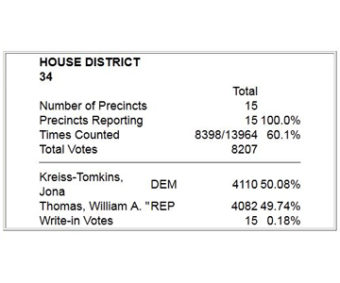
Coast Alaska News Director Ed Schoenfeld will be reporting on Southeast Alaska legislative races. While Juneau races lack opponents, three other districts in the region have competitive campaigns. The tightest is the Sitka-and-Haines-plus-Southeast-Islands House District 34. The Ketchikan-Wrangell House District 33 is also hard-fought. And Senate District Q, for most towns outside Juneau, is of interest. I’ll provide results, behind-the-scenes information, and analysis.

Gavel Alaska’s Jeremy Hsieh will be posting reports from races around the state including updates on Fairbanks and Anchorage results.

The state Division of Elections will be posting unofficial election results at their website as ballots are counted. Polls close at 8 p.m. and unofficial results are expected to start coming in around 9 p.m.

In the 2012 election, Twitter becomes the world’s largest roundtable

#election2012

By the end of today the election frenzy will finally start to abate. But for today at least, it’s still an endless stream of polling, predictions and political ads. However, another source of information and predictions has made a splash this election cycle: Twitter.

Twitter, started in 2006, was moderately adopted in the 2008 General Election. But the 2012 election cycle has broken many records for Twitter.

On Election Day in 2008, 1.8 million total tweets were posted to the social networking site.

Fast forward four years to the first presidential debate on Oct. 3. More than 10 million tweets, specifically about politics, were posted in 90 minutes. More than 20 million tweets were posting during the Democratic and Republican conventions.

“The scale has shifted so dramatically with the amount of conversation happening,” says Elaine Filadelfo, a spokesperson with Twitter. Filadelfo works with Twitter’s government and election team.

“What we’ve seen is that twitter has become the place for this intelligent focused discussion to happen around politics over the past four years–both between voters and because of the prevalence of elected officials and candidates on Twitter themselves.”


Filadelfo explains that Twitter becomes useful in elections because it establishes a direct method for people to get in touch with candidates and elected officials. She notes this is particularly valuable for people living in more rural states like Alaska, where candidates may not visit and traveling to rallies and events might not be possible.

[quote]“Being on Twitter and following the candidates, whether it’s the presidential candidates, whether it’s your own governor or local legislator candidate you can have that one on one interaction with them. You can tweet a question and many campaigns are quite responsive. You can see pictures in real time from a rally. You can see a staffer live tweeting what one of the candidates is saying. So it really breaks down that border if you’re not able to go to these sorts of events in person and have that same direct relationship. You can still be a part of that through Twitter,” Filadelfo says.[/quote]

While Alaska may feel as far from the national election as it gets, Alaskans have also been active participants in the political discussion on Twitter.


The tricky part is figuring out just how many Alaskans. Twitter doesn’t require users to identify their location, unless the user self identifies their location or uses geotagging for their tweets.

“Nothing requires you to tell us where you are coming from,” Filadelfo says.

However, users that have identified themselves as from Alaska, contribute enough data for Twitter to calculate which political issues are resonating with Alaskan voters. Twitter measures this by how much users in Alaska engage with tweets by favoriting, retweeting or replying. The results are displayed in an interactive Political Engagement Map.

For example tweets from @MittRomney about terrorism had the most engagement of any topic that account tweeted about, while retirement generated the most engagement with tweets from @BarackObama.

This election day, Filadelfo expects there to be a notable amount of conversation on Twitter.


“The great thing about the election–well of course we hope–is that so many will be voting and sharing their opinions. It really is something for everyone to rally around and for everyone to be sharing about. It’s something the whole nation can participate in. So we do think it will be a really interesting day on Twitter,” Filadelfo says.


All accounts are publically visible, so even if a person doesn’t have their own account, they can still see other’s tweets. Twitter has a created an event page for the national election that curates tweets about the election from a variety of politicians, candidates, pundits and citizen users.

Voters can follow updates about the Alaska Election by searching tweets with the #akelect tag.

Third parties seek popular votes in Alaska

Jill Stein

Alaska has a history of supporting so-called second-tier candidates.  Ross Perot won 28% of the vote in 1992.

Gail Fenumiai, director the Alaska Division of Elections, said both Libertarian candidate Gary Johnson and Green Party pick Jill Stein passed state muster and landed a spot on the ballot.

“They had to gather signatures of registered voters in the state of Alaska equal to one percent of the total candidates who cast ballots in the last presidential election. So they had to submit a petition with at least 3,723 signatures,” she said. 

That may not sound too difficult; Fenumiai said everyone who applied to appear on the ballot earned a spot.

But political scientist Lawrence Jacobs said third party campaigns tend to operate on a dime, which keeps the organization small. And it’s incredibly hard to grow a small political organization into something larger.

“They don’t have teams of lawyers. They don’t have money,” he said in a phone interview Monday. “And to get your name on the ballot, you need to have the name and the money.”

Gary Johnson

Jacobs said it takes money to file the paper work and to collect the signatures. And, above all, the rules are stacked against smaller parties.

“The rules of the game are written to discourage third parties. Our system with the electoral college, for instance, is not based on total number of popular votes cast, it’s a winner take all system,” he said.

That means the Green and Libertarian Parties are unlikely to capture the state’s three electoral votes, but they could add to the popular vote. Gary Johnson promoted that message in a commercial airing in Anchorage calling a vote for Johnson is a protest vote worth making.  Any federal candidate who wins five percent of the popular vote can qualify for federal financing in the following election.

Johnson’s Libertarian party wound up on the ballot through the independent candidate route; meaning the political organization is recognized by the state for this election only.

The Division of Election’s Gail Fenumiai said the Green Party opted for the limited political party method, which could allow them to stick around until 2014.

“It’s a political group that organizes for the purpose of selecting candidates for electors for president and vice president. And then they may also maintain their status if their candidate receives three percent of the vote,” she said.

So regardless of whether the third parties on the ballot in Alaska play a role nationally, at least one could be around for some time to come.

Election Day is here

The Alaska State Capitol Building. (Photo by Heather Bryant/KTOO)

It’s Election Day. Polls open at 7 a.m. and will close at 8 p.m.

The presidential race is the big draw this year. But in Alaska voters also will determine the make-up of the 2013-2014 state Legislature, as 59 of the state’s 60 legislative seats are on the ballot.

The only exception is Juneau Senator Dennis Egan’s Senate District P seat. Capital City Representatives Beth Kerttula and Cathy Munoz are unopposed.

Alaska’s U.S. House seat and two propositions also appear on this year’s ballot.

Juneau has thirteen polling places. Seven of those are in House District 31, which includes the Mendenhall Valley and north end of Juneau’s road system. Another six are in House District 32, which includes downtown Juneau and Douglas Island.

District 32 also now includes Petersburg, Skagway, Gustavus and Tenakee Springs thanks to the state’s once a decade redistricting process. Previously Juneau had two House districts all to itself.

The Division of Elections is sponsoring an Election Central tonight in Juneau at the Baranof Hotel’s Treadwell Room. The first results are expected at about 9 p.m.

KTOO will provide both national and statewide results tonight on our airwaves and online. Tune in to KTOO-FM starting at 4 p.m. for NPR’s election coverage. Then at 9 p.m. stay with KTOO for APRN’s coverage of statewide races.

KTOO.org will feature links to NPR’s national results, as well as live-blog analysis of Alaska races from former APRN Juneau correspondent Dave Donaldson, as well as CoastAlaska’s Ed Schoenfeld and Gavel Alaska’s Jeremy Hsieh.

Site notifications
Update notification options
Subscribe to notifications