It’s part of the nationwide Native Vote Action Week, with a number of events being held in Alaska to increase voter turnout.
Juneau’s is sponsored by Tlingit and Haida Central Council and Sealaska. It will be held at Elizabeth Peratrovich Hall.
Organizer Nicole Hallingstad says it’s open to all Juneau residents, but the primary goal is to increase the number of Alaska Natives who vote.
While 70 percent of Sealaska shareholders over age 18 living in the state are registered, that doesn’t mean they actually vote.
“We hope to increase the understanding in the Alaska Native population that your vote literally is the source of our collective strength,” Hallingstad says.
People who need to register to vote, update their current registration, or want to learn more about the election process should attend, she says. Many people never register, and many others register but never go to the polls, because voting is an unfamiliar process.
“So we’ll actually have standing ballot booths that are exactly like those you’d see at any balloting station,” Hallingstad days. “People can get a mock ballot. They can get familiar with the process of showing their ID, casting their ballot and going through the act of electing to try to increase familiarity, reduce some of the fear or uncertainty around that process, and get people more comfortable with voting.”
The Voter Registration Rally is from 4 to 8 p.m. Thursday at Elizabeth Peratrovich Hall on Willoughby Avenue.
Volunteer Esther Brooks works the absentee/early voting station at Juneau’s City Hall. Absentee voting for the October 2nd municipal election opened Monday. (Photo by Casey Kelly/KTOO)
Juneau’s municipal election is still two weeks away, but voters can now cast absentee ballots at two polling places in town.
Ballots are available at City Hall Assembly Chambers and in the Mendenhall Mall. Voting hours at the mall are 10 a.m. to 6:30 p.m. weekdays, and noon to 4 p.m. on weekends. City Hall voting hours are 8 a.m. to 4:30 p.m., weekdays only through October 1st.
City Clerk Laurie Sica says any registered Juneau voter can cast an absentee ballot for any reason, and many people prefer it to voting on Election Day.
“It’s just convenient,” Sica says. “And they don’t forget then on Election Day or don’t put themselves in a bind and get to the poll by 8 o’ clock.”
In the past eight municipal elections, city records show between 13 and 15 percent of voters have cast absentee ballots. Sica says the city saw a big increase when it started offering early voting at the Mendenhall Mall about 10 years ago.
Absentee ballots are also available for mail-in and fax-in voting by contacting the clerk’s office.
While most regular ballots will be counted on Election Night, Sica says absentee ballots are always counted a few days later.
“We have to cross check to make sure that that person didn’t go to a poll on Election Day and cast a ballot there,” she says. “So, we do that cross check before we approve all the ballots that are absentee to be counted.”
Municipal Election Day is Tuesday October 2nd.
Juneau voters will choose a new mayor, two new assembly members, three school board members, and decide two ballot propositions that would fund capital projects for the next five years.
Polls open at 7 a.m. and will stay open until 8 o’clock tonight.
Division of Elections Director Gail Fenumiai says she expects the first results to hit the web about 9 p.m., but it will be late before all the results are in, since some rural precincts still count their ballots by hand.
“So those are usually the precincts that are the latest to report. Usually it’s around 11, midnight just because of the hand count precincts. They just take a long time to get their results in,” she says.
Absentee ballots from overseas are accepted up to 15 days after the election.
Fenumiai says the plan is to count ballots cast in the early voting process tonight with ballots cast on Election Day.
“Our first count of absentee ballots and the remaining early votes will be done seven days following the election. We go through a process to check for duplicate voting to make sure people did not vote a by-mail ballot then go to their polling place and vote on Election Day,” she says.
The state review board will convene on Sept. 12, the 16th day after the election. Fenumiai anticipates the election will be certified about Sept. 20.
Check back before 9 p.m. for election results. Also tune into KTOO Radio at 9, 10 and 11 p.m. for statewide updates from the Alaska Public Radio Network.
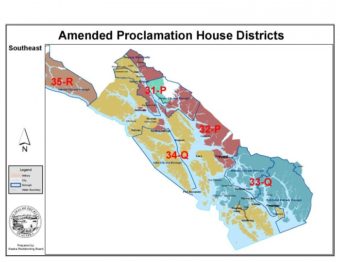
Alaska’s house district map looks dramatically different than the last statewide election two years ago. And while the new districts may take some getting used to for candidates and voters, the state Division of Elections has been ready since the plan was first approved last spring.
State Elections Director Gail Fenumiai says the division began sending out new voter registration cards weeks ago.
“People have been calling regularly and checking in to see where their new polling place is located in their new district and precinct,” she says. “And then all voters received voter identification cards toward the early part of August that identified for them their new district and precinct number and the information that came along with that also said where their new polling place was located.”
Beth Kerttula. Photo courtesy Alaska State Legislature.
Juneau’s legislative delegation would’ve been excused if they took it easy this summer.
Representatives Beth Kerttula and Cathy Munoz are running unopposed in both next week’s primary and November’s general election. And Senator Dennis Egan is the only legislator who doesn’t have to run for reelection this year, because his district was largely unchanged by the state’s once-a-decade redistricting process.
But Kerttula says she’s been busy volunteering for the Alaska Sea Party’s pro-Ballot Measure 2 campaign to restore the Alaska Coastal Management Program.
She also says she spent part of the interim meeting with residents of Petersburg and Skagway — two new communities incorporated into her district under the latest redistricting plan.
“I’m pretty excited about it,” Kerttula says. “It’s a challenge, but it’s a really welcome one. And it also brings the communities closer together as a Southeast unit. We southeastern legislators tend to work together well and we unite often, especially on budget.”
Both Kerttula and Munoz say they’ve been busy working on constituent issues as well. Kerrtula says Petersburg residents came to her with concerns after the state ferry Matanuska slammed into a fish processing dock there earlier this year.
Munoz says she’s trying to keep up to speed on construction activity, especially a proposed Auke Bay traffic project led by the state Department of Transportation.
Cathy Munoz. Photo courtesy Alaska State Legislature.
“Especially when there was concern about the possibility of acquiring the DeHart’s building to put in a roundabout,” Munoz says. “We advocated with the Department of Transportation and worked with the community groups that were concerned about that to find another location for the roundabout.”
Munoz is a Republican and Kerttula the Democratic Minority Leader. But both say the Juneau delegation works together across party lines to do what’s best for the Capital City. They both think that’s one reason why they don’t face any challengers in this year’s elections.
Ballot Measure 2 on Tuesday’s primary election ballot is the most hotly contested initiative Alaska voters have faced in recent memory.
In the last five years, only the 2008 “Clean Water Initiative” — aimed at stopping development of the proposed Pebble Mine — had more spending for and against. As with that initiative, industry groups are lining up against Measure 2 — outspending proponents by more than seven to one.
If approved, Measure 2 would restore the Alaska Coastal Management Program — a federally funded state agency that operated smoothly, and with little fanfare, for more than 30 years before legislators and the Parnell administration failed to reach a deal to reauthorize it in 2011.
KTOO’s Casey Kelly has more.
If Measure 2 opponents are to be believed, coastal management is actually a good thing. The one-time head of the state’s coastal management review process Kurt Fredriksson is now the public face of the “Vote No on 2” campaign.
“Whether it’s called coastal management or some other form, clearly I believe Alaska needs a stronger voice in federal decision making,” Fredriksson told the Juneau Chamber of Commerce in June. “They are a dominant force in Alaska and we have to have a stronger voice in the decisions they make, whether it’s to protect or develop Alaska’s resources.”
But Fredriksson says Measure 2 would be a step backward for the state. The Alaska Coastal Management Program changed significantly during the Frank Murkowski administration. Some say it was gutted; others say reformed. Fredriksson, who also served as Department of Environmental Conservation Commissioner under Murkowski, falls into the latter category.
“In the previous coastal management program, which existed for 35 years, there were lots of debates over the years, and those debates got resolved,” he says. “They got settled, and they got reflected in the law. We’re going back to a time when those debates are going to just kind of come up again.”
Fredriksson thinks that will lead to lawsuits, confusion and project delays.
But Ballot Measure 2 supporters say those are exactly the kind of things the initiative would help avoid. It restores the coastal management program’s coordinated review process, which streamlines the coastal development permitting activities of various local, state, and federal agencies.
The Alaska Sea Party sponsored Measure 2. At a recent news conference, Sea Party Co-chair Terzah Tippin Poe gave an example of the regulatory morass developers face without coastal management.
“Say it’s a dock. You’re going to have to take that project proposal, and the list of permits that you need for that project and you’re going to have to go to the Department of Natural Resources, the Department of Environmental Conservation, Fish and Game, Corp of Engineers, and walk that from agency to agency,” Poe says.
That may not be a big deal to large corporations, but Poe says it hurts small businesses and individuals.
Measure 2 also would reestablish an Alaska Coastal Policy Board — part of the program scrapped by Murkowski. The board would be comprised of four state commissioners and nine public members to be nominated by local communities and appointed by the governor.
The board would review district management plans developed by coastal communities to ensure they comply with state regulations. Poe says it would not have veto power over projects as claimed by some opponents of the initiative.
“One of the big things that this coastal management program accomplishes, is that you actually identify, a project proponent can identify issues early in the process,” she says. “Then go and talk with communities and get their input on how to work towards a successful development project.”
The reestablishment of a policy board ultimately doomed efforts by state lawmakers to reauthorize the coastal management program during the past two legislative sessions.
Some Measure 2 opponents think the legislature should try again, saying the issue is too complicated to be decided by voters.
“Something as complex as this should really be worked on at the legislative process, so that we can develop something that everybody will agree to,” says Mike Satre, executive director of the Council of Alaska Producers — a trade group representing large scale mines and mining projects in the state.
“But I get very scared about something supporters admit has problems, and simply want it to pass so they can fix it later,” Satre says.
Measure 2 supporters concede it might not be perfect for everyone, and they admit it leans toward giving communities more of a voice in coastal management.
Charlotte Brower is mayor of the North Slope Borough — the Sea Party’s top financial backer. With exploratory drilling in the Chukchi and Beaufort Seas imminent, Brower says the state can’t afford to delay restarting the program. And she insists it’s not about stopping development.
“We are not in a position to stop offshore development or inshore development. It’s there,” Brower says. “We just need to make sure that we have a seat on the table and talk about this issue that is going to impact our residents. It’s coming.”
Alaska is the only coastal state without a federally approved coastal management program. The 1972 Coastal Zone Management Act allows states that opt for a program to get some federal funding.
Industry opponents of the ballot measure — including the big three oil producers and several mining companies in Alaska — have donated more than $1.5-million to the “Vote No on 2” campaign.
The Alaska Sea Party has raised just over $204,000, mostly from coastal communities and individuals.
Close
Update notification options
Subscribe to notifications
Subscribe
Get notifications about news related to the topics you care about. You can unsubscribe anytime.