Alaska Elections

Ballot measure to repeal Alaska’s ranked choice voting system is now failing by fewer than 200 votes

Election officials count ballots during the Alaska Division of Elections’ hand-count audit at Centennial Hall in Juneau on Nov. 18, 2024. The audit, mandated by state law, seeks to identify possible errors in machine counts by examining at least 5% of ballots from each state House district. (Eric Stone/Alaska Public Media)

The ballot measure that would repeal Alaska’s open primary and ranked choice voting system is now failing by the narrowest of margins, according to the latest results update from the Division of Elections on Monday.

Out of 314,056 ballots counted so far, “No” on Ballot Measure 2 now leads by 192 votes, 50.03% to 49.97%.

Loading…

Monday marked the first time since election night that No has taken the lead. No on 2 Campaign Manager Juli Lucky said she was not surprised No pulled ahead.

“We’ve heard from a lot of voters all over the state about how important it is to have representation that looks like them,” Lucky said. “What we heard from Alaskans was that there was a lot of support to keep open primaries and ranked choice voting in place.”

Former Lt. Gov. Loren Leman, an advocate for the repeal measure, said Yes on 2 was thoroughly outspent and didn’t have enough money to counter what repeal opponents were saying in their barrage of ads and mailers.

“It was like 100 to one,” Leman said. “And you know, when you have a campaign like that, it’s really tough to respond, and especially to all the deception. It was really just a very difficult campaign.”

Some repeal advocates are casting aspersions on the integrity of the vote counting. Leman, when he was lieutenant governor, used to be in charge of the Division of Elections. He said he doesn’t see any cause for suspicion. Alaska, he noted, gives up to 15 days for ballots to arrive for overseas military voters.

“I have no reason not to trust the director of the Division of Elections,” he said. “She’s an incredibly competent and honest person.”

Ballot Measure 2 is one of a handful of tight races that remains unresolved nearly two weeks after Election Day.

In the U.S. House race, Republican challenger Nick Begich is holding on to his lead. Monday’s count shows he’s ahead with 48.5%. He declared victory on Saturday, after a data company called Decision Desk HQ called the race for him.

Loading…


Congresswoman Mary Peltola, a Democrat, trails with 46.3%. The Division of Elections will tabulate ranked choices on Wednesday, but those ballots may not help her. A conservative Alaskan Independence Party candidate, John Wayne Howe, has about 4% of the vote, quadruple the share received by federal inmate Eric Hafner, who filed as a Democrat.

Another of the unsettled races, for House District 18 in North Anchorage, remains tight. Rep. Cliff Groh, D-Anchorage, now leads his Republican challenger, David Nelson by just 25 out of 3,530 votes.

A handful of additional races where no candidate reached 50% of the vote will be determined when officials tabulate voters’ ranked choices on Wednesday.

Election update: Begich declares victory, margin for ranked choice repeal now under 900 votes

Republican U.S. House candidate Nick Begich helps wave campaign signs with supporters in Anchorage on Monday, Nov. 4, 2024. (Matt Faubion/Alaska Public Media)

Republican Nick Begich declared victory in the race for Alaska’s lone seat in the U.S. House of Representatives on Saturday, celebrating an impending win over Democratic Congresswoman Mary Peltola.

“Alaskans have spoken,” Begich said in a social media post. “It will be the honor of a lifetime to have the opportunity to serve as your voice in Congress.”

The organization Decision Desk HQ projected Begich would win the seat Saturday morning, flipping the seat from Democratic to Republican control. The Associated Press had yet to call the race as of late Saturday afternoon. Begich leads Peltola by more than 8,300 votes, 48.7% to 46.1%.

Loading…


A representative for Peltola did not immediately respond to a request for comment.

The Alaska Division of Elections added roughly 6,800 votes to its count on Saturday.

The update narrowed the gap in another high-profile statewide race, a ballot measure that would repeal the state’s open primary and ranked choice voting system.

As of Saturday’s update, “Yes” on Ballot Measure 2 leads by just 895 votes in a race that has seen 310,289 votes counted so far. The margin is now 50.1% to 49.9%, well within the 0.5% threshold that would trigger a state-funded recount.

The update did not significantly change the standings in other races.

The Division of Elections estimated Saturday that roughly 9,000 ballots were left to count. Counting is scheduled to conclude on Wednesday, Nov. 20.

The election is expected to be certified on Nov. 30.

Correction: An version of this story misstated Alaska’s recount procedures. Races with a less than 0.5% margin can be recounted at the state’s expense, but the recount must be requested. Recounts are only automatic in the case of a tie.

Final rural Alaska precinct reports Election Day results, but counting isn’t done

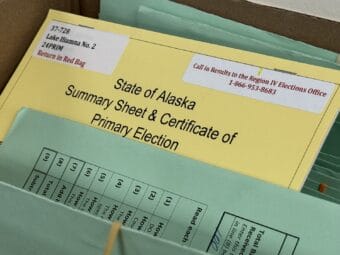
Election materials are seen at the Alaska Division of Elections headquarters on Tuesday, Nov. 12, 2024, in Juneau. (Photo by James Brooks/Alaska Beacon)

Nine days after Election Day, all of Alaska’s 403 polling stations have reported results.

On Thursday, the Alaska Division of Elections reported that a tally sheet from the village of Atqasuk, a village of about 280 people in the North Slope Borough, had reached state officials.

Statewide, an estimated 30,000-35,000 absentee, questioned and early votes remain to be counted. Atqasuk was the last precinct to report results from Election Day itself.

Carol Beecher, director of the Division of Elections, said workers also added scanned ballots from the town of Coffman Cove, in Southeast Alaska.

Altogether, the division added 37 ballots to the statewide count on Thursday.

Those new ballots didn’t change the leaders of any races. The closest statewide race remains Ballot Measure 2, the proposed repeal of the state’s open primary election and ranked choice general election. As of Thursday night, “yes” on repeal led by 2,425 votes out of 304,386 cast statewide.

Wednesday is expected to bring the final unofficial count and will be tabulation day for the handful of state races that will be decided by ranked choice voting.

Ballots from all 403 precincts must reach elections officials before Wednesday in order to be included in the tabulation. Two years ago, ballots from six rural villages failed to arrive on time and were not fully counted in the general election.

After Wednesday, elections workers will hand-count randomly selected precincts to check for errors in the machine count. The division expects to certify the results by the end of the month.

Begich maintains lead and repeal of ranked choice still passing in updated election results

Republican U.S. House candidate Nick Begich helps wave campaign signs with supporters in Anchorage on Monday, Nov. 4, 2024. (Matt Faubion/Alaska Public Media)

Republican Nick Begich III maintained his lead over Democratic Congresswoman Mary Peltola after the Division of Elections posted an updated results tally late Tuesday night.

Begich now has about 49% of first-place votes to Peltola’s nearly 46%. That’s a difference of nearly 10,000 votes. If neither of the candidates win more than 50% of first-place votes once all valid ballots are counted, the winner will be determined by ranked choice tabulation on Nov. 20.

Meanwhile, a ballot measure to repeal the state’s open primary and ranked choice voting system remains on track to pass. Though thousands of ballots remain to be counted, yes votes outnumber noes by more than 2,800 votes. That’s a margin of 1 percentage point.

The Alaska Division of Elections is expected to release at least two more result updates: one on Nov. 15 and another on Nov. 20. Tuesday’s included roughly 38,000 new ballots, mostly absentee, early and questioned ballots, plus votes from one Election Day precinct in rural Alaska that had not previously reported its tally. It’s the first large batch of ballots to be added after Election Day as officials process and count votes from within the state and around the world.

The updated results also provide some insight on some key races for state Legislature. The leaders in all races remain unchanged.

Fairbanks Sen. Scott Kawasaki, a Democrat, has increased his lead over Republican challenger Leslie Hajdukovich to more than 350 votes.

And in two key Anchorage House races, Democrats continue to lead. In North Muldoon, challenger Ted Eischeid has widened his margin over incumbent Republican Rep. Stanley Wright to 198 votes. Government Hill and Joint Base Elmendorf-Richardson Rep. Cliff Groh leads by a razor-thin margin, outpacing challenger David Nelson by just 19 votes.

Wasilla Republican Rep. David Eastman continues to trail fellow Republican challenger Jubilee Underwood. Underwood leads by 216 votes.

The results are expected to strengthen the House and Senate’s bipartisan coalitions. Shortly after Election Day, prospective leaders in each chamber announced they’d secured enough seats to form a majority. The House’s leadership would flip from a Republican-led coalition to a mostly-Democratic caucus led by new Speaker Bryce Edgmon, an independent from Dillingham.

It’s not the final word on the election. Alaska’s vote-counting process is slow. That’s due in part to the long window for absentee votes to arrive.

The count now includes nearly 48,000 absentee votes and nearly 69,000 early votes, plus more than 3,800 questioned ballots, which are cast largely by voters who show up at the wrong precinct on Election Day.

How many votes remained to be counted was not immediately clear Tuesday night. The Division of Elections issued nearly 60,000 absentee ballots, and nearly 14,000 had not arrived by Tuesday.

Final counts aren’t expected until Nov. 20, which is the last day for ballots to arrive from overseas. And even then, the winners won’t be official until the Division of Elections completes error-checking and other post-election procedures. State officials plan to certify the election Nov. 30.

Early election results mistakenly showed imprisoned U.S. House candidate leading in one Southeast Alaska precinct

Pelican on Monday, July 3, 2023. (Clarise Larson/KTOO)

Unofficial results from the Division of Elections earlier this week showed one Southeast Alaska precinct seemed to overwhelmingly choose a peculiar candidate for the U.S. House — a man currently imprisoned in New York. 

Those results confused voters from the communities, who said that didn’t line up with how they voted. 

When Pelican resident Patricia Phillips tuned in to the radio Thursday morning to catch up on the news, she said something caught her ear. 

“It said that there were zero votes for Mary Peltola in Pelican, Elfin Cove. And I went ‘That’s strange,” she said. 

She said she thought the news report she heard couldn’t be right. 

A screenshot of the Alaska Division of Elections interactive voter website on Wednesday afternoon. (Alaska Division of Elections)

“I know for sure there were two votes for Mary Peltola. I came into the city office on Election Day and I voted,” she said.

Phillips said she and her husband voted for Democratic Congresswoman Mary Peltola. Phillips has lived in Pelican for 50 years and went for Peltola in the last two elections. And she wasn’t sure why early reports showed that Democratic candidate Eric Hafner had more than half of the vote in her precinct.

She didn’t even know who he was. 

“I saw the results and I was wondering that maybe there was some sort of a clerical error that they put him down for that person instead of for Mary,” she said.

Pelican and Elfin Cove are home to about 122 year-round residents combined, according to census data. The pair of communities share a single precinct for general elections at Pelican’s City Hall. 

On Wednesday and Thursday, Division of Elections data showed that 40 ballots had been counted for the 156 registered voters in the area. The results showed that the area had swayed heavily in favor of Hafner for U.S. House – and that no one voted for Peltola.

But, that wasn’t the full picture. By Thursday afternoon, the vote tally changed. 

Elections Director Carol Beecher said Friday morning that the results her division initially reported were incorrect and the error happened at the Juneau director’s office during input. The count was corrected Thursday to reflect the actual vote tally.

A screenshot of the Alaska Division of Elections interactive voter website on Friday afternoon. (Alaska Division of Elections)

The incorrect data the state and news outlets reported on Wednesday was astonishing for a few reasons. At that time, Peltola had more than 50% of the vote for the precincts surrounding Pelican and Elfin Cove – Sitka, Tenakee Springs and Hoonah.

Hafner on the other hand, received less than 3% of those votes. Across the state, he had only about 1%. 

Hafner is one of three candidates running to unseat Peltola. He also happens to be serving a decades-long sentence in a prison in New York for threatening public officials. When KRBD’s Jack Darrell interviewed him earlier this year, Hafner said he’s never been here. 

“I think I have a very good reason right now that I simply can’t come to Alaska,” he said. 

A Thursday afternoon update on the Division of Elections website showed that no one had voted for him after all. The Division of Elections changed his 24 votes to zero on the state’s interactive voter website and reported that Peltola led the race instead. 

Hafner being on the ballot was a concern for the Alaska Democratic Party. They argued his presence could lead to voter confusion. It even sparked a lawsuit earlier this year that challenged his eligibility. The Alaska Supreme Court affirmed his candidacy in September.

In Alaska, vote counts are slow — by Friday morning, four Alaska precincts still hadn’t reported their results. Statewide, results won’t be certified until Nov. 30. 

Coalition lawmakers say they’re confident bipartisan Alaska House majority will hold

The Alaska State Capitol on Jan. 11, 2024. (Clarise Larson/KTOO)

There are still tens of thousands of votes across the state left to be counted, and some key races remain undetermined. But in the Alaska Legislature, members of bipartisan coalitions in the House and Senate are wasting no time in announcing their leadership and organizing their caucuses.

Lawmakers announced Wednesday that the House would flip from Republican-led majority control. The speaker of the House will be Dillingham Independent Rep. Bryce Edgmon.

“There’s still a little bit of the dust-settling factor in play here, but we’re confident at this point we’ve got enough members to form a majority organization,” Edgmon said Thursday morning.

That means the Legislature as a whole will be more moderate than it has been for the past two years. Though Alaskans voted for Donald Trump this year by a wider margin than four years ago, the trend at the state level runs counter to the rightward shift seen across the country this cycle.

Edgmon said the majority has four key principles it’s organizing around: balanced budgets that don’t overdraw the Permanent Fund, stable funding for public education, reforming the state’s 401(k)-style retirement system and boosting energy development.

Two other leadership posts in the bipartisan coalition would go to moderate Republicans: Kodiak’s Louise Stutes would chair the Rules Committee, and Chuck Kopp of Anchorage would be majority leader.

Right now, Democrats, independents and the two Republicans announced as coalition leaders are ahead in 22 House races. They need 21 to secure control, but there are two Anchorage races where Democrats hold leads of under 100 votes.

Challenger Ted Eischeid leads incumbent Republican Stanley Wright in North Muldoon by 111 votes. And in Government Hill, parts of Northeast Anchorage and Joint Base Elmendorf-Richardson, incumbent Democrat Cliff Groh has a razor-thin lead over Republican David Nelson. The difference in that race is a mere 28 votes.

With those two key races undetermined, House Republican leaders say it’s too soon to say anything definitive about who will hold power next year.

“I just think it may be just a little bit premature,” Wasilla Republican and House Majority Leader Cathy Tilton said by phone Wednesday evening shortly after the multiparty coalition claimed control of the House in a news release. “There’s a lot of votes still out there.”

Chuck Kopp said that as of Thursday afternoon, there are more than 22 members committed to joining the bipartisan caucus. That includes the Anchorage Democrats who hold slim leads and at least one more Republican, who Kopp declined to name.

Kopp said he expects more to join, and coalition leaders are leaving the door open.

“We’re intentionally keeping the invitation open for a good amount of time so that people can hopefully go back to their districts and talk to their leaders and the people they respect, and ask them, ‘How can I best represent you? Should I do it in the minority, or should I do it with a seat at the table in the majority?’” Kopp said Thursday afternoon.

Kopp said he expects the coalition to announce its full membership, including committee chairs, before Thanksgiving.

A bipartisan coalition will also continue to lead the Senate under very similar leadership to the past two years. Kodiak Republican Gary Stevens plans to stay on as Senate president.

“I think we want to address the elections issue as early as we can, and also the funding of education as early as we can,” Stevens said Thursday. “Those are the two big issues right now, but there’ll be a lot of others that come up when the Senate gets together later in December or January.”

The size of the Senate majority is up in the air. Two coalition Republicans from last session will not return to the Legislature, and it’s not clear if their replacements will join the bipartisan group. Wasilla Republican Robert Yundt, on track to defeat David Wilson, did not return messages, nor did Mike Cronk of Tok, who is slated to replace Click Bishop. Another incumbent coalition member, Fairbanks Democrat Scott Kawasaki, has a slight lead in a close race for reelection.

If five or more senators decline to join the coalition, they could form a minority caucus that would guarantee them seats on Senate committees.

A spokesperson for Republican Gov. Mike Dunleavy, Grant Robinson, said in a statement that the governor looks forward to working with “anyone in the legislature who is focused on moving Alaska forward.”

But whether Dunleavy will be in the governor’s mansion is an open question. He has attended campaign events for Donald Trump and congratulated the president-elect late Tuesday night — that’s before the race was called. Four years ago, the Dunleavy administration joined a lawsuit attempting to overturn the 2020 presidential election results in four swing states.

In an interview with Alaska’s News Source on Wednesday, Dunleavy left the door open to joining the Trump administration.

“I have not had the discussions with the President about jobs. I have not had discussions with his people about jobs,” Dunleavy said. “If those discussions come, I’d be certainly interested in hearing what the President is thinking, but that hasn’t happened yet.”

Spokesperson Jeff Turner said Dunleavy “remains fully committed to serving as Governor and moving Alaska forward.”

If Dunleavy does leave, he would be replaced by Republican Lt. Gov. Nancy Dahlstrom, a former corrections commissioner and state lawmaker who represented Eagle River.

Site notifications
Update notification options
Subscribe to notifications