Alaska Elections

Alaska Republican Party hires a Trump lawyer to watch recount of ranked choice repeal measure

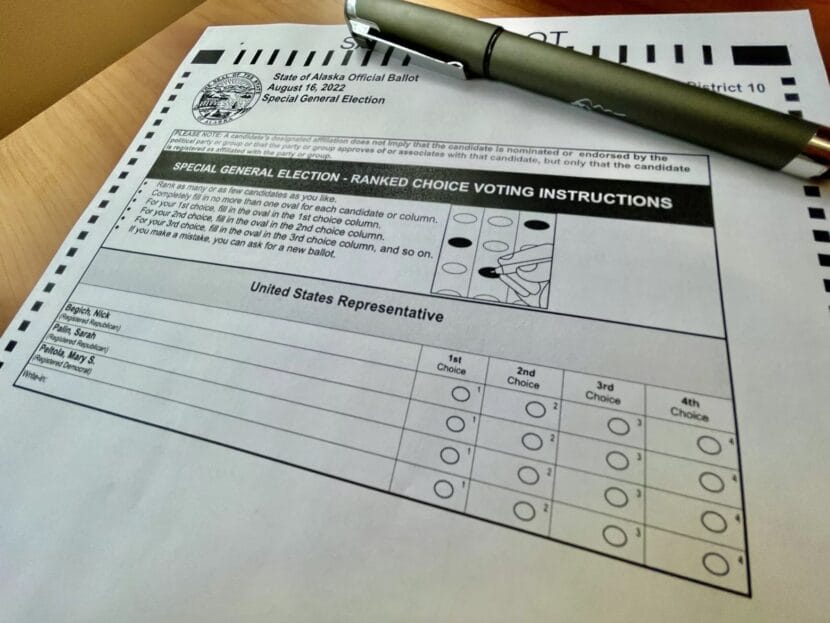
A sample ballot from the 2022 special election. (Liz Ruskin/Alaska Public Media)

The state and the Alaska Republican Party are gearing up for a recount of Ballot Measure 2. The initiative to repeal Alaska’s open primary and ranked choice voting failed by just 664 votes in the Nov. 5 election

State Party Chair Carmela Warfield announced that the party is assembling a legal team for the recount and has hired attorney Harmeet Dhillon. Dhillon is a frequent guest on Fox News and has represented President-elect Donald Trump in election cases.

Warfield did not respond to an interview request but said in a social media post this weekend that the party would make its recount request once the election is certified, which is slated for Nov. 30.

Anchorage attorney Scott Kendall, the architect of Alaska’s voting system, is confident the results will hold up.

“It’s clear to me that Alaskans voted to keep open primaries and ranked choice, including the tens of thousands of voters who both voted for President Trump, voted for Rep-elect Begich, but also voted no on 2,” said Kendall, who expects to participate in the recount on behalf of Alaskans who oppose repeal.

Kendall said he doesn’t know of any statewide recount that has changed a margin this large. He recalled the recount four years ago of the measure that established the Alaska voting method.

“In 2020 they did not only a recount, they did a hand audit of the election,” he said. “And ultimately, the outcome in that hand audit was 31 votes different from the original outcome.”

Discrepancies are typically due to stray ink marks on a ballot or ovals that a voter didn’t fill in completely, he said.

Lt. Gov. Nancy Dahlstrom announced Monday that the state is preparing for a recount. Since the results are so close, less than half of a percentage point, the state will pay for it.

She also said a recount opens the door for more absentee ballots to be counted. The deadline for absentee ballots to arrive was 10 days after Election Day, or 15 days for ballots mailed from other countries. But state law says that a recount extends that deadline, so any absentee ballots that were postmarked by Election Day but arrived late will be counted until the recount is complete.

Separately, the Division of Elections says the State Review Board has finished its post-election audit. During that process, officials hand-count ballots from a random precinct in each state House district, to ensure that the human count matches the machine count. A discrepancy of more than 1% would require a hand-count of all ballots in the district. Elections director Carol Beecher said by email that no discrepancy of that size was found. She didn’t say if the hand-counts revealed any discrepancies.

Alaska House Democrats Cliff Groh and CJ McCormick ousted after final ballot count

Cliff Groh and Conrad “CJ” McCormick. (Alaska Public Media and KYUK)

Two Alaska House Democrats appear to have lost their seats, flipping party control of one of them, according to unofficial results posted by the Alaska Division of Election on Wednesday.

North Anchorage Rep. Cliff Groh lost by 23 votes to Republican challenger David Nelson in the final unofficial count. Groh had maintained a slim lead since election night. Wednesday’s final count was the first time the race tilted toward Nelson.

Groh was one of 22 members of a Democrat-heavy bipartisan caucus that is seeking to take control of the Alaska House of Representatives from a Republican-led coalition. Groh’s loss leaves an apparent count of 21 Democrats, independents and moderate Republicans in the caucus, a bare majority in the 40-member House.

In the four-way race for House District 38, Bethel Rep. CJ McCormick trails fellow Democrat Nellie Jimmie by 58 votes following ranked choice tabulation. But election officials say the tabulation run Wednesday did not include all ballots cast in that race. A final count is expected ahead of election certification scheduled for the end of this month.

Ranked choice tabulation determined the winner Wednesday of seven other legislative races where no candidate got more than 50% of the vote, plus it  determined the winner of the U.S. House race, giving Republican Nick Begich III a victory over Democratic Congresswoman Mary Peltola.

Here’s who won the state House and Senate contests that went to ranked choice tabulation. In all cases, the candidate with the most votes ahead of tabulation wound up winning.

  • In Senate District D, a northern and central Kenai Peninsula race that includes incumbent Sen. Jesse Bjorkman and conservative challenger Ben Carpenter, both Republicans, and Democrat Tina Wegener, Bjorkman held on to win, besting Carpenter by a margin of 54.7% to 45.3% in the final round of tabulation.
  • In Senate District F, on the Anchorage Hillside, where incumbent Republican Sen. James Kaufman faced Democrat Janice Park and Republican Harold Borbridge, Kaufman maintained his lead to beat Park in the final round, 52.8% to 47.2%.
  • In the Senate District L race to represent Chugiak-Eagle River, where incumbent Republican Sen. Kelly Merrick faced conservative Republican challenger Jared Goecker and Democrat Lee Hammermeister, Merrick came out on top over Goecker in the final round, 55.5% to 44.5%.
  • In House District 6, including Homer and the southern Kenai Peninsula, where incumbent Republican Rep. Sarah Vance was challenged by independent Brent Johnson and Republican Dawson Slaughter, Vance won over Johnson in the final round, 52.3% to 47.7%
  • In House District 28, an all-Republican race for an open seat in Wasilla that includes Elexie Moore, Steve Menard and Jessica Wright, Moore won over Menard in the final round, 50.1% to 49.9%, a difference of 13 votes.

Three other races were tabulated despite the Division of Elections not having a complete count of the voters’ ranked choices.

Though election officials have a count of first-choice votes from those districts, which call in their preliminary results by phone, the Division of Elections has not received the paper ballots by mail from some rural Alaska polling stations. The paper ballots must be scanned to account for voters’ second, third and fourth choices, said Brian Jackson, the election program manager at the division.

“The manually entered votes are not included in the ranked choice tabulation,” he said in a brief interview at Division of Elections headquarters in Juneau.

That said, here are the preliminary results of tabulation in those races:

  • In House District 36, covering a wide swath of the Interior stretching from Glennallen to Delta Junction to the Yukon River drainage, where Republican Rebecca Schwanke, Democrat Brandon Putuuqti Kowalski, Republican Pamela Goode and Libertarian James Fields competed for an open seat, Schwanke won over Kowalski in the final round, 56.6% to 43.4%.
  • In House District 38, the Lower Kuskokwim, where Democrat Nellie Unangik Jimmie faced incumbent Democratic Rep. CJ McCormick, Veterans Party candidate Willy Keppel and Democrat Victoria Sosa. Jimmie bested McCormick in the final round, 51% to 49%.
  • In House District 40, the North Slope and Northwest Arctic, where Democrats Robyn Niayuq Burke and Saima Ikrik Chase faced Republican-turned-independent Rep. Thomas Ikaaq Baker, Burke won over Chase in the final round, 60.1% to 39.9%.

It was not clear Wednesday how many ballots remained untabulated, nor whether they could have a significant impact on the results.

The Division of Elections plans to run a final tabulation before certifying the election. Certification is planned for Nov. 30, though the date could change as the State Review Board performs its audit and other post-election quality control procedures.

Correction: A previous version of this story swapped the percentages for the House District 38 race. 

Alaska’s ranked choice repeal measure fails by 664 votes

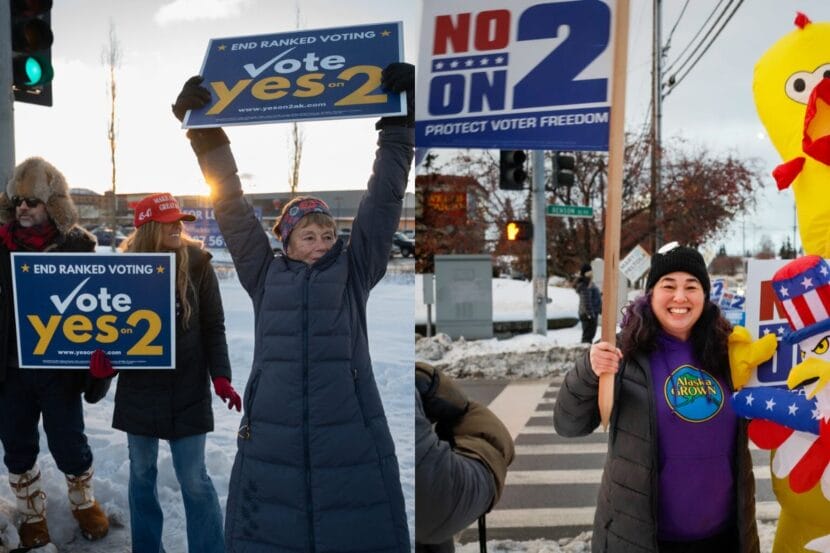
Supporters for and against Ballot Measure 2 waive signs in Anchorage on the lead up to election night, Nov. 5, 2024. (Matt Faubion/Alaska Public Media)

A ballot measure that would repeal Alaska’s ranked choice voting and open primary system has very narrowly failed, according to final unofficial results released Wednesday by the Division of Elections.

The final margin for Ballot Measure 2, pending certification, is 664 out of 340,110 votes, with “No” outpacing “Yes” 50.1% to 49.9%.

The No on 2 campaign said the failure of the ballot measure was “a win by Alaskans, for Alaskans, which will benefit our state for generations to come.”

“We are thrilled that Alaskans from all over the state with diverse views and different backgrounds came together to preserve the system that empowers voters to elect representatives that will put Alaska first,” No on 2 Executive Director Juli Lucky and Campaign Chair Lesil McGuire said in a statement emailed to reporters.

Loading…

“Yes” on Ballot Measure 2 led at the end of election night counting, but its margin shrank little by little as absentee, questioned and early ballots were counted. “No” overtook “Yes” on Monday by a razor-thin margin as election officials continued to tally ballots.

Former Lt. Gov. Loren Leman, an advocate for repeal, said he hopes the Legislature will pass a law getting rid of the voting system, but if that doesn’t happen, another repeal initiative is possible.

“I would say half of Alaskan voters were influenced, at least in part, and maybe in large part, by big money from outside the state,” he said by phone. “And ours was a grassroots, homebody campaign.”

The No on 2 campaign attracted nearly $14 million in contributions, largely from outside the state, and outspent the Yes on 2 campaign by a 100-to-one margin.

The race is likely headed to a recount. Alaska law allows candidates and campaigns to request recounts, and the state must pay for them in races won by less than 0.5%. Recounts are not automatic except in races that end in a tie.

Phil Izon, who led the campaign in support of the ballot measure, said he planned to submit a recount request once the election is certified, though he said he was “not optimistic” it would change the outcome.

Izon also said he plans to submit a petition to place a similar ballot measure before voters in 2026. He said he was encouraged by the failure of ballot measures in other states this year that would have implemented election reforms similar to Alaska’s system.

“Against all odds and with just a fraction of the resources, we stood toe-to-toe with the giants [who] outfunded us 100-to-one and came within a whisper of victory,” he said by phone. “With renewed energy and a belief in our cause, we can turn that razor-thin loss into a decisive win.”

Before considering a recount, Leman said he wanted to look into some allegations of “irregularities” in which ballots were deemed qualified. He said in a few cases he thought the call might be questionable. But he said he has no reason to suspect fraud and the number of ballots was relatively small.

“I would say it’s more than a dozen, maybe two dozen, and that wouldn’t make the difference on this ballot measure,” he said.

Vote counting concluded Wednesday, the final day for absentee ballots to arrive from U.S. citizens living abroad. The results will remain unofficial until they’re certified by the Division of Elections. The estimated date for that is Nov. 30.

This story has been updated. 

The results are in: Nick Begich III has won Alaska’s U.S. House race

Republican U.S. House candidate Nick Begich helps wave campaign signs with supporters in Anchorage on Monday, Nov. 4, 2024. (Matt Faubion/Alaska Public Media)

Republican Nick Begich III has won election to Congress.

That’s according to the unofficial final vote count completed Wednesday, and the tabulation of ranked choice ballots.

Begich prevailed over incumbent Democrat Mary Peltola with 48.4% of first-choice votes. The minor congressional candidates — John Wayne Howe of the Alaska Independence Party and a federal inmate, Eric Hafner, who filed as a Democrat — took only 5% of the vote, and the tabulation of those ballots increased Begich’s lead. After ranked choice tabulation, Begich had 51.3% of the vote to Peltola’s 48.7%.

Begich posted a statement on Facebook saying there was much work ahead to improve the lives of Alaskans.

“I’d like to thank Congresswoman Mary Peltola for her service to the state and nation in what is an exceptionally challenging role during an exceptionally challenging moment in our national history,” he said.

Begich’s win flips a seat from Democrat to Republican, adding to the GOP’s slim majority in the House. With three seats still undecided, the Republicans now have 219 members in their majority. The Democratic minority is 213.

Peltola said serving as Alaska’s congresswoman “has been the honor of my life.”

“Nick, I’m rooting for you,” she said in a statement once the results came out. “Please don’t forget when D.C. people keep telling you that you are one of three (members of the state congressional delegation) you are actually one of more than seven hundred thousand Alaskans who are ready to fight for our state, myself included.”

U.S. Congresswoman Mary Peltola. (Matt Faubion/Alaska Public Media)

Peltola, a former state legislator, is the only Alaska Native person ever elected to Congress, and the first person elected under Alaska’s system of open primaries and ranked choice voting.

In 2022, she ran on a campaign theme of “fish, family, freedom.” One of her priorities was to rein in the Bering Sea trawl fleet, which is widely blamed, particularly in western Alaska, for poor salmon returns.

Despite low name recognition outside of her home region in Bethel, she finished fourth in a special primary election, when hers was one of 49 names on the ballot. That was enough to get her a spot on the special general election ballot, with Begich and former Gov. Sarah Palin.

Peltola finished first on election night in 2022. When ranked choices were tallied, Palin gained votes from Begich’s ballots, but not enough to catch Peltola. It was a similar story months later, when Peltola won in the regular 2022 election.

In Congress she joined bipartisan groups, spoke up for gun-owners’ rights and tried to put some distance between herself and the Democratic administration.

Begich, a tech entrepreneur and business investor from Chugiak, has never held elected office. He will be sworn in on Jan. 3, 2025, to Alaska’s sole seat in the U.S. House.

His grandfather, also named Nick Begich, was Alaska’s Congressman from 1971 until he disappeared on a chartered flight from Anchorage to Juneau in October 1972.

Begich is the nephew of former U.S. Sen. Mark Begich and former state Sen. Tom Begich. Unlike the new congressman-elect, the other Begich family members to hold public office were Democrats.

Alaska’s elected leaders issued statements of congratulations to Begich. Gov. Mike Dunleavy’s celebrated the Republican victory.

“With President Trump returning to office, Alaska’s future looks bright once again,” he said. “I am confident that the Biden-Harris policies, which have worked to strangle our economy and undermine our Alaskan way of life over the past four years, are thankfully nearing an end.”

U.S. Sen. Dan Sullivan also highlighted Trump’s return to office in his congratulatory message to Begich posted on X.

“I’m looking forward to working with you to unlock Alaska’s energy potential, protect Alaskans’ way of life, enact President Trump’s agenda and put America—and Alaska—back on track,” he said. “And thank you, @Rep_Peltola, for your service to Alaska in the House—I wish you the very best in the future.”

U.S. Sen. Lisa Murkowski said she looked forward to working with Begich. And she called Peltola, whom she served with in the state Legislature, a friend.

“You have represented Alaskans well throughout your short tenure, and navigated this journey while facing unimaginable personal tragedy with grace, humility, and determination,” Murkowski said in a statement. “Alaska has been made better with your service in Congress.”

Peltola’s husband, Gene, died in a plane crash a year after she was sworn in.

The results announced Wednesday will remain unofficial until the Division of Elections certifies the vote at the end of the month.

This story has been updated. 

Watch Alaska’s ranked choice tabulation

The Alaska Division of Elections is set to announce its final unofficial vote count Wednesday before tabulating voters’ ranked choices to determine the winners of races where no candidate got a majority of the vote in the first round.

Gavel Alaska will livestream the tabulation process from the Division of Elections in Juneau. The broadcast is scheduled to start at 5 p.m. You can watch the process live at the video above, on KTOO 360TV, or on Gavel Alaska’s YouTube channel.

The final count and the results of tabulation will determine the winners — pending certification — in several key races, including the race for U.S. House and eight legislative contests.

Republican Nick Begich III has already declared victory in the U.S. House race. He leads Congresswoman Mary Peltola, a Democrat, by roughly two percentage points, but is short of the majority necessary to give him a first-round victory. Second choice votes from the 5% of voters who chose minor candidates in the first round are not expected to give Peltola the lead. We’ll find out who those voters chose as their second choice during this evening’s tabulation.

In the tabulation process, if no candidate receives more than 50% of first-choice votes, the candidate with the fewest votes is eliminated. Those voters’ second choices are then redistributed to the remaining candidates.

This process continues until one candidate secures a majority of votes or only two candidates remain, at which point the candidate with the most votes wins.

The results will remain unofficial until they’re certified by the Division of Elections. The estimated date for that is Nov. 30.

Here are the eight legislative races that will be decided during tabulation:

  • Senate District D, a northern and central Kenai Peninsula race that includes incumbent Sen. Jesse Bjorkman and conservative challenger Ben Carpenter, both Republicans, and Democrat Tina Wegener
  • Senate District F on the Anchorage Hillside, where incumbent Republican Sen. James Kaufman faces Democrat Janice Park and Republican Harold Borbridge
  • Senate District L in Chugiak-Eagle River, where incumbent Republican Sen. Kelly Merrick faces conservative Republican challenger Jared Goecker and Democrat Lee Hammermeister
  • House District 6, including Homer and the southern Kenai Peninsula, where incumbent Republican Rep. Sarah Vance faces independent Brent Johnson and Republican Dawson Slaughter
  • House District 28, an all-Republican race for open seat in Wasilla that includes Elexie Moore, Steve Menard and Jessica Wright
  • House District 36, a wide swath of the Interior stretching from Glennallen to Delta Junction to the Yukon River drainage, where Republican Rebecca Schwanke, Democrat Brandon Putuuqti Kowalski, Republican Pamela Goode and Libertarian James Fields are competing for an open seat
  • House District 38, the Lower Kuskokwim, where Democrat Nellie Unangik Jimmie faces incumbent Democratic Rep. CJ McCormick, Veterans Party candidate Willy Keppel and Democrat Victoria Sosa
  • House District 40, the North Slope and Northwest Arctic, where Democrats Robyn Niayuq Burke and Saima Ikrik Chase face Republican-turned-independent Rep. Thomas Ikaaq Baker

Ranked choice repeal now failing by just 45 votes after Tuesday results update

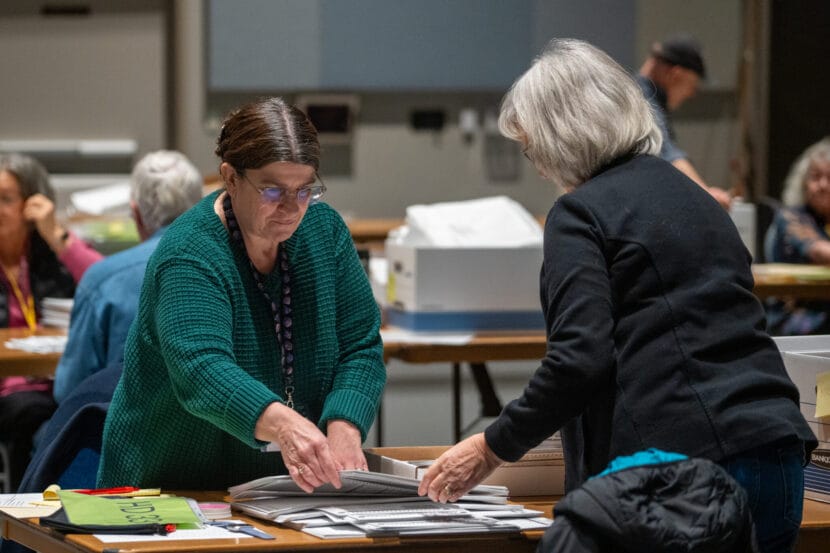
Election officials count ballots during the Alaska Division of Elections’ hand-count audit at Centennial Hall in Juneau on Nov. 18, 2024. The audit, mandated by state law, seeks to identify possible errors in machine counts by examining at least 5% of ballots from each state House district. (Eric Stone/Alaska Public Media)

A ballot measure that would repeal Alaska’s ranked choice voting and open primary system remains on track to fail, though its margin has shrunk even further, to just 45 votes.

In the latest update Tuesday afternoon from the Division of Elections, “No” on Ballot Measure 2 leads by just 0.02% in a race in which 315,633 votes have been counted to date. Tuesday’s update included 2,050 newly counted votes.

Loading…


The new ballots came largely voters in Southeast Alaska and the Matanuska-Susitna Borough.

“No” took the lead by 192 votes on Monday after trailing since Election Day.

The closely watched ballot measure would replace Alaska’s top-four open primaries and ranked choice general elections with party primaries and single-choice general elections. The No on 2 campaign attracted nearly $14 million  in contributions, largely from outside the state, and outspent the Yes on 2 campaign by a 100-to-one margin.

Roughly 5,800 ballots remain to be counted on Wednesday, the final day of counting in Alaska’s elections. It’s also the last day for absentee ballots to arrive from overseas voters. Division of Elections Director Carol Beecher said by email that the remaining ballots will mostly come from voters in Anchorage and rural Alaska.

Election officials will tabulate the ranked choice results in races where no candidate reached 50% of the vote at 5 p.m. Wednesday.

The standings in other races remained unchanged following Tuesday’s update.

Site notifications
Update notification options
Subscribe to notifications