Alaska Elections

Alaska Republican leaders celebrate Trump’s victory

Sen. Dan Sullivan delivers remarks at a Republican election watch party on Nov. 5, 2024. (Wesley Early/Alaska Public Media)

Alaska Republican leaders said they’re elated by Tuesday’s election results and hopeful they will create more opportunity for oil drilling and other development on Alaska’s federal lands.

Not only did Donald Trump win back the White House, but Republicans regained control of the U.S. Senate. That means both Alaska senators are back in the majority, increasing their ability to advance their agenda in Congress.

U.S. Sen. Dan Sullivan sees the wins as good for Alaska.

“Those are bipartisan issues that we want to get done here — the King Cove road, ANWR, NPR-A,” he said at an election night watch party. “I mean things that are very bipartisan in Alaska, the Biden administration sought to shut down, successfully.”

Alaska voters opted decisively for the Trump ticket. With nearly all precincts counted, 55% of Alaska voters picked Trump while 40% picked Kamala Harris.

Alaska Republican Gov. Mike Dunleavy also celebrated Trump’s victory. In a livestream Wednesday morning, Dunleavy said the former president was good for the state during his first term, and the governor expects similar priorities in Trump’s second term.

“He sees Alaska’s oil resources, our gas resources, our mining resources, our timber resources, our location on the globe, our military, as assets, not just for Alaska, but as solutions to the country’s problems,” he said.

Gov. Mike Dunleavy discusses the 2024 election results during a livestream on Nov. 6, 2024. (screenshot)

The Biden administration has until Jan. 20 to try to carry out its Alaska policies. Just Wednesday it issued a decision on the Arctic National Wildlife Refuge that infuriates development advocates. The Interior Department decided to open just 400,000 acres to oil leasing, the minimum required by Congress. The first Trump administration had proposed to open an area three times as large.

U.S. Sen. Lisa Murkowski achieved major agenda wins under the Trump administration, including the law that requires oil leasing in the Arctic Refuge. But her relationship with Trump is rough. She voted to convict him after his second impeachment. Earlier this year she called him flawed “to his core” and indicated he lacks the character to be president. Trump has called Murkowski “disloyal” and in 2022 flew to Alaska to help promote a more conservative challenger.

Murkowski said they can still have a productive term.

“If that just means I need to approach things in a different way, I will do so,” she said during a news conference on Wednesday. “But at the end of the day, regardless of how a given president feels about me, personally or politically, my job, my role, is to make sure that Alaska stands to gain, and that’s what I intend to do.”

U.S. Sen. Lisa Murkowski speaks to reporters at her Anchorage office on Nov. 6, 2024. (Matt Faubion/Alaska Public Media)

Murkowski said with the Senate Republican majority, she could become chair of the Indian Affairs Committee and also chair of the subcommittee that holds the purse strings of the Interior Department.

Bipartisan coalitions claim control of both Alaska House and Senate

The Alaska State Capitol on March 25, 2024. (Eric Stone/Alaska Public Media)

Bipartisan majorities will control both the Alaska House and Senate following the election, lawmakers said Wednesday evening.

That means the state House will flip from Republican-led majority control and have a new speaker, according to a news release. Independent Dillingham Rep. Bryce Edgmon will take the gavel.

Two other top leadership jobs will go to moderate Republicans, according to the release. Chuck Kopp, a moderate Anchorage Republican with a large lead over incumbent Republican Craig Johnson, will be the House’s majority leader, and Republican Louise Stutes of Kodiak will chair the powerful Rules Committee.

Stutes has been the only Republican in the predominantly Democratic and independent minority coalition for the last two years. Kopp was a member of a multiparty caucus during a previous stint in the Legislature.

The House coalition says it’ll prioritize stable education funding, budgets that do not overdraw the Permanent Fund, retirement reform and energy development.

“Alaskans have spoken clearly and we will work together, representing residents of all regions,” Edgmon said in the news release.

It’s not clear how many members the House majority will have, but the announcement invited “additional legislators supportive of these principles” to join.

Several House races remain unresolved as of Wednesday evening, and there are thousands of ballots around the state left to count. Wasilla Republican Cathy Tilton, the current House speaker, said that meant it was too soon to form a majority.

“I just think it may be just a little bit premature,” she said by phone. “There’s a lot of votes still out there.”

Members of both the House and Senate coalitions have frequently found themselves at odds with Republican Gov. Mike Dunleavy.

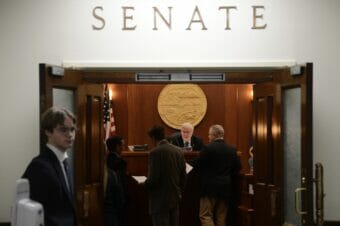
The current leadership of the bipartisan Senate majority will remain in place, according to a news release from Senate leaders.

Kodiak Republican Gary Stevens will continue as Senate president. Anchorage Republican Cathy Giessel will be the majority leader. Anchorage Democrat Bill Wielechowski will continue as chair of the powerful Rules Committee.

“Alaskans can look forward to a productive Senate majority, getting the important things done. We are focused on doing our best for Alaska families, businesses, and communities,” Giessel said in a prepared statement.

Though the three current co-chairs of the Senate Finance Committee will remain at the helm, there is one notable change. Bethel Democrat Lyman Hoffman will chair the committee as it discusses the state’s operating budget, and Sitka Republican Bert Stedman will lead its approach to the capital budget. Hoffman is currently the capital budget co-chair, and Stedman is the operating budget co-chair.

Golovin Democrat Donny Olson will stay on as the Finance Committee co-chair responsible for other bills that come to the committee.

Eagle River Republican Kelly Merrick will be Senate’s majority whip, and Anchorage Democrat Elvi Gray-Jackson will chair the Legislative Budget and Audit Committee.

Wielechowski said in a prepared statement that the bipartisan caucus would work to strengthen the state’s workforce, improve public schools and invest in infrastructure.

“By removing partisan differences, we’re focused on what truly matters to Alaskans with solutions that support strong communities and lasting economic growth,” he said. “This is about making tangible improvements that benefit all corners of our state – urban and rural.”

The existing Senate majority includes 17 of the body’s 20 members, but at least two will not return to the Legislature. Republican Click Bishop of Fairbanks did not seek reelection, and Wasilla Republican David Wilson is on track to lose his bid for another term.

Their probable replacements are Republican Mike Cronk, who leads in the race to replace Bishop, and Robert Yundt, who is leading Wilson. They did not immediately respond to messages. Yundt has been critical of the current majority, in recent days citing on social media the caucus’s failure to pass legislation barring transgender girls from school sports.

Another majority-caucus member, Fairbanks Democratic Sen. Scott Kawasaki is in a tight race with Republican challenger Leslie Hajdukovich with many ballots left to be counted.

Final unofficial election results, including ranked choice tabulations, are expected Nov. 20. State election officials plan to certify the election Nov. 30.

Find more election coverage at ktoo.org/elections

Juneau voters favored Peltola in this election — even the ones that voted for Trump

People voting early at the Mendenhall Mall on Monday, Nov. 4, 2024. (Clarise Larson/KTOO)

Former Republican President Donald Trump is set to return to power and preliminary election results show Republican Nick Begich III leads the race for the state’s sole U.S. House seat.

But in Juneau, there’s a slightly different story unfolding. Though voters were split on who should be president, there’s little question about who voters in the capital city wanted in the U.S. House – Democratic incumbent Mary Peltola. 

Peltola outpaced Begich in every Juneau precinct – even in the five precincts from the Juneau International Airport to Mendenhall Valley that went for Trump. Downtown and Douglas voters overwhelmingly leaned blue in both races. 

That’s different from the rest of the state. Though preliminary results show Peltola is leading in rural and coastal Alaska communities, Begich controls much of the area surrounding Anchorage and Fairbanks. And with nearly all state precincts counted as of Wednesday afternoon, the race tilts in his favor by about 10,500 votes.

Begich is an entrepreneur who lives in Chugiak. He’s a conservative from a well-known Democratic family in the state. His grandfather won the same U.S. House seat as a Democrat back in 1970.

Peltola’s favor among Juneau voters isn’t all that surprising. She already won in Juneau in her last two elections. She became the first Alaska Native person elected to Congress when she won the 2022 special election. She beat Begich then, along with Republican Sarah Palin. Months later, she also won reelection in the 2022 regular election, again beating Begich and Palin. 

In the 2020 presidential election, Juneau voters overall opted for the Democratic choices as well — Joe Biden for president, Al Gross for U.S. Senate and Alyse Galvin for House. 

Election results are not yet final. Begich holds 49.6% of the vote to Peltola’s 45.5% as of Wednesday evening. The current vote tally is just first-choice ballots. If neither candidate secures more than 50% of the vote, ranked-choice tabulation will determine the winner on Nov. 20.

The Alaska Division of Elections on Wednesday did not give a clear timeline of when updated results would be released.

Juneau’s local delegation in the Alaska Legislature are all Democrats. In this election, incumbent Sen. Jesse Kiehl, Rep. Andi Story and Rep. Sara Hannan ran unopposed. They will all serve another term.

Bethel’s absentee in-person polling location ran out of official ballots hours before closing

A sample ballot from the 2022 special election. (Liz Ruskin/Alaska Public Media)

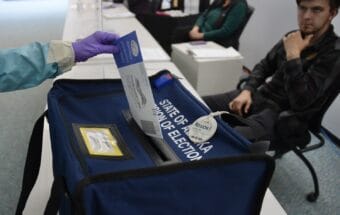
An absentee in-person voting location in Bethel ran out of official ballots on Monday and started recording votes with sample ballots. The move prompted some concern on a popular community Facebook page, but the state said that it was perfectly legal.

A screenshot of a post that briefly appeared (since deleted) on a popular Bethel community Facebook page on the afternoon of Nov. 4. (Facebook)

State election program manager Brian Jackson said that the use of unofficial ballots is permitted under Alaska statute.

“If a location runs out of official ballots they are permitted to use sample ballots as official ballots, and any voter voting on those samples, their votes will still be counted,” Jackson said.

Alaska Division of Elections Director Carol Beecher said that her office was notified that official ballots had run out at the Orutsararmiut Native Council (ONC) building in Bethel at some point on Tuesday afternoon, just hours before the absentee in-person polling location closed.

Beecher said that the shortage of official ballots was a result of historic high voter turnout. She said that the number of ballots sent to early and absentee in-person polling locations across the state was based on numbers seen in the 2020 United States presidential election.

According to Beecher, the early polling location for Dillingham also reported running out of official ballots on Monday.

Beecher said that the state did not anticipate any shortage of official ballots on Election Day, Nov. 5.

Anyone with concerns about voting is urged to contact the Alaska Division of Elections at 907-465-4611, or by email at elections@alaska.gov.

Alaska voters retaining all 19 state judges up for election

Pedestrians pass the Nesbett Courthouse, located in downtown Anchorage on August 31, 2022. (Valerie Kern/ Alaska Public Media)

All 19 of Alaska’s state judges up for election this cycle are leading in their bids to remain on the state bench, including the judge who faced a campaign to oust him over his controversial homeschool ruling.

Voters are so far approving Anchorage Superior Court Judge Adolf Zeman by the slimmest margin, with 53% saying yes to his retention, meaning he’d serve another six years on the bench.

Zeman was the only judge on this year’s ballot to face an organized removal campaign.

The campaign followed his ruling that the state’s correspondence school system violated a provision of the state constitution that bars the use of state money for the benefit of a private or religious school, since some parents use the system to subsidize private school tuition. The ruling was set to take effect in July until the Alaska Supreme Court set it aside on technical grounds, saying school districts were a necessary party to the suit, and sent it back down to the lower court.

Though the ruling did not take effect, it led two conservative groups — Alaska Family Action and a local chapter of Moms for Liberty — to organize a campaign urging voters in Southcentral Alaska to oust Zeman.

It is extremely rare for voters to remove judges from the bench. In state history, just six judges have been ousted in retention elections. However, approval of state judges has fallen to record lows: in 2022, 19 of the 20 judges up for retention won with less than 60% of the vote.

This year, the independent commission that selects nominees for the bench, the Alaska Judicial Council, recommended that all judges, including Zeman, be retained based on performance evaluations that incorporate feedback from attorneys, jurors and others who interact with the court system.

View the full election results here. Additional ballots will be counted in the coming days and weeks.

Juneau’s legislative delegation wins reelection — not that it’s any surprise

Juneau delegation 2019
From left to right: Rep. Sara Hannan, Sen. Jesse Kiehl and Rep. Andi Story pose for photographers outside the Capitol in Juneau on Jan. 16, 2019. The three Democrats were newly sworn in to represent Juneau in the Alaska Legislature. (Photo by Skip Gray/KTOO)

As results continue to trickle in for the national and state elections, Juneau’s local outcome, at least, is clear. 

Juneau’s delegation in the Alaska Legislature ran unopposed this year. Incumbents Sen. Jesse Kiehl, Rep. Andi Story and Rep. Sara Hannan are all Democrats and will all serve another term in office. All three were first elected in 2018. 

Kiehl represents District Q in the Alaska Senate. That includes Juneau, Haines, Skagway, Klukwan and Gustavus. His term is four years. 

Story represents House District 3, which includes Gustavus, Haines, Skagway, Klukwan and parts of the Mendenhall Valley, Auke Bay and Out the Road. 

Former state legislator Bill Thomas of Haines originally filed to run against Story, but withdrew from the race in June.

Hannan represents House District 4, which includes Douglas, downtown and Lemon Creek. 

Both Story and Hannan will serve two year terms. 

Site notifications
Update notification options
Subscribe to notifications