Alaska Elections

Angoon resident and former teacher launches bid for Alaska governor

Jim Parkin smiles for a photo in Angoon in 2017. (Photo by Emily Russell/KCAW)

A retired school teacher and principal from the small Southeast Alaska City of Angoon entered Alaska’s 2026 governor’s race earlier this month.

James Parkin filed a letter of intent to run for governor on July 1. He is one of six Republican candidates who have filed, including Lt. Gov. Nancy Dahlstrom, former state Sen. Click Bishop and Mat-Su Borough Mayor Edna DeVries. Retired Anchorage podiatrist Matt Heilala and Conservative activist Bernadette Wilson are also in the running. 

This is Parkin’s first campaign for public office.

In an interview on Monday, Parkin said he is a supporter of large Permanent Fund dividends, increased state funding to school districts and the revival of a pension plan for state employees. He also wants to eliminate homelessness. 

He said, if elected, he believes he can lead the state to achieve all of those priorities while still cutting back state spending. 

“I think what we need to do is work on efficiency — and I think that the state has been doing some good things in that direction — I’d just like to push us forward a little bit more,” he said. “I have some other ideas I think that will be helpful to move us towards a budget that’s more sustainable.”

The state would need to make severe cuts to services or dramatically increase its revenue to pay for a full statutory dividend. Its expenses would also increase if there’s a significant boost in funding to schools. While he said he has a few ideas to cut down on spending, it doesn’t include implementing a state income tax.

Parkin has lived in Alaska for more than 30 years, living in different parts of the state before settling in Angoon. Parkin is a retired teacher and principal at Angoon’s Chatham School District. He now works for Coeur Alaska’s Kensington mine near Juneau. 

He said Alaska voters should choose him over the other Republican candidates because he intends to work with the Alaska State Legislature — not against it — to make changes constituents have been asking for. 

“It’s a cooperative and collaborative thing — the governor and the legislature and the departments,” he said. “We’ve all got to work together to come up with some ideas — some new ideas, some fresh ideas — that are going to eliminate the waste, that are going to increase the efficiency.”

No registered Democratic candidates have entered the 2026 governor’s race so far. Current Republican Gov. Mike Dunleavy is terming out and cannot seek reelection. The deadline to file is June 1, 2026.

National Democrats are ‘salivating’ over a Mary Peltola bid for US Senate. But Alaska’s governor’s race could be ‘wide open’ too.

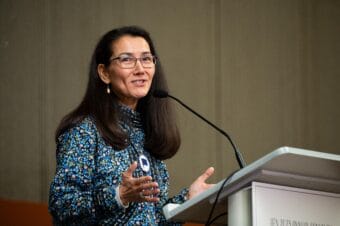
Mary Peltola speaks at a community celebration last year, Founder’s Day, in the Indigenous community of Metlakatla, south of Ketchikan. (Nathaniel Herz/Northern Journal)

Democrat Mary Peltola, who was Alaska’s sole member of the U.S. House, lost her re-election bid last year.

But her margin of defeat of less than three percentage points, in a state that Donald Trump won by double-digits, showed that Peltola remains a formidable candidate.

And that means “every national Democrat is salivating” at the idea that Peltola could challenge incumbent Republican U.S. Sen. Dan Sullivan next year, said Jim Lottsfeldt, a longtime Anchorage political consultant.

“I’ve been asked by some famous ones, by some less famous ones, ‘What can you do to convince her?’” Lottsfeldt said.

But many Democrats inside Alaska see Peltola as the party’s strongest candidate for governor next year, when Republican incumbent Mike Dunleavy is barred by term limits from seeking re-election. And they’re waiting to see which race she enters.

“If she chooses to run for either U.S. House or U.S. Senate, I will absolutely run for governor,” said Tom Begich, the Democratic former state senator from Anchorage. “If she doesn’t choose to do that, but chooses to run for governor, then I’ll be supporting her.”

As for the potential candidate herself?

She’s biding her time.

Peltola, who declined to comment, earlier this year took a job with a national law and lobbying firm, Holland & Hart, where she works with her former chief of staff, Anton McParland.

Peltola has not made up her mind about whether to run for governor, U.S. Senate or U.S. House, said Elisa Rios, a former campaign manager for Peltola who still speaks with her regularly.

“It’s really just where she can make the greatest impact for Alaskans,” Rios said. “She is going to make that decision on her own time.”

While some operatives and prospective candidates may be impatient for Peltola to make up her mind, the filing deadline for the 2026 elections isn’t until June 1. And she can afford to wait, said Joelle Hall, president of the Alaska AFL-CIO, the state’s largest organized labor group.

One poll earlier this year found that Peltola had higher favorability ratings than all three members of the Alaska congressional delegation, as well as Dunleavy.

“She’s Mary Peltola — she has 100% name ID, and she will raise money,” Hall said. “Is waiting, in any way, a problem for Mary? Absolutely not. She can decide on her own terms.”

Alaskans elected Peltola to the U.S. House two times, in quick succession, in special and regular elections in 2022 after the death of Republican Don Young, who held the seat for a half-century.

Peltola, a former member of the Alaska House, defeated Republican former Gov. Sarah Palin in both elections; she quickly became a star in national Democratic circles as the first Alaska Native woman elected to Congress.

In the U.S. House, Peltola established herself with a brand of centrist politics unique to her state: supporting abortion rights, crusading against factory fishing and salmon bycatch while also endorsing large-scale mining and oil projects.

Her term, however, was marked by the death of her husband Buzzy Peltola, who was killed when the small plane he was piloting crashed in September 2023.

Mary Peltola ran for re-election last year but lost to Republican Nick Begich III. Begich, a nephew of Tom Begich, won by a final margin of 2.5 percentage points after two other candidates’ support was redistributed in Alaska’s count of ranked choice votes.

Peltola  has largely kept a low profile since her loss. But in recent days, she has emerged publicly. On July 1, the same day Sullivan voted in favor of President Donald Trump’s “One Big Beautiful Bill,” Peltola made her first post to social media in nearly five months.

“We can not secure Alaska’s future by increasing healthcare and energy costs for regular Alaskans, so millionaires, like many of my former colleagues in Congress, and their billionaire donors, can get even richer,” Peltola said.

Peltola also served as grand marshall at Anchorage’s Pride parade last month, sporting a rainbow scarf and flag as she told an enthusiastic crowd that it was “so good to be here with all these people who are pro-love.”

Officials with the Senate Democrats’ recruitment and campaigning arm, the Democratic Senatorial Campaign Committee, did not respond to requests for comment.

But Jessica Taylor, who tracks U.S. Senate races for the nonpartisan Cook Political Report, said that if Peltola decides to challenge Sullivan, she would “put that seat into play.”

“I think Sullivan would certainly not want to run against her, because she’s won statewide before,” Taylor said.

A spokesman for Sullivan’s campaign declined to comment.

Winning a U.S. Senate race would net Peltola a six-year term — two more years than she’d get by winning a gubernatorial race.

She has also proven to be a formidable fundraiser in federal elections, bringing in more than $12 million total for her campaign in 2023 and 2024.

But political observers say there are also reasons that a U.S. Senate campaign might be less attractive for Peltola.

If elected, she’d have to resume a 3,300-mile commute to Washington. She’d likely face millions of dollars in attack ads from conservative groups.

A U.S. Senate campaign could also complicate her job at Holland & Hart, the law and lobbying firm.

While Peltola is barred from lobbying Congress for a year after leaving office, the the firm, whose clients include oil and gas companies, mining businesses and pharmaceutical giant Bayer, does have contact with members of Congress.

That includes Sullivan, who Peltola would be running against. McParland, Peltola’s former chief of staff, has visited Sullivan’s office in his new role at the law firm, according to a person with knowledge of the visit.

In a bid for governor, meanwhile, Peltola would not have to face an incumbent. Of the multiple Republicans who have announced campaigns so far, only Lt. Gov. Nancy Dahlstrom has held statewide office.

“When she enters, it’s going to be Snow White versus the seven dwarfs,” said Lottsfeldt, the consultant. “The governor’s race is just wide open for her.”

Lottsfeldt, citing the state’s economic woes, said he wants Peltola to run for governor — even though he often earns substantial sums as a local consultant for national Democratic groups when high-profile candidates like her run for congressional races.

“It would be a crazy amount of money. And, you know, I suspect I would do very well — you can quote me,” he said. “But I live in Alaska. The state is failing. The need for a governor is our highest priority right now. And so we have to focus on that.”

Backers of new Alaska ballot measure seek to permit ‘magic mushrooms’ and other hallucinogens

“I voted” stickers are seen on display in the headquarters offices of the Alaska Division of Elections in Juneau on Tuesday, Nov. 12, 2024. (Photo by James Brooks/Alaska Beacon)

A draft ballot measure proposal under review by the Alaska Department of Law would decriminalize “magic mushrooms” and similar psychedelics, allowing home cultivation and personal use, as well as their use for medical and traditional reasons.

The measure does not allow commercial sale.

“For most people, their lives will not change, but for people who really need support, they may be able to find it,” said Ismail Ali, interim co-executive director of the Multidisciplinary Association for Psychedelic Studies, a national nonprofit devoted to studying psychedelic substances and advocating their safe use.

The “Alaska Natural Medicine Act” is modeled after Colorado’s Proposition 122, which was approved by voters in that state in 2022 and became effective this year. Oregon has also decriminalized the growth and use of psychedelic mushrooms.

If the Department of Law approves the measure for full-fledged signature-gathering, supporters would have to collect at least 34,099 signatures from registered voters, including specific minimums in at least 30 of 40 state House districts, in order to put the measure in front of voters.

If supporters gather the signatures before the Alaska Legislature convenes in January, the measure could be up for a vote in 2026. If the signature-gathering ends after the Legislature convenes, the measure would be subject to a vote in 2028.

The new measure is being supported by Natural Medicine Alaska, a group that submitted its initial draft with 230 signatures on June 18. In a post on social media, the group said it is attempting to get the issue on the ballot in 2026.

Members of the group did not return multiple calls and emails seeking comment.

One hundred signatures were needed to start a legal review, a prerequisite before full signature gathering begins. The review, usually a formality, is expected to finish by Aug. 17.

The text of the ballot measure states that it would no longer be a crime to possess, use, display, store or transport “fungi containing psilocybin or psilocyn, psilocybin or psilocyn in extract or other concentrated form, or plants or fungi capable of producing psilocybin, psilocyn, dimethyltryptamine (DMT), or mescaline (except from Peyote).”

The possession or use of those psychoactive chemicals would be restricted to people at least 21 years old.

Personal cultivation would be restricted to an area no more than 12 feet wide by 12 feet long.

The sale or trading of personally cultivated psychoactive fungi would be prohibited, and public consumption would still be banned.

In many ways, the measure would legalize practices that already happen quietly in Alaska.

“There’s millions and millions of Americans who use psychedelics every year, and most of the time that goes off without a hitch, and people don’t even know about it,” Ali said.

He said Alaska’s proposed ballot measure is similar to the one enacted by Colorado but also takes into account subsequent rulemaking by that state.

In addition to permitting personal use and setting up a regulatory system for medical use, the measure also creates a third channel of regulation, for traditional, Indigenous use of psychedelics.

“This is the first time that I’ve seen an advocacy group that includes a number of Native leadership and people who are not just geographically local, but also of the Indigenous tribes there,” Ali said.

Alaska setting up a way to allow and regulate traditional use of psychedelic substances is something new, he said.

“I find that really beautiful and really ambitious, because it is something that comes up a lot, and it’s sort of like direct Indigenous to Indigenous conversation, which is happening increasingly in other states as well,” he said.

Psychedelic mushrooms remain a Schedule I drug and illegal under federal law, except for clinical research, but Colorado, Oregon and more than a dozen cities have decriminalized them.

In those places, federal officials have not prosecuted people and businesses that use psychoactive substances, which has allowed individual states to experiment with different ways to regulate and use them, Ali said.

There is growing interest in psychoactives’ ability to treat people with depression, anxiety and post-traumatic stress disorder.  Clinical studies have found varied results, and additional research is underway at a variety of universities and laboratories nationwide.

In 2024, the Alaska Legislature voted to create a task force to draft recommendations for psychedelic medicines if approved by the U.S. Food and Drug Administration.

That task force released draft recommendations in May.

Because the FDA rejected an initial psychedelic medicine application, those recommendations have never been implemented. In addition, the task force did not consider personal, recreational use as proposed by the ballot measure.

Currently, only one ballot measure — proposing new limits on financial contributions to candidates for public office — has been approved for the 2026 ballot. A second measure, seeking to repeal Alaska’s ranked choice voting system, is gathering signatures and is expected to garner enough support to also appear on the 2026 ballot.

If it does so, it will be the third time in six years that Alaskans have voted on the issue of ranked choice voting.

Senate President Gary Stevens to retire; House Rep. Louise Stutes announces run for seat

Senate President Gary Stevens, R-Kodiak, is seen before the start of a session of the Alaska Senate on Monday, Feb. 27, 2023. (Photo by James Brooks/Alaska Beacon)

After 22 years in the Alaska Senate, Senate President Gary Stevens is retiring.

Stevens’ decision has been discussed in the Alaska Capitol for more than a year, but on Tuesday, it became official as Kodiak Republican Rep. Louise Stutes became the first person to announce that she will run for Stevens’ seat.

“I certainly will endorse Louise any way I can to help her out,” Stevens said on Wednesday. “She should be a really fine senator. She’s had a lot of experience in the House, and I think she’d do a great job, and I’d be glad to help her out in any way I can.”

Stutes filed a letter of intent with the Alaska Public Offices Commission shortly after the Alaska Legislature adjourned its regular session for the year.

Legislators are forbidden from campaigning during the session, and the day after the first year of the legislative session typically marks the informal opening of the candidate filing period.

Campaigning typically doesn’t begin in earnest until after the second year of the legislative session.

Stutes’ early start may be a foreshadowing of things to come in the district: Stevens has represented the area covering Kodiak and the southern Kenai Peninsula since being appointed to the seat in 2003, making next year’s election a generational shift for the district.

Stutes said on Wednesday that fundraising doesn’t come naturally to her, “so I thought that I’d better get a jump start on it. You can’t get a jump start on it until you file your letter.”

Stutes said she doesn’t know whether there will be many candidates in the race.

Each of Alaska’s Senate districts includes two House districts. Rep. Sarah Vance, R-Homer, represents the other half of Stevens’ district and hasn’t filed a letter of intent for next year’s elections. She did not return a phone call seeking comment on Wednesday afternoon.

Stutes noted that her husband, commercial fisherman Stormy Stutes, grew up in Anchor Point, and they still have family members who live in Vance’s district, so she has connections to that part of Alaska.

This isn’t the first time that Stevens has said he will retire, but it’s certain this time.

“I’m 83 now. I’ll be 85 when I retire, and I think that’s just enough,” he said by phone. “I have other plans, things I want to do. I wrote a play about Ted Stevens that was successful in Anchorage; I want to do another one. I’m a bit of a painter, and I want to go on and do painting and writing and concentrate on those things, as well as spend time with my grandkids.”

Stutes said she’s been interested in running to replace Stevens since that first abortive retirement.

“I’m really lucky. Gary and I get along really well. … He’s been wonderful to work with. I’ll really miss him, of course, because we have such a great working relationship,” she said.

Voters elected Stutes to replace longtime Kodiak lawmaker Alan Austerman in 2014 and reelected her five times since then. She has governed as a moderate Republican, frequently joining the House’s predominantly Democratic coalition and once served a term as speaker of the House.

“I’m like every legislator. I really feel like I’m helping my district and Alaskans. Right or wrong, I feel like I’ve been able to make a difference with the Marine Highway System. I believe I’ve been able to help bring fisheries to the forefront,” Stutes said. “When I first got elected years ago, I told Stormy that the one thing I want to do is take fisheries from the back burner and put them on the front burner. And I think that I’ve been somewhat successful in moving it forward.”

The Alaska Senate is currently controlled by a 14-person bipartisan coalition that includes nine Democrats and five Republicans. Three of those Republicans are up for reelection next year, and all are in potential swing districts.

Sen. Bert Stedman, R-Sitka, and Senate Majority Leader Cathy Giessel, R-Anchorage, said they will run for office again. Stevens is the third.

Among the coalition’s Democrats, Sens. Elvi Gray-Jackson, D-Anchorage, and Löki Tobin, D-Anchorage, both confirmed that they will run for reelection.

Sens. Bill Wielechowski, D-Anchorage, and Lyman Hoffman, D-Bethel, have not yet filed letters of intent. Hoffman has been in the Legislature since 1987 and in the Senate since 1991, making him the longest-serving legislator in state history.

Senate Minority Leader Mike Shower, R-Wasilla, said on Wednesday that he hasn’t yet decided whether he will run for reelection.

Sens. Shelley Hughes, R-Palmer, and Rob Myers, R-North Pole, also face reelection next year. Neither returned a text message seeking comment on Wednesday.

Among incumbent members of the state House, Reps. Maxine Dibert, D-Anchorage, Carolyn Hall, D-Anchorage, and Donna Mears, D-Anchorage, have all filed letters of intent for reelection.

Former Rep. Cliff Groh, D-Anchorage, announced that he will again seek to challenge Rep. David Nelson, R-Anchorage, in 2026. Nelson had been elected in 2020, lost to Groh in 2022 and defeated Groh in 2024.Through Wednesday afternoon, Groh was the only nonincumbent to file with the Public Offices Commission.

Conservative activist Bernadette Wilson joins 2026 Alaska governor’s race

woman standing in front of metal and glass doors
Bernadette Wilson, an entrepreneur and conservative activist, poses for a photo in front of the Alaska State Capitol after announcing a run for governor on May 13, 2025.

Conservative activist Bernadette Wilson announced on the steps of the Alaska State Capitol in Juneau on Tuesday that she’s entering the race for governor.

Wilson, a business owner who has also led conservative policy groups, pitched herself as a political outsider in an interview.

“I think it’s time that we take someone with a business background and entrepreneurial spirit, someone that hasn’t been jaded, you know, within the halls of this building, and we get infrastructure done,” she said. “We’ve got to sit down and have a serious conversation about how we’re going to get education in this state. There’s no reason Alaska shouldn’t be No. 1.”

Wilson says she has deep roots in the state as the great-niece of former Alaska Gov. Wally Hickel and a member of the Naknek Native Village Council. She is the majority owner of the nine-year-old Anchorage garbage company Denali Disposal, according to state records.

Wilson has also been active in conservative politics. She’s a sponsor of the latest ballot initiative seeking to ask voters in 2026 to repeal Alaska’s open primaries and ranked choice voting. Until recently, she was the interim executive director of the Alaska Policy Forum, a conservative think tank. Prior to that, she was the state director for the Alaska arm of Americans for Prosperity, a conservative advocacy group affiliated with brothers Charles and David Koch. Wilson was the top choice in a straw poll of readers conducted by the conservative site Must Read Alaska.

In her announcement, broadcast on social media by Must Read Alaska, Wilson said her lack of experience in elected office was an asset.

“Current leaders like President Donald Trump and Congressman Nick Begich, previous leaders like Governor Hickel have all gone and done wonderful things for our state and for our country, but they all have one thing in common,” she said. “None of them had a government bureaucrat background when they started. Indeed, even when President Ronald Reagan first ran for governor of California, he had not been in government.”

Wilson also lamented the state’s failure to pay Permanent Fund dividends in line with a formula in state law that lawmakers have essentially ignored since the mid-2010s, when oil prices crashed and the state started relying on an annual draw from the Permanent Fund to pay for state services. The Permanent Fund draw has replaced oil revenue as the top source of the state’s unrestricted cash, which pays for everything from state troopers and schools to roads, bridges and ferries.

As oil prices drop on weakening global demand and growing supply from abroad, the state faces a grim fiscal future. Senators recently approved an austere budget while warning of even tougher times to come. Legislators in the predominantly Democratic bipartisan coalition in the Senate have pushed to expand taxes on out-of-state corporations and oil and gas companies to help close the gap, but they have run into resistance from Gov. Mike Dunleavy and the narrowly divided House.

Asked how she would address the state’s looming budget crunch, Wilson said she would reduce the state workforce.

“We have one of the highest rates of public employees, government employees per capita than any other state,” she said. “It’s time for us to look at the bloat. Is it going to be painful? Absolutely, it is. But we need to take a strong look at that budget and figure out, what are we going to do?

Though she holds a number of traditionally conservative positions on resource extraction and development, Wilson breaks from Gov. Mike Dunleavy on one key issue: She said she would like to see a significant increase in education funding in an effort to improve student performance.

“I am tired of hearing an arbitrary number on education continually get thrown out, whether it’s $1,000, $1,200, $700. I want to support a (basic school funding) increase that’s the number that the education bureaucrats can look at me and say, Bernadette, that’s the number that’s going to make us number one in the country,” she said. “That’s the number that I want to know. That’s the number that we should be supporting.”

Dunleavy has repeatedly said funding alone would not improve the state’s school system. Education advocates have pushed for a more than $1,800 increase in basic funding to restore schools’ buying power to what it was in 2011, though lawmakers and the governor have said the decline in oil prices has made such a move unaffordable. A bipartisan bill that would, among other reforms, boost basic per-student funding by $700 is pending on Dunleavy’s desk, and he told superintendents on Thursday he plans to veto it unless lawmakers pass additional education policy changes.

But Wilson shares some positions with Dunleavy and other conservative Republicans on public education, including support for so-called education savings accounts, a voucher-like system that allows students to use government funds to attend private schools.

That’s an issue in a high-profile constitutional case working its way through Alaska’s court system challenging the use of state homeschool funds on private school tuition. The Alaska Constitution prohibits the use of public funds “for the direct benefit of any religious or other private educational institution.”

Wilson lives in Anchorage, but she said she kicked off her campaign in Juneau to illustrate her willingness to go “right into the belly of the beast.”

Wilson joins an all-Republican field for the 2026 race alongside Lt. Gov. Nancy Dahlstrom and former Fairbanks Sen. Click Bishop.

Republicans Nancy Dahlstrom and Click Bishop are first to file for 2026 Alaska governor’s race

Alaska Lt. Gov. Nancy Dahlstrom, at left, and former state Sen. Click Bishop, at right, have each filed letters of intent signaling they will run for governor in 2026. (Alaska Beacon file photos)

Former Republican state Sen. Click Bishop of Fairbanks and Republican Lt. Gov. Nancy Dahlstrom are running for governor.

On Monday, Bishop filed a letter of intent with the Alaska Public Offices Commission, an act that signals his readiness to begin raising money for the 2026 election. Hours later, Lt. Gov. Nancy Dahlstrom filed a similar letter of intent.

Incumbent Republican Gov. Mike Dunleavy is term-limited and unable to run for reelection in 2026. Bishop was the first person to formally launch a campaign in next year’s governor’s race.

“I got bib No. 1 coming out of the starting chute,” Bishop said. “I just hope that we can maintain that through to the election.”

Dahlstrom did not answer a call on her listed number or immediately respond to a voicemail message seeking comment.

Dahlstrom, 67, has been Alaska’s lieutenant governor since replacing Kevin Meyer in 2022. A resident of Eagle River, she ran for Alaska’s lone U.S. House seat in 2024 but withdrew from that race after finishing third in the primary election. That decision helped consolidate Republican support behind the eventual winner, Republican Nick Begich.

Bishop, who served 11 years in the Alaska Senate, often as a member of a bipartisan coalition, declined to run for reelection in 2024. At the time, he said he was not done with public service, a comment that was widely interpreted to mean that Bishop was taking a break before running for statewide office.

“People have mentioned it over — about the last eight years, ‘Man, we think you’d make a great governor.’ And of course, your friends are going to tell you that, and they’re sincere. I don’t mean that in a flippant way. And, I got to thinking … (I’m) going to be 68 in July, and I think that if I’m going to do it, now is the time to do it,” he said.

Alaska’s next governor is likely to face immense challenges. The state’s budget is expected to be in deficit, and lawmakers are predicting that they will seek to tap the state’s main savings account next year, possibly leaving the incoming governor with few financial levers.

The state’s public schools are performing poorly by national testing standards, its population has plateaued for more than a decade, its violent crime rate is among the worst in the nation, and it has a large problem with homelessness.

In the Senate, Bishop governed as a moderate, willing to work across party lines while representing his district.

Asked if he governs like U.S. Sen. Lisa Murkowski, he said, “I think that’s it. I don’t get mad and take all my toys home because I don’t get my way. I mean, you have to continue to work with people. … If somebody’s wanting an incendiary bomb-thrower, I’m not that person.”

While in the Senate, he proposed a per-person tax to benefit schools and an increase in the state’s lowest-in-the-nation gas tax. Neither proposal became law. He was able to create a statewide education lottery system based around the Permanent Fund dividend.

Monday’s filings are unusually early by historical standards. When Dunleavy applied for the 2018 governor’s race, he filed a letter of intent in July 2017. Ahead of the 2022 election, the three leading candidates all filed letters of intent in August 2021.

The 2026 governor’s race is expected to feature a crowded field of candidates. It will be the first time since 2002 that an incumbent governor is not on the ballot.

“I don’t know — you might see a dozen (candidates),” Bishop said when asked how many people he expects to enter the race.

Under Alaska’s election system, governor and lieutenant governor candidates run together, on a single ticket.

Bishop said he’s thought about some names for his lieutenant governor, but he isn’t ready to make a decision.

“I will not commit to anything as far as lieutenant governor at this point; we’re a long ways off, but we’ll see how it goes,” he said.

He added that a bellwether for his campaign will be his ability to raise money.

Alaska currently has no limit on the amount of money that an individual can donate to a political campaign. In the 2022 governor’s race, the top two candidates each reported raising more than $2 million. The third raised more than $1.5 million.

“I know a lot of little people and big people, but we’ll see,” he said. “We’ll give ‘er our best shot. Now we’re going to see who was serious about me running or not serious about me running.”

Bishop owns a small gold mine in Interior Alaska and when reached on Monday said he plans to spend the next week working there before fully launching his campaign.

“We’re going to mine this summer, but we’ve got strategic events — listening sessions — over the course of the summer, but they will ramp up after freezeup,” he said.

“I’m just looking forward to seeing and meeting with the people of Alaska to hear them.”

Site notifications
Update notification options
Subscribe to notifications