4 Special Coverage

Neil Steininger and Maureen Hall officially join Juneau Assembly

Neil Steininger and Maureen Hall raise their hands as they are sworn in to the Juneau Assembly on Monday, Oct. 21., 2024. (Clarise Larson/KTOO)

Two new Juneau Assembly members were sworn in at City Hall Monday night. 

Voters selected Neil Steininger to represent Assembly District 1 and Maureen Hall to represent District 2 in this year’s municipal election. 

They will each serve a three-year term. They replace outgoing members ‘Waahlaal Gidaag Barbara Blake and Michelle Hale, who did not run for reelection. 

At the meeting, Assembly members congratulated and thanked both outgoing members for their dedication to the community. Christine Woll applauded Blake’s commitment to the Assembly, while also juggling other leadership roles in the community and state. 

“I’m just in awe of you every day. Everything that you do for your, our community, for your community, it’s so inspiring,” she said. “Your impact is large already in Alaska, and I’m really excited to see what you do next.”

Alicia Hughes-Skandijs thanked Hale for her leadership and kindness.

“I always will feel appreciative of how welcome you made me feel as a newbie who was in over her head, and your faith in me and we’re going to miss you around here,” she said. 

Blake served one term and Hale served two, with the latter as deputy mayor. At the meeting, the Assembly unanimously voted to appoint member Greg Smith to fill the position. 

Mayor Beth Weldon was sworn in last week for her third, three-year term as mayor. Before that, she also served two years as an Assembly member before resigning to run for mayor. 

On Tuesday night the Juneau School Board will swear in three incumbent members to serve another term. This election incumbents Elizabeth Siddon, Will Muldoon and Amber Frommherz all successfully defended their seats.  

Advocates seize AFN convention as opportunity to rally the Native vote

United Tribes of Bristol Bay was among the organizations that promoted voting at the 2024 AFN convention. (Liz Ruskin/Alaska Public Media)

A person could barely move a few yards at the Alaska Federation of Natives convention in Anchorage last week without bumping into a message to vote.

Daniella Tebib was working the ground at the artisans’ market on the first floor.

“Hello! Do you guys have a plan to vote this November?” she asked of passers-by

“In November?” a man responded, a little tentative. “Everybody’s going to vote, right?”

“I hope so. That’s the goal,” Tebib said, thrusting a brochure at him. “Would you like some more information?”

Tebib, a volunteer for Congresswoman Mary Peltola’s re-election campaign, sweetened her pitch with invitations to spin the prize wheel at the Peltola booth for t-shirts, hats and other campaign swag.

The AFN convention is in October, and in election years, there’s always some emphasis on voting. But this year, AFN co-chair Joe Nelson said the convention is especially focused on encouraging a strong Native vote.

“Yes, because we know there are forces in play that are trying to marginalize our communities,” he said.

Shannon Mason staffs a popular prize wheel at Rep. Mary Peltola’s campaign booth at the 2024 AFN convention. (Liz Ruskin/Alaska Public Media)

For Nelson and other AFN leaders, an effort to suppress Native votes came into clear view this month, when a pair of Republican legislators were guests on a conservative talk radio show. State House Speaker Cathy Tilton, R-Wasilla, told host Michael Dukes that she and fellow Republicans killed a bill that would have eliminated the witness signature requirement on mail-in ballots, which she acknowledged is a barrier for rural voters.

“The changes in that bill definitely would’ve leaned the election towards, you know, towards Mary Peltola, to be quite honest,” Tilton said during the broadcast.

Tilton did not respond to an interview request for this story.

Nelson said Alaska Native voters need to show up in huge numbers to overcome barriers like the signature requirement. He’s passionate about re-electing Peltola, the first Alaska Native person elected to Congress — and, incidentally, Nelson’s ex-wife. He’s also plugging a “no” vote on Ballot Measure 2. That’s the measure that would repeal Alaska’s open primary and ranked choice voting. Nelson said Alaska’s current voting method helps eliminate partisan gridlock and serves most Alaska Native voters, who he describes as common-sense moderates.

“We’re, you know, 17-ish percent of the population, 120,000-plus Alaska Natives,” he said. “If we actually aligned on all of our things and showed up and voted, there would be no denying that our vote actually matters.”

The No on 2 campaign was one of the convention sponsors this year, so that message was on banners, pencils, buttons and brochures.

(The Yes on 2 campaign wasn’t present at the convention, but supporters of repeal say that ranked chance voting is confusing and that the open primary is unfair to conservatives.)

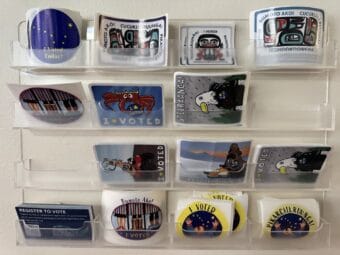
Some of the voting stickers available at a Sealaska table at the 2024 AFN convention. (Liz Ruskin/Alaska Public Media)

Some of the get-out-the vote effort was generic, not promoting any particular candidate.

Shelley Cotton, chief strategy director of United Tribes of Bristol Bay, was reeling in shoppers at the AFN artisans market with a non-partisan approach. She invited voters to sign a pledge to vote, with check boxes to indicate they’d welcome reminder messages or translation services.

“Getting out the vote is really important for us, because we want Native people to decide who’s best for our people and for those people to be in position so we can work with them as well doing our advocacy work,” she said.

Cotton said United Tribes of Bristol Bay has 11 interns spread out in their region, to engage communities and make sure everyone knows when and where to vote.

Upstairs, Michelle Sparck beamed as she handed out indigenous-specific “I vote” buttons.

“Here we go,” Sparck said, sizing up one young family. “That’s for your baby: ‘future Alaska Native voter.’ YayI”

Sparck leads the non-partisan Get out the Native Vote. She has labored largely alone in past years. Not this time. Several Alaska Native organizations pitched in so that she could hire 30 workers for the election season, to spread the word. And, Sparck said, they’re determined not to see a repeat of what happened in the primary, where voting stations didn’t open in some rural villages, for lack of poll workers.

“We’re actually ready to fly out our volunteers to any vulnerable precinct that does not have an election worker signed up, lined up, or will fall out before Election Day on Nov. 5,” she said.

A few yards away, convention participants thronged to a Sealaska table with Native-themed voting stickers and signs. “Aunties vote” was particularly popular.

“We’re not endorsing any candidates here, but we’re just making sure that Alaska Natives have a plan to get to the polls and cast their vote,” Christian Ḵaat’aawu Gomez of Juneau said, “because we know that our voices need to be heard and that we have a huge impact.”

Near him a poster summed up the aspiration: “Voting is our way of life.”

Alaska Federation of Natives endorses Peltola, opposes ranked choice repeal

Attendees at the 2024 AFN convention, listening to an address by U.S. Sen. Lisa Murkowski, R-Alaska, on Oct. 19, 2024, hold signs with Mary Peltola’s face on Oct. 19, 2024. (Photo by Yereth Rosen/Alaska Beacon)

The Alaska Federation of Natives voted Saturday to endorse the reelection of Democratic U.S. Rep. Mary Peltola and to oppose the ballot measure to repeal the state’s open primaries and ranked choice voting.

The votes came on the last day of its annual three-day convention, which had the theme this year of “Our Children, Our Future Ancestors.” The delegates from tribes, nonprofit tribal organizations and regional and village Native corporations passed 18 resolutions on issues ranging from a call for Congress to amend federal law to explicitly recognize Native rights to subsistence hunting, fishing and gathering to support for the state prioritizing public education funding.

Peltola, who is Yup’ik, from Bethel and the first Alaska Native member of Congress, drew broad support from the delegates, though some groups abstained from the vote.

The resolution endorsing Peltola was introduced by Sealaska, the regional Native corporation for Southeast Alaska.

“Representative Peltola has been a strong advocate for Alaska’s fisheries and subsistence users by introducing and working with her colleagues, regardless of party affiliation, for legislation to strengthen US seafood competitiveness in international markets, taking actions to enhance research to improve federal programs that support domestic seafood production and working tirelessly to reduce bycatch and protect fisheries habitat,” the resolution said.

Peltola’s top opponent is Republican Nick Begich. AFN did not host a candidate forum this year, after having hosted forums at previous conventions.

The resolution opposing Ballot Measure 2 — which would repeal the voting system — passed without opposition. But a resolution in support of Ballot Measure 1 never made it to a vote.

Ballot Measure 1 would raise the state’s minimum wage to $15 per hour by 2027, require employers to pay sick leave, and bar employers from requiring workers to attend political or religious meetings.

A motion to table the resolution supporting Ballot Measure 1 was introduced by Curtiss Chamberlain, assistant general counsel for Calista Corp., the regional Native corporation for the Yukon-Kuskokwim Delta region.

Chamberlain noted that many village corporations face declining revenue because of the projected decline in revenue being shared by the Red Dog mine. The potential added costs from the ballot measure trouble village corporations in Calista’s region, he said.

“A few brought their concerns to our attention,” he said. “And with that, and based on those discussions and concerns, I respectfully ask that this be tabled.”

Debra Call, a member of the Cook Inlet Tribal Council, unsuccessfully spoke in favor of the resolution and against the motion to table it.

“You really need to raise the standard of living of many of our people, and this is the start to do that,” Call said of the minimum wage increase.

She later added: “I would request that we support this resolution for the betterment of all of Alaska, particularly those who are in jobs that don’t pay what they can live on, so it’s about a living wage.”

The delegates tabled the resolution by a voice vote.

The AFN passed all of the other resolutions. A full list of the resolutions in their draft form — before they were amended on the convention floor — can be found at this link.

Campaign ads from outside group falsely claim Peltola vote harmed Alaskans’ PFDs

Election mailers, seen Thursday, Oct. 17, 2024, incorrectly connected a vote by Rep. Mary Peltola, D-Alaska, with the size of the Permanent Fund dividend. (Photo by James Brooks/Alaska Beacon)

Alaska has just one U.S. House seat, but the race between incumbent Democratic Rep. Mary Peltola and three challengers is on track to be the most expensive in the country and the most expensive in Alaska history, with more than $15 million spent by party-aligned political groups and $31 million spent altogether across all candidates in both the primary and general elections.

Among the campaign ads flooding Alaskans’ mailboxes is a mailer — there are several versions — that incorrectly claims a Peltola vote against an oil-production bill “weakened the Permanent Fund and shrunk our PFD checks.”

The mailer’s claim includes a footnote to an Alaska Beacon article about possible future financial weakness in the Permanent Fund, but that article was written almost a year before Peltola’s vote and has no connection to it.

Furthermore, Peltola’s vote took place as state lawmakers were setting the amount of this year’s Permanent Fund dividend and had no impact on debates within the state Capitol.

The dividend is based on expected revenue in the coming fiscal year, not on speculative future revenue.

Additionally, most of the Permanent Fund’s value is due to investment income, not oil revenue, and it’s even unclear whether oil production would have been increased by the bill Peltola opposed.

The bill could have reversed restrictions on oil drilling in the Arctic National Wildlife Refuge and the National Petroleum Reserve-Alaska — assuming it could have passed the Senate and survived a presidential veto — but developing new oil projects on the North Slope can take a decade or more.

The Willow project, now under construction in the petroleum reserve, has been in the works for at least eight years. While the state is expected to gain revenue from the development in the long term, it will actually reduce state revenue in the short term, shrinking the amount of revenue available for dividends.

A 2021 lease sale in ANWR attracted little interest.

The group behind the incorrect ads is Club for Growth Action, which has spent more than $56.6 million over the past two years in support of conservative candidates nationwide.

Club for Growth endorsed Peltola’s Republican challenger, Nick Begich, earlier this year, and Begich has a long history with the group, completing a fellowship with Club for Growth before his 2022 run for House.

This year’s Alaska absentee ballots require two stamps, but USPS will still deliver them if you forget

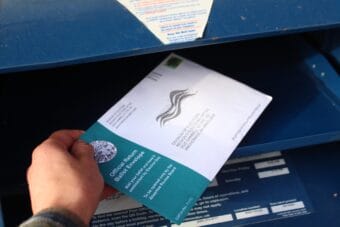
A voter mails an absentee ballot in Oct. 2020. (Lex Treinen/Alaska Public Media)

Alaskans voting by mail this fall should put two stamps on their absentee ballots, according to the Division of Elections.

This year’s ballots require two stamps because of their unusually large 17-inch size, said Carol Beecher, the head of the Division of Elections. They’re so big because the space to rank all eight candidates for president takes up a large portion of the front of the ballot, Beecher said by email.

Though the ballot envelopes require two stamps, the envelope itself simply says “First Class Postage Required.” The division says that’s because the envelopes, unlike the ballots themselves, are printed long before the deadline for candidates to get on the ballot.

“There is no way to anticipate the size of the ballots before the envelopes are printed,” Beecher said.

Nineteen states and Washington, D.C. provide absentee voters with prepaid ballot return envelopes that do not require postage, according to the National Conference of State Legislatures. Alaska, however, does not. The Division of Elections says that’s because it can’t provide prepaid envelopes without funding approved by the Alaska Legislature. Absentee ballots also required two stamps in 2022.

But if you forget to put two stamps on the envelope, don’t worry, says the U.S. Postal Service. On its website, the agency says it’ll still deliver ballots with insufficient postage.

“If a return ballot is entered into the mailstream with insufficient or unpaid postage, it is the Postal Service’s policy not to delay the delivery of completed absentee balloting materials, including mail-in ballots,” reads a frequently-asked-questions page on the USPS website.

The Division of Elections said that if the Postal Service delivers a ballot, they’ll count it, assuming it meets the other requirements for an absentee ballot to be counted. Ballots can also be dropped off at Division of Elections regional offices, early voting locations, or Election Day precincts.

The most common reason for a ballot to be rejected is a missing witness signature. In the 2022 all-mail special election for U.S. House, roughly 5% of ballots were rejected for missing witness signatures. Rural areas off the road system, which tend to be majority-Alaska Native, had a rejection rate of nearly 14%, leading to a lawsuit that remains ongoing. Though a recent bill in the Alaska Legislature would have removed the requirement, Republicans blocked it on a 20-20 vote in the closing moments of the session.

The Alaska Current reported Tuesday that Speaker of the House Cathy Tilton, R-Wasilla, said on a conservative talk radio show earlier this month that removing the requirement would “lean the election toward [Democratic Congresswoman] Mary Peltola.” In response, leaders of the Alaska Federation of Natives called on lawmakers to “work towards improvements, not disenfranchisement” in a series of statements.

Final election results show new, old faces elected as Ship Free Saturdays fails

Final results in Juneau’s municipal election show incumbent Mayor Beth Weldon, Assembly District 1 and 2 candidates Neil Steininger and Maureen Hall and Juneau School Board incumbents are Will Muldoon, Amber Frommherz and Elizabeth Siddon won their respective races. (Clarise Larson/ KTOO)

Final results in Juneau’s municipal election show two new faces will join the Juneau Assembly while Juneau’s incumbent mayor and school board members were reelected for another term. 

Meanwhile, voters overwhelmingly shot down a proposal to ban all large cruise ships on Saturdays and the Fourth of July starting next year. 

Turnout was also significantly up this year. This year’s election yielded one of the highest voter turnouts of the last decade. 

Steininger and Hall win Assembly Districts 1 and 2

Two seats were up for grabs on the Juneau Assembly this year — a District 1 and a District 2 seat. From the get-go, District 1 candidate Neil Steininger and District 2 candidate Maureen Hall led in their respective races, according to preliminary results. 

And, on Tuesday both held their leads through the final count to secure spots on the Assembly. Steininger said he’s grateful to get support from voters and is now eager to start his new role. 

Assembly District 1 candidate Neil Steininger waves signs near Egan Drive on Election Day on Tuesday, Oct. 1, 2024. (Clarise Larson/KTOO)

“I’m just really looking forward to getting my hands in there, and working with the rest of the group and figuring out what problems it is that we need to address and things we need to work together to solve here over the next year,” he said.

Hall said she is already eager to begin working with other members on how best to tackle the issues she campaigned on. 

“Definitely doing my research on what has worked for other communities, for homelessness and obviously the flood mitigation, and making sure that the homeowners that have been impacted are being heard and have what they need,” she said. 

The pair will each serve a three-year term. They will replace current Assembly members ‘Waahlaal Gidaag Barbara Blake and  Michelle Hale who did not run for reelection. 

Weldon wins another term as mayor

Incumbent Beth Weldon won the mayoral race against challenger Angela Rodell. 

Incumbent Mayor Beth Weldon waves signs near Egan Drive on Election Day on Tuesday, Oct. 1, 2024. (Clarise Larson/KTOO)

While both shared similar views on topics like glacial outburst flood preparation, Rodell led her campaign on a fiscally conservative platform while Weldon applauded the work the Assembly has done to give breaks to taxpayers. 

Weldon said she’s eager to continue her work on flood preparation, housing and child care. 

“I am honored to be re-elected as mayor to this great city, and I’m very proud that I get to continue to do this job,” she said. 

Incumbents reelected to school board 

The three incumbents running for reelection on the Juneau School Board held strong leads from the first vote count. And in the end, Elizabeth Siddon, Will Muldoon and Amber Frommherz all successfully defended their seats.  

All incumbents shared a similar goal of keeping the district on firm financial footing following last year’s whirlwind budget crisis and school consolidation process.

Muldoon said having all incumbents back will mean all board members will be up to speed on current issues, and ready to tackle any difficult decisions ahead. 

“We’ve got a tough road ahead, so I think having that institutional knowledge and experience will make things easier,” he said. 

They will remain on the school board along with School Board President Deedie Sorensen and Vice President Emil Mackey, who were the subjects of petitions attempting to recall them in this year’s election. 

Recall initiative fails

The final results showed that most voters were against removing the pair on the board. The effort was led by a group of residents who wanted to remove them in part due to their votes in favor of the consolidation of Juneau’s high schools and middle schools earlier this year. 

Juneau School Board President Deedie Sorensen and Vice President Emil Mackey at a meeting in February 2024. (Clarise Larson/KTOO)

Sorensen said she thinks it shows that most voters understood the complexity of the consolidation process and the need for difficult decisions by the board. 

“I’m not surprised that the recall didn’t prevail,” she said. “I felt that the people that were most unhappy with the decisions that we were making were a fairly select group of people.”

Mackey agreed.

“It speaks well of our community that they were willing to accept the hard choices that nobody wanted to do, and also recognize that a recall could have a chilling effect on future boards trying to find members to run for the school board,” he said. 

Jenny Thomas was one of the leaders of the recall effort. She also unsuccessfully ran for school board this year. She said she had no comment on the results of the recalls. 

Ship Free Saturdays fails, public safety and infrastructure bonds pass

There were three propositions on the ballot this year. One was a public safety bond that asked to borrow $12.7 million to replace the radio system used by first responders, and the other was a wastewater bond that asked to borrow $10 million to replace critical infrastructure at the Juneau Douglas Wastewater Treatment Plant. Both passed in the final vote with wide margins.

But, the third — and most contentious — proposition called “Ship Free Saturdays” asked voters whether or not Juneau should ban all large cruise ships on Saturdays starting next year. And the answer from voters was an overwhelming “no.” 

Final results showed 4,196 people voted yes on the proposition, while 6,575 people voted no — a 2,379 vote difference. 

And, in total, 10,880 registered voters had their ballots counted in this year’s municipal election – that’s 38%. It’s the highest voter turnout in the recent decade.

Amber Frommherz is a member of KTOO’s board of directors. The board has no editorial control over content. 

Correction: A previous version of this story reversed the yes and no votes on the Ship Free Saturdays proposition. 

Site notifications
Update notification options
Subscribe to notifications