4 Special Coverage

What Alaska voters should know as they consider a repeal of open primaries and ranked choice voting

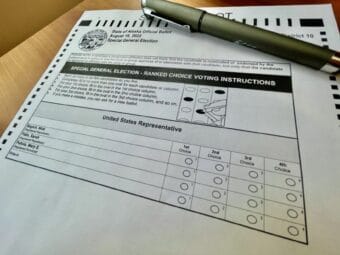
This image was used in an Alaska Division of Elections video explaining ranked choice voting. (Screenshot of Alaska Division of Elections video)

Alaska was the second state to adopt ranked choice voting in federal and statewide elections, but it may be the first to abandon it.

A citizen’s initiative ballot measure that would repeal the state’s open primary and ranked choice voting system made it to the November ballot after legal challenges. As a result, Alaskans will be asked in Ballot Measure 2 to decide if they would like to repeal or keep the state’s open primary and top-four ranked choice voting system.

If the repeal is successful, Alaska will revert to primaries that are controlled by the political parties and general elections where voters pick only one candidate.

The repeal effort centers its argument around the ranked choice aspect of the state’s voting system, while proponents of the system have dug in to fight for the open primary aspect.

The 2020 ballot measure to institute ranked choice voting succeeded with 51% of the vote. But efforts to roll it back ramped up after the system’s debut in the 2022 election.

The 2022 results showed the range of possibilities in statewide elections under the election system: conservative Republican Mike Dunleavy was reelected as governor, moderate Republican Lisa Murkowski was reelected as a U.S. senator, and Democrat Mary Peltola was elected to the U.S. House of Representatives.

Is it partisan?

Phillip Izon II, the man behind the citizen’s initiative effort to repeal the open primary and ranked choice voting, said the effort is about finding the fairest possible voting system, not about its partisan implications.

“The main objective wasn’t because I was a party member, or I was associated with the Republican Party, or anything like that,” he said. “It was primarily because I believe that there was a large percentage of the people, not just in Alaska, but anywhere that ranked choice voting is being implemented, that don’t understand ranked choice voting, and it complicates their voting so much to the point where they just stop voting.”

He pointed to a low general election turnout in 2022 — the lowest in decades.

Prominent Republicans have backed Ballot Measure 2, however. Former Gov. Sara Palin, still smarting from her loss for the state’s sole House seat, was the first to sign the repeal effort’s petition, the Anchorage Daily News reported at the time. And some Republicans pledged to withdraw from their races in this election cycle if they were not among the top vote getters in the primary, in an effort to circumvent the ranked choice system.

But the repeal opposition campaign, No on 2, is chaired by former state Sen. Lesil McGuire, an Anchorage Republican, and has collected millions in donations from national nonpartisan organizations.

Open primaries and ranked choice has benefited Republican and Democrat candidates alike. Notably, Democrat Mary Peltola was elected to the state’s only House seat in Congress after it was filled by Republican Don Young for nearly half a century. Republican Reps. Julie Coulombe and Tom McKay, who were both members of the House’s Republican majority caucus and who both support the repeal, were elected after trailing among voters’ first preferences under the ranked choice system.

What does it cost

State elections officials estimate it would cost $2.5 million to repeal ranked choice voting. That comes after the price tag to institute them, which was $3.5 million in a June estimate from state officials.

But Juli Lucky, campaign manager for No on 2, said there are other costs to an Alaska without open primaries and ranked choice voting, that come in the form of political gridlock. She argues that before open primaries and ranked choice voting, the state’s Legislature was more polarized, and that was expensive.

“The Legislature was not getting organized on time. There was a lot of partisan fighting. We were seeing delays of about 30 days where the Legislature wasn’t actually getting to work, and then we saw a lot of special sessions where there was a lot of arguments and not a lot of solving problems,” she said.

The Legislature called four special sessions in 2021, the year before open primaries and ranked choice voting, costing nearly $2 million.

Open primaries

For the last two decades, Alaska’s primary has been partially closed. The Republican Party limited its primary to registered Republicans and those without a party, while excluding Democrats and third-party voters. The other parties, including the Democratic, Libertarian and Alaskan Independence parties, have shared a primary ballot.

In 2022, with the advent of open primaries, there was only one ballot and all the candidates in each race were on it. Advocates of the open primary say that it benefits the majority of Alaskans because most are not registered with a major political party and do not vote a “straight ticket” — they vote for candidates from multiple political parties in different races. For example, a voter might choose a Republican to represent them as state senator, but a Democrat to represent them in the state House.

Lucky said that ending the open primary would give more power to political parties than to individual Alaskans because parties can choose to close their primaries.

“Right now, we have a system where every Alaskan can vote for any candidate at every election, regardless of the party,” Lucky said. “What’s at stake is taking power away from voters to choose the candidate they like at every election. And I think that’s incredibly important because in the past what we’ve seen is that a lot of races get decided in that lower-turnout primary, which in the recent past has been a closed primary, where voters did not have the ability to look at all the candidates and choose from all the candidates.”

But what looks like a benefit to Lucky, is considered a flaw by those who would like to see the end of the open primary.

Michael Tavoliero, a contributor to conservative Alaska news site Must Read Alaska, wrote in an August post that open primaries and ranked choice voting “blur the lines between political parties, allowing non-Republicans to influence the outcome of Republican primaries and erode both party integrity and conservative values.”

So the multiplicity of choice that open primary proponents value is, in his view, a threat to party ideology.

“In a closed primary, only registered Republicans would have a say in choosing their candidate, ensuring that the nominee aligns closely with the party’s ideology,” he wrote. “Open primaries, on the other hand, can lead to the nomination of candidates who appeal to a broader, less ideologically consistent electorate, potentially weakening the party’s stance on key issues like small government and personal freedom.”

Scott Kendall, an Alaska attorney who helped write the citizen’s initiative that led to open primaries and opposes a repeal, countered that diluting the influence of the parties may be more consistent with representing the will of the majority of Alaska’s electorate that are not affiliated with either major political party.

Of a repeal, he said: “We would be going back to a system where over 80% of the races are decided in the primary by a much more partisan, much smaller group of voters. And I think that’s a huge loss.”

Though Izon’s focus is ranked choice voting, he said the open primary is worth repealing because it is susceptible to manipulation.

“Anybody can finance a candidate to get on the ballot and get into the top four, and then tell them to drop out,” he said, adding that the idea should scare people from any political party. He pointed to the case of Eric Hafner, the imprisoned out-of-state Democrat who is on the U.S. House ballot after a legal challenge failed. “There’s a sizable chunk of the population that don’t even know Eric Hafner is in prison,” Izon said.

He said there are multiple examples of spoiler candidates in this year’s election, so he would rather political parties vet candidates than deal with that.

“Would you rather vote a straight ticket or have a criminal on your ballot in a general [election]?” he asked. “Personally, I would rather vote a straight ticket.”

Ranked choice voting

The main argument of many opponents of ranked choice voting is that ranking candidates is too confusing for voters. Izon said he thinks that confusion is behind a low turnout in Alaska’s 2022 general election. He said it was his grandfather’s bafflement when confronted with a ranked choice ballot that compelled him to begin the recall in the first place.

Lucky countered there were multiple factors that made voting confusing in 2022 that had nothing to do with ranking candidates. She pointed to a redistricting effort that shook up the Legislature.

“Everybody except for one senator had enough change in their district that their seats were up for election, or they were on a schedule where their seats were up for election,” she said.

Additionally, she said, there was a special election to fill Don Young’s congressional seat after his death, closely followed by that year’s primary election.

Nevertheless, she said, 99.8% of ballots in the 2022 general election were filled out properly and more than 70% of voters ranked candidates. She said those results show that voters do understand the election system.

Izon reflected that in fighting one confusing change, he may be precipitating another. But he said he is driven to find the most fair voting system.

“Every time we make a change, we’re hurting someone, and that’s the problem. What is the most fair system right now? I think the most fair system is the system that everyone understands,” he said.

If the quest for the most fair system unites the opposing sides of the recall effort, then its answer divides them.

Peltola, Begich face off in amiable Debate for the State

U.S. House Republican challenger Nick Begich III and Congresswoman Mary Peltola, a Democrat, presented their views Thursday at Debate for the State at Alaska Public Media. (Matt Faubion/Alaska Public Media)

The major candidates running for Alaska’s U.S. House seat squared off Thursday night in a debate in Anchorage, drawing out contrasts on abortion rights and presidential elections, and in personal style.

Democratic Congresswoman Mary Peltola made a forceful case for ensuring women have the right to end their pregnancies, especially because their lives are on the line.

“Being pregnant and delivering a baby is one of the most lethal things a woman can do in her lifetime,” Peltola said. “This is one of the deadliest propositions a woman can undertake. Myriad things can go wrong, and it is not anyone’s place in D.C. or in the state Legislature to get between a woman and her doctor.”

Republican challenger Nick Begich III said he didn’t support a national law banning abortion, nor one protecting abortion rights. He said each state should decide.

Begich, who has the endorsement of former President Donald Trump, voiced a variation on Trump’s false claim of election fraud. Begich alleged that election rules were changed in swing states in 2020 and that Google suppressed free speech as techniques to produce Joe Biden’s win.

“I think it’s acceptable and reasonable for any American to question, hey, is this reasonable? Is this what we expect in a free and fair election?” he said. “And I think the answer is a clear no.”

In other parts of the debate, Begich, a tech entrepreneur, spoke in business terms, about T-bills, liquidity and using cryptocurrency “as a hedge asset class for a devalued dollar.”

Peltola more often exuded empathy, such as for homeless children and victims of disaster and war. To a question about balancing gun rights and school safety, she said the common thread linking school shootings was an isolated perpetrator.

“We need to make sure that every child — every child in our community, every child in our school — feels seen and heard,” she said.

Begich raised competitive youth shooting leagues as a solution to school shootings.

“I believe that training responsible firearm ownership at an early age is a great way to push back against the risk that was just described,” he said.

As she has before, Peltola declined to endorse Kamala Harris, the Democratic nominee for president, or say whom she’d vote for. She said she’s running her own race.

“I don’t know why I would use up any of my gas on a race I don’t have any control over,” she said.

Debate for the State was broadcast from Alaska Public Media’s studio in collaboration with Alaska’s News Source.

After the broadcast ended, the candidates traded notes on the rigors of debating and campaign travel. They shook hands, and both said they wished they’d remembered to do that while the cameras were still rolling.

WATCH: Debate for the State 2024 with U.S. House candidates

Candidates for Alaska’s only seat in the U.S. House of Representatives make their case for your vote during Thursday’s Debate for the State.

Tune in at 7 p.m. for a live debate between incumbent Democrat Rep. Mary Peltola and Republican challenger Nick Begich ahead of the Nov. 5 election. You can also watch live on KTOO 360TV or listen live on the radio.

Debate for the State is presented in partnership between Alaska Public Media, Alaska’s News Source and KTOO.

Updated preliminary vote count in Juneau shows clear victors, Ship Free Saturday downfall

Assembly District 1 candidate Neil Steininger waves signs near Egan Drive on Election Day on Tuesday, Oct. 1, 2024. (Clarise Larson/KTOO)

Preliminary results for Juneau’s local election haven’t budged much since the city last released an update a week ago. 

On Thursday another update showed that Juneau voters continue to reject the Ship Free Saturday ballot initiative, but the two bond propositions related to public safety and infrastructure are soundly passing. 

Incumbent Mayor Beth Weldon continues to hold her lead with a growing margin, as does candidate Neil Steininger for the District 1 Juneau Assembly seat and Maureen Hall for District 2. 

Juneau School Board incumbents Elizabeth Siddon, Will Muldoon and Amber Frommherz are also successfully defending their seats for reelection. Voters continue to reject the recall petitions for School Board President Deedie Sorensen and Vice President Emil Mackey.

Thursday’s count included 10,780 ballots, bringing voter turnout to roughly 38%. That’s more than last year’s turnout. But, there’s still more to be reviewed and processed before the Canvass Review Board meets to certify the final results next week.

Cure letters have been sent to voters who may need to provide more information before their ballots are counted. Election officials encourage voters to check their mail and respond by Monday to ensure their votes are counted.

That ad claiming Begich ‘sold phony medical devices’? Here’s the backstory.

The Alaska Democratic Party sent this mailer. The devices it refers to were sold by a company the candidate’s father founded. Nick Begich Sr. says it never sold “medical devices” and never marketed them to seniors. (Liz Ruskin/Alaska Public Media)

Democratic Congresswoman Mary Peltola is running an attack ad on her Republican opponent, disparaging how he made his personal wealth.

“Nick Begich only looks out for himself,” her campaign ad begins, over ominous music. “First, he hired workers in India instead of Alaska to make himself rich. Now we learn he cashed in with an online company that pushed phony medical devices to seniors.”

With the campaign ad, Peltola breaks with the Alaska-nice campaign tradition she set in 2022. She’s throwing shade on the brightest feature of Begich’s personal history as he sells himself to Alaska voters: That he’s a brilliant and successful businessman. And the Alaska Democratic Party is doubling down with a new mailer accusing Begich of “scamming seniors with fake medical devices.”

Both the Peltola and Begich campaigns rejected interview requests to discuss the claim. But in an email, the Peltola campaign said the allegedly “phony medical devices” the ad refers to were sold on EarthPulse.com, a business started by the candidate’s dad in the late 1990s, primarily to sell Nick Begich Sr.’s writings about mind control and the alleged powers of a University of Alaska Fairbanks antenna array known as HAARP.

EarthPulse.com also used to sell several electronic products, such the “Alpha-Trainer biofeedback anti-tension device” headset and the handheld “Pointer-Plus.” The website said the Pointer-Plus could locate acupuncture points and stimulate them. “Never miss the point!,” the web copy said. “A complete clinic in your hands.” It sold for $149.

The Pointer-Plus is still for sale on other websites and some models have good reviews on Amazon.com. The problem, the Peltola campaign said, is in the claim the Begich-owned business made for the product.

“Earthpulse advertised Pointer-Plus as basically being 100% accurate and the sole acupuncture tool needed,” the campaign said in an email. “An academic study found it was NOT reliable and should NOT be used by itself.”

Nick Begich Sr. said it was a good product and that his website made no false claims.

“It is 100% accurate at locating points,” he said, when asked about one of the products the Peltola campaign takes issue with, “unless you have some tissue disturbance, like a scar that would interfere with the normal flow of energy across the surface of the skin.”

The elder Begich said Peltola’s ad alleging the company “pushed phony medical devices to seniors” is wrong, because they weren’t medical devices. And, he said, they weren’t pushed on seniors.

“Never,” he said. “We’ve never marketed anything for any specific group, seniors or otherwise.”

He estimates that his company sold fewer than 500 devices over 20 years.

The EarthPulse website recently went offline. Nick Sr. said he’s done with retail. Anyway, he said, his son was just a passive investor.

The candidate’s financial disclosures show he owns a 17% stake of EarthPulse Press that’s worth between $1 million and $5 million. In the latest filing, Begich reports earning less than $50,000 a year from EarthPulse. That’s a drop from the two prior years, when he reported that his stake earned him more than $50,000 a year.

It’s through a different company Begich III owns that he created jobs in India.

That one is FarShore Partners, a software development company he founded. When Nick Begich III first ran for Congress two years ago, FarShore was central to the image he projected as a successful tech entrepreneur, and he never hid that many or most of its workers were overseas.

This year, it’s hard to find any mention of Begich on the FarShore website. The Peltola campaign isn’t the only one making an issue of FarShore’s non-Alaska focus.

“How many Alaska jobs did businessman Nick Begich create? Seems almost none,” an ad from a pro-Peltola group called Vote Alaska before Party says. “Instead, seems almost 90% of Begich’s employees are in India. Which is nice — for India. While doing nothing for Alaska.”

Anchorage consultant Jim Lottsfeldt, who leads Vote Alaska Before Party, said the geography of Begich’s job creation matters.

“It shows you a little bit where his head’s at,” Lottsfeldt said. “He doesn’t see the future of Alaska in business. He sees it as a place where he doesn’t have to pay taxes, and he’s got a famous last name, and he can get into politics, but he’s not investing in Alaska.”

Actually, Begich’s candidate disclosure form shows he has invested in several Alaska businesses.

“Nick has created hundreds of jobs in Alaska,” a Begich campaign spokeswoman said by text message.

She cited his 15% stake in Stuaqpak Inc., through which he’s the partial owner of grocery store in Utqiagvik. That’s one of several investments Begich has made in partnership with his well-known uncle, former U.S. Sen. Mark Begich. Mark and Nick Begich III also teamed up to form an Anchorage-based consulting firm, Begich Capital Partners.

Moderate Alaska House and Senate candidates lead in fundraising a month out from election

Voters stand in line at Anchorage School District waiting to receive their ballot for Alaska’s primary election on Tuesday, Aug. 20, 2024. (Matt Faubion/Alaska Public Media)

Moderate candidates have a large fundraising advantage in state House and Senate races key to control of the Alaska Legislature, according to a new round of campaign finance data reported a month ahead of Election Day.

“Moderate to progressive people have figured out fundraising better than their Republican counterparts,” political consultant Jim Lottsfeldt, who has worked with centrist and left-leaning candidates, said in an interview.

Democrats, independents and Republicans open to a bipartisan caucus have raised a combined total of more than $2.5 million, according to an analysis of campaign finance data. Republicans who would only join Republican-led coalitions have raised about half that.

Moderate and left-leaning candidates have an especially large advantage in Anchorage-area races. Midtown Rep. Andy Josephson, a Democrat, is outraising Republican challenger Heather Gottshall by a more than four-to-one margin with nearly $140,000 in contributions. Democratic Sen. Matt Claman of West Anchorage has raised $190,000 to Republican Liz Vazquez’s roughly $11,000. Rep. Craig Johnson of South Anchorage, a senior member of the conservative Republican House majority, has raised $28,000, roughly half the funding of his more moderate Republican challenger, former Rep. Chuck Kopp.

In northeast Anchorage, Democrat Ted Eischeid has raised more than four times the total of Republican incumbent Rep. Stanley Wright. Eischeid chalked his lead up to the strength of his message.

“I think my three priorities of education, public safety and infrastructure really resonates with donors,” he said. Wright did not respond to an interview request.

In another closely watched Senate race, Kenai Peninsula Sen. Jesse Bjorkman, R-Nikiski, has raised $131,000, roughly twice as much as challenger Rep. Ben Carpenter, R-Nikiski, who is challenging him from the right. Savannah Fletcher, an independent candidate for the open Senate District R seat covering much of the Interior, has raised $120,000; Rep. Mike Cronk, R-Tok, the conservative candidate for the seat currently occupied by outgoing Sen. Click Bishop, R-Fairbanks, has raised $95,000.

But in another Fairbanks race, the dynamic is reversed: a Republican challenger is outraising a Democratic incumbent in the race for a state Senate seat. Leslie Hajdukovich, a former staffer for U.S. Sen. Dan Sullivan, R-Alaska, challenging Sen. Scott Kawasaki, D-Fairbanks, a member of the current 17-member bipartisan majority, has raised more than $196,000.

In an interview, Hajdukovich cast herself as more moderate than many Republican candidates. She said she would have voted to overturn Gov. Mike Dunleavy’s veto of a bipartisan education bill and said she’d be open to joining the Senate’s bipartisan coalition, which currently features nine Democrats and eight Republicans.

“I am a Republican, and I would hope for a Republican majority, but either way, the leadership in the Senate is going to be bipartisan the way the makeup is,” she said. “I would not join a Democrat-led coalition, but I would be open to a Republican-led coalition.” She said she saw the current Senate majority as a “slight[ly] Republican-led coalition.”

However, she opposes a return to a pension plan for state employees and told the Alaska Beacon she supports a bill proposed by Republicans last session that would ban transgender girls from girls’ sports. She said she is “personally pro-life.”

Hajdukovich has some notable major donors, including the CEO of Hilcorp, Luke Saugier, who donated more than $1,500 and Diane Bundrant, the wife of the late co-founder and majority owner of Trident Seafoods, who chipped in $2,500. Her largest single contribution, $4,435, comes from the Capital City Republicans in Juneau.

Just over half of Hajdukovich’s nearly 600 contributors list a Fairbanks address, according to campaign finance records, and 8% of her contributions come from out of state. Her average donation so far has been $336.14. Hajdukovich has spent nearly $160,000 as of this week.

Kawasaki, meanwhile, has raised roughly $166,000 and spent just $33,000, according to campaign finance records.

Like many Democrats and independents who support a return to a defined benefit retirement plan for state employees, Kawasaki has strong support from organized labor groups, including the AFL-CIO, the Alaska State Employees Association, the National Education Association and the International Brotherhood of Electrical Workers.

“We need to be competitive to keep teachers here in Alaska,” he said. “There is a high cost of living, and one of the ways that we can keep teachers is with a good public pension system like we used to have.”

Roughly a third of his contributions come from Fairbanks addresses, and about half are from donors with Anchorage addresses, including $11,000 from attorney Robin Brena and $7,000 from relatively new political contributor Justin Weaver. Brena has spent more than $80,000 on campaigns this cycle, and Weaver has contributed more than $100,000 to Democrats and moderate candidates.

Candidates for state House and Senate have raked in some $4.5 million in total contributions. But that amount is dwarfed by the war chests amassed by some independent expenditure groups: No On 2, opposing the repeal of ranked choice voting and open primaries, has raised $12.3 million and spent nearly $8 million. Yes On 2, supporting the repeal, has raised just over $100,000 as of late September. Two groups supporting Ballot Measure 1, which would increase the minimum wage from $11.73 to $15 an hour by 2027 and provide workers with sick leave, have raised $3.8 million.

Left-leaning and centrist independent expenditure groups also appear to have an edge in spending. Putting Alaskans First Committee, funded largely by union members, has spent more than $500,000 supporting left-leaning and moderate Republican legislative candidates. The American Leadership Committee, funded by the party-affiliated Democratic Legislative Campaign Committee, has outlaid nearly $140,000 supporting Democratic candidates. Americans for Prosperity has spent nearly $160,000 in support of conservative candidates, and Families of the Last Frontier, a Republican Party-affiliated group, has spent more than $326,000.

Matt Shuckerow, a political consultant who has worked extensively with conservative candidates, said voters should look closely at who donates to campaigns and consider their motives. But at the same time, he noted, spending does not always translate into electoral success.

“Fundraising is just one measure of the success of a campaign. Ultimately, it’s how you spend those resources,” he said.

Site notifications
Update notification options
Subscribe to notifications