4 Special Coverage

Effort to repeal Alaska’s ranked choice voting still holds narrow lead

Dorthy Smith (right) waves a sign in support of Ballot Measure 2 in Anchorage on Monday, Nov. 4, 2024. (Matt Faubion/Alaska Public Media)

Ballot Measure 2, the effort to repeal Alaska’s ranked choice voting and open primaries, was winning slightly as election results continued to come in early Wednesday, with about 97% of Alaska precincts counted.

Wednesday results showed Ballot Measure 2 ahead by 4,289 votes, out of a total of more than 256,000 ballots cast. That’s a margin of less than 2 percentage points.

The other initiative on Alaska voters’ ballots, to increase the state’s minimum wage, appeared headed to victory, with a margin of 13 percentage points.

Loren Leman, a former Republican lieutenant governor who worked with the campaign to repeal ranked choice voting and open primaries, pointed to the Ballot Measure 2 campaign being outspent 100-to-1.

“I think just the very fact that the numbers are that close, even after they spent all the money, says that Alaskans don’t really want the complexities of ranked choice voting, and it’s confusing to a lot of people and it’s unnecessary,” Leman said.

View the full results here.

Anchorage attorney Scott Kendall, an architect of the 2020 ranked choice voting law and an opponent of 2024’s Ballot Measure 2, said he was feeling positive as results showed the margin between “yes” and “no” votes narrowing late Tuesday.

“We knew this would be a tight race,” Kendall said. “However, when it comes to outstanding votes, it’s like real estate: location, location, location. It’s noteworthy that in our strongest core of support in rural Alaska, very few votes are in.”

Alaskans had narrowly adopted the voting method in 2020. It was first deployed in 2022, in a special election for U.S. House that Democrat Mary Peltola won.

The system’s fans say it encourages bipartisanship and gives candidates an incentive to appeal to a broader swath of the electorate.

But opponents, especially conservatives and the state’s Republican Party, never liked it.

Jeff Fenske, who was waving campaign signs in Midtown Anchorage before polls closed, said he didn’t trust the tabulation process and he really resented that the opponents of repeal were able to raise so much money from out of state to keep ranked choice voting.

“It doesn’t help the conservative cause at all,” Fenske said. “You know, they just made up a bunch of stuff, and they have so much money for those ads that they were able to manipulate people’s opinion.”

The new system did away with partisan primaries. Instead, candidates of any party and stripe appeared on the same August ballot. The top four finishers — or more, in the case of presidential elections — advanced to the November ballot.

In the general election, ranking gave voters the opportunity to participate in an “instant runoff.” Voters could choose their favorite and also rank the remaining candidates to indicate where they’d like their ballot to go if their No. 1 choice was eliminated.

Toby Ovod-Everett of Anchorage waved on “No on 2” at rush-hour traffic. He said the open primary and ranked choice voting produces “less bickering and more governing.”

“I’d like to see more centrist candidates, candidates that I would agree with less, but that I could feel like were maybe beginning to combat this hyper-partisanship that is taking over the country,” Ovod-Everett said.

No on 2 ran a $14 million campaign, pitching the issue as one of “voter freedom” — meaning the freedom to vote a ballot that includes all the primary candidates, regardless of party. Some of their ads suggested veterans would be “forced to join a political party in order to vote for the candidate we want.”

Before the 2020 election reforms, the Republican party limited access to its ballot but still allowed unaffiliated voters to vote in its primary. Leman called the No on 2 claims misleading, because no one was forced to join the Republican party to vote in the GOP primary.

“It was an open primary, or you can say a semi-open: It was open to all voters, 80% of the voters of Alaska, except for those who chose to be registered to another party,” he said.

The Yes on 2 campaign raised barely more than $150,000.

Thousands of ballots remain to be counted over the next 15 days, but if Ballot Measure 2 passes, parties would regain the right to close their primaries to the extent they choose.

If voters do end up approving Ballot Measure 1, the state’s minimum wage would increase in steps, to $13 an hour in 2025, $14 in 2026 and $15 in 2027. The initiative would also require that the state’s minimum wage is set at least $2 more than the federal minimum wage and require paid sick leave for many employees.

This story has been updated. 

Find the latest election results at ktoo.org/elections

Race for Alaska’s congressional seat tilts Begich with almost all precincts counted

Republican U.S. House candidate Nick Begich helps wave campaign signs with supporters in Anchorage on Monday, Nov. 4, 2024. (Matt Faubion/Alaska Public Media)

Republican challenger Nick Begich III has built a lead in the race for Alaska’s U.S. House seat.

With about 97% of precincts reporting by Wednesday afternoon, Begich led incumbent Democratic Congresswoman Mary Peltola by about 10,500 votes, with 49.6% of the vote to Peltola’s 45.5%.

The current vote tally is just first-choice ballots. If no candidate gets more than 50% of the vote, ranked choice tabulation will determine the winner on Nov. 20.

View the full results here.

Late Tuesday, Begich arrived to cheers at his election night party at a hotel in downtown Anchorage. Attendees were also applauding national results showing Republican presidential candidate Donald Trump, who endorsed Begich, winning key battleground states.

Begich told his supporters that Alaska has an important role to play in national politics.

“The pathway to America’s prosperity starts in Alaska, but it’s not good enough to know that,” Begich said. “We got to talk about it down in D.C. We got to be down in D.C. We only have one person in the House, and we need Alaska’s voice in the House.”

One attendee, Gretchen Stoddard, said she voted for Begich because she wants a Republican majority in the U.S. House.

“Honestly, I think it’s good for our state,” Stoddard said. “I think it’s good for my child, you know, the economy.”

Begich, an entrepreneur who lives in Chugiak, is a Republican from a prominent Democratic family. If his lead holds, he’ll win the seat once held by his grandfather. Congressman Nick Begich, D-Alaska, was campaigning for reelection in 1972 when his chartered plane disappeared enroute to Juneau.

Nick Begich III greets supporters on Tuesday, Nov. 5, 2024, at the Marriott hotel in downtown Anchorage. (Matt Faubion/Alaska Public Media)

View the full results here.

At the Peltola watch party, also in downtown Anchorage, the national results flashed on a TV screen behind the bar, and people checked their phones for the early Alaska results.

Peltola urged her supporters to remain patient.

“We’re not going to know results until, like, three days before Thanksgiving,” she said.

Someone in the crowd booed.

“Boo to that,” Peltola agreed, but she said the delay leaves a lot of time “to celebrate.”

“And remember, we’re all in this together. We’re all Americans,” she said, in an apparent nod to the national results. “We’re all pulling for the same things. We all love the same things.”

Democratic stalwart Jane Angvik said she was hopeful Peltola could win and she was philosophical about the presidential results.

“I believe that she’s done a really good job of making sure that she can work with whoever is the president in the United States, and that is to our advantage,” Angvik said.

U.S. Rep. Mary Peltola greets supporters on Election Night, Nov. 5, 2024, at 49th State Brewing in downtown Anchorage. (Matt Faubion/Alaska Public Media)

Peltola became the first Alaska Native person elected to Congress when she won the 2022 special election. She beat Begich and Republican Sarah Palin. Months later, she won reelection in the 2022 regular election, beating Begich and Palin again.

A year after she took her oath of office, in September of 2023, the congresswoman’s husband, Eugene “Buzzy” Peltola, died in a plane crash in western Alaska.

Unlike the 2022 election, Begich’s rival Republicans declined to accept their spots on the general election ballot this year, clearing the field for Begich to benefit from a huge influx in national money.

The Alaska race was one of only about two dozen House races across the country considered a toss-up. Political groups spent more than $28 million to influence the outcome, hoping to win the House speaker’s gavel for one of the major parties.

That spending bought independent ads that echoed the claims of candidates but were outside their control. The outside money was almost evenly divided between Begich and Peltola, diminishing the Peltola campaign’s 6-to-1 fundraising advantage. She raised some $12 million for her campaign, while Begich raised about $2 million.

John Wayne Howe of the Alaska Independence Party had taken about 3.9% of votes in the House race in early returns.

Democrat Eric Hafner, a federal inmate who has never been to Alaska, had 1%.

This story has been updated. 

Find the latest election results at ktoo.org/elections

Juneau voters share why they’re voting — and why it matters

McClain Taylor-Manning, 4, waits patiently as his mother, Jackie Manning, votes at Centennial Hall on Tuesday, Nov. 5, 2024. (Clarise Larson/KTOO)

Election Day was stormy in Juneau, but voters moved steadily through polling places as they dispatched their civic duty.

Out at the Auke Bay Ferry Terminal, gusts of wind kept knocking down the “vote here” sign. While election workers tacked it back up, voters trickled in and out of the voting center.

David Gaudet has been voting in Juneau since 1984.

“I have never missed an election. I just think it’s our duty to do that,” he said. 

Gaudet wouldn’t say which candidates he chose, but he said he’s glad he got to express his support of ranked-choice voting. 

“I was unhappy to see it trying to be repealed. But I was happy to be able to vote that I like it again,” he said. 

This year was Oliver Sheufelt’s first time voting in a presidential election in Juneau.

“Everybody’s got to chip in and do your civic duty, just like taking out the trash and going to the dentist. It’s just one of those things for societal health that’s important,” they said. 

They also said that it was important for them to vote to keep ranked-choice voting and that they chose Mary Peltola for Alaska’s U.S. House seat and Vice President Kamala Harris for President.

At the University of Alaska Southeast Rec Center, Valley residents stopped to vote in between work, classes and family obligations. 

James Pietan said he voted to repeal ranked-choice voting and for former President Donald Trump. 

Gunnar Tarver said he also voted for Trump. He reflected on the historical importance of voting and American democracy.

“Like for the generations before us, they all fought on the line with their lives, and they got us this right, and so I think it’s good for us to exhibit it,” he said. 

Linda Blefgen said she’s always voted. 

“It’s part of being a citizen and having a voice, and this election, particularly as a woman, this is not one to miss,” she said. 

Blefgen said she’s a Harris vote and she’s supporting ranked-choice voting, too. 

A voter heads into the Centennial Hall voting precinct on Tuesday, Nov. 5, 2024. (Clarise Larson/KTOO)

At Centennial Hall downtown, Liam Parrott, a member of the U.S. Coast Guard, said he also cast a vote to keep ranked-choice voting. He said that’s the only thing he really cared about on the ballot. 

“I’m gonna be honest, I really don’t like any of these people that are running,” he said. “It’s pretty obvious that it’s only gonna be Kamala or Trump because everybody’s so polarized. It’s been very polarized for a long time now, and I don’t see it getting very better.”

A short while later, Shawn Hatt Cohen also steps out of Centennial Hall. She said she votes every election. She voted Democrat, like she always does. 

“It’s just sort of the civic duty that I take very seriously,” she said. “I want to make sure democracy stays alive and well.”

Hatt Cohen said she supports Harris’ policies for reproductive rights and price gouging. Her eyes brimmed with tears when she shared what democracy means to her. 

“I think it’s the freedom to live our lives as we choose,” she said. 

Find live election results once the polls close at ktoo.org/elections. KTOO will carry Alaska Public Media’s live state election coverage from 9 p.m. to 11 p.m. Tuesday on 104.3 FM and online. That follows special live national coverage from NPR. 

Alaska voters head to the polls with bad weather delaying voting in 2 remote communities

About a dozen people were lined up outside Airport Heights Elementary School in Anchorage at 6:55 a.m. on Election Day, Nov. 5, 2024. (Bart Rudolph)

Early-morning Election Day voters in Anchorage had to contend with high winds and downed power poles Tuesday that caused an outage slowing Midtown traffic.

One Anchorage polling place, at Tudor Elementary School, was briefly impacted by the power outage. The high wind warning for Anchorage ended at noon.

Michaela Thompson, the operations manager for the state Division of Elections, said all polling places were open across the state early this afternoon except in two remote communities: St. George in the Pribilof Islands and Wales near Nome were closed due to weather-related issues.

“St. George is in the middle of a windstorm and will try to open at 2 p.m. today,” Thompson said. “We have a team to work at Wales, but they are waiting for the weather to allow travel.”

There are 63 registered voters in Wales and 31 in St. George.

A line of voters at Ptarmigan Elementary School in Anchorage on Election Day, Nov. 5, 2024. (Wesley Early/Alaska Public Media)

In Anchorage, Alaska Public Media reporters saw early lines at polling places ranging from a dozen people to 50 waiting to vote soon after polls opened at 7 a.m. But lines became shorter by midday.

Across the state, there was a steady turnout at many polling places, from Kodiak to the Aleutians to Nome to the Kenai Peninsula. Homer City Hall saw a “steady trickle of people” during the day, while an Unalaska election worker reported more than 100 voters showing up by 10 a.m., describing it as a good turnout. In Nome, voters were coming and going in waves from Old St. Joe’s Church.

Kodiak voters faced no lines while casting their ballots at one of the local fire halls Tuesday afternoon.(Brian Venua/KMXT)
A steady trickle of voters cast their ballots at Old Saint Joe’s in Nome early Tuesday. (Ben Townsend/KNOM)

Meanwhile in Anchorage, the power outage reported at 7 a.m. by Chugach Electric affected about 3,100 members. Power was restored in about an hour. The Old Seward Highway remained closed as of about 1 p.m. between Sylvan Drive and Dowling Road as the utility responded to the downed poles.

KBBI’s Jamie Diep, KNOM’s Ben Townsend, KUCB’s Sofia Stuart-Rasi, KMXT’s Brian Venua and KDLL’s Hunter Morrison contributed to this report.

Feds to monitor compliance with voting rights laws in rural Alaska

A voter fills in a ballot during Bethel’s municipal election on Oct. 1, 2024. (MaryCait Dolan/KYUK)

The U.S. Department of Justice will monitor Alaska’s compliance with federal voting rights laws in rural areas of the state for the Nov. 5 election, according to a statement from the agency.

The five areas of focus will be the Bethel Census Area, Dillingham Census Area, Kusilvak Census Area, North Slope Borough, and Northwest Arctic Borough – almost the entirety of the Northern and Western reaches of the state, with the exception of the Nome Census Area.

Officials in some Republican-led states, including Texas and Florida, have said they will not allow federal monitors to enter polling places. Asked whether Alaska would cooperate with DOJ’s monitoring efforts, Gov. Mike Dunleavy’s office referred questions to the Alaska Division of Elections. Neither state election officials nor the DOJ responded to emails Monday.

The state of Alaska has historically struggled to deliver equal voting opportunity to rural parts of the state – areas off the road system that tend to be higher-percentage or predominantly Alaska Native.

Seventy-seven communities in Alaska don’t have their own polling place, or share a polling place with a different community, according to the nonpartisan “Get Out the Native Vote” effort affiliated with the Cook Inlet Tribal Council.

In this year’s primary election, over a dozen communities experienced a late start to voting, including the Yukon-Kuskokwim Delta communities of Napaskiak and Stony River.

There is also only one early voting location in the entirety of rural Alaska: in Nome at the Region IV elections office. Some rural hub communities have the opportunity to vote early through absentee in-person ballots, which have historically been rejected at a higher rate than early votes in urban communities. The rejection rate can in part be explained by the fact that for early voting, eligibility is verified before a ballot is cast. With absentee ballots, eligibility is verified after the ballot is cast.

In June, the DOJ announced its finding that Alaska had violated the Americans with Disabilities Act (ADA) in 2022 at the local, state, and federal level by not properly providing people with disabilities access to voting.

In 2023, a U.S. District Court also approved the extension of a settlement in a long-standing case against the state, which alleges that Alaska violates the Voting Rights Act by not providing adequate language assistance to Alaska Native voters.

Earlier this year, DOJ monitored Alaska’s primary elections for compliance with language assistance requirements and other federal voting rights laws.

And just last month, the Alaska Division of Elections also delivered incorrect ballots to more than 90 voters who’d voted early through absentee in-person voting in Dillingham, King Salmon, and Aniak, according to the Anchorage Daily News.

On Election Day, DOJ said that Civil Rights Division personnel will be available to receive questions and complaints from the public related to possible violations of federal voting rights laws. Reports may be made through the department’s website www.civilrights.justice.gov or by calling toll-free at 800-253-3931.

Juneau’s early voters brave long lines to cast their ballots

People wait in line to vote early at the Mendenhall Mall on Monday, Nov. 4, 2024. (Clarise Larson/KTOO)

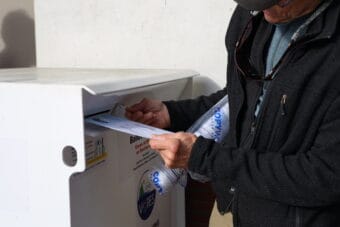
Tuesday is the big day — voters across the state will head to the polls for Election Day. That’s unless they’ve taken advantage of early voting, which is already underway.

Long lines for early voting and uncontested local races in Juneau haven’t stopped voters here. Juneau resident Amy Smith described how it felt to cast her first-ever vote in a presidential election at the Mendenhall Mall on Monday. 

“A mix of exciting and nervousness, making sure I filled out everything correctly,” she said.

Early voting in Juneau took place at the Mendenhall Mall and the State Office Building. On Monday afternoon, the line at the mall was out the door. But Smith said it was worth the roughly 45-minute wait. 

 “I just want my voice to be heard, and I just don’t want the country to go in a direction I don’t want it to go without my say,” she said. 

Lauri Wilson, the state’s Region 1 election supervisor, said throughout the weekend the mall had lines out the door and into the parking lot.

“We’ve had a good voter turnout,” she said. “We’re happy to see voters turn out here and get their vote in for the 24’ general election. We expect today to be pretty steady as well as tomorrow.”

People voting early at the Mendenhall Mall on Monday, Nov. 4, 2024. (Clarise Larson/KTOO)

On the ballot, voters can rank candidates for president and vice president, Alaska’s sole U.S. House seat and the local state House and Senate races. Plus, there are two ballot propositions asking voters whether to raise the state’s minimum wage and repeal ranked-choice voting. 

Juneau resident Jake Carpenter lives downtown but was in the Valley on Monday to cast his ballot. 

“I mean, all elections are important, right?” he said. “I think this is kind of a pivotal moment for our nation when it comes to our democracy. So I’m glad to see so many people out here voting, and I hope that they, and I imagine that they all recognize the gravity of this election.”

Carpenter said the presidential election is what motivated him the most to go out and vote, but he said everything on the ballot was important for him to consider. 

Juneau has one seat in the Alaska Senate. It’s filled by Jesse Kiehl. Sara Hannan and Andi Story fill Juneau’s two seats in the Alaska House. All are Democrats who took office in 2019. They’re also running uncontested for reelection.

“Voters in our region have got to show up and make your voices heard, because it matters tremendously,” Kiehl said in an interview. “If our issues are going to remain important issues, our votes have to count statewide, and that means we have to go out and cast them. It’s as simple as that.”

Kiehl said despite all Juneau’s races being uncontested, every vote counts. After all, Southeast Alaska makes up roughly 10% of the state.

All three lawmakers have been strong supporters of getting a permanent increase to state education funding – an issue that dominated the last legislative session. Story said it’s one of the main reasons she’s running again.

“I can just taste we are so close to getting a permanent education BSA, Base Student Allocation, over the finish line,” she said. 

Hannan said voter participation is what helps her shape what policy she and other lawmakers choose to focus on — policy that can directly impact the lives of people in Juneau and across Alaska. 

“My job as a legislator, I represent everyone who lives in my district, whether they vote for me or not, and everyone in the state, so hearing from a diversity of voices helps us formulate policy and people need to remember that,” she said. 

And for Juneau residents like Feleti Tupou, voting means much more to him than just filling out some bubbles. 

“Freedom. The opportunities are endless in this country,” he said. “If we come out here and support the election, and be able to choose the things that we have then that’s what brings freedom to us. There are many countries out there that cannot do that.”

Juneau voters can find more information about where and how to vote on Election Day by visiting the Alaska Division of Elections website.

The first round of election results is anticipated to drop shortly after the polls close at 8 p.m. – but we may not know the outcome of some races for weeks. Final results will be certified later this month. 

Site notifications
Update notification options
Subscribe to notifications