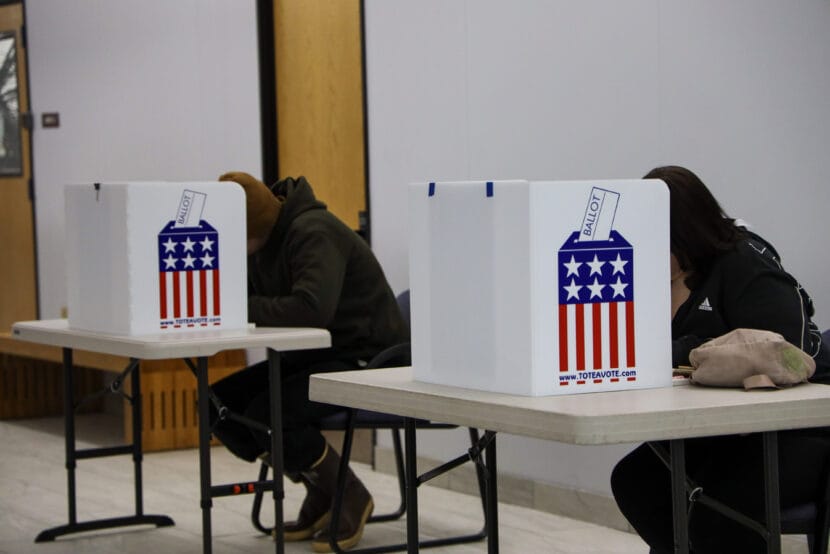
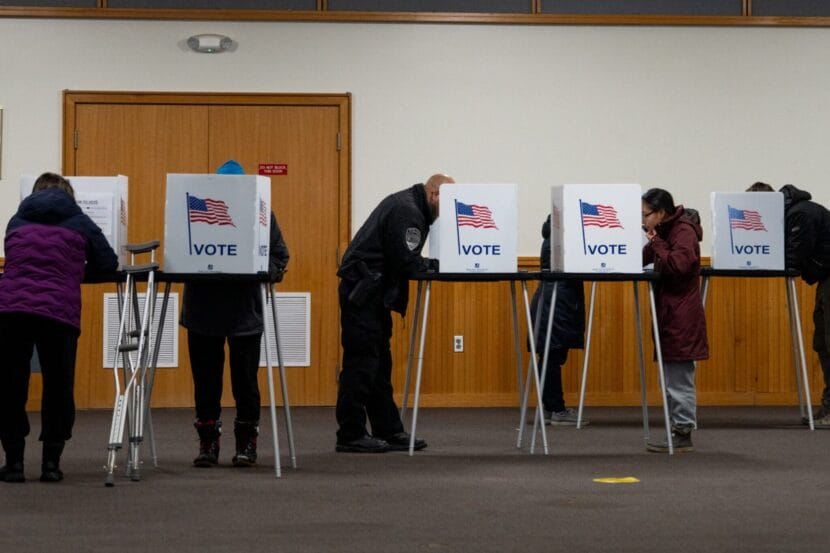
People voting early at the Mendenhall Mall on Monday, Nov. 4, 2024. (Clarise Larson/KTOO)
Former Republican President Donald Trump is set to return to power and preliminary election results show Republican Nick Begich III leads the race for the state’s sole U.S. House seat.
But in Juneau, there’s a slightly different story unfolding. Though voters were split on who should be president, there’s little question about who voters in the capital city wanted in the U.S. House – Democratic incumbent Mary Peltola.
Peltola outpaced Begich in every Juneau precinct – even in the five precincts from the Juneau International Airport to Mendenhall Valley that went for Trump. Downtown and Douglas voters overwhelmingly leaned blue in both races.
That’s different from the rest of the state. Though preliminary results show Peltola is leading in rural and coastal Alaska communities, Begich controls much of the area surrounding Anchorage and Fairbanks. And with nearly all state precincts counted as of Wednesday afternoon, the race tilts in his favor by about 10,500 votes.
Begich is an entrepreneur who lives in Chugiak. He’s a conservative from a well-known Democratic family in the state. His grandfather won the same U.S. House seat as a Democrat back in 1970.
Peltola’s favor among Juneau voters isn’t all that surprising. She already won in Juneau in her last two elections. She became the first Alaska Native person elected to Congress when she won the 2022 special election. She beat Begich then, along with Republican Sarah Palin. Months later, she also won reelection in the 2022 regular election, again beating Begich and Palin.
In the 2020 presidential election, Juneau voters overall opted for the Democratic choices as well — Joe Biden for president, Al Gross for U.S. Senate and Alyse Galvin for House.
Election results are not yet final. Begich holds 49.6% of the vote to Peltola’s 45.5% as of Wednesday evening. The current vote tally is just first-choice ballots. If neither candidate secures more than 50% of the vote, ranked-choice tabulation will determine the winner on Nov. 20.
The Alaska Division of Elections on Wednesday did not give a clear timeline of when updated results would be released.
Juneau’s local delegation in the Alaska Legislature are all Democrats. In this election, incumbent Sen. Jesse Kiehl, Rep. Andi Story and Rep. Sara Hannan ran unopposed. They will all serve another term.
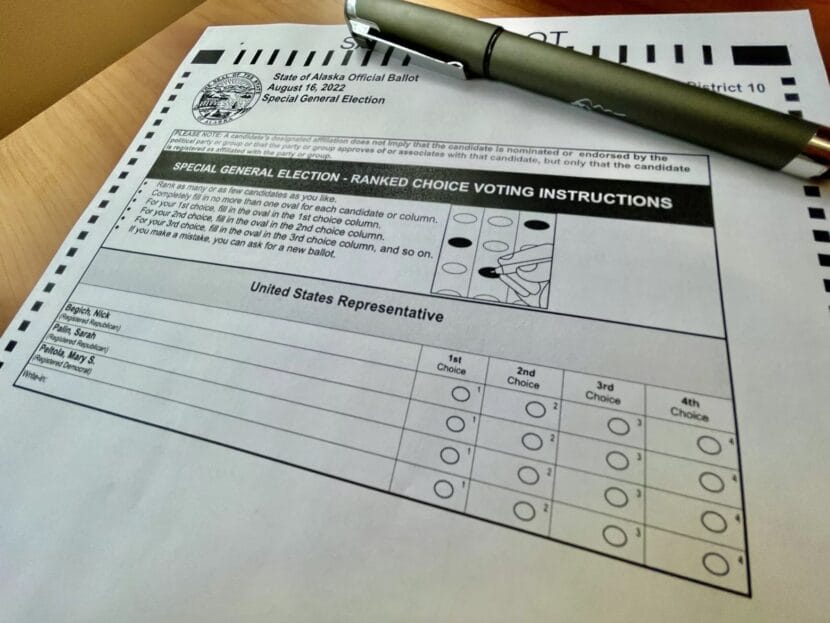
A sample ballot from the 2022 special election. (Liz Ruskin/Alaska Public Media)
An absentee in-person voting location in Bethel ran out of official ballots on Monday and started recording votes with sample ballots. The move prompted some concern on a popular community Facebook page, but the state said that it was perfectly legal.
A screenshot of a post that briefly appeared (since deleted) on a popular Bethel community Facebook page on the afternoon of Nov. 4. (Facebook)
“If a location runs out of official ballots they are permitted to use sample ballots as official ballots, and any voter voting on those samples, their votes will still be counted,” Jackson said.
Alaska Division of Elections Director Carol Beecher said that her office was notified that official ballots had run out at the Orutsararmiut Native Council (ONC) building in Bethel at some point on Tuesday afternoon, just hours before the absentee in-person polling location closed.
Beecher said that the shortage of official ballots was a result of historic high voter turnout. She said that the number of ballots sent to early and absentee in-person polling locations across the state was based on numbers seen in the 2020 United States presidential election.
According to Beecher, the early polling location for Dillingham also reported running out of official ballots on Monday.
Beecher said that the state did not anticipate any shortage of official ballots on Election Day, Nov. 5.
Anyone with concerns about voting is urged to contact the Alaska Division of Elections at 907-465-4611, or by email at elections@alaska.gov.
Pedestrians pass the Nesbett Courthouse, located in downtown Anchorage on August 31, 2022. (Valerie Kern/ Alaska Public Media)
All 19 of Alaska’s state judges up for election this cycle are leading in their bids to remain on the state bench, including the judge who faced a campaign to oust him over his controversial homeschool ruling.
Voters are so far approving Anchorage Superior Court Judge Adolf Zeman by the slimmest margin, with 53% saying yes to his retention, meaning he’d serve another six years on the bench.
Zeman was the only judge on this year’s ballot to face an organized removal campaign.
The campaign followed his ruling that the state’s correspondence school system violated a provision of the state constitution that bars the use of state money for the benefit of a private or religious school, since some parents use the system to subsidize private school tuition. The ruling was set to take effect in July until the Alaska Supreme Court set it aside on technical grounds, saying school districts were a necessary party to the suit, and sent it back down to the lower court.
Though the ruling did not take effect, it led two conservative groups — Alaska Family Action and a local chapter of Moms for Liberty — to organize a campaign urging voters in Southcentral Alaska to oust Zeman.
It is extremely rare for voters to remove judges from the bench. In state history, just six judges have been ousted in retention elections. However, approval of state judges has fallen to record lows: in 2022, 19 of the 20 judges up for retention won with less than 60% of the vote.
This year, the independent commission that selects nominees for the bench, the Alaska Judicial Council, recommended that all judges, including Zeman, be retained based on performance evaluations that incorporate feedback from attorneys, jurors and others who interact with the court system.
View the full election results here. Additional ballots will be counted in the coming days and weeks.
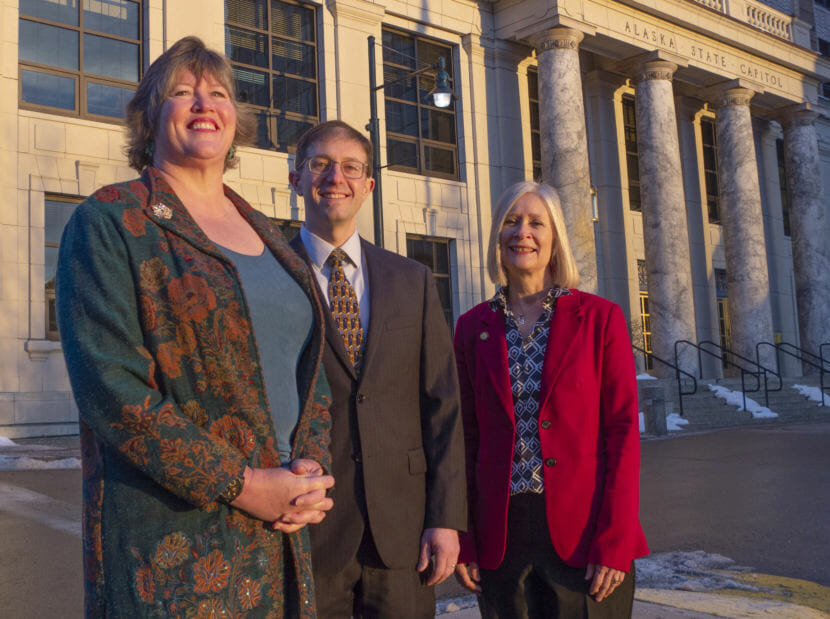
From left to right: Rep. Sara Hannan, Sen. Jesse Kiehl and Rep. Andi Story pose for photographers outside the Capitol in Juneau on Jan. 16, 2019. The three Democrats were newly sworn in to represent Juneau in the Alaska Legislature. (Photo by Skip Gray/KTOO)
As results continue to trickle in for the national and state elections, Juneau’s local outcome, at least, is clear.
Juneau’s delegation in the Alaska Legislature ran unopposed this year. Incumbents Sen. Jesse Kiehl, Rep. Andi Story and Rep. Sara Hannan are all Democrats and will all serve another term in office. All three were first elected in 2018.
Kiehl represents District Q in the Alaska Senate. That includes Juneau, Haines, Skagway, Klukwan and Gustavus. His term is four years.
Story represents House District 3, which includes Gustavus, Haines, Skagway, Klukwan and parts of the Mendenhall Valley, Auke Bay and Out the Road.
Former state legislator Bill Thomas of Haines originally filed to run against Story, but withdrew from the race in June.
Hannan represents House District 4, which includes Douglas, downtown and Lemon Creek.
Voters fill out ballots at Bethel’s Precinct 1 in the Yupiit Piciryarait Cultural Center on Nov. 5, 2024. (MaryCait Dolan/KYUK)
Results are rolling in Wednesday for the Alaska legislative races.
At stake: control of the House and Senate, responsible for setting state policy on everything from education to energy to the Permanent Fund and more.
So far, with 97% of precincts reporting, many coalition-minded Senate candidates are leading, and control of the state House is up in the air.
Absentee ballots will continue to be counted as they arrive for up to 15 days after the election. And in any race where no candidate gets more than 50% of the vote, ranked choice tabulation will determine the winner on Nov. 20.
That said, here are some more takeaways from early results:
Bipartisan coalition members lead in many races for Alaska Senate
Many conservative Republicans hoped to break the 17-member bipartisan majority that controls the state Senate. The caucus is made up of nine Democrats and eight Republicans, but some conservative Senate candidates have objected to what they see as a betrayal by coalition members.
But even before results emerged, that appeared to be an uphill battle given the seats in play this year.
So far, members of the Senate’s bipartisan coalition are leading in some key races.
On the Kenai Peninsula, incumbent Republican Sen. Jesse Bjorkman leads his conservative challenger, Rep. Ben Carpenter. Bjorkman far outraised Carpenter in the race. During the last session, Bjorkman supported bills that would boost public school funding and return state employees to a pension system. Carpenter opposed both bills.
In Chugiak-Eagle River, conservative Republican Jared Goecker is trailing incumbent Sen. Kelly Merrick, also a Republican. Goecker made Merrick’s choice to caucus with a bipartisan group a focus of his campaign.
In Anchorage, coalition Democratic Sen. Matt Claman has a substantial lead over Republican challenger Liz Vazquez.
Democratic Anchorage Sen. Bill Wielechowski, a member of the bipartisan caucus’s leadership team, said late Tuesday that it’s clear that voters think bipartisanship works.
“I think in the end, voters want us to get things done,” he said by phone. “They want to move Alaska forward and I think that’s the message that comes out of this, is that they want us to work together
The only member of the bipartisan majority trailing is Wasilla Republican Sen. David Wilson. His Republican challenger Robert Yundt has a double-digit lead.
Another race is close: In Fairbanks, Democratic Sen. Scott Kawasaki, a coalition member, has a narrow lead over Republican challenger Leslie Hajdukovich.
And in the race for an open seat in the vast Interior Senate District R vacated by the Republican coalition member Click Bishop, Republican Rep. Mike Cronk leads independent Savannah Fletcher by a wide margin. Cronk has more than half the vote.
Control of the state House is up in the air
Though early results indicate the Senate is unlikely to flip from bipartisan control, control of the state House is uncertain.
The chamber is narrowly divided. The Republican-led majority has 23 of 40 seats. It’s a majority made possible by rural legislators in the so-called Bush Caucus, including Democrats and independents.
Many races key to control of the chamber are in Anchorage, where Democrats and independents hope to pick up seats currently controlled by Republicans. So far, they do appear poised to flip some seats.
In Northeast Anchorage, Democrat Ted Eischeid leads incumbent Republican Stanley Wright. In a coastal South Anchorage district previously held by Republican Rep. Laddie Shaw, independent Ky Holland has a double-digit lead.
Democrats are also well-positioned to pick up the North Slope and Northwest Arctic House District 40. Democrat Robyn Burke leads Republican-turned-independent Rep. Thomas Baker early Wednesday by more than 30 points.
House Minority Leader Calvin Schrage, an Anchorage independent, said he was optimistic a multiparty coalition could take control of the lower chamber, flipping it from Republican control.
“What it should show, when we have final results, is that Alaskans are ready for us to have a majority that’s going to solve some of these problems facing Alaska, whether it’s our workforce or fully funding education, making sure that we address our economy and the cost of energy in Alaska,” he said.
Another member of the Republican majority, South Anchorage Republican Rep. Craig Johnson, is trailing the more moderate Republican former Rep. Chuck Kopp, who joined a bipartisan coalition during a previous stint in the House, by a wide margin.
Republicans lead in some other close Anchorage races. Republican Mia Costello leads Democrat Denny Wells for an open seat in the Sand Lake area previously held by Republican Tom McKay. On the Hillside, Republican Rep. Julie Coulombe is ahead of independent Walter Featherly. And in a district that includes Government Hill, Northeast Anchorage and Joint Base Elmendorf-Richardson, Republican challenger David Nelson is just a few dozen votes behind incumbent Democrat Cliff Groh.
And Wasilla Republican Rep. David Eastman, the controversial archconservative who is a member of neither the majority nor minority caucus, may lose reelection. He trails Republican Jubilee Underwood in a tight race.
House Speaker Cathy Tilton said those results provide a reason for optimism. She said it’s hard to draw any firm conclusions about who will control the chamber.
“I wouldn’t say there’s any, like, huge surprises,” she said. “There are some that I would have liked to see gone a different way, but … there’s still lots of votes out there, so we’ll just have to see what happens with those.”
Republicans’ best opportunity to pick up a seat is in District 1, which covers southern Southeast Alaska communities including Ketchikan, Wrangell and Metlakatla. Republican borough assembly member Jeremy Bynum leads his two independent challengers, former fellow assembly member Grant EchoHawk and nonprofit leader Agnes Moran. The House seat was previously held by independent Dan Ortiz, who successfully peeled off conservative voters in earlier campaigns but decided not to seek reelection. Bynum has more than half the vote so far. If he can maintain a majority, he could win the race outright.
But, there’s only so much you can know on election night.
Even after results are finalized, because lawmakers don’t always fall along neat partisan lines, it can take weeks or months after the election for majority caucuses in the House and Senate to organize. So while we may know the results of some races, it is difficult to say definitively who will control each chamber.
This story was last updated at 3:30 p.m. on Nov. 6.
Republican former President Donald Trump, joined by, from right, Melania Trump and Barron Trump, arrives to speaks at an election night watch party. (Alex Brandon/AP)
WEST PALM BEACH, Fla. — Former President Donald Trump will return to the White House, according to a race call by the Associated Press.
Trump won the key states of Wisconsin and Pennsylvania, with a combined 29 electoral votes to clinch the 270 necessary to win the presidency. As of 5:34am ET Wednesday, Trump had 277 electoral votes total.
Prior to the race call for Wisconsin, and before the Associated Press had called the race in his favor, Trump spoke at Palm Beach Convention Center in West Palm Beach, Fla., where he stood flanked by family and staff and spoke to a crowd of supporters.
“We overcame obstacles that nobody thought possible,” Trump said.
“Every single day I will be fighting for you and with every breath in my body, I will not rest until we have delivered the strong, safe and prosperous America that our children deserve and that you deserve. This will truly be the golden age of America,” he said.
“We’re going to help our country heal, help our country heal,” Trump said.
Trump said that he won the popular vote, but those results have not been fully tabulated.
Republicans say Trump won the election for one simple reason. Voters felt that they were better off four years ago than they were today.
“Voters have really short memories,” said Alex Conant, a Republican strategist who helped lead Senator Marco Rubio’s presidential campaign in 2016. “And while I think everyone is appalled by what happened on January 6, they’re also appalled by what they have to pay for eggs today. People think about inflation every single day when they’re buying gas, when they’re going to the grocery store.”
The former reality star and real estate magnate weathered crisis after crisis, each one career ending for most any politician. But he maintained steadfast and unwavering support among his base and convinced just enough Americans to send him back to the White House.
The results were a blow not only to Vice President Harris, but also to the legacy of President Biden whose administration struggled with border challenges, high inflation and increasing uncertainty around the world.
This story has been updated.
Close
Update notification options
Subscribe to notifications
Subscribe
Get notifications about news related to the topics you care about. You can unsubscribe anytime.