4 Special Coverage

Anchorage state Sen. Matt Claman is second Democrat in Alaska governor’s race

Anchorage Democratic state Sen. Matt Claman speaks on the floor of the Alaska Senate on April 28, 2025.
Anchorage Democratic state Sen. Matt Claman speaks on the floor of the Alaska Senate on April 28, 2025. (Eric Stone/Alaska Public Media)

The number of Democrats running for governor of Alaska grew to two on Monday as Anchorage state Sen. Matt Claman entered the race. Claman, an attorney, has represented West Anchorage in the Legislature for more than a decade and said in an interview his experience working across the aisle prepares him well for the top job in state government.

“I think that Alaska needs a person with my background and experience and balanced approach to doing what’s best for Alaska,” he said.

Claman is a member of the 14-person Senate majority caucus that includes nine Democrats and five Republicans. He’s chair of the Senate Judiciary Committee and in 2024 led the effort to pass a wide-ranging crime bill that, among other things, allows drug dealers to be charged with second-degree murder and allows prosecutors to avoid forcing sexual assault survivors to testify to a grand jury.

The bill included proposals backed by Republican Gov. Mike Dunleavy, who publicly praised it and signed it into law later that year.

Claman said he’d been “actively involved” in 21 pieces of legislation related to public safety. That’ll be one area of emphasis in his campaign, he said.

“I think we’ll be very focused on improving public safety, quality education, strengthening the economy and being fiscally responsible in how we manage state government,” he said.

Claman said he supports an “affordable” Permanent Fund dividend. He said the state’s recent budget turmoil — which pushed dividends down to their lowest inflation-adjusted amount in history — will require the next governor to carefully prioritize his or her budget.

“I think we should pay an affordable dividend, but I also think we need to invest in our public schools and invest in public safety to protect our neighborhoods,” Claman said.

He’s the second Democrat to officially enter the race, following former Anchorage state Sen. Tom Begich. Begich has said he plans to step aside if former Congresswoman Mary Peltola, the last Democrat to win a statewide election, enters the race. It’s unclear if she will.

Claman declined to say what differentiates him from Begich — and also declined to make a similar commitment to exit the race if Peltola enters.

“Mary Peltola is not in the race today, and I’m entering because I believe I’m the best candidate for governor,” he said. “I’m looking forward to a very positive and engaged campaign.”

Claman said he does not plan to resign his Senate seat to run for governor.

Claman is the 14th candidate to formally enter the race. The top four vote-getters in the August 2026 primary, regardless of party, will advance to the ranked choice general election.

Candidates have until June 1 to enter the race. For now, the rest of the field includes, in alphabetical order:

Alaska Division of Elections begins reviewing petition to repeal election reform law

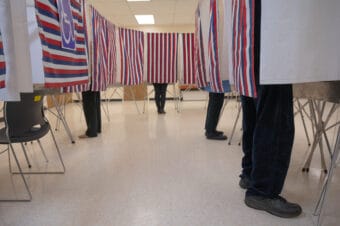
“I voted” stickers are seen on display in the headquarters offices of the Alaska Division of Elections in Juneau on Tuesday, Nov. 12, 2024. (Photo by James Brooks/Alaska Beacon)

State elections officials have begun reviewing signatures gathered by people opposed to Alaska’s system of open primary elections and ranked-choice general elections to determine whether a repeal ballot measure will appear before voters in 2026.

Alaskans enacted the state’s existing elections system via a ballot measure in 2020, and a repeal measure last year failed by only 737 votes out of 320,985 cast.

Proponents of the repeal vowed at that time to renew their effort and began gathering signatures in February to force another vote.

Based on state law and the number of people who voted in the 2024 statewide election, repeal supporters needed to collect signatures from at least 34,099 registered voters, including a certain minimum number in at least 30 of the 40 state House districts.

This week, supporters of the repeal measure said they were submitting more than 48,000 signatures to the Alaska Division of Elections for review.

If the repeal petition is deemed to have enough signatures, it would go before voters in either the 2026 primary or the 2026 general election, depending upon the length of next year’s state legislative session.

If voters approve the measure in 2026, all three components of the 2020 ballot measure would be repealed.

That would have three main results. Financial donors to political campaigns would be able to conceal their identity by contributing to a political nonprofit, which could donate money to causes on their behalf.

The 2020 law, currently in effect, requires campaigns to disclose the “true source” of their money.

The second effect would be the repeal of the state’s open primary system, in which all candidates, regardless of political party, run in the same race. Under the current law, the top four vote-getters in a given race advance to the general election.

If that is repealed, political parties would be able to determine the rules for deciding which of their candidates advance to the November general election.

The third change is to general election. Instead of voters being allowed to rank all candidates in order of preference, voters would be able to choose only one candidate, and the candidate with the most votes would win.

One other ballot measure, which would reimpose a limit on financial donations to political candidates, has already been certified and is slated for the 2026 ballot.

Two other ballot measures remain in the signature-gathering process. One would decriminalize several psychedelic substances, and the other would reinforce the state’s existing prohibition on noncitizen voting.

Backers of those measures must gather sufficient signatures before the start of the January legislative session in order to force a vote in 2026.

New poll shows Peltola neck-and-neck with Sullivan, if she were to run for U.S. Senate

Mary Peltola
Rep. Mary Peltola at a campaign event in Bethel, March 15, 2024. (Sage Smiley/KYUK)

The last Democrat elected to statewide office, former Alaska Congresswoman Mary Peltola, is about even in a head-to-head match with Republican U.S. Sen. Dan Sullivan, a new poll shows.

Peltola hasn’t declared her intention to run in any race for 2026 but is considered a potential candidate for Senate or governor.

The progressive firm Data for Progress conducted the poll, at its own expense. Jason Katz-Brown, an Anchorage-based advisor at the firm, said the results in the Senate race are largely holding steady from its last poll.

“Earlier this summer we had her down by one (percentage point). Now we have her up by one, but that’s well within the margin of error,” he said. “I think we can’t conclude anything about that race. It’s just super, super close, if Peltola were to run for Senate.”

The poll also had Peltola leading in a field of nine candidates for governor – the others being Republicans who actually are running for the office.

It shows Anchorage businesswoman Bernadette Wilson in second place. But once lower-ranking Republicans are removed, former Anchorage Mayor Dave Bronson comes in second.

A large factor is name recognition, Katz-Brown said.

Pollster Ivan Moore of Alaska Survey Research said the Data for Progress results mostly track his own findings – that Peltola leads the field in the governor’s race. But, Moore points out, the other candidates have not had a chance to campaign yet.

“So the idea that this is going to be a cake walk and she can just stroll into the governor’s office is misguided,” Moore said. “She’s just streaks ahead of everyone else because she’s built this following, but it’s not going to be the same in a year.”

The latest poll found Alaskans evenly split on whether they have a favorable opinion of President Donald Trump. The poll had 823 respondents and the pollsters used weighted averages to better reflect Alaska voters.

Wasilla Sen. Mike Shower says he’ll resign to campaign for lieutenant governor

Man speaking in legislative chamber
Sen. Mike Shower, R-Wasilla, speaks in the Alaska Senate on March 25, 2024. (Eric Stone/Alaska Public Media)

Alaska Senate Minority Leader Mike Shower plans to resign to focus on his campaign for lieutenant governor alongside gubernatorial candidate Bernadette Wilson.

In an interview, Shower said he was concerned his duties as a legislator would create roadblocks in the campaign. For instance, state law prohibits sitting lawmakers from fundraising during legislative sessions.

“Going to the Legislature and being sequestered for four months in Juneau, and then maybe a special session or two next year, would limit my ability to fundraise and campaign,” he said. “You can violate the law if you’re not careful, right? You can really make a mistake there.”

The Wasilla Republican represents a large chunk of the Matanuska-Susitna Borough and some other communities, including Talkeetna, Willow, Sutton and Valdez. He leads the all-Republican minority that makes up about a third of the state Senate. He’s been in the Senate since 2018.

Once Shower’s resignation takes effect on Nov. 3, Gov. Mike Dunleavy will have 30 days to appoint a new Republican to serve until the 2026 election.

Shower declined to say who Dunleavy should appoint to replace him, and the governor’s office didn’t immediately respond to questions on the subject. But he said he’d like it to be someone who shares his conservative views.

“What I think is important is that that person represents the values of my district,” he said. “My district is very conservative. It’s one of the most conservative, politically, in the state.”

Since Shower is a Republican, state law requires Dunleavy to appoint a Republican to replace him. The appointment is subject to confirmation by other Senate Republicans.

Sutton Republican Rep. George Rauscher has registered as a candidate for Shower’s seat. Big Lake Republican Rep. Kevin McCabe, who also lives in Shower’s district, has also filed campaign paperwork that would allow him to run for Shower’s seat, as has former Alaska Wildlife Troopers head Doug Massie.

Newly-elected Juneau school board members officially begin terms

From left, Jenny Thomas, Melissa Cullum and Steve Whitney get sworn in as Juneau School Board Members at the Thunder Mountain Middle School library on Oct. 28, 2025. (Photo by Jamie Diep/KTOO)

The Juneau school board swore in three members and honored two outgoing members at a meeting Tuesday. 

In this fall’s municipal election, Steve Whitney was reelected to the board after being appointed to fill a seat vacated earlier this year. Jenny Thomas and Melissa Cullum were elected to the board for the first time.

The board honored outgoing members Emil Mackey and Deedie Sorensen. Mackey initially joined the board in 2015. In his outgoing remarks, he said he hopes to see an end to what he called an “attack on our public servants” nationwide. 

Sorensen worked as a teacher for the district for more than 35 years and was elected to the board in 2019. She ran unsuccessfully as a write-in candidate this fall.

Deedie Sorensen and Emil Mackey exit the Juneau School Board meeting at Thunder Mountain Middle School on Oct. 28, 2025. (Photo by Jamie Diep/KTOO)

Both Sorensen and Mackey survived a failed recall effort last year following the district’s school consolidation last year. Mackey commended Sorensen for attending meetings while undergoing cancer treatment during that time.

“She could have died during that process, and she did not miss a single meeting,” he said. “She would have chemo in the morning, and she would be on the Zoom call later that night.”

Sorensen thanked the public and her colleagues before leaving and said she plans to enjoy some time off.

“I got my all clear from my oncologist last week, and so, you know, so for the knowable future, things are looking really good,” she said.

Once the new members were sworn, the board immediately got to work on district business, including formally accepting Superintendent Frank Hauser’s resignation and listening to more than an hour of public comment about union contracts.

Two newcomers and one returning member elected to Juneau school board

School board candidates Melissa Cullum and Jenny Thomas smile as they wave signs in the Mendenhall Valley on Election Day on Tuesday, Oct. 7, 2025. (Photo by Clarise Larson/KTOO)

The Juneau school board will have two new board members and one returning member following the release of final election results Tuesday.

Steve Whitney and Melissa Cullum won three-year terms, and Jenny Thomas will serve a two-year term on the board.

The board appointed Whitney to fill a seat after Will Muldoon resigned earlier this year. He previously served on the board from 2016 to 2019. Whitney did not respond to a request for comment Wednesday.

Cullum is a homeschool parent and a former teacher. She said she’s looking forward to working with other board members.

“We’re in a good spot of transition, and I’m really kind of excited about moving us towards a more positive feeling or climate in our district,” she said.

Jenny Thomas will serve the remaining two years of Muldoon’s term. She said she’s excited to bring community engagement and new ideas to the board.

“Hoping to make the meetings a little less bureaucratic where it’s just reading reports and getting a little bit more into the like, the meat and potatoes of actually what’s going on,” she said.

Thomas was one of the leaders of an unsuccessful recall campaign against board members Emil Mackey and Deedie Sorenson after the school board closed and consolidated schools last year to fill a $9.7 million deficit. 

Sorenson filed to run as a write-in candidate two weeks before Election Day. The retired educator and current school board president said she’ll find other things to keep herself busy after she steps down.

“I’ve always been, you know, an advocate for public education. So, I mean, I don’t think that I’m going to take that hat off,” she said.

Jeremy “JJJ” Johnson also was not elected. He said in a text message that he’s proud to have received close to 20% of the vote, but he’s disappointed by the results of the ballot propositions and now plans to support his wife’s desire to leave Juneau.

“I can’t justify keeping her and the children here in a community that is steering towards some of the most challenging experiences a school system can face, just because I’m committed to the people I worked with, went to school with, and enjoyed casual time with,” he wrote.

Board members will be sworn in at the next school board meeting on Tuesday.

Site notifications
Update notification options
Subscribe to notifications