4 Special Coverage

Mary Peltola enters Alaska U.S. Senate race

a woman talks into a microphone at a podium on stage
Mary Peltola, then Alaska’s U.S. representative, at the Alaska Federation of Natives convention in Anchorage in 2023. (Matt Faubion/Alaska Public Media)

WASHINGTON — Democrat Mary Peltola announced Monday that she’s running for U.S. Senate, taking on Republican incumbent Sen. Dan Sullivan.

Peltola served one partial and one full term in the U.S. House, becoming the first Alaska Native person elected to Congress. She then narrowly lost her seat in 2024.

Her announcement Monday came with a video portraying her salmon-centered family life on the Kuskokwim River. She repeats her previous campaign slogan: “Fish, family, freedom.” She also hearkens back to Alaska senators who served in less partisan times.

“Ted Stevens often said, ‘To hell with politics. Put Alaska first,'” Peltola says on the video. “It’s about time Alaskans teach the rest of the country what Alaska first and, really, America first looks like.”

(Peltola modified Stevens’s oft-repeated quote. The late senator’s catchphrase was actually “To hell with politics. Just do what’s right for Alaska.”)

Nationally, Democrats believe that with Peltola on the ballot, Alaska presents one of their best hopes of flipping a seat. Political analyst and statistician Nate Silver said in a social media post last week that Democrats still have an uphill battle to win back the Senate majority but that Peltola’s candidacy moves their chances in Alaska from a long-shot to plausible.

Sullivan has already raised $6 million this election cycle. He has President Trump’s endorsement and maintains a strong alignment with Trump.

But, in what Democrats took to be a sign that he’s feeling the political heat, Sullivan last month unexpectedly voted to extend health insurance subsidies. He’s also touting a new bill that targets one of Peltola’s primary issues: Bycatch, or the accidental catch of salmon by the pollock fleet.

For U.S. Sen. Lisa Murkowski, Peltola’s candidacy presents a dilemma. They’re both moderates, and Murkowski endorsed Peltola in the past, despite their party differences. The senator declined to pick a side when a reporter asked before Christmas. But Thursday Murkowski said she’d made a decision: She’s endorsing her Republican colleague.

“We’ve had a pretty solid team here in the Senate for the past 12 years, so we want to figure out how we’re going to keep in the majority,” she said. “And Dan delivers that.”

Both sides are expected to pour tens of millions of dollars into the race.

Sullivan’s last race in 2020 was one of the most expensive elections in state history, with spending by the campaigns and outside groups totaling more than $57 million.

Sullivan was outspent but beat independent candidate Al Gross by a substantial margin.

Peltola lost her House seat to Republican Nick Begich. After ranked ballots were tallied in 2024, she had almost 49% of the vote to his 51%. (The rankings had little impact on the final result in that race. Before voters’ second- and third- choices were counted, Begich’s lead was slightly smaller.)

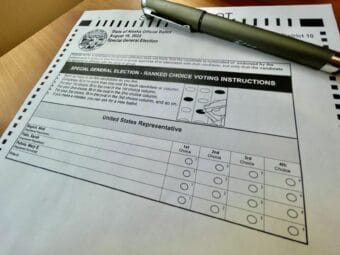
Sullivan and Peltola will face off first in a nonpartisan primary in August. The top four candidates will advance to a ranked-choice ballot in November.

A year before Alaska’s U.S. House election, two candidates are emerging as frontrunners

“I voted” stickers are seen on display at a polling station in Juneau’s Mendenhall Valley on Tuesday, Aug. 16, 2022. (Photo by James Brooks/Alaska Beacon)

One of Rep. Nick Begich III’s uncles is endorsing his main Democratic opponent, Matt Schultz, in next year’s election. Tom Begich’s name was atop a list released to the Alaska Beacon by Schultz’s campaign this month.

Begich’s endorsement of his nephew’s opponent won’t surprise people familiar with Alaska politics — he’s a longtime figure in the state’s Democratic scene, has been publicly critical of his nephew’s actions and is running as a Democrat in the governor’s election — but Schultz’s list and a similar list of endorsements by Republicans for Begich III shows how the state’s political establishment is settling on a two-person race for U.S. House, unlike the crowded contest for governor.

“It will be awkward. It’s always awkward,” Tom Begich said of the endorsement, “ but my mom taught us to learn to live with disagreement, to move beyond it. It doesn’t change the fact that I love my nephew. Just, I’m not supporting him in this election.”

Tom Begich is among 14 people — 12 Republicans and two Democrats — who have registered to run for governor in next year’s election.

Incumbent Gov. Mike Dunleavy is term-limited and unable to run.

While there are plenty of candidates for the governor’s seat, the number of people running for federal office is tiny. Incumbent U.S. Sen. Dan Sullivan, a Republican, doesn’t have a well-known challenger yet. Former U.S. Rep. Mary Peltola, a Democrat, has been rumored as a possible opponent but has yet to file.

In the U.S. House race, as Begich III seeks re-election, he has the endorsement of President Donald Trump and a wide range of state and national Republicans, including those running for governor on different tickets.

The same is true on the Democratic side, where support for Schultz appears almost entirely united.

“I’m very pleased to support him and glad he’s running,” said state Sen. Matt Claman, D-Anchorage and the other Democratic candidate in the governor’s race.

“I think he’s more connected with the general, broad spectrum of values in Alaska, more connected with some of the challenges we’re facing. He’s really looking carefully at how we’re dealing with homelessness, and I think he’s concerned about some of the affordability issues that are particularly a challenge in rural Alaska,” Claman said of Schultz.

Among the other people endorsing Schultz are independent state Rep. Alyse Galvin, who ran unsuccessfully for U.S. House in 2020 and 2018, and Forrest Dunbar, a Democratic state senator who ran unsuccessfully for House in 2014.

One notable absence is Peltola, who held Alaska’s U.S. House seat for one term before Begich III defeated her in the 2024 election.

Also missing is longtime Democrat Mark Begich, the incumbent Republican’s other uncle and Alaska’s U.S. senator from 2009 to 2015.

“There’s definitely been a lot of support from Democrats all around the state, and I’m very grateful for that. It seems to be a lot of coalescing support,” Schultz said by phone.

A pastor in Anchorage, Schultz spoke on the day that the U.S. House announced that it would not vote to renew subsidies for health insurance policies purchased on the federal marketplace.

Without those subsidies, the prices of many policies will spike with the start of the year.

“That’s really, really sad and disturbing,” Schultz said. “It seems like it should be a no-brainer that you start out by making sure that people can afford their lifesaving medicine.”

Schultz said that as he’s gone around seeking early support for his campaign, he’s found joy and excitement among people who want to find a common good.

“It really is this wonderful excitement to say — just like we pulled together as a nation to go to the moon, we can pull together as a state to provide food and health care to people. It’s a goal that matters so much and is so basically good at its heart that people can’t wait to start working for it,” he said. “I think there’s a hope out there that has felt absent in the last decade or so.”

Juneau’s new sales tax exemptions just rolled out. Here’s what you need to know.

Phil Gouvey checks out groceries at Foodland IGA on Wednesday, Nov. 19, 2025. (Photo by Clarise Larson/KTOO)

Before Thursday, when you would grab some groceries or pay your utility bill, Juneau’s city government taxed most residents at 5%. But now, that tax has dropped to zero percent for everyone, regardless of their income or age.

That’s because of a ballot measure that was approved by voters during this fall’s election to remove the local sales tax on essential food and residential utilities.

Phil Gouveia was buying groceries at Foodland IGA on Wednesday afternoon. He said he’s excited for the changes and to see some extra cash back in his pocket. 

“Yeah, it’s gonna help me. I’m 70 years old. I’m on a pension, so groceries keep going up, but my pension doesn’t,” he said. 

The exemptions officially take effect on Thursday, 30 days after the fall election results were certified. The proposition passed with nearly 70% of voter approval. 

Deputy City Manager Robert Barr said the roll out of the exemptions should be pretty hands-off for most residents. He said the city is working with businesses on implementing it, but it may take some time before all retailers are under the new system. 

“Our goal was to implement this in a way that was as easy for residents as possible, so most residents shouldn’t have to do much, if anything,” he said. 

The exemptions apply to the same food items that qualify under the Supplemental Nutrition Assistance Program, also known as SNAP or food stamps. That includes foods like fruits and vegetables, meat and dairy, bread and cereals — and cookies and ice cream. But it doesn’t cover hot food — like a rotisserie chicken — or meals from restaurants.

“What qualifies as food is largely groceries, things that you would buy from the grocery store and prepare at home, or things that are intended to be consumed off-site,” he said. 

The utilities exemptions apply to residential electricity, heating oil or propane, water and sewer and garbage and recycling. 

Alec Mesdag is the CEO of Alaska Electric Light & Power, or AEL&P, Juneau’s sole electricity provider. It serves more than 16,000 customers. Mesdag said the logistics of rolling out the exemptions are challenging and complex due to AEL&P’s large number of customers and having to verify which accounts are for residential use versus commercial. 

Despite that, he said the company is actively working with customers to ensure those who are eligible receive the exemption as soon as possible. 

“What we intend to do is go through our list and apply the exemption as broadly as possible, but excluding certain accounts that appear to us to be highly likely to be not eligible to receive the exemption,” he said.

Mesdag said AEL&P is sending out letters to customers to inform them which accounts have received the tax exemption and which have not.

While the exemptions are expected to put some extra cash back into residents’ wallets, it in turn means the city is expected to face a $6.4 million hole in its budget this fiscal year. And, each year moving forward, the city will face an estimated $12 million revenue loss from both the tax exemption on food and utilities and the separate cap on the city’s property tax rate that voters also passed.

City officials and the Juneau Assembly will be grappling with potential service cuts in the coming months.

Juneau Assembly kills ordinance to adopt local ranked choice voting system

Signs for voting are posted outside the Mendenhall Valley Library on Election Day on Tuesday, Oct. 7, 2025. (Photo by Yvonne Krumrey/KTOO)

The Juneau Assembly officially killed a proposal to locally implement ranked choice voting on Monday night. The body unanimously voted to indefinitely table the ordinance to adopt a ranked-choice voting system for municipal elections beginning next year. 

The decision came after multiple people testified on the topic at the Assembly’s regular meeting, almost all against adopting the change. Roger Calloway said he doesn’t think the decision should be up to the Assembly.

“I’m here to testify against adopting this ordinance. I believe it’s wrong for you, the Assembly, to decide how we, the voters, get to cast our votes,” he said. 

Alaska already uses a ranked choice voting system for statewide elections. In local elections, Juneau voters choose one candidate in single-member races, like Assembly seats. With ranked choice voting, voters would have instead ranked candidates by preference.

Juneau’s recently retired city clerk, Beth McEwen, testified against the change. She said that while she supports ranked choice voting at the state level, she argued it’s unnecessary for Juneau and would confuse voters. 

“I think it was a good decision for state elections, not for local elections,” she said. “Local elections are nonpartisan. The state has a partisan system — and we have primaries and general elections at the state — we don’t have that at the local level.”

Assembly member Ella Adkison originally introduced the ordinance earlier this summer. She made the motion to table it indefinitely on Monday, which means the proposal is dead. A similar ordinance could still arise in the future under a new Assembly.

Adkison said it is not the right time to implement the change as the city faces more pressing issues like budget cuts following the results of the recent local election.

“We are going to have to cut services, and we are going to have to lay people off, and that is a thing we are going to work together as a community to get through,” she said. “But it’s going to be a really tough time for Juneau, and we’re going to have to spend a lot of time and energy as a community getting through that hard time.”

According to data from the state’s Division of Elections, Juneau voters favored ranked choice voting at the state level. Juneau overwhelmingly voted against a repeal effort on the ballot last election, which only very narrowly failed statewide. Advocates have already filed new initiatives in an attempt to repeal it in the 2026 state election.

Alaska Republican Senator Shelley Hughes resigns to pursue gubernatorial campaign

Sen. Shelley Hughes, R-Palmer, walks out of the Senate chambers on Saturday, Aug. 2, 2025. (Photo by James Brooks/Alaska Beacon)

Sen. Shelley Hughes, R-Palmer, resigned from the Alaska Senate on Friday to pursue her gubernatorial candidacy, according to a news release from her campaign.

Her resignation follows that of fellow Senate minority caucus member Mike Shower, who represented Wasilla and resigned at the end of last month to focus on his run for lieutenant governor.

Senate President Gary Stevens, R-Kodiak, confirmed he received Hughes’ resignation letter Friday.

Hughes’ resignation was expected. She told the Alaska Beacon in October she planned to resign in time for her replacement to be in place before the legislative session begins in January.

“My constituents, they’ve been my peeps all these years. I want to make sure that they have representation from the get-go,” she said on Friday afternoon.

Gov. Mike Dunleavy will select her replacement from among a number of nominees to be selected by Republican party officials in her district. Republican Senators must confirm his choice before that person is seated.

Hughes’ replacement must be a Republican and meet the state Constitution’s requirements to hold office.

Hughes said she expects that Rep. Cathy Tilton, R-Wasilla, will be among the nominees for her seat because Tilton has already filed to run for senator in the district. If Tilton were appointed, the governor would then have to select someone to fill the empty House seat.

Hughes was initially appointed to her seat in 2012 by then-Gov. Sean Parnell, which she credits, in part, to the fact that she was already running.

“I think that when a candidate does that, that shows real interest,” she said.

She said she does not expect her departure to cause significant changes because her district reliably produces “reasonable conservative” lawmakers.

Hughes is one of 12 Republicans and 14 total candidates that seek to be elected governor in 2026. Gov. Mike Dunleavy is termed out and cannot seek reelection.

Hughes said she has fond memories of her time in the Capitol.

“It’s a big change, stepping into the gubernatorial race,” she said. “You know, there are unknowns with that, but I have tremendous peace about this. I really did feel that my chapter was closing in the Senate.”

She represented her district for 12 years.

Juneau Assembly will decide whether to adopt ranked choice voting Monday

City election workers empty out the ballot box outside City Hall on Election Day on Tuesday, Oct. 7, 2025. (Photo by Clarise Larson/KTOO)

The Juneau Assembly is slated to decide on Monday night whether Juneau should adopt a ranked choice voting system for municipal elections beginning next year. 

Alaska already uses a ranked choice voting system for statewide elections. In local elections, Juneau voters currently choose one candidate in a single-seat race. With ranked choice voting, voters would instead rank candidates by preference.

If adopted on Monday, Juneau would become the first major city in Alaska to adopt ranked choice voting for municipal elections. But other cities across the U.S., including New York, San Francisco and Minneapolis, already use the system in local elections.

The Assembly was originally supposed to vote on the topic in August, but decided to delay the decision until after the fall local election. Assembly member Ella Adkison proposed the change. During a meeting earlier this summer, she said she thinks voters will support it. 

“It really is good for races where there are lots of candidates in one seat,” she said. “And I think Juneau, in general, likes having lots of candidates in races, because it means that the person that they feel represents them the most is the person who actually gets onto the Assembly.”

But not everyone agrees. During public testimony on the topic this summer, Juneau resident Angela Rodell questioned why the change is necessary. Rodell unsuccessfully ran for mayor in 2023 and led the Affordable Juneau Coalition in advocating for tax cuts this fall. 

“At a time when public trust in our local election process is being tested, this ordinance does not move us towards greater transparency, confidence or affordability,” she said. “Instead, it is the opposite. It proposes a fundamental change to our voting process without first answering a critical question, ‘What is the problem we’re trying to solve with this?’”

According to data from the state’s Division of Elections, Juneau voters previously appeared to favor ranked choice voting. Juneau overwhelmingly voted against a repeal effort on the ballot last election, which only very narrowly failed statewide. Advocates have already filed new initiatives in an attempt to repeal it in the 2026 state election.

Juneau residents have the chance to testify on the ordinance in person or online before the Assembly votes on Monday. People who want to testify online must notify the city clerk by 4 p.m. before the meeting. The meeting begins at 6 p.m. at Centennial Hall.

Site notifications
Update notification options
Subscribe to notifications